Getting a feel for antennas

When readers e-mail me, I often turn around and ask them what topics they would like me to write about here on KB6NU.Com. Well, yesterday, I got this reply:

I think it would definitely be useful to cover antennas and RF transmission theory.  I have a small bit of experience in electronics…completed an AAS EET degree years ago (actually 2 decades – YIKES), but looking at my old textbooks I see that we really did very little with radio. Once basic AC/DC theory was done, it was all about computers.

I think antennas are such foreign things to us nowadays, that I’m probably not in the minority when I say that’s the thing I struggled with the most. Dipoles are pretty easy, but once you get beyond that, it gets a lot more complicated. For example, E9C02: What is the radiation pattern of two 1/4-wavelength vertical antennas spaced 1/4-wavelength apart and fed 90 degrees out of phase? I know that it’s a cardioid, but I’m not entirely sure I understand why. I can visualize the patterns, but I don’t feel like I GET it.

I replied:

Antenna theory is my weakest area, too. Some people just seem to get it, but I struggle like you do. I think one way to overcome this is to play around with antenna modeling software. I think that by modeling some simple antennas, you’ll see that patterns that result, and after a while, get a more intuitive feel for them.

One program that many use is called MMANA-GAL. It’s free, and apparently, a very good program. If you do download it and play around with it, I’d like to get your impressions of it. Heck, I’d even post that to my blog. I think a review like that from a new user would be very valuable to  other new users.

So, now, I have a couple of questions for the rest of you:

  • Do you use antenna modeling software?
  • If so, which program?
  • Do you find it easy to use or hard to use?
  • Do you find it useful to you in learning how antennas work?

Horse fence antenna: progress report and request

In my recent post, More from Dayton 2012, I reported on the horse fence antennas made by KF4BWG, mentioning that every time I see them, I get the idea to try and make my own. Well, yesterday, I went down to Tractor Supply and bought 500-ft. of 2-in. PolyTape fencing material and some clamps. I even got lucky and got the tape on sale. Instead of $64.99, it was on sale for $54.99.

The clamp makes good contact with the conductors in the poly tape, but now, how do I connect it to the center insulator?

This evening, I started playing around with it. The first thing I did was to clamp the tape with the clamps I bought. What I discovered is that the clamps really don’t make contact with all the conductors. They tend to bow, and some of the conductors in the center of the tape were open.

To get around that, I used an X-Acto knife to separate the conductors from the tape and bend them back so that they lay on top of the tape. Now, when I tighten down the clamp, I get a good connection on all conductors.

The problem I’m having now is how to connect the Hy-Q dipole center insulator that I have to the tape. What I need is some kind of clamp that will connect the solid copper wire coming out of the center insulator to the tape clamp. Anyone have any ideas? I can see drilling a hole in the tape clamp to secure the copper wire.  Not only would that connect the tape to the center insulator, it would take out the bow in that clamp and make an even better connection to the conductors in the polytape.

More from Dayton 2012

After going through the materials I brought back from Dayton, I found a few things that I failed to mention in my previous post.

  • Horse fence antennas by KF4BWG. I’ve seen this guy at the last couple of Daytons that I’ve attended, and every time I see his antennas, I think what a great idea this is. Then, I make a mental note to go to Tractor Supply or some such place and get some of this material and make my own. Then, I promptly forget to do it.
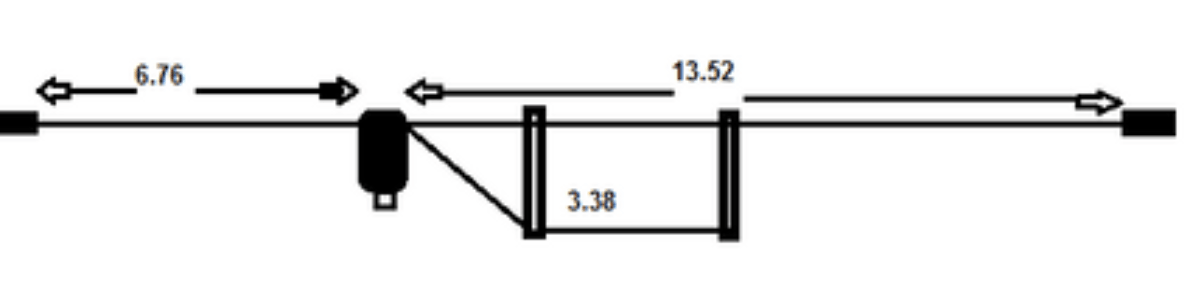
    This does seem like a great idea, though. Not only would the antenna be very strong and light, but it should also be very broadband.  KF4BWG claims an SWR less than 1.4:1 across the entire 80m band, less than 1.3:1 across the entire 40m band, and 1.1:1 across the 20m, 15m, and 10m bands.
    When I mentioned to KF4BWG my plans to duplicate his antenna on my own (his cost $85), he told me that the quality of the fencing material that Tractor Supply sells is not as high as the stuff he uses. That may be true, but I’d bet it will  work just fine. Now, I just gotta do it.
KF4BWG Antenna

This antenna made from horse fence material is very broadband.

  • TubeProjects.Com. I think that I may have written about this company/website  before. The website lists three “products:” an audio amp, a benchtop power supply, and a VTVM. I called them products, but all the website is selling is construction manuals…at $35 a pop.  They do mention that they plan to sell chassis for these projects in the future. Once nice feature is that they have a resources page that lists  parts sources, books, and other websites with tube project information.
  • Society of Amateur Radio Astronomers (SARA). As if I didn’t have enough going on, I’m tempted to join SARA. According to the website, the Society of Amateur Radio Astronomers (SARA) is an international society of dedicated enthusiasts who teach, learn, trade technical information, and do their own observations of the radio sky. SARA was organized in 1981, and today has hundreds of members worldwide. The group consists of optical astronomers, ham radio operators, engineers, teachers and non-technical persons.
    At their booth, the SARA people were touting the Radio Jove Project, a “hands-on educational activity that brings the radio sounds of the Sun, Jupiter, and the Milky Way to terrestrial students, teachers, and the general public.” They sell a $190 starter kit that includes a 20m direct-conversion receiver, parts to construct two dipoles, and a CD ROM with SkyPipe software and general information. Since many hams will already have a 20m receiver, and know how to build a 20m dipole, it seems to me that all you’d need is the software.

21 Things to Do: Build an Antenna

Building an antenna is something that you should do within a month or two of getting your license. There are many reasons for this, including:

  • Building an antenna will help you learn how antennas really work.
  • Building an antenna is cheaper than buying them.
  • If you’re using a handheld with the standard “rubber ducky” antenna, you can build an antenna that will increase the range of your handheld.
  • It’s fun!

Building a 2m quarter-wave ground-plane antenna
The first antenna that you should consider building is the quarter-wave ground-plane antenna for the 2m band. They are very easy to build and will perform better than the antennas that come with most handhelds.

The quarter-wavelength, ground plane antenna is made up of one vertical element, called the driven element, and four radials. The radials make up the ground plane. An easy way to make this antenna is to use an SO-239 coax connector. The driven element is soldered directly to the center conductor, while the four radials are connected to the four holes in the connector’s flange. See the figure at right.

2m ground plane antenna

A simple 2m antenna can be made with an SO-239 connector and four short pieces of stiff wire.

Now, let’s calculate how long the elements should be. Since the wavelength of a radio wave is equal to 300/f (MHz), one quarter wavelength will be equal to 75/f (MHz). At 146 MHz, therefore, the length of the driven element is:

75/146 = .51 m

In practice, we have to make one more adjustment. Because a radio wave travels more slowly in a wire than it does in free space, the wavelength will actually be about 5% less in a wire than in free space. So, we multiply the wavelength in free space by .95 to get the length of the driven element:

.51m x .95 = .49m = 19.25 inches

The radials should be about 5% longer than the driven element. This isn’t really very critical, so if you make them 20.25 inches long, the antenna will work just fine.

You should make the elements out of a stiff wire. 12 AWG copper wire will work for experimentation purposes. Welding rod might be better for a more permanent antenna.

You need to solder the 19.25-in. driven element to the solder cup of the center conductor of the SO-239 connector. Attach the radials to the holes in the flange of the SO-239 connector with nuts and bolts. You can also use these nuts and bolts to mount the antenna to some kind of bracket. Bend the radials out to a 45-degree angle, connect a coax cable to it, and start having fun!

For more information
For more information on how to build and what  you can do with the quarter-wavelength, ground-plane antenna:


FCC collecting data on how antenna restrictions affect emergency communications

FCC LogoFrom ARRL HQ:

Do you live in a CC&R-restricted community or participate in EmComm activities? Have deed restrictions / HOA covenants prevented you from erecting amateur radio antennas? Have these restrictions prevented you from full participation in emergency communications activities during disasters?

If your answer is “Yes”, ARRL needs to hear about your experience.

As you are probably aware, Congress has directed the FCC to conduct a study of the uses and capabilities of Amateur Radio Service communications in emergencies and disaster relief. The FCC was directed to identify ” impediments to enhanced Amateur Radio Service communications, such as the effects of unreasonable or unnecessary private land use restrictions on residential antenna installations”. Finally, the study is to make “recommendations regarding the removal of such impediments.”

The FCC has issued a Public Notice – DA 12-523- soliciting input from the public as part of their study. The ARRL is gathering comments from the Amateur Radio community to present as part of its comments on the public notice.

The ARRL is looking specifically for input in two specific areas:

  • Recent Amateur Radio involvement in actual emergency communications and disaster relief;
  • Specific details about how CC&Rs and other private land use restrictions have impaired licensed Amateurs to participate fully in these disaster relief communications.

If your ability to participate in ARES, RACES, SKYWARN, CERT, or other emergency and disaster relief communications has been limited because the inability to have adequate antennas due to CC&Rs, you are asked to provide that information to the ARRL.

First, we recommend that you prepare a narrative of your exact situation, in as much detail as practical. Some areas for you to consider in writing your story might be:

  • Were there alternative properties without CC&Rs in the area you wished to reside?
  • What exactly does your CC&R allow / prohibit (please include a copy of the specific wording)
  • Have you applied for a waiver of the CC&R with the Home Owner’s Association / Architectural Review Committee but were denied? If so, what was the reason?

To assist you in sharing your information with the ARRL, please visit the special ARRL website built to allow you to readily provide the pertinent information at www.arrl.org/ccr-study-information

This page will present you with an overview of what we are asking and have links to the two forms for you to complete. Please be as factual as you can with the information you provide and please provide only information about events and activities in which you were directly involved.

If you wish to write out the details of your situation in advance, please do so. Then, they can be either uploaded to the website or they can be sent as an email attachment to an email sent to CCRinfo@arrl.org

Keep in mind that the FCC study does not apply to ordinances and zoning laws implemented by the government – such as towns, cities or counties. PRB-1 covers those situations.

TIME IS OF THE ESSENCE! Congress directed that the FCC provide the report back within 180-days and that clock is already counting. The FCC is only accepting comments for a 45-day period, which will end May 17,2012. In order for the ARRL to collate your information in a common report, we ask that you send in your information no later than WEDNESDAY APRIL 25. If you need more information, please contact reginfo@arrl.org The time to act is NOW!

Dan Henderson, N1ND
Regulatory Specialist

New QRP kit measures power, SWR

From Terry, WA0ITP, via the qrp-l mailing list:

QRP-o-meterThe Four State QRP Group is pleased to announce a new kit, the QRPometer, a sensitive and accurate power/swr meter designed by David Cripe, NMØS.   Complete specifications, assembly manual, and ordering information can be found online PayPal is accepted.

The range of accurate power measurement extends down to a low 100 milliwatts.  This kit was conceived to fill a need within the hobby for an inexpensive, highly accurate RF power and VSWR meter for QRP power levels.  With it’s large digital display it makes a very useful addition to your shack.

The QRPometer uses simple analog signal-processing circuitry to provide a set of essential measurement features not previously available in a single unit. High quality, double sided, printed circuit board construction is used, with solder mask and silk screened component reference designators.

All components are  through-hole for easy assembly. NO toroids are required, and all controls  and jacks are PCB mounted. The QRPometer can be constructed by beginners as well as experienced builders. Construction time is approximately 3 hours, depending on experience level. The only equipment required for calibration is a digital voltmeter, and a QRP transmitter..

All proceeds  go to fund OzarkCon.  As always, thank you for supporting the Four State QRP Group.

Beam fixed!

A week and a half ago, my friend, Bob, WD8BNA, came  up to me at our Rotary Club meeting and said, “Have you taken a look at your beam lately?” referring to the three-element Yagi at WA2HOM, our club station down at the Ann Arbor Hands-On Museum.

“No,” I replied, “what’s up?”

“Part of the antenna’s missing,” he said. “It must have come off during the high winds we had last week.” I drove by the next day, and sure enough, we were missing half the reflector.

Jack, WT8N, who was majorly responsible for us getting the beam up in the air in the first place, jumped right on this. He got up onto the roof, found the missing element, and organized a work party to re-attach it.

The work party was this afternoon. Jack; Ovide, K8EV; yours truly; and Jerry, head of maintenance for the museum and the son of a ham headed up to the roof to lower the antenna and fix the antenna.

Lowering the antenna proved easier than I expected. We unbolted the tilt-over tower from the mounting bracket and it came down relatively easily. Re-attaching the errant element was also pretty straightforward. All the bolts were there. It looks like we just didn’t tighten it down well enough the first time.

Tilting the tower back up proved to be a little more difficult. We first tried it with two men pushing and two men pulling on one of the guy wires.  When that didn’t work, we tried three guys pushing it, and one pulling. That didn’t work either.

Ovide then went in search of another helper. He returned shortly thereafter with one young museum employee, and with four guys pushing, we finally got the tower into an upright position. We inserted and tightened the bolts, and now we’re back in business with all of the elements in the right position. Overall, this took just an hour to do.

Despite missing half of the reflector, the beam seemed to work just fine. It tuned up just fine, and was still quite directional. I’m sure with the complete reflector, it works even better, though. If I knew more about antenna modeling, I’d run a simulation and figure out how much directionality we were actually using.

Has anyone done this? If you have, or have some idea what the effect of losing half of a reflector has on a three-element Yagi, I’d like to hear from you.

Two Gems from G0KYA

10m Slim Jim antenna

At more than 9m tall, this antenna isn't very stealthy, but if you have a tall tree to hang it from, it should be a great performer.

Steve, G0KYA blogs about HF propagation and antennas. Recently, he posted plans for a 10m “Slim Jim” antenna made from 450-ohm ladder line. At more than 9m tall, this antenna isn’t very stealthy, but if you have a tall tree to hang it from, it should be a great performer.

While you’re on Steve’s site, make sure you check out his two books, Stealth Antennas, and Understanding LF and HF Propagation. The latter is a compilation of articles he wrote with Alan Melia G3NYK for the Radio Society of Great Britain’s (RSGB) RadCom magazine.  You can’t beat the price. It’s a free download!

Extra Class question of the day: miscellaneous antenna questions

This section consists of a miscellaneous selection of antenna questions. We’ll start with some questions about grounding, then talk a little bit about vertical antennas, then mobile antennas, and finally directional antennas.

Much has been written about station grounding. One thing’s for sure. A station’s safety ground is not adequate as an RF ground. The reason for this is that conductors present different impedances at different frequencies.

A wide flat copper strap is the type of conductor that would be best for minimizing losses in a station’s RF ground system. (E9D14) The main reason for this is that at RF tends to be conducted near the surface of a conductor. The more surface area there is, the lower the impedance to ground.

To  minimize inductance, it’s best to keep the RF ground connection as short as possible.  An electrically-short connection to 3 or 4 interconnected ground rods driven into the Earth would provide the best RF ground for your station. (E9D15)

For many amateurs, there first antenna is a trapped vertical antenna. Mine was a Hy-Gain 14AVQ, which was resonant on 40m, 20m, 15m, and 10m.  One advantage of using a trapped antenna is that it may be used for multiband operation. (E9D12) Another big advantage is that it doesn’t require a lot of space when compared to a dipole antenna.

A disadvantage of using a multiband trapped antenna is that it might radiate harmonics. (E9D07) For example, if your 40m transmissions have high harmonic content on 20m, and the multiband vertical is also resonant on 20m, it will radiate those harmonics.

Another disadvantage is that they are generally shorter than 1/4 wavelength. The bandwidth of an antenna is decreased as it is shortened through the use of loading coils. (E9D08) Not only do they have a smaller bandwidth, but loaded verticals are also less efficient than full, quarter-wavelength verticals. One way to lessen this disadvantage is to use top loading. An advantage of using top loading in a shortened HF vertical antenna is improved radiation efficiency. (E9D09)

Mobile antennas are almost always shorter than a quarter wavelength. What happens to the feed point impedance at the base of a fixed-length HF mobile antenna as the frequency of operation is lowered is that the radiation resistance decreases and the capacitive reactance increases. (E9D13) To transform this impedance to 50 ohms, they use a loading coil. The function of a loading coil as used with an HF mobile antenna is to cancel capacitive reactance. (E9D11)

Because short verticals, such as those used in mobile installations are inherently inefficient, you should do whatever you can to make them as efficient as possible. An HF mobile antenna loading coil should have a high ratio of reactance to resistance to minimize losses. (E9D06)

The ratio of reactance to resistance is called Q. A high-Q loading coil should be placed near the center of the vertical radiator to minimize losses in a shortened vertical antenna. (E9D05)

An antenna that used to be very popular when TV antennas used 300-ohm feedline is the folded dipole. The reason for this is that that approximate feed point impedance at the center of a two-wire folded dipole antenna is 300 ohms. (E9D10) Amateurs would use the 300-ohm feedline for both the antenna elements and the feedline, and then use a balun or some other matching device to match the 300 ohm impedance to the transmitter output impedance.

Finally, there are four miscellaneous questions about directional antennas. The first is about how beamwidth and antenna gain are related. The beamwidth of an antenna decreases as the gain is increased. (E9D03) This is intuitively obvious. An antenna does not amplify a signal but instead focuses the power. So, when we say that the gain is increased, what we’re really saying is that we’re focusing the power into a smaller beam.

On the VHF and UHF bands, Yagi antennas are operated either horizontally for weak-signal work and vertically for FM operations. In some cases, however circular polarization is desirable. You can use linearly polarized Yagi antennas to produce circular polarization if you arrange two Yagis perpendicular to each other with the driven elements at the same point on the boom and feed them 90 degrees out of phase. (E9D02) The disadvantage to this approach is, obviously, that you need two antennas, instead of just one to achieve circular polarization.

For satellite operation, some hams have antenna systems that can tilt up and down as well as rotate. This is so the antenna can point directly at the satellite as it passes overhead. It is desirable for a ground-mounted satellite communications antenna system to be able to move in both azimuth and elevation in order to track the satellite as it orbits the Earth. (E9D04)

Parabolic antennas are often used at microwave frequencies to direct a signal in a particular direction. One thing to keep in mind is that gain increases by 6 dB if you are using an ideal parabolic dish antenna when the operating frequency is doubled. (E9D01) Also keep in mind that, as pointed out earlier, the beamwidth is narrower as well.

Need an antenna? Spray it on!

The Wall Street Journal blog Digits recently ran a story on a Utah company, Chamtech Operations, that claims to have developed a spray-on antenna. The post says:

A start-up called Chamtech Enteprises (sic) has an answer to the problems of poor cellphone reception and other shortcomings of traditional antennas…The company has developed a spray-on antenna that it says is more lightweight, energy-efficient and effective than the old-school version…The Sandy, Utah-based start-up’s nanotechnology, unveiled last week at Google’s inaugural Solve For X gathering, can be painted onto a tree, a wall, the ground or even the back of a soldier, enabling a more portable, lightweight way to get reception for a variety of uses.

It goes on to say:

Traditional antennas—the kind that receive radio and TV signals—work OK, but they’re beset by problems, Spencer [Chamtech chief technology officer...Dan] said. They suck up energy, drain battery life and get too hot. They don’t send or receive signals as far or as clearly as users would like. They don’t work well under water.

Personally, I find these claims to be hilarious. Or, am I missing something?