From my inbox: 1, 2, 3-tube radios, cheap cap tester, cheap frequency synthesizer

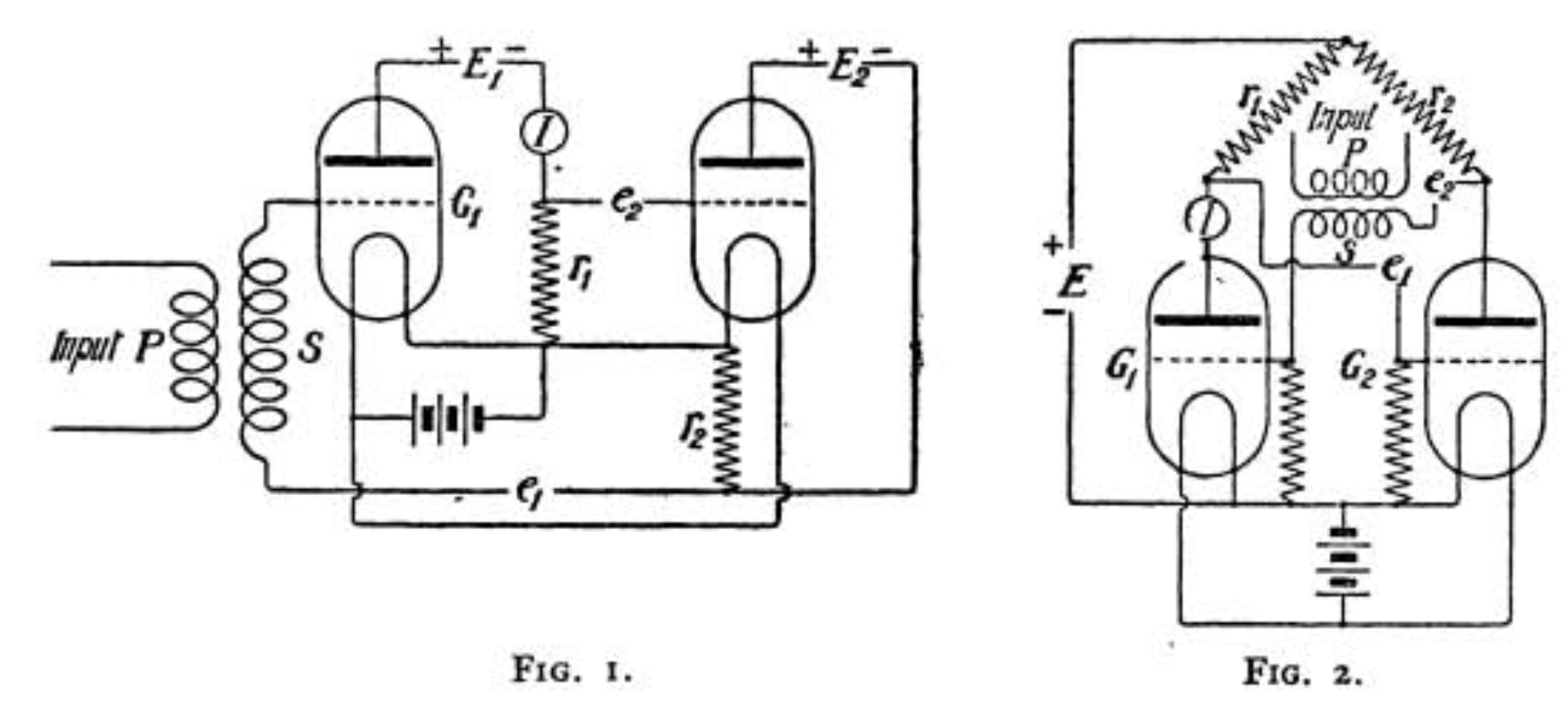
  • Build a radio with three tubes or less. This article lists radios that you can build with three tubes or fewer. In general, this is a very cool website. (Thanks to Brad, AA1IP, and the Glowbugs mailing list.)
  • Cheap capacitance tester. The Glowbugs mailing list also recently had a discussion of cheap capacitance testers. I just bought a fancy, new Keithley DMM  that measures capacitance, but some of the instruments mentioned in this thread also measure inductance. The consensus seems to be that while they’re not as accurate as a “real” test instrument, for $20 or so, how can you go wrong?Brad, AA1IP mentions the article, “A Low Cost Automatic Impedance Bridge” by Dr. George Steber, WB9LIV, that appeared in the October 2005 QST. Brad says, “This arrangement uses a PC’s sound ports, a dual-section op amp, a few components and some software to deliver reasonably precise RLC measurements along with a graphic screen display.”
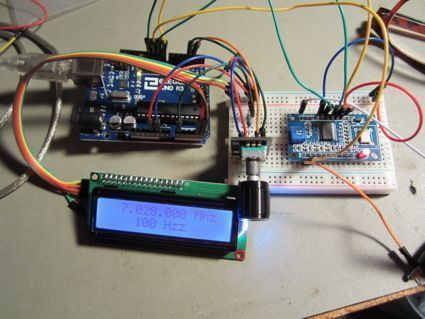
These frequency-synthesizer boards use the AD9850, and can be purchased on eBay for as little as $5 each.

These frequency-synthesizer boards use the AD9850, and can be purchased on eBay for as little as $5 each.


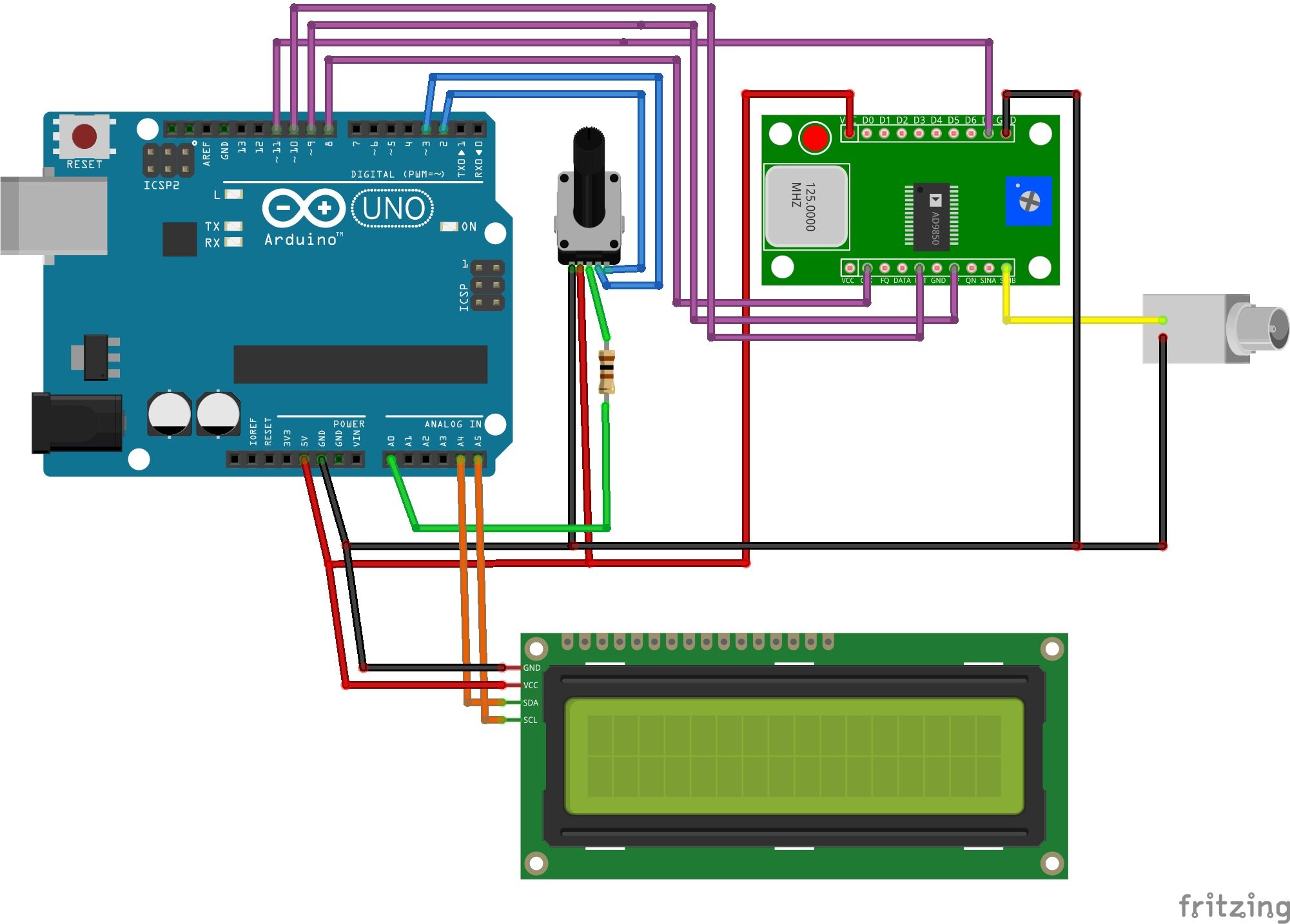
  • Cheap AD9850 boards. The AMRAD mailing list has a thread on these inexpensive signal-generator modules. One of the AMRAD guys has been experimenting with using them with an Arduino to make frequency control easier. They’re only $5 each and generate 0 – 40 MHz.On the Glowbugs list, they talked a little bit about these boards, too. One guy gave a link to the article, “An Improved VFO Driver Amp for Tube Rigs.” This article describes a circuit that allows you to easily use the AD9850 boards (or any other digital synthesizer, for that matter) as the VFO for a tube rig.

From my Twitter feed: Lids, EDA, TV

PD3EM
@KL8DX Publish your LID list onhttp://t.co/8hLu0GOy #LOTA #LidsOnTheAir


KD4E_73
http://t.co/Rq3ZqVgr links to Electronic Design Automation (EDA) tools that are released under the GPL.

Radio_2_Radio
Amateur Radio: Ham Radio in upcoming episode of Last Man Standinghttp://t.co/ME9vPCth

Extra Class question of the day: Amplifiers

There are several classifications of amplifiers, based on their mode of operation. In a class A amplifier is always conducting current. That means that the bias of a Class A common emitter amplifier would normally be set approximately half-way between saturation and cutoff on the load line. (E7B04)

In a class B amplifer, there are normally two transistors operating in a “push-pull” configuration. One transistor turns on during the positive half of a cycle, while the other turns on during the negative half. Push-pull amplifiers reduce or eliminate even-order harmonics. (E7B06)

A Class AB amplifier operates over more than 180 degrees but less than 360 degrees of a signal cycle. (E7B01) Class B and Class AB amplifiers are more efficient than Class A amplifiers.

A Class D amplifier is a type of amplifier that uses switching technology to achieve high efficiency. (E7B02) The output of a class D amplifier circuit includes a low-pass filter to remove switching signal components. (E7B03)

Amplifiers are used in many different applications, but one application that is especially important, at least as far as signal quality goes, is RF power amplification. RF power amplifiers may emit harmonics or spurious signals, that may cause harmful interference.

One thing that can be done to prevent unwanted oscillations in an RF power amplifier is to install parasitic suppressors and/or neutralize the stage. (E7B05) An RF power amplifier be neutralized by feeding a 180-degree out-of-phase portion of the output back to the input. (E7B08) Another thing one can do to reduce unwanted emissions is to use a push-pull amplifier. Signal distortion and excessive bandwidth is a likely result when a Class C amplifier is used to amplify a single-sideband phone signal. (E7B07)

While most modern transceivers use transistors in their final amplifiers, and the output impedance is 50 ohms over a wide frequency range. A field effect transistor is generally best suited for UHF or microwave power amplifier applications. (E7B21)

Many high-power amplifiers, however, still use vacuum tubes. These amplifiers require that the operator tune the output circuit. The tuning capacitor is adjusted for minimum plate current, while the loading capacitor is adjusted for maximum permissible plate current is how the loading and tuning capacitors are to be adjusted when tuning a vacuum tube RF power amplifier that employs a pi-network output circuit. (E7B09)

Figure E7-1

The type of circuit shown in Figure E7-1 is a common emitter amplifier. (E7B12) In Figure E7-1, the purpose of R1 and R2 is to provide fixed bias. (E7B10) In Figure E7-1, what is the purpose of R3  is to provide self bias. (E7B11)

Figure E7-2

In Figure E7-2, the purpose of R is to provide emitter load. (E7B13) In Figure E7-2, the purpose of C2 is to provide output coupling. (E7B14)

Thermal runaway is one problem that can occur if a transistor amplifier is not designed correctly. What happens is that when the ambient temperature increases, the leakage current of the transistor increases, causing an increase in the collector-to-emitter current. This increases the power dissipation, further increasing the junction temperature, which increases yet again the leakage current. One way to prevent thermal runaway in a bipolar transistor amplifier is to use a resistor in series with the emitter. (E7B15)

RF power amplifers often generate unwanted signals via a process called intermodulation. Strong signals external to the transmitter combine with the signal being generated, causing sometimes unexpected and unwanted emissions. The effect of intermodulation products in a linear power amplifier is the transmission of spurious signals. E7B16() Third-order intermodulation distortion products are of particular concern in linear power amplifiers because they are relatively close in frequency to the desired signal. (E7B17)

Finally, there are several questions on special-application amplifiers. A klystron is a VHF, UHF, or microwave vacuum tube that uses velocity modulation. (E7B19) A parametric amplifier is a low-noise VHF or UHF amplifier relying on varying reactance for amplification. (E7B20)

Extra Class question of the day: Modulation and demodulation

Modulation is the process of adding some kind of information, including voice and digital information, to a carrier signal. The most common types of modulation that we use in amateur radio are amplitude modulation (AM) and frequency modulation (FM). Single-sideband, or SSB, is a form of amplitude modulation.

To frequency modulate a carrier, a transmitter will sometimes us a modulator that varies the phase of the signal. This is sometimes called phase modulation (PM). One way to generate FM phone emissions is to use a reactance modulator on the oscillator. (E7E01) The function of a reactance modulator is to produce PM signals by using an electrically variable inductance or capacitance. (E7E02) An analog phase modulator functions by varying the tuning of an amplifier tank circuit to produce PM signals. (E7E03)

To boost the higher audio frequencies, a pre-emphasis network is often added to an FM transmitter. (E7E05) For compatibility with transmitters using phase modulation, de-emphasis is commonly used in FM communications receivers. (E7E06)

Amplitude modulation and single-sideband signals are produced using mixer circuits. The carrier frequency and the baseband signals are input to the mixer circuit which produces an amplitude modulated output. The term baseband in radio communications refers to the frequency components present in the modulating signal. (E7E07) The principal frequencies that appear at the output of a mixer circuit are the two input frequencies along with their sum and difference frequencies. (E7E08)

When using a mixer, you must take care not to use too high of a signal at the inputs. Spurious mixer products are generated when an excessive amount of signal energy reaches a mixer circuit. (E7E09)

Single sideband is most often used for phone transmission on the HF bands and for weak-signal operation on the VHF and UHF bands. One way a single-sideband phone signal can be generated is by using a balanced modulator followed by a filter.  (E7E04) A balanced modulator is a type of mixer.  The output of a balanced modulator, however, does not contain the carrier frequency, only the two sidebands.

Modern transceivers use digital signal processing to generate SSB signals. The quadrature method describes a common means of generating an SSB signal when using digital signal processing. (E7E13)

At the receiving station, a modulated signal has to be demodulated. Amplitude modulated signals are often demodulated using a diode detector circuit. A diode detector functions by rectification and filtering of RF signals. (E7E10)

For demodulating SSB signals, you want something a little more sophisticated. A product detector is a type of detector that is well suited for demodulating SSB signals. (E7E11) A product detector is actually a frequency mixer. It takes the product of the modulated signal and a local oscillator, hence the name. In an FM receiver, the circuit for detecting FM signals is a frequency discriminator. (E7E12)

Some modern receivers demodulate a signal entirely in software. These receivers are called software-defined receivers. When referring to a software defined receiver, direct conversion means incoming RF is mixed to “baseband” for analog-to-digital conversion and subsequent processing. (E7E14)

Extra Class question of the day: frequency synthesizers

Most modern amateur radio transceivers use digital frequency synthesizers instead of analog oscillators to generate RF signals. On reason for this is that they are much more stable than analog oscillators. The two main types of digital frequency synthesizers are the direct digital synthesizer and the phase-locked loop synthesizer

A direct digital synthesizer is the type of frequency synthesizer circuit that uses a phase accumulator, lookup table, digital to analog converter and a low-pass anti-alias filter. (E7H09) The phase accumulator is a principal component of a direct digital synthesizer (DDS). (E7H12) The information is contained in the lookup table of a direct digital frequency synthesizer is the amplitude values that represent a sine-wave output. (E7H10)

Both the direct digital synthesizer and the phase-locked loop synthesizer have issues with spectral purity. The major spectral impurity components of direct digital synthesizers are spurious signals at discrete frequencies. (E7H11)

For a more detailed explanation of how direct digital synthesizers work, see the electric druid’s  Synth DIY page.

Another type of frequency synthesizer that’s popular are those that use a phase-locked loop. A phase-locked loop circuit is an electronic servo loop consisting of a phase detector, a low-pass filter, a voltage-controlled oscillator, and a stable reference oscillator. (E7H14) 

A phase-locked loop is often used as part of a variable frequency synthesizer for receivers and transmitters because it makes it possible for a VFO to have the same degree of frequency stability as a crystal oscillator. (E7H17) Frequency synthesis, FM demodulation are two functions that can be performed by a phase-locked loop. (E7H15)

An important specification for phase-locked loop circuits is the short-term stability of the reference oscillator. The short-term stability of the reference oscillator is important in the design of a phase locked loop (PLL) frequency synthesizer because any phase variations in the reference oscillator signal will produce phase noise in the synthesizer output. (E7H16) Phase noise is the major spectral impurity components of phase-locked loop synthesizers. (E7H18)

Another important specification is capture range. The capture range of a phase-locked loop circuit is the frequency range over which the circuit can lock. (E7H13)

From my Twitter feed – 5/1/12

RT @mental_floss: Why is “mayday!” an international distress signal? It comes from the French “venez m’aider,” meaning “come help me!”

Finally got “Unleashing the LM386″ on my blog – amazing old audio amp chip http://t.co/Fi38DV97 #hamr #hamradio

Measuring Battery Capacity w/ an Arduino … very cool! http://t.co/HcBys27g #hamr

From trade magazines: GE Transistor Manual, analog circuit design, HF op amp filters

This time, I have two items from EE Times and one from MicroWaves&RF…..Dan


GE Transistor Manual

Master the first 170 pages of the venerable GE Transistor Manual and you'll be a transistor expert.

The GE Transistor Manual. This editorial by Jack Ganssle reminisces about the old GE Transistor Manual. He notes, “It explains transistor theory in a level of detail that my college classes almost a decade later never approached. Read – and understand – the first 170 pages and you’ll be a transistor expert. But no attempt is made to make the subject easy.” One of the comments contains a link that you can use to download your own copy.

Book excerpt: Analog Circuit Design— A Tutorial Guide to Applications and Solutions, Part 1. Based on the Application Notes of Linear Technology, this book covers the fundamentals of linear/analog circuit and system design to guide engineers with their design challenges. It includes a broad range of topics, including power-management tutorials, switching-regulator design, linear-regulator design, data conversion, signal conditioning, and high-frequency/RF design. VERY good stuff.

Fabricating HF Opamp Filters. Until recently, op amp filters have generally been restricted to circuits operating below 1 MHz. Recent advances, though, are enabling op amps to amplify at frequencies up to 1 GHz.This article explains how to use them for lowpass filters to 150 MHz.