Extra Class question of the day: Frequency counters and markers

To measure the frequency of a signal, you use an instrument called a frequency counter. The purpose of a frequency counter is to provide a digital representation of the frequency of a signal.(E7F09) A frequency counter counts the number of input pulses occurring within a specific period of time. (E7F08)

To accurately measure high-frequency signals digitally, you need a highly stable and accurate frequency source, called the time base. The time base provides an accurate and repeatable time period, over which you count the number of pulses of the test signal. The accuracy of the time base determines the accuracy of a frequency counter. (E7F07)

An alternate method of determining frequency, other than by directly counting input pulses, that is used by some counters is period measurement plus mathematical computation. (E7F10) An advantage of a period-measuring frequency counter over a direct-count type is that it provides improved resolution of low-frequency signals within a comparable time period. (E7F11)

You also need an accurate and stable time base to generate and receive microwave signals. All of these choices are correct when talking about techniques for providing high stability oscillators needed for microwave transmission and reception: (E7F05)

  • Use a GPS signal reference
  • Use a rubidium stabilized reference oscillator
  • Use a temperature-controlled high Q dielectric resonator

If you want to measure a signal whose frequency is higher than the maximum frequency of your counter, you might use a prescaler. The purpose of a prescaler circuit is to divide a higher frequency signal so a low-frequency counter can display the input frequency. (E7F01) A prescaler would, for example, be used to reduce a signal’s frequency by a factor of ten. (E7F02)

You might use a decade counter digital IC in a prescaler circuit. The function of a decade counter digital IC is to produce one output pulse for every ten input pulses. (E7F03)

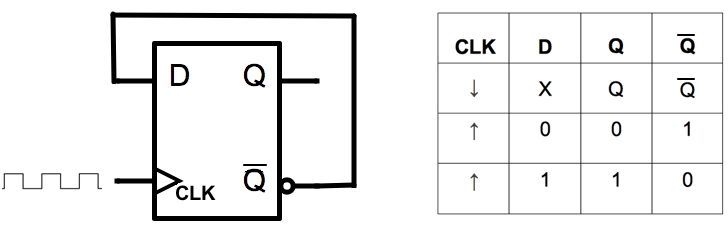
In some cases, you might use a flip-flop. Two flip-flops must be added to a 100-kHz crystal-controlled marker generator so as to provide markers at 50 and 25 kHz. (E7F04) The purpose of a marker generator is to provide a means of calibrating a receiver’s frequency settings. (E7F06) You mostly find marker generators in older, analog receivers.

Extra Class question of the day: Digital integrated circuits

Integrated circuits (ICs) are now an integral part (pun intended) of amateur radio electronics. The two main technologies used to manufacture IC are transistor-transistor logic, or TTL, and complementary metal-oxide semiconductor, or CMOS.

CMOS is arguably the most common type of digital IC. An advantage of CMOS logic devices over TTL devices is that the have lower power consumption. (E6C05) CMOS digital integrated circuits also have high immunity to noise on the input signal or power supply because the input switching threshold is about one-half the power supply voltage. (E6C06)

TTL is the other common digital logic IC technology. 5 volts is the recommended power supply voltage for TTL series integrated circuits. (E6C01) The inputs of a TTL device assume a logic-high state if they are left open. (E6C02)

BiCMOS logic is an integrated circuit logic family using both bipolar and CMOS transistors. (E6C12) An advantage of BiCMOS logic is that it has the high input impedance of CMOS and the low output impedance of bipolar transistors. (E6C13)

Tri-state logic devices are logic devices with 0, 1, and high impedance output states. (E6C03) These devices can be made with either TTL or CMOS technology. The primary advantage of tri-state logic is the ability to connect many device outputs to a common bus. (EC604) When a device’s outputs are in the high-impedance state, they act as if they are disconnected.

Digital Logic Schematic Symbols

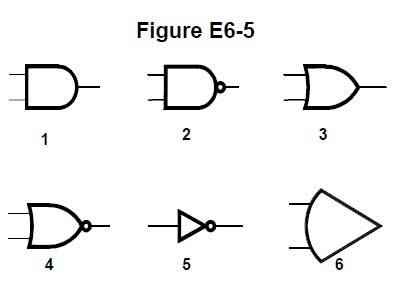
When working with digital ICs, it is important to recognize the various symbols for the different types of logic gates. In Figure E6-5, 1 is the schematic symbol for an AND gate. (E6C07) In Figure E6-5, 2 is the schematic symbol for a NAND gate. (E6C08) In Figure E6-5, 3 is the schematic symbol for an OR gate. (E6C09) In Figure E6-5, 4 is the schematic symbol for a NOR gate. (E6C10) In Figure E6-5, 5 is the schematic symbol for the NOT operation (inverter). (E6C11)