A Column for Your Newsletter

In December 2007, a friend of mine took over as newsletter editor for the Livingston (County) Amateur Radio Klub (LARK) and asked if I would be interested in submitting a regular column to their newsletter. Well, that sounded like work, so my first thought was to pass on that offer, but I realized that I do like writing about ham radio, so I accepted.

Then, it occurred to me that if LARK found my column valuable, other clubs might, too. So, I made up a list of newsletter editors from the ARRL Big List and e-mailed all the clubs in Michigan. When a number of them thanked me for my offer, I extended the invitation to clubs in Ohio and Kentucky, and then to any and all ham radio clubs out there. The upshot is that there are now about 300 clubs (as of May 1, 2012) who have either already started running my column or will be shortly.

The way this works is that towards the end of each month, I’ll send you 300-500 words on some aspect of amateur radio. Some columns may be edited version of blog items; others will be original material.

There’s no obligation to run a particular column. If you have room and you think the material is appropriate, feel free to do so. If you’re tight on space in a particular issue, or you just don’t like what I wrote, don’t run the column. I won’t feel offended.

To get on the distribution list, use this online form.

Amateur Radio Stations at Science Museums

I’ve written many times about our efforts to set up an amateur radio station at the Ann Arbor Hands-On Museum. Well, recently on the HamRadioHelpGroup mailing list, Jeremy, N2BUF, noted, “I am trying to compile a list of other Science Centers that have Amateur Radio clubs or Amateur Radio displays for kids.”

Below is a list of clubs that others mentioned and some that I know about:

  • New York Hall of Science, Flushing, NY
    Club: Hall of Science Amateur Radio Club
    Callsign: WB2JSM
  • Ann Arbor Hands-On Museum, Ann Arbor, MI
    Club: ARROW
    Callsign: WA2HOM
  • Oregon Museum of Science and Industry, Portland, Oregon
    Club: Blueback Submarine Radio Club, info on QRZ.Com
    Callsign: W7SUB
    This station is located inside the sub, which is on display at the museum.
  • Museum of Science and Technology, Flushing, NY
    Club: Hall of Science Amateur Radio Club
    Callsign: WB2JSM
  • Arizona Science Center, Phoenix, AZ
    Club: Center for Amateur Radio Learning
    Callsign: W7ASC
  • Ontario Science Center, Toronto, ON
    Club: Ontario Science Center Amateur Radio Club, info on QRZ.Com
    Callsign: VE3OSC
  • Canada Science and Technology Museum, Ottawa, ON
    Club: Amateur Radio Exhibit Group
    Callsign: VE3JW
  • Discovery Place, Charlotte, NC
    Club: Mecklenburg Amateur Radio Society, www.w4bfb.org/dplace1.htm
    Callsign: W4BFB
  • Smithsonian Institution, Washington DC
    Club: no club, web info
    Callsign: NN3SI

Apparently, there will be one in India, too. The Hindu, a paper in Kerala, ran the story, “Ham radio station at science museum” recently. This is all very cool stuff.

Club Construction Project Ideas

On the qrp-l mailing list, Brian KB9BVN writes:

I belong to a local ARC and we, like most clubs, are shrinking, and most say it is do to boredom. So I suggested we do a group build….half of them said, but “but we don’t know how to solder”. I’m guessing half or more of our 40 person membership is Tech or General…mostly no CW experience but they have a lot of interest in it.

So what I am looking for is a kit, that produces a useful doo-
hickey, and can be assembled by anyone with beginner level soldering skills. I think I will have about 16 people doing the build. I am guessing we will need to keep the costs to about $25 maximum, a lot of these folks are retirees and on fixed incomes.

There have been several suggestions already:

  • PicoKeyer. This was my suggestion based on our experience building this as a club project a couple of years ago.
  • Pixie2. This is a cute little kit, and only ten bucks. There are versions for every band. I’m not sure that these are really for novices, though. I’d be worried that the receivers aren’t very good, and at 200-300 mW output, it would be difficult to make contacts.
  • MKARS80. At $90, this QRP SSB rig is a little expensive, and maybe a little complex, for everyone to build, but it looks like a very cool project.

More as other ideas are posted.

More Foreign Readers

I just got a note from Giorgio, IZ4AKS, about 1A4A, the amateur radio station of the Sovereign Military Order of Malta. He notes that this is “the first activity in a major contest from that little state.”

Their website is interesting to surf. One item reports that Marconi was actually a Knight of Malta. Another details their project to erect a girl’s middle school in Sudan.

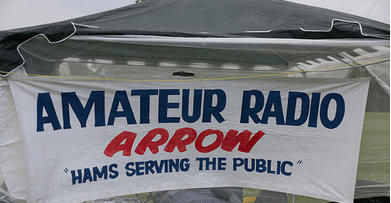
A New ARROW Banner

Our club needs a new banner, so I’ve come up with the design below. I’m not much of a designer, but I don’t think this is so bad. I’m also happy to get some suggestions. Fire away.

btw, I’m obviously using an unregistered copy of the drawing program I used to created this. It’s a pretty good program, though, and I’ll be purchasing it soon.

new ARROW banner

Want to Get Your Community Involved in Amateur Radio? Get Involved in Your Community!

I often hear hams lament that their communities show little interest in amateur radio. While this may be true, these hams have to realize that community involvement is a two-way street. To get communities involved in amateur radio, amateur radio needs to be involved with the community.

I’ll give you an example of what I’m talking about. Here in Ann Arbor, MI our amateur radio club worked with the local Red Cross and maintained a station there in the 1980s and early 1990s. For reasons too complicated to get into here, this partnership was severed in the late 1990s.

Even so, we often talked about what we’d have to do to re-establish the mutually beneficial relationship that we once had. Unfortunately, we really didn’t know who to talk to at the Red Cross, and the attempts we made to try to get back in their good graces were fruitless.

That is until I joined the Ann Arbor Rotary Club in March 2006. It just so happened that one of the guys that joined the club at the same time I did was the Chairman of the Board of Directors of the Red Cross. Not only that, but he was very interested in re-establishing an amateur radio capability at the local chapter.

The result is that our club is now working with them again. We have helped them install their 47 MHz radios at the chapter headquarters and in their emergency response vehicles. Having finished that project, we are now in the process of setting up the amateur radio station. While we may have eventually been successful without the contact I made at the Rotary Club, my guess is that this contact greatly accelerated the effort.

Another example is our work with the Ann Arbor Hands-On Museum. This is a science museum that gives kids (and adults, too) some real, hands-on experience with science and technology. There are, for example, exhibits that help kids learn about electricity, springs, weather, electricity, and other topics in science and technology.

When the executive director of the museum spoke to our Rotary Club, the thought occurred to me that this would be a great place for an amateur radio station. I met with the director, who is also a Rotary Club member, and he was very enthusiastic about the possibilities. The result is that we are going to be operating a series of special events throughout the fall of this year, with a goal of setting up a permanent station at the museum in 2008.

I’m sure that my involvement with the Rotary Club was a big part of the enthusiastic reception they gave me and amateur radio. Membership in the Rotary Club, and other community service clubs, such as Kiwanis or the Optimists, give one, if not instant credibility, at least some measure of it. So, my advice is that if you want to get your community involved in amateur radio, perhaps you should first get involved with your community, and one way to do that is to join a service club.

Seven of Eleven Become Techs at ARROW’s First One-Day Tech Class

Eleven folks attended ARROW’s first one-day Tech class on Saturday, July 28, with seven passing the test. They include:

  • KD8GTR – Chuck Graham
  • KD8GTS – Ty Graham
  • KD8GTT – Fern Katz
  • KD8GTU – Rachel Katz
  • KD8GTV – Naomi Katz
  • KD8GTW – Lorie Zupan

CONGRATULATIONS!

There was also another gentleman who passed the test, but I couldn’t find his new callsign in the database. It may not have been issued yet as he was reluctant to give his Social Security number to our VEs.

If some of those names sound familiar, it’s because they are. Fern Katz is Ralph Katz’ (KB8ZOY) mother, and Rachel and Naomi are his daughters. Ham radio is a tradition in Ralph’s family. His father was a ham (K8JZT), his wife Deb is a ham (KD8ESJ), his brother Louis is a ham (W0IT), and he has two brothers-in-law (N8DNX and N8ZKF) and a sister-in law (KC8NEW) who are hams.

Lorie Zupan is Jeff’s (W8SGZ) wife.

Unfortunately, four students failed the test, although by the slimmest of margins. One of the attendees missed passing by only one question, another by only two questions. Both have said that they are determined to take the test again and pass next time.

A third student failed by a bit more, but I take the blame for this as I didn’t stress the importance of studying the material before attending the class. Fortunately, he, too, is determined to study and pass the next time. Bruce, KD8APB, one of the instructors, will be holding a review session before the next VE test session to ensure that they pass next time.

Lessons Learned
The students weren’t the only ones that learned something. I certainly learned some things about how to conduct one of these one-day Tech classes.

First of all, I need to stress more clearly the importance of not only reading through the study guide, but also studying it thoroughly. In a one-day class, we really don’t have time to cover material in depth, so it’s important that students come prepared.

It’s also important that the students take the online tests before they show up for class. I point this out in my study guide, but I also need to do that in the class information sheet.

I think we also need to develop some kind of schedule so that we make sure we cover all of the topics. I know that there are some things we didn’t cover, and one of the folks who failed the test missed a question from that section.

THANKS!
First, a big thanks to the instructors—Bruce, KD8APB and Jeff, W8SGZ. Rich, KD6HWF, also helped out after he arrived around noon.

Second, thanks to the Red Cross. I was a little disappointed that only one RC volunteer took our class, but the facilities were first-rate, and they did provide lunch.

I think that despite some of the snags, the class was a success. It was a lot of fun, and now we have seven new Techs and seven new ARROW members. As a result, I think the feeling is not if we’ll hold another one-day class, but when.

Getting Ready for Field Day!

Field Day 2007 is tomorrow!

I really love Field Day. It’s like the perfect amateur radio event. You do, however, have to prepare for it. I actually work on it all year ’round, mostly finding and recruiting CW ops for the station I captain.

The week before the event, I start getting the equipment ready. I take antennas, radios, power supplies, etc. My philosophy is to take anything that might be useful. If it actually does get used, great. If not, well, that’s OK, too.

One thing that I think I’m going to bring this year is a first aid kit. Fortunately, we’ve never needed one, but you never know. Again, it’s better to have it and not use it than to need it and not have one handy.

Finally, take (and use) sun screen! You don’t want to get burnt.

More Wallpaper

Also arriving in yesterday’s mail was an attractive certificate from the Washington State Salmon Run, a contest sponsored by the Western Washington DX Club. It seems as though I finished second in Michigan in the low-power, CW category. I don’t recall making all that many contacts, so I was probably second out of two. :) I checked the contest website, but they haven’t yet posted the final results.

soccertificate.jpg

A week or so ago, I received my Second Class Operator’s Certificate (above), confirming my status as a member in good standing of the Second Class Operator’s Club (SOC). The motto of the club is, “Because so few are really First Class.” If you’re feeling bad about not making the cut for the First Class Operator’s Club, be aware that there will always be a place for you in the SOC.

UPDATE 4/16/07: In today’s mail, I got yet another certificate. This one for placing first in Michigan in the single-operator, low power category of the 2007 Virginia QSO Party. I did this one all on 80m CW. Thanks, guys!

Club Awards?

I worked a guy down in GA a couple days ago, and we got to talking about a bunch of different things. It was such a good QSO that he asked me to e-mail him so that we could continue the discussion.

Well, as it turns out, one of his hot buttons was the Amateur Extra license class. His contention is that it’s not really that “extra” anymore, and that he wanted the FCC to create a new class of license whose requirements would include a 25 wpm CW test and a “really hard” written examination.

I replied that it probably would be next to impossible to have volunteer examiners administer such a test. My thought is that if we really want to recognize someone’s technical or operating skills, we should perhaps put more emphasis on programs such as the A-1 Operator’s Club and the various technical awards.

Then, it hit me that our club should have such a program, and I ripped off an e-mail to our Board of Directors. In the e-mail, I proposed the following awards:

  • Club Service Award. This award would recognize a club member who has gone above and beyond in promoting, organizing, and running club activities.
  • Public Service Award. This award would recognize a local radio amateur–not necessarily a club member–who has excelled in providing public service, including emergency communications, community outreach, etc.
  • Technical Award. This award would recognize a club member who has done something excellent from a technical point of view, for example designing and building a custom interface for the repeater or building a cool dual-band J-pole antenna or has perhaps helped fix radios for guys whose rigs have died.

How does this sound to you? Do you have any suggestions for other awards that we should give?

Also, does your club have an awards program? If so, what kinds of awards do they give out? How often do they give them out? What are the criteria?