CW or Voice During an Emergency?

On the ARRL PR Mailing List, someone wrote that he had been approached by a relatively new ham and was asked, “What percentage of hams do you think use CW on a regular basis?” The reason that the new ham asked this question was that he wondered if more people would be monitoring phone frequencies or CW frequencies during an emergency. That is to say, would he “have a better shot of getting in touch with someone on CW or phone”?

Here was my reply:

I am going to hazard a guess and say that less than 10% of licensed amateur radio operators are regular CW users. Having said that, a couple of thoughts occur to me:

  1. The type of emergency will dictate where one should be listening and/or transmitting. For example, here in the summer, we sometimes have tornado watches. For the most up-to-date information on this situation, I listen to the local SkyWarn net, which takes place on one of the 2m repeaters. It’s all voice communication.
  2. On the other hand, if I’m out on a boat in the middle of the ocean with no satellite phone, I’d want to be able to send out a CW signal. The CW signal will get out farther, and if you can’t be heard, it doesn’t matter how many people are listening. There are enough hams monitoring the HF CW bands that you should be heard.
  3. If you can operate both voice and CW, you’ll have more chance of getting in touch with someone than if you can only operate one of those modes.

Any other thoughts?

Batteries Just Cost Me Some Points!

Down at the museum today, I got sucked into working the PA QSO Party. I made 35 contacts before packing it in for the day.

This evening, I thought I’d get on and make a few more contacts. So, I set about programming my WinKeyer.

Normally, this is a no-brainer, but tonight, the keyer started acting up on me. I would get halfway through programming one of the memories, and the thing would just quit on me. It was all very puzzling. I plugged and unplugged the key without success. I had it play back its status to me, but that gave me no clue.

Then, it dawned on me that I had never changed the batteries in the thing. In fact, I couldn’t even remember what kind of batteries it used. So, I opened up the case and found that it used three, AAA batteries.

I changed them and got the thing working again, but by that time, the band had changed and there were no PA stations to be found! So, I guess the moral of the story is change your keyer batteries before the next big contest.

While I’m miffed that I missed a few points, I can’t really complain about the battery life. I built this keyer in December 2008, and this is the first time I’ve changed the batteries, so they’ve lasted nearly two years.

The QMN: A Celebration of the First Traffic Net.

This is from the August Michigan Section News, by Dale, WA8EFK, Section Manager:

The year 2010 will mark an important anniversary in the History of Amateur Radio: The birth of the first public service net and it happened here in Michigan.

Before the implementation of a net concept, radiogram traffic and emergency communications activity was conducted on a system of schedules and random contacts. Radiogram traffic moved across the country on “Trunk Line” networks staffed on a daily basis by “iron man” traffic handlers. From these key stations, traffic was routed to its destination via individual schedules, directional “CQ” requests, and similar techniques. The ARRL “Amateur Radio Emergency Corps,” “National Traffic System,” and similar programs had not yet emerged.

This all changed during the autumn of 1935 when members of the Detroit Amateur Radio Association (DARA) formed the Michigan Net and adopted the net call “QMN.” The plan was simple and elegant in concept. Using the relatively new technology of crystal control, radio amateurs from throughout the State of Michigan would gather on a single “spot frequency” to exchange radiogram traffic and coordinate emergency communications response to disasters. A QMN Committee standardized the procedures and created the familiar “QN-Signals” so familiar to generations of traffic handlers. With the creation of QMN, the modern traffic net was born.

This year, QMN will celebrate its Diamond Anniversary with a very special event! A 75th Anniversary Banquet will be held at Owosso, Michigan on Saturday, October 23, 2010. Activities include:

  • A special event station on 7055 KHz and 3563 KHz using the call K8QMN. This special event station will use vintage equipment from the 1930s and ‘40s. Visitors will have an opportunity to sit down at the key and experience QSOs using 1930s era receivers.
  • A presentation entitled “An Early History of Radio” will be featured along with a talk on the history of QMN.
  • Long-time members will reminisce about their experiences in Amateur Radio.
  • Vintage radio equipment will be on display for all to enjoy.
  • A working Morse Telegraph Circuit will be available on site for those who would like to see land-line telegraphy and American Morse Code in use.
  • A special commemorative booklet will be provided to each attendee. This commemorative booklet will include an excellent history of QMN written by the Don Devendorf, W8EGI (SK), along with an introduction covering the early history of Amateur Radio.

QMN members both past and present are invited to attend, as are all radio amateurs with an interest in the history of Amateur Radio and the history of public service communications. Those wishing to attend this event should request a registration form from James Wades, WB8SIW at the following e-mail: jameswades@gmail.com You don’t want to miss this celebration to be held on October 23, 2010 at the Comstock Inn, Owosso, Michigan.

Logged at 0155Z, 8/6/10

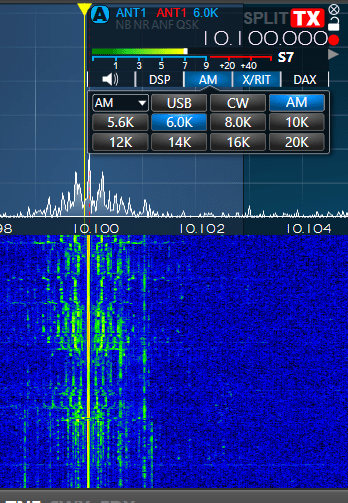
I fired up the rig about 45 minutes ago and found this on 10115.5 kHz:

ICJYX BMHDI QKXGT SKCQD ZFBZZ MOVOY HIRWA SUQER PIOGL RZPNN SKVFL ANYVQ AAMWM IVVLM IDKAL MAIYG LIYTE ROWIH DOYAC HDRJM SHJIH

and on and on and on. They were going about 20 wpm. Seems like there are an awful lot of Ys and Qs in there.

I normally set up on 10115 kHz, but I didn’t want any black helicopters landing in my backyard and taking out my dipole.

My Latest Pet Peeve…

…is the operator who treats a normal rag-chewing QSO like a DX contact.

Let me give you an example. The other day I called CQ, and a fellow came back to me with only his callsign. Not only that, he only sent it once. Now, if you have any experience at all with CW, you know that it’s always wise to send your callsign at least twice. The reason for this is that there are a number of things, including QRN, QSB, and distractions in the shack, that could cause the receiving station to miss the callsign.

Now, normally, I would make the other guy send his call again, by sending QRZ? This, time, though, I copied the signal cleanly, so I launched into the QSO, sending him a report, my name, and location. When I turned it back to the guy, he sent, “599 FL 73″  and off he went.

Now, I ask you, what sense did it make for that guy to even answer my CQ? This has happened to me two or three times in the last month and each time I had the same reaction.

Please, unless you’re a DX station trying to make use of good band conditions, don’t answer my CQ if all you want to do is swap signal reports with me. Unless I’m calling CQ DX, which I almost never do, I’m looking for conversation, not just an info swap.

If a Nine-Year-Old Girl Can Do It….

….shouldn’t all of you?

Thanks to Jim, W8JPM, for sending me a link to this YouTube video of RZ9UMA working the recent WPX CW contest:

More Morse
And, while we’re on the subject of Morse Code, here’s another video that I found while surfing around YouTube. It’s a video of how to use a simple microcontroller to decode Morse Code. I will grant that since the input to the microcontroller in this example is a pushbutton switch, the practicality of this example is somewhat limited, but it should get you started on making your own Morse decoder, if you’d like to give it a try.

Touch Keyer Really Works

A couple of months ago, I realized that I hadn’t really built anything in a while. About that time, there was yet another discussion about whether to use a straight key or a paddle. The difference this time was that someone mentioned the Touch Paddle. These are devices that sense when someone touches a metal pad and electronically switches an output. There are two outputs, one for the dit and one for the dah.

The company that makes these devices, CW Touch Keyer, have a whole range of different products. Some have a built-in keyer. Some are just the paddles that you then have to connect to a keyer.

They even have a kit, the P3, which is what I opted to buy. At $20, it seemed a little steep, but what the heck. If it worked, it would be worth it.

What I received is different from the kit shown on their website. Mine uses surface-mount caps and resistors that were already soldered to the board. Assembly was really easy as I only had to solder in the two, eight-pin ICs; two transistors, a diode, an electrolytic cap, and a voltage regulator.

The hard part was figuring out how to make the dit and dah contacts. As shown in the photo above, I cut out a hunk of PC board material, and used a Dremel tool to file off some copper down the middle, creating two contacts. I hooked up 9 V from my bench power supply, and I had a working touch paddle.

Sort of, anyway. The problem with the setup as it is is that the touch pads are just floating. To work really well, I’m going to have to figure out some way to mount them somewhere, so that they don’t move around.

One funky thing about this kit is that the company has painted over the markings on the ICs. I guess he figured that since the circuit is so simple that someone would steal the design. I tried scraping the black paint off one of the ICs, but didn’t have any success with that.

A little Googling did the trick. I found the article, Touch Paddle Keyer, published in the March 2007 QST. The circuit shown in this article is almost identical to the circuit of my P3. The chip used in the article is the Atmel QT113-G, and while that part is no longer manufactured, DigiKey carries various types of the QT110, which would also work, if you wanted to roll your own.

I plan to figure out a good way to mount the paddles and then use this for the CW demo at the upcoming Mini-Maker Faire here in Ann Arbor. Kids should have fun playing with it.

W1AW Offers Code Practice, Bulletins via EchoLink

From today’s ARRL Letter:

Audio from W1AW’s CW code practices and CW/digital bulletins is now available using EchoLink via the W1AW Conference Server “W1AWBDCT.” The 9:45 PM ET phone bulletin is currently unavailable via W1AWBDCT. The audio is sent in real-time and runs concurrently with W1AW’s regular transmission schedule. According to W1AW Station Manager Joe Carcia, NJ1Q, this server is currently at an experimental stage: “Since the server is located at ARRL — and uses the ARRL’s Internet connection — there may be an issue as to how many users can connect to W1AWBDCT via EchoLink. The current number of connections is set to 350. If the current system can properly handle these connections without adversely affecting the performance of the conference server, this number will be bumped up higher.” All users who connect to the conference server are muted. Please note that any questions or comments should not be sent via the “Text” window in EchoLink. Please send any questions or comments via e-mail.

I like this idea. It will bring code practice to those Techs who still don’t have an HF radio.

Operating Notes – 4/14/10

In no particular order, here are some notes from my recent operations, such as they are:

  • Operating without guilt. Monday night, I finally finished preparing my tax returns. Now, I can operate without feeling guilty that I’m putting it off.
  • Operating without power. For the last couple of weeks, I’ve been QRP. I had to send my IC-746PRO in for service, so I’ve been using my Elecraft KX-1 exclusively.
        It’s been interesting. Thanks to good band conditions, most of the contacts have been quite solid. This evening, I even received a 599 signal report.
        I’ve even mad a couple of DX contacts: FM5LD and CT1JOP. The CT1JOP QSO even qualifies me for the “1000 Mile per Watt” award. Of course, it helped that he has a 40m beam. He should really get the credit for the award.
  • Another QSO of note. A couple of nights ago, I worked N4NAB. His QSL, should I be fortunate enough to get it, will go into my collection of QSL cards from stations whose call signs spell words.
  • What went wrong with the IC-746PRO? In case you’re wondering what went wrong with the IC-746PRO, the problem is with the antenna tuner. For some reason, it decided it didn’t want to tune my dipole on the lower 100 kHz of 40m, even though that’s where the SWR is lowest (<1.5:1). My guess is that one of the relays went out. The display backlight had also started acting funny, so I’ve requested that they look at that as well.
  • Forza Begali! I love my Begali paddle, but in the last year or so, I’d been having trouble with the contacts. I tried various ways to clean the contacts, but to no avail. About a month ago I e-mailed Begali, described my problem, and even offered to bring it to Dayton to have them take a look at it.
        Bruna, Piero’s daughter, offered to send me a contact cleaner that she thought would cure the problem. I was expecting some kind of cleaning fluid, but what arrived was what looked like a strip of brown plastic.
        Whatever it is, it worked like a charm. I’m now having no problems at all with the contacts, and it’s a real joy to use again.
  • Another QSO of note. My third QSO of the night was with Tim, W3TIM. He was running a 250 mW Tuna Tin into a 730-ft. doublet antenna, tuned with a homebrew, balanced line tuner (see below).
    W3TIM Antenna Tuner

    W3TIM uses this antenna tuner to tune a 730-ft. doublet antenna.

    He obviously doesn’t need that much tuner for that little Tuna Tin transceiver. We swapped some e-mail after our QSO, and I asked him about it. He confessed to being a broadcast engineer, and noted that that’s how they build them at broadcast installations. He guesstimates that it will handle 5 kW. In addition, he has an old Gates BC transmitter that he uses on 160m AM, where he runs considerably more power than 250 mW.

A “No-Nonsense” Guide to Operating CW

A recent post to the SolidCpyCW Yahoo Group, which, in my humble opinion, contained some misinformation, got me to thinking about what I might do help people to get started in using and enjoying CW. Since I have already helped a lot of people get started in ham radio with my “No-Nonsense” license study guides, I’m thinking of writing The No-Nonsense Guide to Operating CW.

The topics I’d cover include:

  • learning the code;
  • selecting a key;
  • making contacts; and
  • other stuff, including CW clubs, modulated CW (MCW), and whatever other miscellaneous stuff that I can think of that would help hams enjoy operating CW.

There are already lots of books out there covering this stuff, most notably The Art and Skill of Radio-Telegraphy. This is a great book, but the copy I have has more than 240 pages. Does someone really need to plow through 240 pages to learn the code?

So, what do you think? Do you think that I have the topics right? What else would you include? What resource did you find most useful when you were learning the code? What do you know now that you wish you knew when you got started learning Morse Code?