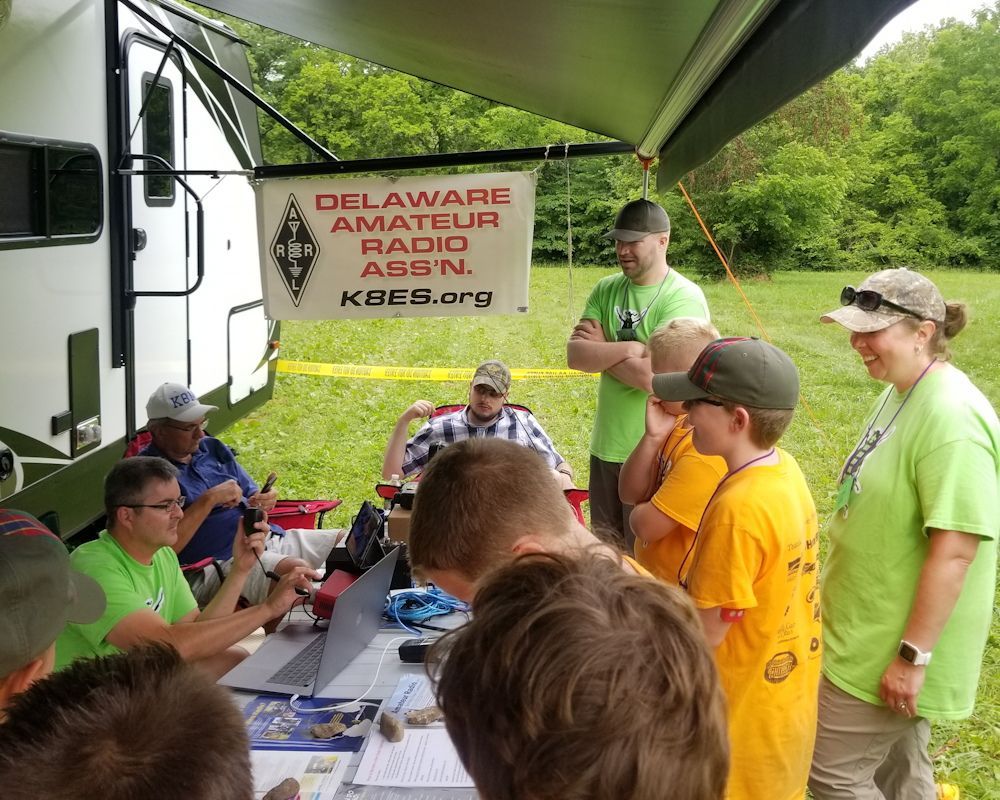
Space Station QSO a Success

Thanks to Ig, N0EFT, and his crew:

  • Tim, WA8VTD, back up radio operator;
  • Steve, KB9UPS, ARISS mentor and antenna and az/el rotor operator;
  • Olivia, KC8VGH, who handled the microphone and kids; and
  • Candy. KD8IPC, who made the initial contact and helped with the kids;

yesterday’s Space Station contact from the Ann Arbor Hands-On Museum was a success. Despite the low orbit (21 degrees), the contact lasted nearly nine minutes and they were able to ask 14 questions.

I hope to post video later, but in the meantime, here are a couple of news stories:

How we get kids (and parents) interested in Ham Radio

Barry, K2JV, wrote this for the ARRL’s Contact, an e-mail newsletter for PIOs:

The New Providence Amateur Radio Club of New Jersey has been actively introducing kids to Amateur Radio for about 5 years. The activities and events which we have mentored have been a source of considerable pleasure for the senior club members involved, but also require a considerable effort, both physical and mental.

Our formal programs include:

  • Kids Day twice a year, in cooperation with two township supported Recreation Commissions
  • Operating a GOTA station at Field Day
  • Running an after school Ham Radio Club at an elementary school
  • A program of “Ham Radio at Summer Camp,” also a Recreation Commission function
  • Mentoring ARISS QSOs, 4 contacts at various school levels.
  • Kids march with the Club in the annual Memorial Day Parade. They carry the Club banner and each has an HT on 2 meters using the callsign of and supervised by one of our licensed members.

These activities have given us an “insider’s look” at the behavior and interests of children, mostly of elementary and middle school age. Most of these programs include on the air operating on HF, and sometimes on VHF.

For programs of longer duration like the school radio club or at summer camp, it’s usually pretty easy to identify those kids who show a more than passing interest, and get them right on HF. It is frequently difficult to establish reliable, clear communication on 20 or 40 meters. The stations contacted are uniformly interested in speaking with the kids, but most operators don’t know how to speak with kids. The simple concept of speaking slowly, asking only one question at a time, and making that question something within the comprehension of a child, is something that most of us need a little time to grasp. The control op and mentor usually has to start the kids asking questions which will engage the person on the other end. Such questions include: “Do you have any pets?” or “Do you have any children?” or “What flavor ice cream is your favorite?” This clues the operator on the far end as to how to respond and how to ask a question which a kid can answer.

When we do “Ham Radio at Summer Camp” we are in competition with all the other activities which are going on. It soon becomes quite apparent however, that there are a few kids who will stay at the Ham Station for the whole day, and a few more who keep coming back – generally with the question “can I try it again?” These are the ones we are looking for to bring up the subject of Ham Radio at their schools and at home. We have prompted them when they return to school after the summer, and when their teacher asks “What did you do this summer?” to respond “Oh, I just spoke with a rancher in Arizona who raises Buffalo” or “I talked to a man who was in the jungle in Panama” or for our ARISS communicators “Oh, all I did was have a conversation with an astronaut on the International Space Station!”

One of the most important values of Ham Radio which we try to get through to parents and adults is that it teaches their kids how to speak with an adult who is not a family member, in sentences not monosyllables, and how to behave in the presence of a stranger. The science, technology, geography, etc. which they are learning even if they don’t know it – is purely collateral.

For Kids Day, in order to insure plenty of contacts we usually have a few “ringers” listening on a previously selected VHF repeater or simplex frequency. That way when a kid calls CQ he is likely to get an immediate and clear answer (kids have a short interest span). After that, it’s usually possible to get them on HF to make exchanges with other kids. Even the youngest, grasp the procedures for Kids Day almost immediately. We help them with a “crib sheet” which has the exchange written out, and they recognize the fact that the station contacted is sending them similar information. If conditions are poor, we have some “ringers” waiting on 20 meters too.

For an ARISS QSO, we have used “ringers” in preparing our Student Communicators. We usually do this on VHF simplex and one of our experienced Club Members becomes a “Simulated Astronaut.” This allows the kids not only to get familiar with the exchange protocol which will be used, but also lets them practice the questions which they have made up for the astronaut, and change the question when they hear the answer. This is done under the supervision of the Control Operator for the QSO who is one of our “graduate students” having communicated with the ISS, obtained a ham license, but is still in Middle School or High School.

We have a few “internal rules” for our ARISS QSOs:

  1. It’s all kids. Everyone including the control operator is a “kid” meaning High School or younger.
  2. No adults are visible on the stage, at least not to the audience.
  3. It is advertised as “a conversation with an Astronaut” and the kids respond after their question is answered, thank the astronaut, and pass the microphone to the next communicator.
  4. We introduce them early on, to a Satellite Tracking Program and the NASA website, which they are urged to use at home.
  5. To get more kids involved we do manual antenna train and elevate, and manual Doppler correction. A separate group of kids (usually boys) want to do this.

My Summary
After 5 years a few generalities as related to Ham Radio can be observed:

  • Little girls like to talk to each other. We set them up in small groups, each group with a handitalkie. Using proper protocols and callsigns the groups play games with each other like “battleship” or some games using LEGO blocks, etc.
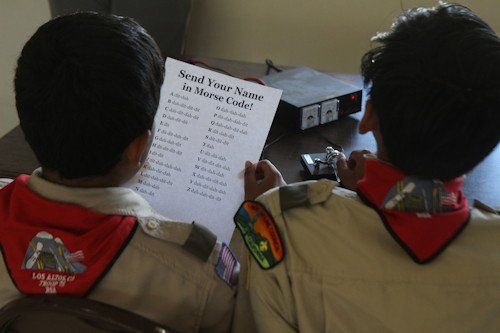
  • Little boys like to play with electronic toys and love Morse code. They use computer based Morse training programs and soon learn to recognize their names and the names of their buddies. We have them build code oscillator kits and make them work.
  • Neither sex has the capability to carry on a conversation with a stranger. They have not yet learned to initiate a conversation with an adult. They don’t have this problem with their peers.
  • Both sexes tend to answer questions with monosyllabic answers. They can be prompted to answer in sentences, to speak slowly and clearly, but if not supervised they revert to their original style.
  • Girls have a much longer social interest span than do the boys. This is true for social gatherings like the games and communication exercises. The boys will work on the code for a long time, but this is a more solitary activity.
  • Boys like the complexities of games and puzzles more than girls. When on the air we can get them involved in the competitive and contest activities.
  • All children function better in a structured, organized environment. If the Ham Radio environment is made to feel like school, they can relate to it and will behave as though they are in school. Since most of their teachers are female, they all have far less problem conversing on the air with a YL (preferably a grandma) than with an OM of any age.

MI Section Publishes First Youth Newsletter

MI Assistant Section Manager Simon, KC8DYZ, has published the first Youth Radio in Michigan newsletter. Included in this issue are articles by out SM Dale, WA8EFK; Corey, KD8BOQ; and Simon himself.

Another interesting part of the newsletter is a proposal for creating a website just for kids in ham radio. I like this idea a lot. Not only would it be great for kids who are hams in Michigan, but perhaps for kids all over the country.

Buying a Rig for the Museum

As I’ve reported before, we have been awarded a $10,000 grant by the IEEE for setting up an amateur radio station at the Ann Arbor Hands-On Museum. $3,000 has been allotted for a transceiver. There are a lot of options, so I’m asking for some help.  Here’s some of my thinking so far:

1. Don’t purchase anything and use our club’s IC-746PRO for a while.
PROS:

  • The IC-746PRO is a good performer, and lots of us already know how to operate the radio.
  • Will give us time to try to get a manufacturer to donate a radio.
  • We could use some of the money for other stuff for the shack.

CONS:

  • Ties up the club’s radio at the museum.
  • Technology is not quite as impressive as some of the newer radios, such as the IC-756PROIII or TenTec Omni-7. (The HOM people want impressive.)

2. Purchase another IC-746PRO for the museum.
PROS:

  • The IC-746PRO is a good performer, and lots of us already know how to operate the radio.
  • We could use some of the money for other stuff for the shack.

CONS:

  • Technology is not quite as impressive as some of the newer radios, such as the IC-756PROIII or TenTec Omni-VII. (The HOM people want impressive.)

 
3. Purchase a TenTec Omni-VII.
PROS:

  • New technology, good performance.
  • Has features that will make remote control somewhat easier.

CONS

  • Eats up the entire budget for a radio.

 
4. Purchase an Icom IC-756PROIII.
PROS:

  • New technology, good performance.
  • Impressive display.
  • Price includes power supply.

CONS

  • Eats up the entire budget for a radio.

Sooooo, what do you guys think?

Teach Your Children Well

A Crosby, Stills, Nash, and Young song goes:

Teach your children well,
Their father’s hell did slowly go by,
And feed them on your dreams
The one they picked, the one you’ll know by.

How can we expect kids to pick up on ham radio if we don’t show it to them?

How do we do this? Well, the online article “Teach-in” will give you some ideas. This article describes how a group of Florida hams demonstrated ham radio to a bunch of elementary kids.

As someone who’s done this many times myself, I can tell you that kids ARE interested in amateur radio and even Morse Code. Get out and do it and you’ll find it a very rewarding experience.

Brainstorming at the Museum

One of the fun things about operating at the Ann Arbor Hands-On Museum is enjoying the company of other hams and sharing ideas. Two weeks ago, a bunch of us were joking about how to make CW more fun and get more kids into it. Well, someone noted that since CW is a rhythm kind of thing, maybe someone could make a dancing game out of it. I don’t know how hard or easy it would be to hack one of the dance mat games, but if you could get the thing to generate dits when you step on some of the pads and dahs when you step on the others, that might be kind of fun.

Yesterday, we were talking about the experiences that a couple in the group had talking to Cub Scouts about ham radio. They quickly came to the conclusion that you can’t just talk at them, you have to get them actually doing something. I think that’s one reason kids love to bang on the code practice oscillator at the museum.

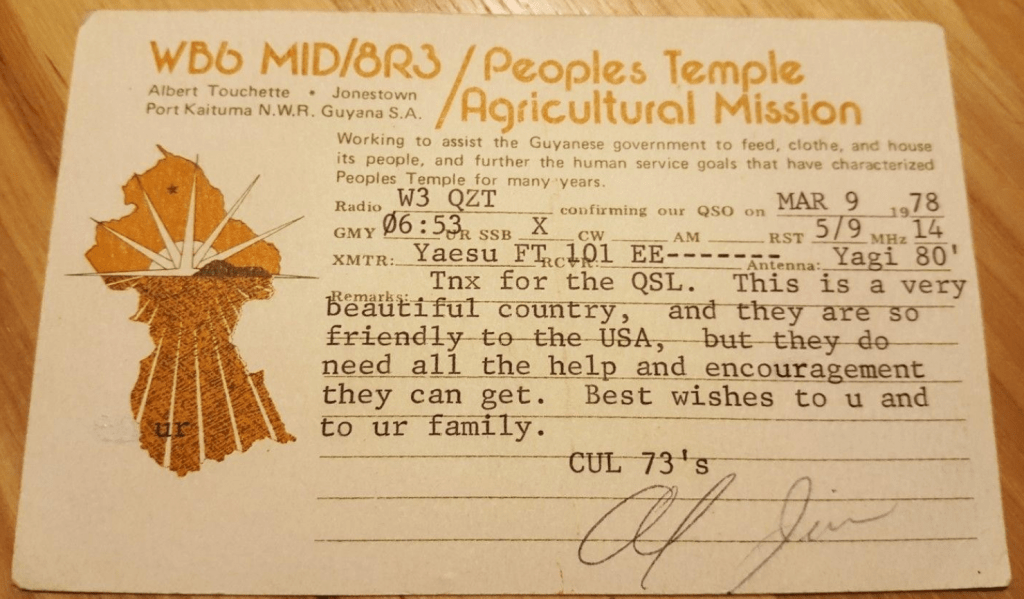
Along those lines, they said that one of the more successful activities they had the Scouts do was to design their own QSL card. I think this is a really great idea, and I plan to use this idea when I go talk to kids about ham radio.

What’s Happening at the Ann Arbor Hands-On Museum

When I last blogged about this, I simply reported that we’d applied for a grant from the IEEE Foundation. While we don’t expect an answer to our proposal for a while, Jack, WT8N, and I have been brainstorming about how we might use the money. Part of the money we requested were to go towards, “two to four tabletop displays,” and given that we are working with the “hands on” museum, we’ve been trying to come up with exhibits that kids could actually get their hands on.

Accordingly, we’ve come up with several ideas that will attempt to demonstrate some aspect of wireless technology, but in a “hands on” kind of way. What we’ve come up with so far includes:

  • Morse Code. Being ham radio operators this is a natural. The question is how to do it. Kids do seem to love to “pound brass,” so getting them to use the key to produce a sound is a no-brainer, but how to get them to learn something is another matter. One idea is to have them type in their name, send that in code, then have them try it. Another is to have two stations and have kids send code to one another.
  • Ohm’s Law. The idea for this exhibit would be to have users switch resistors in and out of a circuit, and possibly set the level of a voltage source and have a big ammeter so that they see how changing the voltage and resistance in a simple circuit affects the current in a circuit.
  • See your voice on an oscilloscope. Kids would speak into a microphone and see their voice on an oscilloscope display.
  • Transformer. Similar to the Ohm’s Law display, kids would somehow be able to switch in more or fewer windings and see how that affects the output/input voltage ratio. We’re kind of sketchy on how to actually do this, though.
  • Tuned Circuit. Kids would tune a capacitor and see how that affects the output frequency of an oscillator. This might be a visual display (oscilloscope) or audio output.
  • Directional Antennas. In this display, kids rotate directional antennas and note that when the antennas are pointing at one another, they are able to hear a signal or talk to other kids at second station. We were thinking of doing this with 440 MHz antennas and radios, as the antennas would be of a reasonable size. This might not, however, be legal for unattended operation, even with very low power. Anyone know of a frequency we could use for this kind of thing?

All of these displays would be accompanied by some text that explains the phenomenon.

In addition, to the tabletop displays, we were thinking of conducting regular fox hunts. Kids seem to love fox hunts. One thing we’re wondering about, though, is how well we could conduct a fox hunt inside the museum. That is will the fox’s signal reflect off all the metal inside making  finding it nearly impossible.

Another concern is how safe it will be to have kids running around with 440 MHz Yagi antennas. I’ve done a little surfing on fox hunting, and thought I’d found a way around this by using a loop antenna. One website, though, says that while they are great for direction finding at HF frequencies, they’re not really that good for VHF. Anyone have any experience to share with us on this point?

Contact Frequencies for Schools, Kids

This item is from the November 2007 edition of the ARRL’s Education Services News for Instructors and Teachers….Dan

Teachers and Scout leaders and others who are working with kids and amateur radio have been telling us that it can be difficult to find another school or group of kids to talk to. Scheduled nets are pretty difficult to arrange with kids amid all of the conflicts that arise during school days and after school.

To help you find each other, we suggest some meeting places on the bands where kids and teachers and youth leaders can look for a contact. If we get the word out to enough of you, perhaps we can make these band locations a destination for kids looking to share a conversation with other kids somewhere across the country. These bands are available to those with the appropriate license privileges, or kids under supervision of an operator with those privileges.

We picked these locations to become youth hot spots:

  • 40 meters: 7,180 kHz
  • 20 meters: 14,270 kHz
  • 10 meters: 28,333 kHz

Brian Lloyd from Granite Bay Montessori School suggests we add destinations on 30 meters for CW and other digital modes and 17 meters. Let’s try these:

  • 30 meters: 10,125 kHz
  • 17 meters: 18,120 kHz

I hope you’ll find a way to join Brian and his 5th-8th grade wireless technology students on the air!

More Fun with the Boy Scouts

Last March, we did a good thing by hosting a radio merit badge session. At that event, more than 120 Scouts got their badge. Yesterday, we followed up on that success by participating in the Great Sauk Trail 2007 Boy Scout Camporee. Pat W8LNO, Dave N8SBE, Mark AB8ZI, yours truly, and more than 6,000 Scouts and their adult supervision attended the Camporee. This was quite an event, and I think I speak for the other guys when I say it was a lot of fun.

This was not my finest hour as far as an organizer. As late as Friday morning, I really didn’t have any idea how were were going to do this. A few phone calls later, though, and Pat had agreed to tow the ARROW trailer out to the site, and Mark volunteered his Buddipole and VHF station. Dave brought his FT-817, while I brought the club’s IC-746PRO, a code practice oscillator, and some ham radio literature. This, coupled with a cooler of bottled water brought out by Mark, proved to be quite a decent station. Thanks, guys, for stepping up.

We made about 30 contacts, mostly on 40m and mostly on phone. (I did manage to sneak in a few CW QSOs, though.) We did try operating 20m for a bit, and we did manage a contact with a German station, but for the most part, the band didn’t seem to be cooperating.

This looked like it was going to be a problem because Mark’s Buddipole doesn’t seem to like to load up on 40m phone. After a bit of goofing around on 20m, without a lot of success, Mark suggested that we try the Buddipole in a vertical configuration, using a 32-ft. counterpoise. That worked like a charm, and we began to make lots of contacts on 40m phone.

The odd thing about this configuration is that it didn’t want to load on 40m CW. So, in the dipole configuration, the antenna didn’t like 40m phone, but in the vertical configuration it didn’t like 40m CW. As it turns out, the problem was that Pat’s truck, which he parked underneath the low end of the counterpoise to prevent the kids from getting clotheslined, was detuning the antenna. When he left, the antenna would then magically tune up on CW.

We also made a bunch of VHF contacts via the LARK repeater. In particular, Pat was able to raise Ricky, KD8EYO, who’s just ten years old. He encouraged a lot of the Scouts he talked to to get their tickets.

At 4:30 pm, the action in the Midway, where we were located, started to wind down. The big inflatable playpens were deflated, and the drunk driving demo was decommissioned. We continued operating for a while, and got a few more visitors, but it was clear that this part of the Camporee was over. Just before 5 pm, we headed over for dinner.

After dinner, we decided to pack it up and go home. I was on the road about 6:45.

Overall, this was a great event. We made a lot of contacts, and demoed ham radio to quite a few campers and their parents and troop leaders. And the interest level was really quite high, measured by the number of pamphlets and other info that we passed out.

47 Eighth Graders Earn Ham Licenses

Who says kids aren’t into ham radio? I think the key to this program’s success is that the teachers were an integral part of the project. Unfortunately, I did not have this kind of cooperation when I tried doing this at a local middle school. I’ve started working on another local school, though……Dan

47 Eighth Graders Earn Ham Licenses

On June 8, representatives of the Las Virgenes Unified School District (LVUSD), LA County Sheriff’s Department, County Disaster Communications Service (DCS), City of Calabasas, and the American Radio Relay League (ARRL) gathered to congratulate 47 eighth-graders at A.C. Stelle Middle School, who earned their amateur radio license by passing an FCC exam this semester. The exam tested their knowledge of electronics, radio, rules & regulations and safety.

Principal, Mary Sistrunk, and science chairman, Karl Beutel (amateur call KE6MAO), offered students the opportunity to take the exam on campus. Beutel kicked off the project in all six of his science classes with a presentation and demonstrations of radio, including communication with other amateur operators using the schools own radio station.

The station was provided by the American Radio Relay League’s “Big Project” as a way of promoting science education in the schools. Dick Norton (N6AA), ARRL Southwest Division Director, congratulated the students on their achievement and welcomed them to the amateur radio community. AC Stelle was one of only 10 schools to qualify for a station grant this year.

Beutel said, “We nearly tripled the number of students who earned their licenses from the program’s inception last year. This is very likely the largest group of middle school students to ever accomplish this. The students studied on their own time, augmenting their school studies, picking up valuable knowledge of electronics and radio, and completing the daunting task of taking their first `grown-up’ federal exam. What they learned here will help them in high school, college and later in life. They also proved to themselves that they could master a difficult topic on their own.”

Emergency services groups are nurturing this project with hopes that it will provide a source of communications volunteers, a critical resource in case a disaster strikes our area. Reserve Captain, Tom Fakehany (N6FDR), was on hand, representing the LA County Sheriff’s Department and DCS group,. “These students are the next generation of emergency volunteers who will provide communications when all else fails.” Norm Goodkin (K6YXH), DCS member, added, “Our plan is to help organize these new hams into a youth group to provide communications services to the school and community – the City of Calabasas and other groups are excited about having a new resource pool to join their teams.” Next semester, the 47 students plan to start an amateur radio club at Calabasas High School, along with the 17 new hams already there from last year’s project. The club will set up their own radio station to provide emergency communications services to the school and neighboring community.

“When these kids turn 16,” said Goodkin, “they’ll be eligible to join a special Explorer Scout program with the LA County Sheriff’s Department, grooming them for volunteer work with DCS and even professional careers in law enforcement.”

Sandra Smyser, Superintendent of the Las Virgenes Unified School District, was on hand to congratulate the students, faculty and community volunteers who supported this project.

Gary Lysik (KF6BIX), is Chief Financial Officer for the City of Calabasas, and responsible for the Calabasas Emergency Response Program (CERP). He and Debbie Larson (KG6ZRF), Risk Management Analyst for the City and head of the CERP team, set up licensing classes for Calabasas and the surrounding communities; 9 of the ACS students and 13 community volunteer workers passed the FCC exam at the June session. CERP is planniing to use these students as `eyes and ears’ to report into the City, and to get the word out to the public in case of an emergency if normal communications are down. CERP is also encouraging members to get licensed and bring ham radio into the program.

The FCC Amateur Radio licensing program is administered by a cadre of FCC-accredited volunteer examiners – Marty Woll (N6VI), Naomi Goodkin (WB6OHW), Daniel Goodkin (KA6VSS), Murray Kay (WA6USL) and Mari Levenson (KA6PTV) came to the school to administer the exam, coordinated by the Greater Los Angeles Amateur Radio Group Volunteer Exam Coordinator(GLA ARG VEC); R. C. Smith (Smitty, W6RZA), the head of the group, came out to meet these new hams in person.

Next year, A.C. Stelle will offer students an opportunity to operate the school station at noon, using a high-powered radio to let the students talk around the world. Open to 6th graders, this should stimulate even more interest in ham radio and the licensing project.

Beutel expects to continue the project, adding another 40 to 50 more hams to Calabasas High School each year. At that rate, there will be 100s of ham operators at CHS, quite an accomplishment for the students and the groups supporting the project.