On the air this weekend at WA2HOM

WA2HOM is our club station at the Ann Arbor Hands-On Museum. I go down there nearly every weekend and operate for anywhere from two to eight hours. This weekend, I had a lot of fun down there.

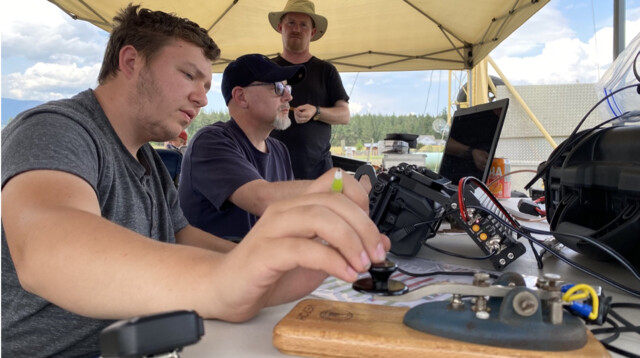
This photo, from the Boy Scouts of America website, shows one Cub Scout sending code to another.

Late last week, I was contacted by a woman who was a Cub Scout pack leader, asking if she could bring some Scouts by. Silly question. Of course, she could! We arranged to meet around 1:45 on Saturday. Well, right on time, she arrived with three Cub Scouts in tow.

Fortunately, I had just made contact with Jim, K0JIM, and he had a really solid signal here in Ann Arbor. That’s important because it’s sometimes difficult for inexperienced operators to hear a weak signal or one that’s accompanied by a lot of noise. When signals are weak or hard to copy for any reason, the kids get frustrated.

We were doubly fortunate in that Jim was just great with the kids. He asked each their name and got them to tell him a little bit about themselves. And, none of the kids were mike-shy, so it was a good experience for everyone involved. In addition to having them talk on the air, I took them over to our Morse Code display and showed them how to send their names in Morse Code.

I really hadn’t planned to go down on Sunday, but after doing some things around the house, I decided to zip down there about 2:30 pm to check into the Rotarians on Amateur Radio net. It’s so much easier to do from down at the museum because of the beam antenna. I didn’t hear a peep on the net frequency (14287 kHz) at either 3 pm or 4 pm (2000Z, which is the time listed on the ROAR website), though, so I’m not sure what’s going on there.

When I’m at the museum, I’m usually also tweeting. (I’m @kb6nu on Twitter.) I tweeted that 20m sounded kind of quiet, and got a reply from @hamradioireland, EI2KC, suggesting that we give it a try. After agreeing on a frequency, I pointed the beam northeast and gave him a call. Unfortunately, the propagation didn’t cooperate, and we could barely hear one another. Even so, it was still pretty cool using Twitter to arrange a DX QSO.

Tuning around after my short QSO with EI2KC, I found a couple of interesting nets. The first was the Collins Collectors Association Net on 14263 kHz. I could really only hear the net control station, but it sounded as though everyone checking in was running some kind of Collins gear. It was interesting to listen to, but not being a Collins operator, I didn’t check in.

Around 4 pm, I started looking for the ROAR net again. I never did find that net, but I did find the Heathkit Net on 14293 kHz. According to the Web page Heathkit Resources, the net starts at 2030Z, but I’m guessing that it really started at 1930Z.

Since I have a bunch of Heathkits—several that I still use regularly—I did check into this net. They’re a great group of guys, and I will definitely be checking into this net again. Who knows? It may even spur me to get my HW-101 back on the air.

Operating notes: DX, OKQP, U-M net, LOTW

DX, DX, DX. I’ve been working a lot of DX lately. It’s almost as if I can’t avoid working DX. About half my recent contacts have been DX contacts, when you subtract the 50 Qs I made in the WI QSO party last weekend. A lot of these have been made calling CQ. It’s still a rush when a DX station answers my CQ.

Working the OK QP at WA2HOM. The Russian DX contest just swamped the Oklahoma QSO Party yesterday. I worked a few OK stations on 20m CW yesterday from WA2HOM, but just about as soon as I worked them, they were gone, as stations working the Russian DX contest took over the frequencies. Phone operation was about the same.

10m was dead yesterday. I only made one contact, EA5BY (which I can hopefully add to my QSL collection as I don’t have a “BY” yet). I called CQ TEST for about ten minutes 3 kHz below EA5BY, but never got any replies.

LOTW. I don’t know what I did differently, but I just got the N3FJP ACLog program to upload my log to Logbook of the World (LOTW). Not only that, LOTW processed the upload in a matter of minutes. So, it looks like the ARRL folks really nailed those LOTW problems…at least for now.

There were four new entities in this latest upload, including Uganda, Oman, and Burundi. This brings my DXCC total up to 118 now, and that doesn’t include my contact with TX5K on Clipperton Is.

U-M ARC Net.  The University of Michigan Amateur Radio Club Net meets every Sunday night at 8pm on the W8UM repeater on 145.23 MHz. It can also be accessed via EchoLink (W8UM-R). It’s a very eclectic net, and you never know who will join us. One guy checks in from Honolulu, mainly to gloat about the weather. Another is  U-M astronomy professor, who sometimes checks in from Chile, when he’s working at a telescope facility down there.

Tonight, I put out a call on Twitter, and Flo, @WM6V joined us from Livingston, TX. Flo is the first of my followers to check in to the net as a result of my Tweets. That was pretty cool.

Amateur radio in the news: School Roundup in WA, Laporte (IN) hamfest, the magic of ham radio

Middle schoolers in North Bend, WA participate in the School Roundup.

Two Rivers calling: Ham radio roundup connects students with learning moments
After a slow morning of attempting to contact other ham radio operators, middle-schoolers at Two Rivers School in North Bend enjoyed an afternoon chatting with people all over the world, as part of the annual School Club Roundup.

Amateur radio enthusiasts flock to La Porte for annual event
For one man it was the discovery of a nearly 100-year-old radio in his attic. For another, it was a Christmas gift that connected him to voices from around the world. And for a third, it was his father’s military career that led him into the world of amateur radio. Hundreds like them gathered in La Porte on Saturday for the annual Cabin Fever Hamfest at the La Porte Civic Auditorium.

Magic Valley Ham Radio Operators Share the Fun
Video allows Magic Valley (ID) amateurs share the magic of our hobby.

W8P Spreads the Word about End Polio Now

Rotary InternationalOn Saturday and Sunday, February 23-24, 2013, Ann Arbor, MI, USA amateur radio operators gathered at WA2HOM, the amateur radio station at the Ann Arbor Hands-On Museum. They were there to operate special event station W8P to commemorate the founding of the Rotary Club on February 23, 1905 and spread the word about Rotary International’s End Polio Now Campaign.

Operating the station on Saturday were:

  • Dan, KB6NU
  • Jack, N8PMG
  • Jameson, KD8PIJ
  • Dinesh, AB3DC
  • Mark, W8MP

Since the museum is only open from 1500Z – 2200Z, we were only able to operate for seven hours on Saturday. We spent all of our time on 20m phone, with our beam pointed southwest, concentrating on working mostly U.S. stations. We had originally intended to operate on 14.287 MHz, but quickly had to change frequencies, as that portion of the band was occupied by participants in the Mississippi QSO party. Before moving, though, we were able to contact Pertti, EA7GSU, who was operating the event in Spain.

We finally ended up on 14.227 MHz and made a total of 110 contacts on Saturday. This included 29 states and four DX contacts.

On Sunday, we only operated for a couple of hours and made another 27 contacts. While we made fewer contacts on Sunday, the contacts that we did make were more poignant than the ones on Saturday.

My first contact on Sunday was with a gentleman who was spending the winter in Florida, but whose hometown was Standish, Michigan. He told me that his mother had polio, and in the late 1930s and early 1940s, they would put her on a bus for Ann Arbor, where she would receive treatments. While there’s no way to be sure, I think that this ham’s mother was taking part in some of the research leading to the Salk vaccine in 1955. That research took place right here at the University of Michigan in Ann Arbor.

I also talked to hams that had direct experience with polio. One was a polio survivor himself. Another’s wife was a polio survivor. A third was a physician who had been to Africa and had treated polio victims there.

It was a real treat to combine two activities that I enjoy so much–amateur radio and Rotary–and it felt good to know that in some small way I was furthering the work of the End Polio Now campaign. I hope that next year we will once again operate this special event and get even more Rotarians and amateur radio operators to participate.

Operating Notes: Africa, four new countries, JT65

Operating notes from the last couple of days:

Africa
I finally worked the 5X8C DXpedition in Uganda Thursday night on 40m. They must have worked nearly everyone that’s wanted to work them because they were actually calling CQ. I got them on the second or third call.

On Friday night, after the DX contest had started, I worked 9U4U DXpedition in Burundi on 30m. I thought this a bit odd because I would have thought they would be operating the contest, but apparently not. That made it much easier for me to work them. They were actually calling CQ, and I was able to get them on the second call.

Three new countries for WA2HOM
Yesterday, I went down to WA2HOM. I hadn’t really intended to participate in the ARRL CW DX contest, but after making a couple of phone contacts, I couldn’t resist tuning around to see how conditions were. As it turned out, conditions were pretty good on 10m and 15m. Ii was able to add four new countries (errrrrr, DXCC entities) to the WA2HOM log:

  • New Zealand: ZL3IO, 15m.
  • Peru: OA4SS, 15m
  • Senegal: 6V7S, 10m

@kb6nu
I’m @kb6nu on Twitter and enjoy tweeting about my operating activities there. Several of my followers have said that they enjoy reading my reports. One night last week, after complaining about not getting any replies to my CQs, @VA5LF saw that tweet, fired up his rig, and came back to me. We were having a nice chat until his QRN level jumped.

A lot of the guys on Twitter seem to enjoy working JT65. I’m going to have to look into that.

From my Twitter feed: Lids, EDA, TV

PD3EM
@KL8DX Publish your LID list onhttp://t.co/8hLu0GOy #LOTA #LidsOnTheAir


KD4E_73
http://t.co/Rq3ZqVgr links to Electronic Design Automation (EDA) tools that are released under the GPL.

Radio_2_Radio
Amateur Radio: Ham Radio in upcoming episode of Last Man Standinghttp://t.co/ME9vPCth

IARU Region 2 Seeks Input on HF Band Plan

Note that the deadline for comments is March 1. So, you have less than one month to tell the IARU what you think……Dan

ARRL FlagZCZC AX01
QST de W1AW
Special Bulletin 1 ARLX001
From ARRL Headquarters
Newington CT February 7, 2013
To all radio amateurs

SB SPCL ARL ARLX001
ARLX001 IARU Region 2 Seeks Input on HF Band Plan

The International Amateur Radio Union (IARU) Region 2 conference will be held later this year in Mexico. The Region 2 conference – held every three years — is attended by delegations from the national Amateur Radio societies in the western hemisphere that are members of the IARU. The ARRL is the IARU Member Society for the US.

One of the topics on the conference agenda will be the Region 2 HF band plan. This band plan is “harmonized” with — spectrum  management-speak for “very similar to” — the IARU Region 1 and Region 3 band plans. Many hams in the US may not know there is such a thing as a Region 2 band plan. Other American hams have heard of it but may not know how — if at all — this band plan affects them.

Here are important facts for American hams to keep in mind:

  • IARU band plans are voluntary guidelines. They do not have the force of FCC regulations. For radio amateurs in the US, IARU band plans are informational, not regulations.
  • It would be inappropriate to incorporate Region 2 band plans into the FCC rules, and the ARRL has no plan to petition the FCC to do so.
  • Most other countries do not have the detailed sub-band regulations that are in Part 97 of the FCC rules. For radio amateurs in those countries, IARU band plans may offer the only guidance on frequency usage.
  • The appearance of a calling frequency or band segment for a particular purpose or mode in the IARU band plan does not convey any special rights or exclusivity of use.
  • The absence of a calling frequency or band segment associated with a particular purpose or mode should not be interpreted as disparaging or discouraging that purpose or activity.

The Secretary of IARU Region 2 has asked Member Societies to offer any suggestions they may have about possible changes to the Region 2 band plan. The ARRL is cooperating with this procedure by inviting your input to be sent to the ARRL Board’s HF Band Planning Committee. The committee will review the existing Region 2 band plan, consider input from the amateur community and make recommendations to the ARRL Board of Directors for submission to IARU Region 2.

Radio amateurs in the US who would like to submit input should take the following steps:

  1. Study the existing IARU Region 2 band plan posted on the Region 2 website at, http://www.iaru-r2.org/band-plan/. The Region 1 and Region 3 band plans are also posted there, so be sure you are looking at the band plan for Region 2.
  2. Formulate a clear statement of any change you propose. Include a brief explanation of why you think the change would be beneficial. Please include your name and call sign in your message.
  3. Send your input via e-mail no later than March 1, 2013. Messages will be automatically acknowledged.

If you live in another country in Region 2, please contact your national Amateur Radio society for information on how to submit input for the band plan process. The contact information for Region 2 Member Societies can be found on the web at http://www.iaru-r2.org/directory/.

NNNN
/EX

Why don’t we have a Spanish-language QSO party?

I think that this is an idea whose time has come. What do we need to do to get this started?……Dan

Several days ago I ran the idea of an annual Spanish language QSO party by the PR reflector. An ARRL Spanish language annual QSO party brings many benefits to Amateur Radio, to the League, and to those of us who look for PR opportunities for Amateur Radio.

Let’s look at the benefits!
For the League to reach out by incorporating Spanish would, in my observation –

  • further globalize US Amateur Radio,
  • make US hams more useful and valuable when events like hurricanes, typhoons, and earthquakes hit Spanish speaking areas,
  • demonstrate by action that we are truly an international community of communicators,
  • bring more Spanish speaking DX into US sub-bands, making stations in many countries easier for US Amateurs to talk with,
  • strengthen Amateur Radio in Spanish speaking countries, which gives Amateur Radio better standing at the ITU when frequency allocations are handed out,
  • and be an electronic person-to-person ambassadorship that’s priceless for making friends and building relationships people-to-people, culture-to-culture, and nation-to-nation.

Hispanics are the fastest growing components of our American population.  According to the US census, the U.S. Hispanic population surged 43%, rising to 50.5 million in 2010 from 35.3 million in 2000. Latinos now constitute 16% of the nation’s total population of 308.7 million

A Spanish QSO party would be a great annual PR event, tied in with either cinco de mayo (although that’s an American-adopted Mexican holiday) or tied in with national Hispanic Heritage Month which takes place every year from September 15 to October 15.

My experience in broadcasting shows well that Spanish language TV station intensely serve their core markets – a great PR opportunity for PIO/PIC’s to spread Amateur Radio’s story to a part of our population that is both growing in number and gaining political strength every day. I guarantee great Spanish language and local TV coverage of a Spanish QSO party that also incorporates some field-day-like operation from public spaces (parks, malls, etc.)

The League could publish a handbook of Spanish Amateur Radio phrases that would help us all work Spanish speaking DX.  Exchanges during a Spanish language QSO party could be in Spanish, Spanglish, mixed Spanish and English, or in EnglishMultipliers would be given based on the number – or percent – or whatever – of conversations conducted at least partly in Spanish.

As some of us dust off or begin to practice our beginning Spanish language vocabulary, I expect Spanish speaking foreign stations will begin to spend more time in the US Phone Band Segments of our HF allocations, making them easier for the casual DXer to work!

Particularly for those of us in border states and other states with burgeoning Hispanic populations, an annual Spanish QSO party is the perfect PR, public-serving, new-ham-generating, all-inclusive event promoting the growth of Amateur Radio.

Listen for a few minutes to the Citizen’s Band along our southern border and in many other places.  Many of the truckers’ conversations are now in Spanish.  We’ve benefited by bring a number of CB operators through the years into Amateur Radio’s “Big Tent.”  Let’s keep up the momentum!

If you’ll give it a moment’s thoughts, I’m sure you’ll come up with additional benefits for Amateur Radio, for the League, and for our PIO/PRC participants. I’m sure I’ve just scratched the surface. I hope this Spanish language annual QSO party idea will catch hold, and will be a real “plus” for Amateur Radio and for being one more step in making the world of Spanish and English speakers together.

A short bit of personal background
Here in New Mexico, the “border state” where I live  we have two official languages.  You can speak only Spanish and participate in state court proceedings, follow legislative initiatives, vote, read bus schedules, subscribe to city and council notices of meetings and their contents, and choose from several Spanish over-the-air TV channels and many Spanish language radio stations.

Nearly a third of our state’s residents speak Spanish (although perhaps not exclusively) at home.

My QSL card says, on its front, “New Mexico – where the sun shines on three cultures, two official languages, and the greatest scenic beauty in the southwest.”

My first job at age 19 in commercial radio engineering was at a “bilingue” radio station.  Every weekday night, movie tickets and other prizes were given away to listeners who could answer “Preguntas de la noche.”  I usually had no problem knowing the answer – but I had no idea what the question was.  Once a week or so one of the non-English speaking announcers (Jesus Buenrostro) and I would go to lunch, determined to talk with each other.  I learned some Spanish; he learned some English.  We’d end up scribbling on napkins and gesturing to each other, and frequently would attract the attention of folks at nearby lunch tables who spoke Spanish and English – and we’d all end up in roundtable conversation with smiles and grins at each other’s attempts to use a language we were just beginning to learn!

Our daughter, Susan (bear in mind that my wife and I are purely of northern European descent) teaches English as a Second Language to high school students from predominantly Spanish speaking households in Albuquerque’s most centrally downtown located high school in the mornings, and is a certified legal interpreter English/Spanish – Spanish English in the State and Municipal Courts in the afternoons. Not bad for a German-Irish gringa (young white woman)!

Yes, Spanish is an integral part of our community, and of our family’s lives.  And more and more, it’s becoming an integral part of yours!  Language shouldn’t be a barrier between neighbors.  And I hope the League will commit to spearheading a thrust to make Amateur Radio here in the US even more inclusive than it is today!

It would be great if the answer to the question “Can we (hams) talk” would be both a resounding  “Yes!” and ¡Si!

I would love to be part of whatever group forms to spearhead an exchange with Board members of the League and with League headquarters staff to create an annual Spanish language QSO party, with all the improvements that I expect you can and will offer.  It will be a big plus for Amateur Radio!

Let’s carry this message, to all interested parties!  We can make it happen for the good of Amateur Radio!

Siete tres a todos
73, everyone!

Operating Notes: “?” is not a proper response to QRL?

Random notes about my recent operations:

  1. “?” is not a proper response to QRL?

    Last night, someone responded to my call of QRL? with a question mark.  This is not the first time that this has happened. This is not a proper response. Let me repeat that. This is not a proper response. How the heck is the station sending QRL? supposed to respond to that?

  2. “?” is a proper response to a CQ.

    I also got that last night. Generally, that means that I’m sending too fast for the station to copy my call. (Hopefully, they were able to understand the CQ part.) When I hear a question mark after my CQ, I slow down so that the other station can copy my call. Doing so has resulted in several nice QSOs, including the one with N0JTE last night.

  3. EAs on 30m.
    On the evening of January 25, I worked 3 EAs in a row on 30m:

    • EA8BLV
    • EA2SS
    • EA2DPA

    It’s really not all that unusual for me to work EAs on 30m, but it was unusual to work three in a row. Also, I didn’t really hear any other Europeans on that night, and it’s been a while since 30m has been open to Europe.

  4. Dit, W8IX.
    A couple of days later, I worked Dit, W8IX. First of all, it was remarkable because of his nickname. It isn’t a result of his affinity for Morse Code, but because his last name is Ditmer. The second remarkable thing about the QSO is that Dit now has the callsign W8IX because it’s the call of his Elmer, the original W8IX. The original W8IX worked a spark-gap transmitter back in the day! You can read the story on W8IX’s QRZ.Com page.

Operating Notes: Happy Holidays, calling CQ, K3s

I hope everyone is having a happy and safe holidays. Here at KB6NU, we celebrate both Christmas Eve and Christmas. Christmas Eve is with my family, Christmas with my wife’s family. It’s twice the fun!  Here are my operating notes for today:

  • One thing I’ve noticed lately is other stations calling CQ right near the frequency where I’m calling CQ. Often, I’ll answer their call, and usually they come right back to me. This leads me to wonder why they didn’t call me in the first place. They obviously could hear me, if they’d tuned to my frequency. Usually, they’re sending slower than I was sending, but I’m always happy to slow down to whatever speed they want. Who knows?
  • Does it seem you that there are more Elecraft K3s on the air than other rigs? It seems like half the stations I work anymore are using K3s. This morning, for example, both K1JD and WT2W were running K3s. I’m seriously considering getting one myself.
  • Double the pleasure. A couple of days ago, I ran across KO1U on 20m. We had a short, strained QSO. The band wasn’t quite yet open, and signals were kind of poor. After ending that QSO, I moved down to 30m and started calling CQ. Who’s the first station to reply? KO1U, of course. :) The signals were a lot better on 30m, and my noise level was a lot lower, too.