Operating Notes – 7/16/12

OHR Sag 2012

KB6NU providing communications for the 2012 One Helluva Ride (OHR). Photo: Dikhran Khanian, KC8UXT

Saturday, I made absolutely no CW contacts on the HF bands. I spent all day riding around in a sag wagon supporting a local bicycle event called One Helluva Ride. That’s yours truly in the front seat of the SAG wagon in the photo at right. It was very hot and sunny, and we spent a lot of time picking up people who just couldn’t make it.

You can’t really see it in the picture, but we got a cool T-shirt with a picture of a Sandhill Crane on it. Sandhill Cranes are one of the largest birds in North America, and there’s a crane reserve in the are where they were bicycling. They are truly spectacular birds, and you can often spot them while driving or bicycling in that area. I  saw a pair out in a farm field on Saturday.

Although the sag wagons were pretty busy picking up passengers, we were fortunate in that there were no major accidents or injuries. We had a good crew, too, including several that I taught, either in one of my one-day classes or in one of the General classes. One of them, Mike, KD8SRU, was in the most recent class.

Sunday, I went down to the museum for a little while. It was only a little while because the band conditions were so poor. One of my Twitter friends blamed this on a coronal mass ejection. I heard nearly no signals at all on 20m, either CW or phone. I did manage to eke out one CW contact, but then just gave up because it was so hard to make contacts.

Later that evening, conditions were a little bit better. I did manage to make one contact with a station in Florida on 30m, but the propagation was really strange. The only station spotting my CQs on reversebeacon.net was PJ2T.  I QSYed to 40m and made one contact there before pulling the plug.

Operating Notes – 7/8/2012

Yesterday, down at WA2HOM, our club station at the Ann Arbor Hands-On Museum, I worked a bunch of special event stations:

In addition, while tuning around down in the CW portion of the band, I ran into Peter, N4UP, who graciously worked me so that I could get his QSL card to add to my collection of QSL cards from stations whose callsigns spell words. The contact worked out for both of us. Peter told me that he’s started a collection of cards with unique prefixes, and that I’m his first KB6.

Field Day in the news for 2012

Newspapers, radio stations, and TV stations all over the country covered Field Day last weekend. Many wrote stories before the event, many after. Below, are only some of the stories that appeared after the event.

Amateur radio operators practice communications as hobby and …
KY3 – SPRINGFIELD, Mo. — When disaster strikes, communication often breaks down. Without cell phones and the internet, most of us would be lost. But a fraction of …

Amateur radio operators provide lifesaving communication and …
KSPR – Local operators assist in disaster situations and help to spot storms.

‘When all else fails,’ there’s amateur radio
Helena Independent Record – Amateur radio remains part of the emergency communications system, but another appeal for the users is being able to do a lot of things with different gadgets.

Amateur Radio Operators Prep for Disaster
WAAY – The technology was invented nearly a century ago, but today, these radios can be the most effective form of communication when disaster strikes.

‘Hopping and popping’ on radio in Live Oak
Appeal-Democrat – Microphones in hand, fingers at the radio dial, the amateur radio operators … About a dozen members of the Yuba-Sutter Amateur Radio Club joined radio hams …

Amateur radio operators connect Anderson to the world at training
Anderson Independent Mail – Ham radio operators from Anderson County spent Saturday telling the world about the 90-degree weather in Anderson.

Amateur radio operators have a busy weekend at SCCC
New Jersey Herald – NEWTON — When Kelly Leavitt wanted to send his stepdaughter in Florida a message Saturday afternoon, he didn’t reach for his cell phone to instantly text her …

Amateur radio operators prepare for disasters at the 5th annual Field ...
Billings Gazette – When disasters strike, ham radio and amateur radio operators are sometimes a … The club, a group of about 60 amateur radio operators, have helped out local …

Radio club practices craft for Field Day
Lawrence Journal World – The Douglas County Amateur Radio Club on Saturday had its annual Field Day, when amateur radio members practice their skills by making contacts all over …

Ham radio preps for disaster
Times Record News – Members of the Wichita Amateur Radio Society operate radios to contact other sites across the United States …

Amateur radio operators participate in field day
Janesville Gazette – Carl Cramer and about 15 members of his ham radio club, the Greater Beloit Amateur Radio Club, have been camped out this weekend at Thresherman’s Park …

Ham radio operators stay in practice
BlueRidgeNow.com – A handful of ham radio operators, with the Blue Ridge Amateur Radio Club, tapped on keyboards or messaged Morse code across the wires during Field Day, …

Amateur Radio Field Day Held in Bend
KTVZ – BEND, Ore. — Amateur radio is a hobby for most people interested in communication, and this weekend, several people in Bend participated in a national …

Amateur radio operators demonstrate hobby
Marshfield News-Herald – Members of the Marshfield Area Amateur Radio Society gathered at the Miller Recreation Area shelter Saturday and Sunday to hone their skills and show off …

Amateur radio still proving useful in an emergency
YNN – It can’t exactly be described as a lost medium, but as new communication technologies have evolved, amateur radio has been pushed to the back burner. But as …

Amateur Radio Operators Often Help In A Crisis
WDEF News 12 – It may seem just like another hobby to most, but Amateur Radio operators, known as Hams are often called upon in a crisis. And the Bradley County club has …

Huntsville area ham radio operators have a ‘fun’ time during a mock …
al.com (blog) – Enlarge Dave Dieter Field Day is the climax of the week-long “Amateur Radio Week for the national association for Amateur Radio. Using only emergency power …

Amateur radio enthusiasts ready for emergencies
Dothan Eagle – To the average person, ham radios may seem like relics – ties to the first half of the 20th century useful only for nostalgic reasons.

Debby heightens significance of amateur radio
WJTV – GAUTIER, Miss. (AP) A weekend of “field day” activities for the Mississippi Coast Amateur Radio Association and the Jackson County Amateur Radio …

Local amateur radio enthusiasts practice their emergency response
Norman Transcript – Throughout the U.S. and Canada, ham radio enthusiasts spent 24 hours over the weekend practicing for emergency situations like Norman’s April 13 torna.

Amateur Radio Operators Participate in Nationwide ‘Field Day’
Patch.com – Saturday event at Horton’s Point Lighthouse was a blend of ham radio fun and emergency preparedness.

Small Town Amateur Radio Society participates in Vilonia field day
Log Cabin Democrat – A mobile weather spotter, James Cope of Vilonia, was in his vehicle seven miles south of the city on April 25, 2011, when he “had eyes on the tornado” that …

Debby Heightens Significance of Amateur Radio
ClaimsJournal.com – A weekend of “field day” activities for the Mississippi Coast Amateur Radio Association and the Jackson County Amateur Radio Association gained significan.

Hams succeed during national field day
Jackson Progress-Argus – The Butts County Emergency Communications Auxiliary participated in the national Amateur Radio Relay League (ARRL) Field Day event during a 24-hour …

Field Day offers radio club a chance to shine
Weatherford Democrat – Members of the Amateur Radio Club of Parker County took part in a worldwide Field Day Saturday to raise awareness for what the club does. Will Teague, left …

Field Day shows off ham skills
Ramona Sentinel – Amateur radio operators—usually referred to as “hams”—have long communicated with each other without the benefit of the Internet, cellphone towers or other …

Amateur radio operators prepare for ‘worst’
Sand Springs Leader – Tulsa area amateur radio operators gathered Saturday at Chandler Park to practice for a “worst case scenario.”

Yuma’s Amateur Radio Ops Demonstrate Emergency Capabilities
KSWT-TV – Yuma’s Amateur Radio Operators joined thousands across the country in demonstrating their emergency capabilities Saturday.

Lake of the Woods Amateur Radio Society makes connections …
Daily Miner and News – Members of the Lake of the Woods Amateur Radio Society were among thousands of ham radio operators across North America reaching into the airwaves…

Police Explorers Begin Amateur Radio Classes
The Missourian – When four young members of the Pacific Police Explorers Club signed up to take classes for the amateur radio federal license exam, Keith Wilson, Franklin …

Amateur radio operators prepare in case of an emergency
Kalispell Montana News – GREAT FALLS- When disaster strikes and all communication lines are down, its licensed amateur radio operators that step in to help, and many of them …

Amateur Radio Event Showcases Emergency Preparedness Skills
Emergency Management – More than 35000 amateur radio operators participated in Field Day and demonstrated the practical uses of ham radio during an emergency.

Local club practices emergency readiness
Jacksonville Daily Progress – Amateur radio enthusiasts gathered together on Saturday to test their emergency readiness. The Cherokee County Amateur Radio Club participated in the.

Emergency radio operators hone skills
Navarre Press – The Navarre Community Emergency Response Team (CERT) Amateur Radio Club held a field day from 1 p.m. on June 23 until 1 p.m. on June 24 to test …

Is this thing on?
Maple Ridge News – The Mission Amateur Radio Emergency Services group braved the inclement … This year they joined in with the Maple Ridge Amateur Radio club station who …

Amateur radio connects Coweta County, world
Newnan Times-Herald – Online edition of The Times-Herald, Newnan and Coweta County’s Online Source. Find the latest local, state, national and international news. View and place classified ads online.

Amateur radio club tests emergency communication
Star Community Newspapers – A friend in radio broadcasting attracted Hansen to amateur radio frequencies while he was living in southern California. Just a few months after obtaining his amateur radio license and his own call sign, Hansen’s house was a victim of the Northridge …

When all else fails…Local Ham Radio operators give demonstration for Gordon …
Calhountimes – The Cherokee Capital Amateur Radio Society held its annual field day event in Gordon County on Saturday, June 23, 2012, where the club set up a three alpha station, using no commercial power, to demonstrate how communication could be established, via …

Hamming it up
Coeur d’Alene Press – This past weekend the world got a little smaller. Every fourth weekend in June since 1933 Amateur Radio operators (Hams) have participated in Field Day.

Hams’ Offer Information Lifeline When All Else Fails
The Epoch Times – Hams are the operators of amateur radio, the old-time tech that once connect people across oceans. Nowadays, hams are practically a stereotype—laid back, white-haired retirees who fiddle with dials and antennas, talking to fellow operators across the …

Ham Radio
Santa Ynez Valley News – Field Day is the annual test of radio operators’ ability to set up emergency communications under field conditions and operate solely on emergency power systems for 24 hours, said Ray Lischka, the emergency coordinator for Lompoc Valley Amateur Radio …

Ham radio operators hold annual Field Day exercise
Clay Today Online – But amateur radio operators in the area were on the air within hours after the hurricane hit.” As emergency coordinator for Clay County, Gray said, “We work through the Clay County Emergency Operations Center in Green Cove Springs as an alternative in …

Having a field day: Amateur radio operators contact Croatia
The Union of Grass Valley – The Nevada County Amateur Radio Club held a field-day event on June 23 and 24 at Empire Mine. More than 375 contacts with amateur radio stations all (read more)

Ham radio demo held
Shore News Today – The Shore Points Amateur Radio Club hosted Amateur Radio Field Day last weekend at the North End Observation Deck Ham radio operators from Atlantic County participated in the emergency preparedness.

Local radio operators gather
The Hillsdale Daily News – The Hillsdale County Amateur Radio Club Field Day was held recently. Here, Club member, Milt Bowers, communicated with various parts of the country and said between 600 and 700 contacts would be made by the end of the 24-hour period depending on …

Field Day Report

Field Day 2012I was holding off on reporting on my Field Day activities this year because I thought I would do a comprehensive report on the entire Field Day. Well, that doesn’t look like it’s going to happen, so here’s a report on the operating activities.

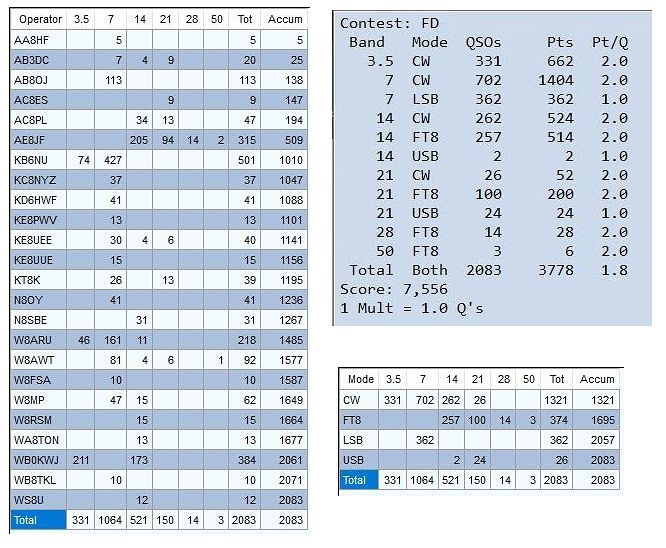
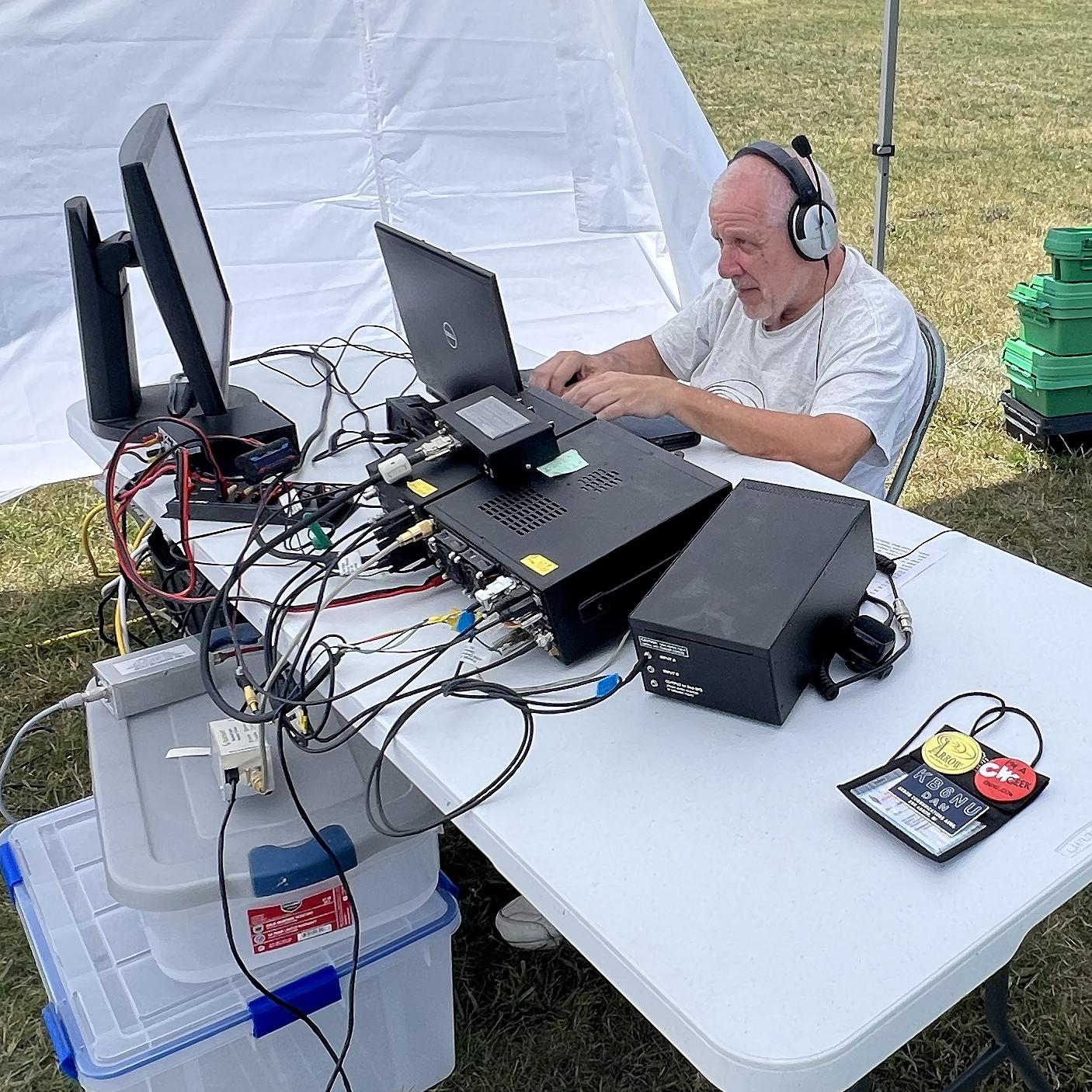
Unlike last year, I  operated with ARROW, our club here in Ann Arbor, MI. I was the main operator of the 40m CW station. We had 866 total QSOs. I made 540, KD8LWR had 197, N8OY made 109, and N8SBE pounded out 19. Here are the top runs as reported by N1MM:

  • 2012-06-23 1806 – 1849Z,    7022 kHz, 51 Qs, 70.5/hr KB6NU
  • 2012-06-23 1903 – 2245Z,    7021 kHz, 214 Qs, 58.1/hr KD8LWR
  • 2012-06-23 2245 – 2311Z,    7021 kHz, 25 Qs, 59.4/hr KD8LWR
  • 2012-06-23 2313 – 0040Z,    7017 kHz, 87 Qs, 60.1/hr KD8LWR
  • 2012-06-24 0051 – 0124Z,    7013 kHz, 37 Qs, 66.5/hr KD8LWR
  • 2012-06-24 0633 – 0655Z,    7023 kHz, 17 Qs, 46.6/hr KB6NU
  • 2012-06-24 0705 – 0909Z,    7035 kHz, 102 Qs, 49.4/hr KB6NU
  • 2012-06-24 0923 – 0938Z,    7023 kHz, 12 Qs, 49.2/hr KB6NU
  • 2012-06-24 0946 – 1033Z,    7036 kHz, 35 Qs, 44.8/hr KB6NU
  • 2012-06-24 1103 – 1211Z,    7030 kHz, 53 Qs, 47.0/hr N8OY

These are the top runs that included more than 10 QSOs.  I don’t know if you can ask it to give you 10-min. or 1-hr. rates, but that would have been interesting to see.

Unfortunately, this station did not operate for about three hours from 11:30pm – 2:30am, when I got back to the FD site. Next year, we’re going to have to find more CW ops and schedule better. It might have been possible to hit 1,000 Qs if it had been operated all 24 hours.

Operating Notes: 6/13/12

Operating notes from the past week:

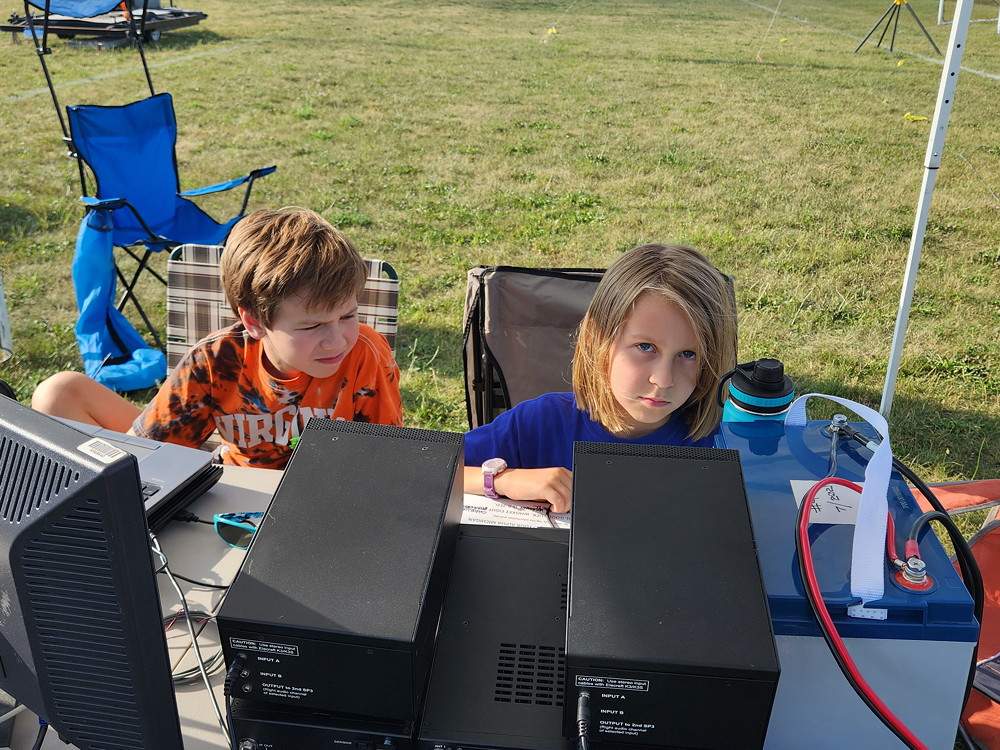
  • I was net control for this week’s ARROW 2m net. This net takes place every Monday night at 8 pm  on the 146.96 repeater. This Monday, we had ten stations check in. One station had two young visitors, who were able to say a few words on the radio. QNI: 13, including yours truly.
  • On Sunday afternoon, I left my HF rig tuned to 28.010 MHz while I played around on the computer upstairs. I turned up the volume so that I could hear it if anyone came on. Twice, I heard DX stations calling CQ. I worked CT1HMN one of those times.
  • DX was pretty good over the weekend. I worked a ZP6 (Paraguay) on 30m and an HK0 (Colombia) on 40m.
  • Sunday night, there was a “numbers station” on 10115.5 kHz. This one was sending random code groups, each consisting of five characters. I hear these stations about every six months.
  • At WA2HOM, our station down at the Ann Arbor Hands-On Museum, I worked EO2012KW, a special event commemorating the European 2012 Football Championship taking place at venues in Poland and the Ukraine.
  • If the Detroit Tigers win the American League pennant, I’ll organize a special event station commemorating their participation in the World Series. I won’t be able to get a cool call with a “2012″ in it, but I could probably get the callsign W8S.

EFC 2012


  • Last night, I worked Jim, W4BKV. When he heard that I lived in Ann Arbor, MI, he volunteered that he used to come up here a lot in the 1970s and 1980s doing consulting work for a company called Sycor. Well, as it happens, I came to Ann Arbor to work for Northern Telecom, the company that purchased Sycor. We had a great chat, nearly an hour long, talking about Sycor and how technology has progressed since then.
  • Ann Arbor is a great town from a QSO prospective. Despite it being a relatively small town, the University of Michigan is here, and lots of hams have either visited here or gone to school here or have heard of the place. So, there’s plenty to talk about.

Extra Class Question of the Day: Amateur satellites

Working the satellites is a very popular amateur radio activity. There’s even an organization dedicated to launching and operating amateur radio satellites – AMSAT (www.amsat.org).

Perhaps the most important thing you need to know when trying to communicate via satellite is where the satellites are. One way to predict the location of a satellite at a given time is by calculations using the Keplerian elements for the specified satellite. (E2A12)

Amateur radio satellites are not in a geostationary orbit. That is to say they are constantly changing position in relationship to a point on the Earth. The type of satellite appears to stay in one position in the sky is geostationary.

When determining where a satellite is, you might want to know its orbital period. The orbital period of an Earth satellite is the time it takes for a satellite to complete one revolution around the Earth.(E2A03)

It’s also important to know the direction in which it is travelling. The direction of an ascending pass for an amateur satellite is from south to north. (E2A01) The direction of a descending pass for an amateur satellite is from north to south. (E2A02)

Next, you need to know what mode the satellite is in. The term mode as applied to an amateur radio satellite means the satellite’s uplink and downlink frequency bands. (E2A04)

We use a combination of letters to denote the mode. The letters in a satellite’s mode designator specify the uplink and downlink frequency ranges. (E2A05) If it were operating in mode U/V, a satellite’s receive signals would be in the 435-438 MHz band. (E2A06) U stands for UHF, V of VHF. With regard to satellite communications, the terms L band and S band specify the 23 centimeter and 13 centimeter bands. (E2A09)

Satellites repeat signals using transponders. Transponders are similar to repeaters, except that they receive signals across a band of frequencies and repeat them across another band of frequencies. The most common type of transponder is the linear transponder. All of these choices are correct when talking about the types of signals can be relayed through a linear transponder (E2A07):

  • FM and CW
  • SSB and SSTV
  • PSK and Packet

One thing to keep in mind is to keep your transmitter power to the minimum needed to hit the satellite. Effective radiated power to a satellite which uses a linear transponder should be limited to avoid reducing the downlink power to all other users. (E2A08)

There are quite a few interesting phenomena that result from the fact that satellites rotate while they are orbiting. One reason the received signal from an amateur satellite may exhibit a rapidly repeating fading effect is because the satellite is spinning. (E2A10) To mitigate the effects of this of fading, you might use a circularly polarized antenna. A circularly polarized antenna is the type of antenna that can be used to minimize the effects of spin modulation and Faraday rotation. (E2A11)

From the ARRL Letter – 5/31/12

Two items in today’s ARRL Letter caught my eye:

FCC News: FCC Expands Part 95 MedRadio Rules to Allow Devices in 2360-2400 MHz Band. In a First Report and Order and a Further Notice of Proposed Rulemaking (ET 08-59) released on May 24, the FCC decided to expand the Part 95 Personal Radio Service rules to allow medical devices to operate on a secondary basis in the 2360-2400 MHz band. These devices — called Medical Body Area Networks (MBAN) — provide a way for health care facilities to monitor their patients via wireless networks. Because use of these frequencies will be on a secondary basis, MBAN stations will not be allowed to cause interference to — and must accept interference from — primary services, including radio amateurs who operate on a primary basis in the 2390-2395 MHz and 2395-2400 MHz bands. Read more.

MARS: House Armed Services Committee “Urges” MARS Coordination. On May 18, the US House of Representatives approved HR 4310, The National Defense Authorization Act for Fiscal Year 2013. This bill authorizes appropriations for military activities and prescribes military personnel strengths for Fiscal Year 2013. When the House Armed Services Committee sent the bill to the House, it included language in support of the Military Auxiliary Radio System (MARS) and called for the three MARS branches — Army, Air Force and Navy/Marine Corps — to be brought under one umbrella. Read more.

I don’t have much to say about the MARS item, except to say that I’m surprised that Congress would have much to say about it. I’m a little more concerned about the Part 95 decision, but what can I say? Amateurs are not really using that spectrum, for the most part, and until we do, encroachment is inevitable.

Ham Radio in the News – 5/30/12

China/PhillipinesHam radio pulled into territorial dispute. China is using amateur radio to claim sovereignty of Scarborough Reef. The Chinese say that in 1990 a German ham was told  by the Philippine ambassador that the reef was not within Philippine territory.

Amateur radio essential tool. Behind the scenes at every Drivesouth Rally of Otago a team of local amateur radio enthusiasts works tirelessly to keep track of every car. Their support is vital to the three-day event, which started last night, as there is either unreliable or no cellphone reception where many of rally’s stages are held.

W6G Salutes Golden Gate Anniversary. The San Francisco Amateur Radio Club helped mark the 75th anniversary of the opening of the Golden Gate Bridge by contacting other amateur radio operators this Memorial Day weekend.

From my Twitter stream – 5/27/12

10 Ways to Destroy an Arduino : Application Note ANCP01 http://t.co/Of1XM8g4 Good to know. o_O


G7IGB
Great vintage RSGB video – How to become a radio amateur http://t.co/NKydLm4I via@youtube #hamr #hamradio #rsgb

??????????? ??????????? ???: ??????????? ??????????? ??? ??????!! ?????… http://t.co/wdpY1omR#YoutubeHam3 #Hamrjp
Nuts. I lost the Japaneses characters in the last item above. Apparently, it is  two friends talking about amateur radio in Japan. I don’t understand Japanese at all, but you can tell that they are having a lot of fun doing this video.

21 Things to Do: Get on the air

Once you’ve acquired a radio, the next step is to get on the air. You’re now an amateur radio operator, not an amateur radio listener.

If your first radio is a VHF transceiver, the first thing to do is to find the repeaters in your area.  One way to do this is to use the K1IW Amateur Repeater and Broadcast Transmitters Database (http://rptr.amateur-radio.net/). Simply fill in the form, and it will give you a list of repeaters near you. When I asked for 2m repeaters within 10 miles of Ann Arbor, MI, I got the following list:

Location Frequency PL (Hz) Callsign Sponsor
Ann Arbor, MI 145.23 100.0 W8UM U of M ARC
Ann Arbor, MI 146.96 100.0 W8PGW ARROW ARC
Ypsilanti, MI 146.92 100.0 K8RUR I-94 ARC

What this chart is telling me is that to communicate with other amateur radio operators using the W8UM repeater, I need to set the frequency of my transceiver to 145.23 MHz and enable the CTCSS tone and set that frequency to 100.0 Hz.

Once you’ve set your transceiver up properly, you should first listen to see if other amateurs are currently using the repeater. If no one is using the repeater, you can try to start a contact with someone, by simply saying your callsign followed by “listening” or “monitoring.” For example, I would say, “KB6NU listening.” If another amateur radio operator is listening, and wants to talk to me, he or she will replay with his or her callsign, and then we’ll start our contact.

If there are already operators using the repeater, listen to their conversation, noting how long they speak before letting the other operator take a turn, how often they identify, and even what they are talking about. If you don’t think that they would mind if you joined their conversation, say your callsign immediately after one of them has stopped transmitting. They’ll break for you and let you join the conversation.

It really is just that easy. Most hams are welcoming and great people to talk to. By getting on the air frequently, you’ll get to know a lot of great people and have many interesting conversations. Sure, you’ll run into the occasional grouch, but don’t let them ruin your enjoyment of amateur radio.

Operating on the shortwave, of HF, bands is a little different than operating on the VHF bands. A complete description of those differences is beyond the scope of this book, but you’ll find a lot of good information in the The ARRL Operating Manual for Radio Amateurs (see below).

The basic principles apply, though. Listen first to see if there are other amateur radio operators on the air that you can contact, and if not, give out a call inviting other operators to contact you. Then, once you have established contact, have an interesting contact with the other radio amateur.

Over the years, I’ve met many amateurs who studied hard to get their license, but then didn’t get on the air for months, or even years. Don’t let that happen to you. Amateur radio is a contact sport. Get a radio and get on the air!

Resources