Connect with ARRL and Amateur Radio via Social Media?

This from the latest ARRL Letter. Do any of you follow the ARRL on Facebook, YouTube, or Twitter?  What do you get out of it?

ARRL participates on many of the popular social networking sites to share news, photos, events and videos. Check out these sites for communities of ARRL members who share your interests in Amateur Radio. We’ll share everything with you — and you can share with us, too!

Find Us on Facebook

  • www.facebook.com/ARRL.org — With almost 20,000 fans, the ARRL’s Facebook page is the largest Amateur Radio site in social media.
  • www.facebook.com/LogbookOfTheWorld — A nifty way to follow the latest LoTW news. LoTW is an exciting way for radio amateurs to confirm two-way contacts they have made and use the confirmations as credit toward various ARRL awards.

Follow Us on Twitter

  • arrl — Find all of the latest information in the Amateur Radio community with this Amateur Radio newsfeed.
  • ARRL_EMCOMM — Interested in Emergency Communications? Then be sure to follow all the latest EmComm and ARES® happenings.
  • ARRL_PR – Geared toward the ARRL Public Information Coordinators and Pubic Information Officers in the League’s Field Organization, this Twitter feed focuses on public relations and media issues involving Amateur Radio.
  • ARRL_DXCC — The Twitter home of the ARRL’s DXCC awards program.
  • ARRL_Youth — For the young and young-at-heart, this Twitter feed delves into how youth can have fun with Amateur Radio.

Watch Us on YouTube

  • www.youtube.com/ARRLHQ — Catch the latest videos from the ARRL – including monthly Product Reviews and event highlights — on the League’s YouTube channel.

Listen to Us on iTunes

  • www.arrl.org/arrlletter/audio/aan.rss — Listen and download the latest ARRL news, uploaded as a podcast to iTunes. Click here for instructions on how to subscribe to this weekly feature.

Yet Another Silly Post Calling Ham Radio an “Obsolete” Technology

Ars Technica has posted yet another silly article, “Dead media walking? ‘Obsolete’ communications systems live on,” declaring amateur radio to be an outdated technology. Fortunately, many hams, like myself, have commented on the article to set the record straight. One comment that I liked was from someone using the name cream wobbly:

I like the way you completely gloss over the rise of Internet-like technologies over the amateur radio bands, packet radio being at the inception of this; and any other developments that have arisen from amateur radio, such as SDR, the basis of the Joint Tactical Radio System. Others have commented on the disaster preparedness of radio amateurs, too. If this were /. you’d've been instructed to hand in your geek card, Mr. Lasar. Sheesh.

I’d encourage everyone who reads this to head on over there and add a comment of your own.

Ham Radio in the News

One of the ways I gather information for this blog is Google Alerts. It sends me an e-mail every day with references to stories or web pages that have ham radio content. This includes newspaper stories that have found their way into online editions of the newspaper.

I’ve been slightly surprised by the number of articles. Every day, there seems to be one or two. Here are two that showed up today, for example:

  • Ham radio hangs on. This story from the Christian Science Monitor captures some of the essence of ham radio, including the do-it-yourself nature of our hobby and the camaraderie of our hobby.
  • Young ‘ham’ finds words are golden in radio contest. This story describes the efforts of 16-year old Matthew E. Morrison of Landisburg, who won several thousand dollars worth of amateur radio equipment from a radio club as a prize for an essay he wrote. He’s already licensed, but the story fails to give his callsign.

These are just two examples, and there are many more. If you all are interested, I’ll post links from time to time.

From Our Director

Jim Weaver, K8JE, regularly sends out an e-mail to ARRL members in the Great Lakes Division (MI, OH, KY).  Here are a few nuggets from the latest one:

+++ Homebrew Challenge Issued +++
The art of homebrewing amateur equipment is not dead. To help keep it strong, ARRL sponsors homebrewing contests annually. The following information relates to the 2011 contest.

“The ARRL has sponsored two Homebrew Challenges in the past, designed to test our members’ design and construction skills by making useful amateur gear at low cost — and sharing their results with our members. Our first ARRL Homebrew Challenge, announced in QST for August 2006, required the construction of a 40 meter, 5 W voice and CW transceiver built for less than $50 of new parts. The Second Homebrew Challenge, announced in February 2009, resulted in a number of creative designs of low cost 50 W linear amplifiers to follow the transceiver — two for about $30, as well as a multiband amplifier with many features for somewhat more.

“For 2011, the ARRL has issued a challenge to build a transceiver in celebration of the (slow) return of sunspots. This challenge will be in two parts and hams can enter either or both options:

“Option 1: A single band 25 W SSB and CW transceiver for 10 or 6 meters, with a prize of $200. Option 2: A 25 W SSB and CW transceiver that can be switched between 10 and 6 meters, using one or two switches, with a prize of $300.

“Instead of challenging entrants to make the transceiver at the lowest cost, the ARRL will instead challenge builders to provide the highest quality, best performance and most features within the cost target of $150 for Option 1 and $200 for Option 2. In addition to the cash prize, the winners of these challenges will have articles describing their designs in QST and will receive the usual page rate for the published articles. Additional entrants who meet the minimum requirements — and have interesting design features — may also be considered for QST or ARRL Web articles.

“Entries for either option must be received at ARRL Headquarters no later than November 1, 2011. To be considered, each entrant must submit a working transceiver that is suitable for testing in the ARRL Lab and for on-the-air judging by the ARRL staff judges. Documentation required includes a priced parts list indicating the source and purchase price of each part, an article draft including a design description, construction hints, alignment instruction, block diagrams and schematic diagrams. Photographs may be provided, but final magazine photos will be taken by ARRL staff.

“For more information, including specific requirements and evaluation criteria, please visit the ARRL Homebrew Challenge web page.”

+++ Amateur Radio Comic Books Available +++
Writing in The Ham Radio Promoter, Dee Logan, W1HEO, reminds that several Amateur Radio comic books are available for use with youngsters. These are available online from ICOM. The comics may be read online, downloaded and printed, or copies may be requested from ICOM.

By the way, the Ham Radio Project newsletters are available online and contain some good information on promoting ham radio in general……Dan

+++ The Status of HR 607 +++
HR 607 is titled the Broadband for First Responders bill. Unfortunately, one of the bill’s clauses would take the amateur 420-440 MHz frequencies in achieving its otherwise excellent objective.

Upon being introduced into the House, the bill was referred to the House Energy and Commerce Committee. To date, the subcommittee has taken no action. In addition, in a meeting with a group of amateur constituents the bill’s sponsor, Rep. Peter King of New York, has stated he no longer favors taking the amateur frequencies. Finally, alternative bills having the same objective as HR 607, but that do not involve amateur frequencies, have been introduced into the House as well as the US Senate.

Considering the above facts, one can easily speculate that the present threat to 420-440 MHz may be over. Using only the letter generating utility developed by Rick Haltermon, KD4PYR, amateurs are known to have generated over 13,000 letters in opposition to the potential frequency grab. What a great response to the call for action!

As tempting as it is to speculate on victory, it is more important that amateurs keep an eye on HR 607 and other bills that could impact our frequencies. This is precisely what is being done by legislation watchers at ARRL.

For now, it is appropriate to sheathe our pens, but to keep them primed and handy to use if the need arises.

+++ Division Convention Coming +++
September 11, the day of the Great Lakes Division Convention at the Findlay Hamfest will be on us soon. In particular, the time for submitting nominations for Division Awards is approaching rapidly. Nominations must be received by August 1. There are five Award open for nomination. These are:

  • the George S. Wilson III (W4OYI, SK) Lifetime Achievement Award
  • the Amateur of the Year Award
  • the Technical Achievement Award
  • the DX Achievement Award
  • the Young Radio Amateur of the Year Award

Also to be presented is the Joseph J. Phillips (K8QOE, SK) Newsletter Award. This award is selected from the newsletters that have been judged, previously, to be the best in each Section in the Division.

For additional information about the awards and how to nominate people for them, please go to the Great Lakes Division web site and click on the AWARDS icon at the left of the opening screen. Nominations may be made as hard copy or using the online form on the web site.

The Great Lakes Division Convention is being held on the grounds of the Findlay Hamfest. Admission to the hamfest provides admission to the convention. An interesting series of forums will begin at 9 AM. The convention will end with presentation of the awards at an informal luncheon near the hamfest grounds.

Last Saturday on the Radio at KB6NU

I had a busy ham radio Saturday here at KB6NU. It started early Saturday morning as I headed out to the Ann Arbor Mini-Maker Faire. It’s a small, locally-organized version of Make: magazine’s Maker Faires that take place in San Francisco, CA and Austin, TX.

This year’s exhibits included:

  • Learn to Solder
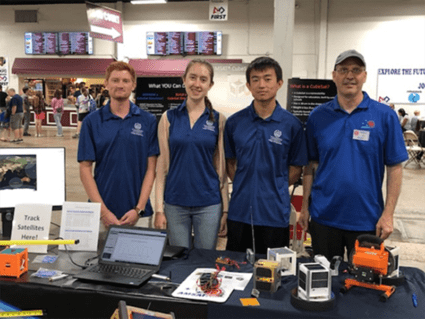
  • DIY Satellites
  • See neural electrical activity
  • Silkscreen what you’re wearing
  • Electric Allis-Chalmers Tractor
  • Marshall Stack Touchscreen Jukebox
  • Hands-on activities from the Ann Arbor Hands-On Museum
  • Amateur Radio
  • Sustainable Technology
  • Pedal Power Pavilion
  • Return of the Giant Vortex Cannon
  • Electric Scooters
  • Robots
  • Paper folding and pop-up books

Basically, it’s a bunch of geeks showing off the geeky things they’re working on and demonstrating the geeky things that they like to do.

I organized the amateur radio exhibit, which, like last year, consisted of me getting people to send their names in Morse Code, and Dave, N8SBE, demonstrating the capabilities of his Elecraft K3. Dave’s K3 was really the hit of the show, with its panadapter and digital modes display.

kb6nu-at-mini-maker-faire-2011

KB6NU trying to get yet another person to send their name in Morse Code at the 2011 Ann Arbor Mini Maker Faire. It was pretty hot in the shed we were in, and right about this time, I was ready for a nap.Photo: Roger Rayle

This being a geeky kind of event, I was quite successful at getting people to send their names in Morse Code. After showing them how to use the touch keyer that I’d brought, a lot of them really got into it. I even managed to amaze a few of them, when after they’d sent their name, I was able to say, “Well, nice to meet you Sally or Joe or whatever name it was they’d sent.”

All in all, there was quite a bit of interest in our display, amongst both kids and adults. We had one girl, for example, who I’m guessing was about 11 or 12, come by several times, looking at everything we had with intense interest. One time, she even dragged her parents along with her.

After all was said and done, I ended up passing out quite a few brochures and handing out quite a few business cards. As far as PR goes, it was a very successful event.

You can see more of Roger Rayle’s photos of the event here.

More Stations Whose Callsigns Spell Words
After the Faire, I went out to dinner with my wife and in-laws, but later that evening, I got back on the radio. I tuned around for the AL QSO Party, and only made about a dozen contacts, but two of them—W4HOD and W4CUE—are stations whose callsigns spell words. Both are club stations, too. My cards are in the mail, and I’m hoping to get their replies soon.

From the Mailbag

Here are some items of interest that have been discussed on the many ham radio mailing lists I’m on.

  • KISS-SSBKISS-SSB. The KISS-SSB is a counterpoise designed to be used with a marine SSB transceiver. It’s a nice compact design that claims to operate from 2-30 MHz, when used with an automatic antenna tuner. Basically, it’s a ten-ft. long tube stuffed with bunch of radials. At $145, this seems a bit expensive, but this device, or a homebrew version of it, might be just the ticket for someone operating stealthily.
  • Field Day PR. The June issue of Contact! is loaded with new ideas, links and materials you can use for Field Day.
  • SWR Video. This awesome video from the AT&T archives looks like it was produced in 1959, and explains wave behavior using a mechanical machine. As the presenter, Dr. J. N. Shive, points out, though, electrical waves behave just like mechanical waves. Shive is really having fun presenting this topic. So much so, that it makes me wish I’d had him for my physics professor back at the University of Detroit!
  • Elecraft K3. Wayne Burdick, N6KR, of Elecraft shows the new Elecraft KX3 at the QRP ARCI ‘Four Days In May’at Dayton this year.

I was also going to post a couple of links to YouTube videos showing the sewer line explosion at Hara Arena during the recent Dayton Hamvention, but there’s a little too much profanity in them. If you really want to see them, go to YouTube, search for “2011 Dayton Hamvention,” and you’ll find them. It’s really amazing, and yet another reason that the Dayton Amateur Radio Association should move the Hamvention from Hara. It’s just a terrible facility, and it’s undoubtedly dissuaded many from ever returning to the Hamvention.

Ham Radio Show to be Broadcast on twit.tv

TWITThis Week In Technology announces the launch of “HAM Nation,” a weekly HD video webcast about ham radio featuring interesting guests. Hosted by Bob Heil, K9EID, the show will cover many fascinating aspects of amateur radio each week.

The webcast will be broadcast on Tuesday evenings at 8:00 pm CDT (Central) starting May 24. The first episode will have special guests Joe Walsh, WB6ACU and Dave Jennings,  WJ6W.

Presumably, you can view the webcast by going to twit.tv. twit.tv is also available on Roku, if you have a Roku box.  I do, and will see if I can stream it there.  I think this could be a very cool thing for ham radio.

NPR: Ham Radio Volunteers Worry About Spectrum Plan

This evening, NPR aired a spot titled, “Ham Radio Volunteers Worry About Spectrum Plan,” on the HR607 controversy. There’s both the audio that was broadcast and a transcript.

The spot starts,

Across Alabama, emergency communications systems fell silent this week when tornadoes knocked down antennas and cell phone towers. Amateur radio operators are helping to restore emergency communication in some of the areas hardest hit by the storms. But those volunteers say their ability to provide that help is threatened by a new bill in Congress.

Click over to NPR and listen.

Want to Know What the Media Think About Ham Radio?

If you’re interested in how the media views ham radio these days, then go to the ARRL’s Media Hits page. On this page, Allen, W1AGP, the ARRL Media & Public Relations Manager, is collecting information about media coverage of amateur radio, and where appropriate, links to the coverage. There are many more media hits on this page than there is space for in the Media Hits column in QST.

Drumming Up Interest in Ham Radio

This morning, I got a e-mail from a ham who says:

At our meeting last week, we decided to investigate an attempt to do something similar to your one-day licensing class. Being a bunch of careful planners, we have come to the conclusion that, rather than jumping right in, we should try to drum up some local interest in amateur radio by educating the public. Beyond the idea of an article or two in the local newspaper, we have no further ideas.

I replied:

  1. Why wait? Even if you only get one or two people to sign up for the class, it will be worth the effort, and having only a few people in the class will help you work the bugs out.
  2. Give a talk on amateur radio to as many community groups as you can find including public library, Boy Scouts, Girl Scouts, middle schools, high schools, senior groups, government emergency management folks, Rotary Club, Kiwanis Club, university groups (engineering school?), Chamber of Commerce, etc.
  3. Set up a special event station at the local mall, library, state park, science museum, etc. Work that station all day. Pass out flyers. When you do this, set up a code oscillator and key and teach people how to send their names in Morse Code. Kids, especially, love this.
  4. If no one in your club is an ARRL Public Information Officer (http://www.arrl.org/public-information-officer), twist a few arms until someone “volunteers.” Being a registered PIO has several advantages, including being able to get ARRL brochures for just the cost of shipping.

Well, that’s all I could think of off the top of my head. Please help us out here and tell us what’s worked for your club.  Thanks!