If a J-Pole Antenna is Good for 2m, Would it be 3X as Good for 6m?

Nick, KD8IPE, one of the guys in my latest Tech class got interested in working 6m and asked me about 6m antenna. Well, having never worked 6m, I didn’t have a very good answer for him. Then, I thought about the J-pole antenna. I have built many 2m J-poles. They’re simple to build, and using my favorite set of plans, the SWR in the repeater portion of the band has always been 1.5:1 or less. So, I suggested he build a 6m J-pole.

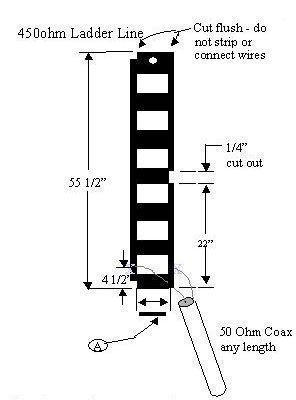
Nick then turned the tables on me and suggested that we each build one. Then, he reasoned, he’d at least have someone to talk to. I took him up on that, and last night, we built one using plans developed by DK7ZB. This antenna differs from the 2m J-pole in a couple of ways. First, the radiator is made from antenna wire, not the 450-ohm ladder line, as in the 2m J-pole.

Second, the feed point seems to be at a different point. In the first set of plans, the feed point is approximately 20% up from the shorted end of the matching stub. In DK7ZB’s plans, the feedpoint is 5-10% from the shorted end. Since I’d had such good success with the first set of plans, we decided to go with the 20% figure and placed the feedpoint about 13.5-in. from the shorted end.

Third, the DK7ZB design uses a choke balun at the feedpoint. You rarely see this on 2m J-poles, although this is debated now and then.

After some discussion about whether to solder the coax directly to the ladder line or to install an SO-239 (we opted for the SO-239), we soldered it all together and then took it outside to hang it from a tree branch. We ran the coax inside and then hooked it up to my Icom IC-746PRO. I don’t have an SWR meter for 6m, but the 746PRO’s internal antenna tuner was able to find a match, so the SWR mustn’t be too bad.

Of course, 6m didn’t appear to be open at the time, so we didn’t work anyone. Heck, we didn’t even hear anyone or any of the beacons. Even so, it’s kind of cool to be able to say that I’m now capable of working 6m.

I do have some questions, though:

  • What’s up with the feedpoint? Why do the two designs differ as to where to place the feed point? I wish I had an antenna analyzer to make some measurements.
  • Is the balun necessary and/or useful? Does using a balun affect the feedpoint placement?
  • Does polarization matter? I’d guess if I were trying to operate a 6m FM repeater it would, but that it wouldn’t matter so much when working CW or SSB DX.

Solar Flares Cause GPS Failures, Cornell Researchers Warn

From the NARTE News, Winter 2007:

Cornell researchers have discovered that strong solar flares cause Global Positioning System (GPS) receivers to fail. Because solar flares are generally unpredictable, such failures could be devastating for “safety-of-life” GPS operations such as navigating passenger jets, stabilizing floating oil rigs and locating mobile phone distress calls.

“If you’re driving to the beach using your car’s navigation system, you’ll be OK. If you’re on a commercial airplane in zero visibility weather, maybe not,” says Paul Kintner Jr., professor of electrical and computer engineering at Cornell and head of Cornell’s GPS Laboratory.

Alessandro Cerruti, a graduate student working for Kintner, accidentally discovered the effect on while operating a GPS receiver at Arecibo Observatory in Puerto Rico, one of six Cornell Scintillation Monitor (SCINTMON) receivers. Cerruti was investigating irregularities in the plasma of the Earth’s ionosphere—a phenomenon unrelated to solar flares—when the flare occurred, causing the receiver’s signal to drop significantly.

To be sure of the effect, Cerruti obtained data from other receivers operated by the Federal Aviation Administration (FAA) and the Brazilian Air Force. He found that all the receivers had suffered exactly the same degradation at the exact time of the flare regardless of the manufacturer. Furthermore, all receivers on the sunlit side of the Earth had been affected.

The flare consisted of two events about 40 minutes apart. The first lasted 70 seconds and caused a 40% signal drop. The second lasted 15 minutes and caused a 50% drop. But this flare was moderate and short-lived; in 2011 and 2012, during the next solar maximum, flares are expected to be 10 times as intense and last much longer, causing signal drops of over 90% for several hours.

“Soon the FAA will require that every plane have a GPS receiver transmitting its position to air traffic controllers on the ground,” warns Cerruti. “But suppose one day you are on an aircraft and a solar radio burst occurs. There’s an outage, and the GPS receiver cannot produce a location. It’s a nightmare situation. But now that we know the burst’s severity, we might be able to mitigate the problem.”

The only solutions, suggests Kintner, are to equip receivers with weak signal-tracking algorithms or to increase the signal power from the satellites. Unfortunately, the former requires additional compromises to receiver design, and the latter requires a new satellite design that neither exists nor is planned.

“I think the best remedy is to be aware of the problem and operate GPS systems with the knowledge that they may fail during a solar flare,” says Kintner.

The team was initially confused as to why the flare had caused the signal loss. Then Kintner recalled that solar flares are accompanied by solar radio bursts. Because the bursts occur over the same frequency bands at which GPS satellites transmit, receivers can become confused, leading to a loss of signal. Had the solar flare occurred at night in Puerto Rico or had Cerruti been operating SCINTMON only at night, he would not have made the discovery.

“We normally do observations only in the tropics and only at night because that’s where and when the most intense ionospheric irregularities occur,” says Kintner. However, since no one had done it before, Cerruti was looking at “mid-latitudes” (between the tropics and the poles), where weaker irregularities can occur both night and day. As a result, SCINTMON detected the solar flare.

Cerruti reported the findings on September 28 at the Institute of Navigation Meeting in Fort Worth, Texas, where he received the best student paper prize. The full results of the discovery will be published in a forthcoming issue of Space Weather. O t h e r authors of the paper include D.E. Gary and L.J. Lanzerotti of the New Jersey Institute of Technology, E.R. de Paula of the Instituto Nacional de Pesquisas Espaciais and Cornell research associate Hien Vo.

Finding Repeaters

On the HamRadioHelpGroup mailling list, there is a thread about finding repeaters. Someone asked how to find repeaters in an area without carrying around an ARRL Repeater Guide. While I think that carrying around the ARRL Guide is probably the best solution, there were several other good ones, including:

Have fun!

Get on the repeater!

As previously reported, I just bought an IC-207 dual-band rig. It’s a great rig, but for the first two days I didn’t make a single contact on the local repeater. I was not, of course, monitoring the whole time, but you’d think I could raise someone on a Friday or Saturday night. Maybe not, though. I guess the other hams in the area have a life. :)

I did finally manage a contact Saturday night with a fellow who was on his way to Detroit. We had a nice chat, and I found out that he’s a local guy who’d just gotten his license in June. The interesting thing is that despite living in Ann Arbor for the last four years (as a University of Michigan student), he was not familiar with our club, nor of the fact that we owned and operated the repeater we were using.

Of course, I took the opportunity to invite him to our meeting this Wednesday (for more details, see our website), and I think there’s a good chance he’ll show up. I had a similar experience last month. On my way to the club meeting, I had a QSO with a fellow ham, and I mentioned that I was on the way to the meeting, we’d love to have him attend, too. He replied that he’d been meaning to come to a meeting and join, but for one reason or another, just never got around to it. I pressed the point, and he actually did show up. In fact, he brought his checkbook along and paid his dues as well.

My point is that one of the best ways to promote your club is to monitor your local repeater and talk up your club and its activities at every opportunity. Invite people to attend your meetings. Invite them to check in to your nets. If you don’t have a net, start one. If you do some of these things, I think you’ll be pleasantly surprised at the results.