
• Skip to primary navigation
  • Skip to main content
  • Skip to primary sidebar
  • Skip to footer

KB6NU's Ham Radio Blog

KB6NU's Ham Radio Blog
  • HOME
  • Study Guides
  • Teach a One-Day Tech Class
  • W8SRC Repeater Guide
  • Advertise
  • Hire Me

2015 General Class study guide: Section G8A – Carriers and modulation: AM; FM, single and double sideband, modulation envelope, overmodulation

January 28, 2015 By Dan KB6NU Leave a Comment

Several questions were changed in this section. One AM question was deleted and two FM questions were deleted. There was only a net loss of one question, though. Questions about the modulation envelope (G8A11) and frequency-shift keying (G8A01) were added.

Modulation is the process by which we convey information over a radio link, and amplitude modulation is perhaps the most basic type of modulation. When we amplitude modulate a signal, what we’re doing is varying the amplitude of what we call the RF carrier signal in proportion to the amplitude of an audio signal.

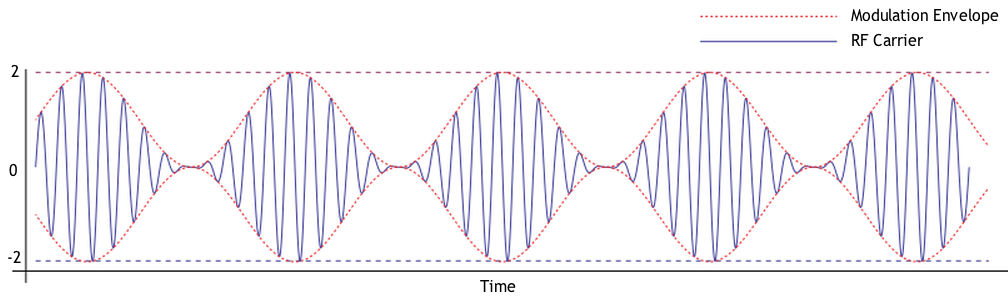
Amplitude modulation is, therefore, the type of modulation that varies the instantaneous power level of the RF signal. (G8A05) The modulation envelope of an AM signal is the waveform created by connecting the peak values of the modulated signal. (G8A11) Figure 1 shows an amplitude modulated signal and the modulation envelope.
amplitude-modulation
Figure 1. An amplitude modulated signal.


Single sideband, or SSB, is a type of amplitude modulation (AM). A conventional AM signal has three components, the carrier and two sidebands. Since the carrier signal carries no information and the information in both sidebands is the same, someone figured out that by eliminating the carrier and one of the sidebands you could still transfer the same amount of information.

Not only that, SSB voice communications has a couple of advantages of AM voice communications. One advantage of carrier suppression in a single-sideband phone transmission is that the available transmitter power can be used more effectively. (G8A06) The reason for this is that you’re putting all of the output power into the single sideband and not wasting it for the carrier and extraneous sideband.

Another advantage is that the phone emission that uses the narrowest frequency bandwidth is single sideband. (G8A07) An AM signal requires a bandwidth of 6 kHz or more; a single sideband signal takes up a bandwidth of only 3 kHz.

You must be careful when setting the audio level used to modulate a phone signal, no matter if it’s AM or SSB. If you set the level too high, the signal will be over-modulated, and this may cause “flat-topping.” Flat-topping of a single-sideband phone transmission is signal distortion caused by excessive drive. (G8A10) Another effect of over-modulation is excessive bandwidth (G8A08).

To set the appropriate audio level, you adjust the microphone gain control while watching the radio’s ALC meter. The transmit audio or microphone gain control is typically adjusted for proper ALC setting on an amateur single sideband transceiver. (G8A09)

Another type of modulation that we use in amateur radio is frequency modulation, or FM. Most VHF and UHF repeaters use frequency modulation. Frequency modulation is the name of the process which changes the frequency of an RF wave to convey information. (G8A03) In an FM signal, the carrier frequency changes proportionally to the instantaneous amplitude of the modulating signal.

Another way to produce a frequency-modulated signal is to use phase modulation. Phase modulation is the name of the process that changes the phase angle of an RF wave to convey information. (G8A02) Phase modulation is produced by a reactance modulator connected to an RF power amplifier. (G8A04)

Some modes, such as radio teletype (RTTY) use a modulation method called frequency-shift keying, or FSK. An FSK signal is generated by changing an oscillator’s frequency directly with a digital control signal. (G8A01)

Related posts:

  1. 2016 Extra Class study guide: E7E – modulation and demodulation
  2. 2014 Tech study guide: modulation modes, signal bandwidth
  3. Extra Class question of the day: modulation methods; modulation index and deviation ratio; pulse modulation; frequency and time division multiplexing
  4. 2015 General Class study guide: Section G4D – Speech processors, S meters, sideband operation near band edges

Filed Under: Classes/Testing/Licensing Tagged With: AM, amplitude modulation, FM, frequency modulation, FSK

Reader Interactions

Leave a Reply Cancel reply

Your email address will not be published. Required fields are marked *

This site uses Akismet to reduce spam. Learn how your comment data is processed.

Primary Sidebar

No Nonsense Technician Class License Study Guide (for tests given between July 2026 and June 2030)

New No Nonsense Technican Class Study Guide now available!

The 2026 version of my Tech Class study guide is now available, and as always, the PDF version is FREE!. The ePub version costs $11.97, and a Kindle version and paperback version will be available on Amazon shortly.

Click here to get all of my "No Nonsense" study guides.

Also available: The CW Geek's Guide to Having Fun with Morse Code

W5SWL.Com
Retevis Ailunce H1 DMR Radio
DXpander: Cobweb antennas, Laser Cutting

You’ve got mail!

Enter your email address below and get an email every time I publish a new post.

Email


I frequently teach classes to help newcomers get their licenses. The next class will take place on Saturday, February 7, 2026 on the University of Michigan campus. Click here for more information.

If you can't make the class, subscribe to the mailing list to be notified of when the next class will be held.

You can always download my free study guide, and if you have any questions about the classes, or amateur radio in general, please feel free to email me directly.

Support KB6NU.Com

Donate $7.30 and get two of these cool stickers. Measuring 4.25-in. W by 2.75-in. H, it's perfect for your car, your shack, or wherever!

Contact me

If you have a question or comment about one of my blog posts, or a question about any of the material in my study guides, or just a question about ham radio in general, you can email me at [email protected].

Blogs You Should Also Read

  • AE5X: A CW-centric blog from Kingswood, Texas
  • K0LWC Blog
  • LA3ZA Ham Radio Blog
  • Little Radios, Big Fun – WB3GCK
  • Mr. Vacuum Tube's Blog
  • Radio Artisan – K3NG
  • The K0NR Weblog
  • VE3WDM's QRP Ham Radio Blog
  • W2LJ’s Blog

Ham Radio Websites

  • Dashtoons – The Hammin' Comedy by Jeff K1NSS

Podcasts

  • ICQ Podcast
  • Linux in the Ham Schack
  • No Nonsense Amateur Radio Podcast
  • Resonant Frequency Amateur Radio Podcast

Recent Comments

  • Dan KB6NU on Finally, a Loop for 10m.
  • Dan KB6NU on 1930s cards for my collection of QSLs from stations whose callsigns spell words
  • Sean on Finally, a Loop for 10m.
  • Bill Waslo on 1930s cards for my collection of QSLs from stations whose callsigns spell words
  • C M Wetzel KD8TNF on The Wesco BN-1

Meta

  • Log in
  • Entries feed
  • Comments feed
  • WordPress.org

Footer

Copyright © 2026 Daniel M. Romanchik, KB6NU · Log in