• Skip to primary navigation
  • Skip to main content
  • Skip to primary sidebar
  • Skip to footer

KB6NU's Ham Radio Blog

KB6NU's Ham Radio Blog
  • HOME
  • Study Guides
  • Teach a One-Day Tech Class
  • W8SRC Repeater Guide
  • Advertise
  • Hire Me
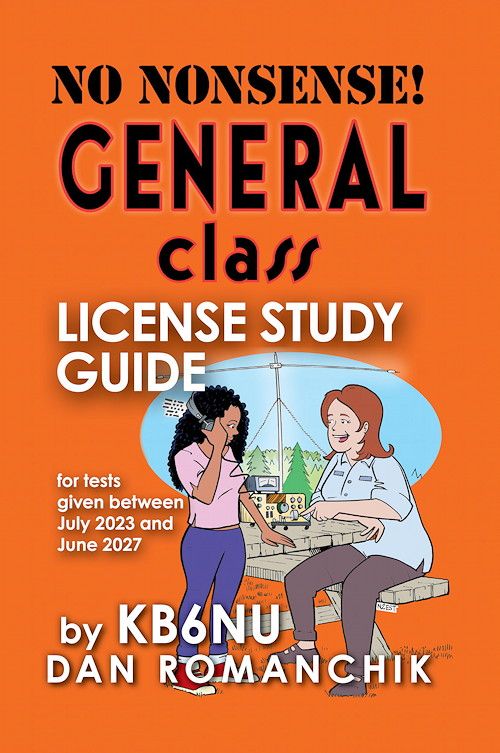
The No-Nonsense General-Class License Study Guide (for tests given between July 2023 and June 2027) - PDF version

The No-Nonsense General-Class License Study Guide (for tests given between July 2023 and June 2027) – PDF version

$9.97

Tags: General Class, study guide
  • Description
  • Reviews (0)

Description

NOTE: This is the PDF version of the study guide. You can read this file with just about any PDF application. This study guide is also available in ePub format.

If you prefer a Kindle version, you can purchase it directly from Amazon. You can also purchase a print version from Amazon.


I’ve been doing these study guides for a long time, and they have helped literally thousands get their licenses and upgrade to General Class and Extra Class. Written in a simple, easy-to-understand style, this study guide covers:

  • Electrical Principles
  • Circuit Components
  • Practical Circuits
  • Signals and Emissions
  • Antennas and Feedlines
  • Radio Wave Propagation
  • Amateur Radio Practices
  • Operating Procedures
  • Electrical and RF Safety
  • Commission’s Rules

Every single question that you’ll find on the test is included in the book. It gives you a short, “no nonsense” explanation of the topic and follows it with the question from the question pool, with the correct answer highlighted. Here’s an example:

The reactance caused by a capacitor depends on the frequency of the AC source. You calculate the reactance caused by a capacitor with the equation XC = 1/(2πfC), where XC is the capacitive reactance in ohms (Ω), f is the frequency of the AC applied to the capacitor in Hertz (Hz), and C is the capacitance in farads. As you can see from the equation, as the frequency of the AC increases, the capacitive reactance decreases.

G5A06
How does a capacitor react to AC?
A. As the frequency of the applied AC increases, the reactance decreases
B. As the frequency of the applied AC increases, the reactance increases
C. As the amplitude of the applied AC increases, the reactance increases
D. As the amplitude of the applied AC increases, the reactance decreases

With this study guide, you really can upgrade to General Class, so why wait?
Reviews

There are no reviews yet.

Be the first to review “The No-Nonsense General-Class License Study Guide (for tests given between July 2023 and June 2027) – PDF version” Cancel reply

Your email address will not be published. Required fields are marked *

This site uses Akismet to reduce spam. Learn how your comment data is processed.

Related products

  • 2024 No Nonsense Extra Class License Study Guide

    2024 No Nonsense Extra Class License Study Guide (PDF)

    $9.97
    Add to cart
  • The No-Nonsense General-Class License Study Guide (for tests given between July 2023 and June 2027) - ePub version

    The No-Nonsense General-Class License Study Guide (for tests given between July 2023 and June 2027) – ePub version

    $9.97
    Add to cart
  • 2024 No Nonsense Extra Class License Study Guide

    2024 No Nonsense Extra Class License Study Guide (ePub)

    $9.97
    Add to cart

Primary Sidebar

No Nonsense Technician Class License Study Guide (for tests given between July 2026 and June 2030)

New No Nonsense Technican Class Study Guide now available!

The 2026 version of my Tech Class study guide is now available, and as always, the PDF version is FREE!. The ePub version costs $9.97, and a Kindle version and paperback version will be available on Amazon shortly.

Click here to get all of my "No Nonsense" study guides.

Also available: The CW Geek's Guide to Having Fun with Morse Code

W5SWL.Com
Retevis Ailunce H1 DMR Radio
DXpander: Cobweb antennas, Laser Cutting

You’ve got mail!

Enter your email address below and get an email every time I publish a new post.

Email


I frequently teach classes to help newcomers get their licenses. The next class will take place on Saturday, February 7, 2026 on the University of Michigan campus. Click here for more information.

If you can't make the class, subscribe to the mailing list to be notified of when the next class will be held.

You can always download my free study guide, and if you have any questions about the classes, or amateur radio in general, please feel free to email me directly.

Support KB6NU.Com

Donate $7.30 and get two of these cool stickers. Measuring 4.25-in. W by 2.75-in. H, it's perfect for your car, your shack, or wherever!

Contact me

If you have a question or comment about one of my blog posts, or a question about any of the material in my study guides, or just a question about ham radio in general, you can email me at [email protected].

Blogs You Should Also Read

  • AE5X: A CW-centric blog from Kingswood, Texas
  • K0LWC Blog
  • LA3ZA Ham Radio Blog
  • Little Radios, Big Fun – WB3GCK
  • Mr. Vacuum Tube's Blog
  • Radio Artisan – K3NG
  • The K0NR Weblog
  • VE3WDM's QRP Ham Radio Blog
  • W2LJ’s Blog

Ham Radio Websites

  • Dashtoons – The Hammin' Comedy by Jeff K1NSS

Podcasts

  • ICQ Podcast
  • Linux in the Ham Schack
  • No Nonsense Amateur Radio Podcast
  • Resonant Frequency Amateur Radio Podcast

Recent Comments

  • Richard A. Golden on Guest Post: ARRL needs new blood
  • Skip K4EAK on Button, button. Who’s got the button?
  • Ed K8MEJ on Is anyone running for the board this year in the Great Lakes Division?
  • Skip Behnke on 2020 Extra Class study guide: E9F – Transmission lines: characteristics of open and shorted feed lines; coax versus open-wire; velocity factor; electrical length; coaxial cable dielectrics
  • Mike on Map your contest QSOs

Meta

  • Log in
  • Entries feed
  • Comments feed
  • WordPress.org

Footer

Copyright © 2026 Daniel M. Romanchik, KB6NU · Log in