
Oscillator circuits are one of the basic building blocks of amateur radio equipment. Oscillator circuits are not only used to generate the signals we transmit, they are also an integral part of receivers, such as the superheterodyne receiver.
You can think of an oscillator as an amplifier with a tuned circuit that provides positive feedback. This tuned circuit might be an LC circuit or a crystal. The values of the components in the tuned circuit determine the output frequency of the oscillator. There are three types of oscillator circuits commonly used in Amateur Radio equipment: Colpitts, Hartley and Pierce. Colpitts and Hartley oscillator circuits are commonly used in VFOs.
QUESTION: What are three oscillator circuits used in amateur radio equipment? (E7H01)
ANSWER: Colpitts, Hartley and Pierce
QUESTION: Which of the following oscillator circuits are commonly used in VFOs? (E7H06)
ANSWER: Colpitts and Hartley
In a Hartley oscillator (shown in the figure below), positive feedback is supplied through a tapped coil.
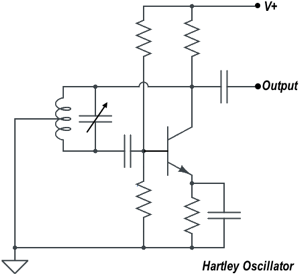
QUESTION: How is positive feedback supplied in a Hartley oscillator? (E7H03)
ANSWER: Through a tapped coil
In a Colpitts oscillator (shown below), positive feedback is supplied through a capacitive divider.
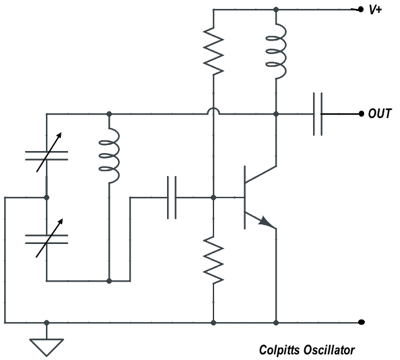
QUESTION: How is positive feedback supplied in a Colpitts oscillator? (E7H04)
ANSWER: Through a capacitive divider
In a Pierce oscillator (shown below), positive feedback is supplied through a quartz crystal. To ensure that a crystal oscillator provides the frequency specified by the crystal manufacturer, you must provide the crystal with a specified parallel capacitance.
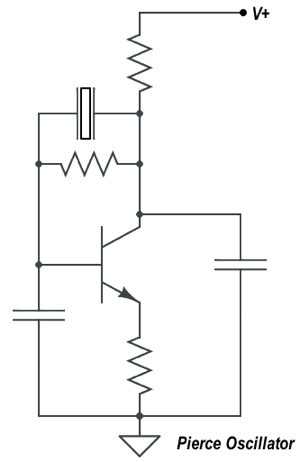
QUESTION: How is positive feedback supplied in a Pierce oscillator? (E7H05)
ANSWER: Through a quartz crystal
QUESTION: Which of the following must be done to ensure that a crystal oscillator provides the frequency specified by the crystal manufacturer? (E7H12)
ANSWER: Provide the crystal with a specified parallel capacitance
One problem that can occur with oscillators that use LC circuits is that their output frequency drifts because as the capacitors heat up their values change and the resonant frequency of the LC circuit changes. This phenomenon is called thermal drift. To prevent this from happening, use NPO capacitors. The capacitance of NPO capacitors changes very little over normal operating temperatures.
QUESTION: Which of the following components can be used to reduce thermal drift in crystal oscillators? (E7H08)
ANSWER: NP0 capacitors
Another problem that oscillators sometimes have is called microphonics. We say that an oscillator has a microphonic problem if the oscillator frequency changes due to mechanical vibration. An oscillator’s microphonic responses can be reduced by mechanically isolating the oscillator from its enclosure.
QUESTION: What is a microphonic? (E7H02)
ANSWER: Changes in oscillator frequency due to mechanical vibration
QUESTION: How can an oscillator’s microphonic responses be reduced? (EH707)
ANSWER: Mechanically isolate the oscillator circuitry from its enclosure
Digital frequency synthesizers
Most modern amateur radio transceivers use digital frequency synthesizers instead of analog oscillators to generate RF signals. One reason for this is that they are much more stable than analog oscillators. The two main types of digital frequency synthesizers are the direct digital synthesizer and the phase-locked loop synthesizer.
A direct digital synthesizer is the type of frequency synthesizer circuit that uses a phase accumulator, lookup table, digital to analog converter and a low-pass anti-alias filter. The information contained in the lookup table of a direct digital frequency synthesizer are the amplitude values that represent a sine-wave output.
QUESTION: What type of frequency synthesizer circuit uses a phase accumulator, lookup table, digital to analog converter, and a low-pass anti-alias filter? (E7H09)
ANSWER: A direct digital synthesizer
QUESTION: What information is contained in the lookup table of a direct digital synthesizer (DDS)? (E7H10)
ANSWER: Amplitude values that represent the desired waveform
Frequency synthesizers that use phase-locked loops are also popular. A phase-locked loop is an electronic servo loop consisting of a phase detector, a low-pass filter, a voltage-controlled oscillator, and a stable reference oscillator. Frequency synthesis, FM demodulation are two functions that can be performed by a phase-locked loop.
QUESTION: What is a phase-locked loop circuit? (E7H14)
ANSWER: An electronic servo loop consisting of a phase detector, a low-pass filter, a voltage-controlled oscillator, and a stable reference oscillator
QUESTION: Which of these functions can be performed by a phase-locked loop? (E7H15)
ANSWER: Frequency synthesis, FM demodulation
Both direct digital synthesizers and phase-locked loop synthesizers have issues with spectral purity. The major spectral impurity components of direct digital synthesizers are spurious signals at discrete frequencies.
QUESTION: What are the major spectral impurity components of direct digital synthesizers? (E7H11)
ANSWER: Spurious signals at discrete frequencies
Because frequency multipliers are often used for generating RF signals at microwave frequencies, it is very important that the oscillators used in microwave transmitters are highly accurate and stable. Any inaccuracy or instability will be multiplied along with the desired frequency. To achieve high accurate and stability, oscillators used for microwave transmission and reception, can use a GPS signal reference, a rubidium stabilized reference oscillator, or a temperature-controlled high Q dielectric resonator.
QUESTION: Which of the following is a technique for providing highly accurate and stable oscillators needed for microwave transmission and reception? (E7H13)
ANSWER: All these choices are correct
- Use a GPS signal reference
- Use a rubidium stabilized reference oscillator
- Use a temperature-controlled high Q dielectric resonator
Leave a Reply