
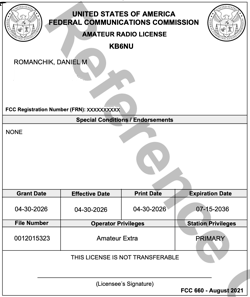
 If there’s anything that radio amateurs like to kvetch about it’s licensing. How many license classes should there be? How difficult should the tests be? What kind of privileges should each class get?
Back in the 1950s and 1960s, the debate was incentive licensing. Incentive license was supposed to be an effort to get radio amateurs to upgrade their technical skills. As you progressed up the ladder from Novice to Extra, you received more operating privileges, mainly on the HF bands. In practice, however, it stripped privileges from General Class hams, and so many of them got upset with the ARRL—which backed the program—that I believe it was the start of the ARRL’s demise.
In the 1990s and early 2000s, the debate was about whether licensees should be required to pass a code test or not. In 1991, the first no-code Tech licenses were issued. In 2003, the World Radiocommunication Conference (WRC) in Geneva voted to allow International Telecommunication Union (ITU) member countries to eliminate the mandatory Morse code proficiency requirement for amateur radio licensing. In 2007, the FCC eliminated the Morse code testing requirement for all amateur radio license classes in the U.S.
In April 2000, the FCC stopped issuing new Novice, Tech Plus, and Advanced class licenses, leaving just Technician, General, and Amateur Extra as the classes available to new applicants. Being an Advanced Class licensee at the time, I was hoping to get Extra Class privileges, but unfortunately, that was not to be. I remained an Advanced Class license until 2005, which is when I started publishing study guides. After all, who would want to buy an Extra Class study guide from a guy with only an Advanced Class license?
Fast forward to today
Steve, N8GNJ, the fellow behind the Zero Retries newsletter, is trying to re-ignite this debate.
(By the way, if you haven’t already subscribed to Zero Retries, you really should, at least if you’re concerned about the future of the hobby. Despite the way he capitalizes “Amateur Radio,” a la the ARRL, it’s well worth reading. And, it’s completely free, although Steve is very happy to accept donations.)
In issue #258, N8GNJ published an article titled, “Fixing the US Amateur Radio Licenses.” The article, which references a blog post by Bob, K0NR titled “How to Fix the Technician License,” In it, he says that many new hams aren’t all that interested in HF, and consider the current license structure, which is a holdover from the old incentive licensing days, to be a disincentive for upgrading only to obtain more HF privileges. He says that the current licensing structure, “smacks of gamesmanship / hoop jumping / jerking them around, and simply, [new hams that Steve calls “new tech hams] have no patience for such things.” I think that he’s right, up to a point, about this.
Steve proposes that we combine the US Amateur Radio Technician and General Licenses into a single license that has all the privileges of the current General Class license and to promote all of the current Techs to this Standard Class. He would make the test for this Standard Class a bit more challenging technically, adding questions about digital technology and software-defined radio, topics which he feels are more relevant than “arcane radio circuits or formulas that aren’t necessary to operate with current off-the-shelf equipment.”
This article has started an interesting discussion on the ZeroRetries discussion group. There, the idea of a two-tier license structure is quite popular, although the form of that structure varies from person to person.
Several advocate for just a single license class and test. I’m not sure that’s a good idea, as you’d have to make that test quite difficult, and that would discourage many people. One fellow suggested a single class of license with endorsements for things such as “VE/VEC stuff, spread-spectrum operation, high-power operation, encryption, and Operational Compliance Observer (Radio Police).”
All of these ideas deserve discussion. Unfortunately, as in many other areas of amateur radio, the current version of the ARRL lacks both the vision to and leadership necessary to move this forward. Personally, I’d like to stop kvetching and really start working on how to improve ham radio.
I like a three-tier license structure, and some kind of built-in incentive framework also seems like a good idea. That said, the current license classes need to be totally overhauled.
I don’t know if ARRL is flawed, corrupt, or just unaware of how US hams feel. My own perception is that things only exist if the league invented them, or if it positions itself as if it had. No matter though, because as the only lobby we have with any credibility, it has effective authority over everything ham-related at the FCC. We’re stuck with it.
Perhaps I’m being naïve, but maybe the directors just need to hear from more hams about things like this.
I think the three-tier system is fine, but updating the Tech frequency and mode privileges is a good idea.
I got my Novice during the brief two year non-renewable plan. I didn’t get to 13 wpm, so it was two years and out for me, not at all the outcome planned. Dumb idea.
I got back into the hobby decades later after no-code. I probably would have just kept renewing the Novice, then getting Tech or Tech Plus or whatever, but the rules kicked me out of the hobby. As I said, dumb idea.