
Here’s the second chapter from the 2022 version of my No Nonsense Technician Class License Study Guide.
Resistors
Resistors are components that, as the name implies, oppose the flow of current. We use them to control how much current flows in a circuit. The higher the resistance, the lower the current.
Most resistors have a fixed value, specified in ohms, but some are designed to be variable. That is, you can change the resistance of the resistor by turning a shaft or sliding a control back and forth. Variable resistors, also called potentiometers, are often used to allow users to adjust the way a device operates.
T6A01
What electrical component opposes the flow of current in a DC circuit?
A. Inductor
B. Resistor
C. Inverter
D. Transformer
T6A02
What type of component is often used as an adjustable volume control?
A. Fixed resistor
B. Power resistor
C. Potentiometer
D. Transformer
T6A03
What electrical parameter is controlled by a potentiometer?
A. Inductance
B. Resistance
C. Capacitance
D. Field strength
Capacitors
Another common electrical component is the capacitor. The most basic type of capacitor consists of two metal plates separated by an insulator, called a dielectric. When you put a DC voltage across a capacitor, an electric current flows into the capacitor until the voltage across the capacitor equals the DC voltage. This puts a positive charge on one plate and a negative charge on the other, thereby creating an electric field between the two plates.
T6A05
What type of electrical component consists of conductive surfaces separated by an insulator?
A. Resistor
B. Potentiometer
C. Oscillator
D. Capacitor
T6A04
What electrical component stores energy in an electric field?
A. Varistor
B. Capacitor
C. Inductor
D. Diode
The capacitor stores energy in that electric field. The ability to store energy in an electric field is called capacitance, and the unit of capacitance is called the farad.
T5C01
What describes the ability to store energy in an electric field?
A. Inductance
B. Resistance
C. Tolerance
D. Capacitance
T5C02
What is the unit of capacitance?
A. The farad
B. The ohm
C. The volt
D. The henry
Inductors
The third most common type of electrical component in amateur radio equipment is the inductor. Inductors are usually small coils of wire, and when a current flows through that coil of wire, a magnetic field is set up around the coil.
T6A07
What electrical component is typically constructed as a coil of wire?
A. Switch
B. Capacitor
C. Diode
D. Inductor
T6A06
What type of electrical component stores energy in a magnetic field?
A. Varistor
B. Capacitor
C. Inductor
D. Diode
The inductor stores energy in the magnetic field. The ability to do this is called inductance, and the unit of inductance is the henry.
T5C03
What describes the ability to store energy in a magnetic field?
A. Admittance
B. Capacitance
C. Resistance
D. Inductance
T5C04
What is the unit of inductance?
A. The coulomb
B. The farad
C. The henry
D. The ohm
Batteries
As amateur radio operators, we often use batteries to power our radio equipment. Some types of batteries are rechargeable, while others are not.
T6A11
Which of the following battery chemistries is not rechargeable?
A. Nickel-cadmium
B. Carbon-zinc
C. Lead-acid
D. Lithium-ion
T6A10
Which of the following battery chemistries is rechargeable?
A. Nickel-metal hydride
B. Lithium-ion
C. Lead-acid
D. All these choices are correct
Diodes
Diodes are the most basic semiconductor component. They have only two electrodes, called the anode and cathode, and conduct current only when it is forward biased. That is to say, diodes only conduct current when the voltage on the anode is positive with respect to the cathode. When the diode is reverse biased, i.e., when the voltage on the anode is negative with respect to the cathode, the diode will not conduct current. To identify the cathode, it is often marked with a stripe.
T6B02
What electronic component allows current to flow in only one direction?
A. Resistor
B. Fuse
C. Diode
D. Driven element
T6B09
What are the names for the electrodes of a diode?
A. Plus and minus
B. Source and drain
C. Anode and cathode
D. Gate and base
T6B06
How is the cathode lead of a semiconductor diode often marked on the package?
A. With the word “cathode”
B. With a stripe
C. With the letter C
D. With the letter K
When a diode is forward-biased, and a current flows through a diode, there is a voltage drop across the diode called the forward voltage drop. The value of the forward voltage drop is lower in some diodes than in others. For example, the forward voltage of a germanium diode is about 0.3 V, while the forward voltage drop in a silicon diode is about 0.7 V.
T6B01
Which is true about forward voltage drop in a diode?
A. It is lower in some diode types than in others
B. It is proportional to peak inverse voltage
C. It indicates that the diode is defective
D. It has no impact on the voltage delivered to the load
Light-emitting diodes, or LEDs, are a particular type of diode. When LEDs are forward-biased, that is to say when DC current flows through them in the forward direction, they emit visible light, making them useful as indicators and as part of digital readouts.
T6B07
What causes a light-emitting diode (LED) to emit light?
A. Forward DC current
B. Reverse DC current
C. Capacitively-coupled RF signal
D. Inductively-coupled RF signal
T6D07
Which of the following is commonly used as a visual indicator?
A. LED
B. FET
C. Zener diode
D. Bipolar transistor
Transistors
Transistors are semiconductor components designed to control the current flow through them. They have three leads and one of those leads is used as the control pin. A current, in the case of the bipolar junction transistor, or a voltage, in the case of the field effect transistor, on the control pin controls the current flow between the two other pins.
In some circuits, the transistor is used as a switch, and the control signal simply switches the current on and off. In other circuits, the transistor is used as an amplifier. When used as an amplifier, the current through the transistor is proportional to the input current or voltage. The ratio of output current to input current is called the gain of the transistor.
T6B03
Which of these components can be used as an electronic switch?
A. Varistor
B. Potentiometer
C. Transistor
D. Thermistor
T6B11
What is the term that describes a device’s ability to amplify a signal?
A. Gain
B. Forward resistance
C. Forward voltage drop
D. On resistance
T6B10
Which of the following can provide power gain?
A. Transformer
B. Transistor
C. Reactor
D. Resistor
Bipolar junction transistors are transistors that consist of three regions of semiconductor material. These regions are either P-type, which means that it has a positive net charge, or N-type, which means it has a net negative charge. Each region has an electrode, making the transistor a device with three leads. The names of these three electrodes are emitter, base and collector.
There are two types of bipolar junction transistors: PNP or NPN. A PNP transistor has two P layers, with an N layer sandwiched between them. An NPN transistor has two N layers, with a P layer sandwiched between them.
T6B04
Which of the following components can consist of three regions of semiconductor material?
A. Alternator
B. Transistor
C. Triode
D. Pentagrid converter
T6B12
What are the names of the electrodes of a bipolar junction transistor?
A. Signal, bias, power
B. Emitter, base, collector
C. Input, output, supply
D. Pole one, pole two, output
Another type of transistor often found in amateur radio equipment is the field-effect transistor, or FET. To control the flow of current through the field effect transistor, you use a voltage signal on the control pin. This voltage sets up an electric field inside the transistor, hence the name field effect transistor. FETs, like NPN and PNP transistors have three electrodes. These electrodes are called the gate, drain, and source.
T6B08
What does the abbreviation FET stand for?
A. Frequency Emission Transmitter
B. Fast Electron Transistor
C. Free Electron Transmitter
D. Field Effect Transistor
T6B05
What type of transistor has a gate, drain, and source?
A. Varistor
B. Field-effect
C. Tesla-effect
D. Bipolar junction
Circuit diagrams, schematic symbols, component functions
When describing circuits on paper, we draw diagrams called schematic diagrams that show the components used in a circuit and how those components are connected together. Using schematic diagrams lets us describe how a circuit works and lets us reproduce a circuit more easily. The circuit components are represented by symbols that readily identify the type of component and its value or part number.
T6C01
What is the name of an electrical wiring diagram that uses standard component symbols?
A. Bill of materials
B. Connector pinout
C. Schematic
D. Flow chart
T6C12
Which of the following is accurately represented in electrical schematics?
A. Wire lengths
B. Physical appearance of components
C. Component connections
D. All these choices are correct

Figure T-1 is a schematic diagram of a simple transistor circuit. In this circuit, the transistor is used as a switch that turns on a lamp when a positive voltage is applied to the input.
T6C02
What is component 1 in figure T-1?
A. Resistor
B. Transistor
C. Battery
D. Connector
T6C03
What is component 2 in figure T-1?
A. Resistor
B. Transistor
C. Indicator lamp
D. Connector
T6D10
What is the function of component 2 in figure T-1?
A. Give off light when current flows through it
B. Supply electrical energy
C. Control the flow of current
D. Convert electrical energy into radio waves
T6C04
What is component 3 in figure T-1?
A. Resistor
B. Transistor
C. Lamp
D. Ground symbol
T6C05
What is component 4 in figure T-1?
A. Resistor
B. Transistor
C. Ground symbol
D. Battery
This battery supplies the current that lights the lamp.
The circuit shown in Figure T2 is a simple power supply. Component 2 is a fuse.
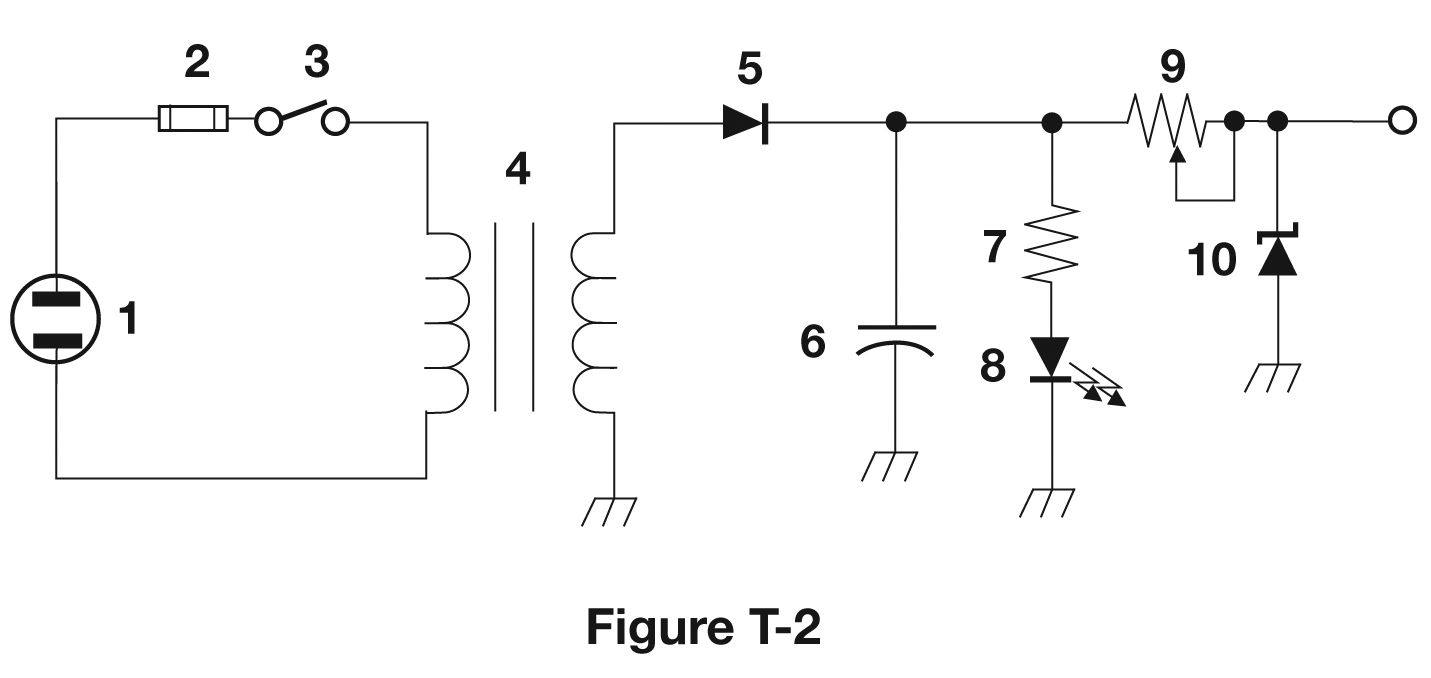
T6A12
What type of switch is represented by component 3 in figure T-2?
A. Single-pole single-throw
B. Single-pole double-throw
C. Double-pole single-throw
D. Double-pole double-throw
It turns the power supply on and off.
T6C09
What is component 4 in figure T-2?
A. Variable inductor
B. Double-pole switch
C. Potentiometer
D. Transformer
T6D06
What component changes 120 V AC power to a lower AC voltage for other uses?
A. Variable capacitor
B. Transformer
C. Transistor
D. Diode
Component 5 in Figure T2 is a rectifier diode. Rectifier diodes are designed to handle the higher currents found in power supply circuits.
T6D01
Which of the following devices or circuits changes an alternating current into a varying direct current signal?
A. Transformer
B. Rectifier
C. Amplifier
D. Reflector
T6C06
What is component 6 in figure T-2?
A. Resistor
B. Capacitor
C. Regulator IC
D. Transistor
Sometimes, this is called a filter capacitor, and its function is to filter out remnants of the 60 Hz AC that are part of the varying direct current signal.
T6C07
What is component 8 in figure T-2?
A. Resistor
B. Inductor
C. Regulator IC
D. Light emitting diode
The LED is a pilot light, serving to alert a user when the power supply is on.
T6C08
What is component 9 in figure T-2?
A. Variable capacitor
B. Variable inductor
C. Variable resistor
D. Variable transformer
Its purpose is to limit the output current of the supply.
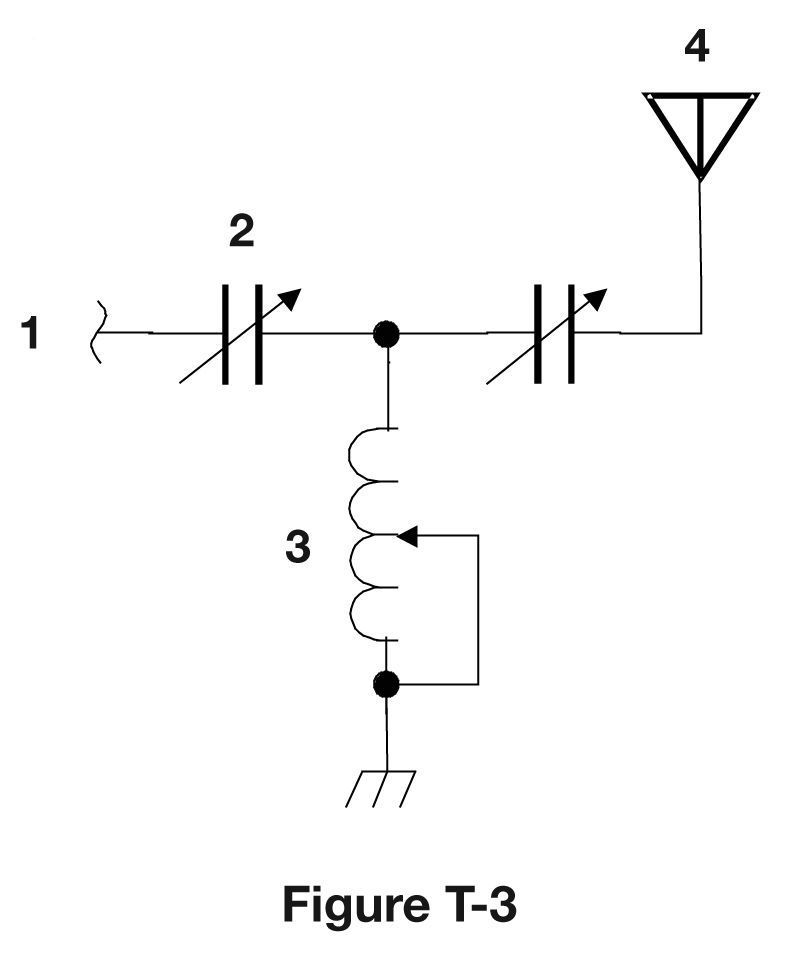
The circuit shown in Figure T3 is a type of antenna tuner.
T6C10
What is component 3 in figure T-3?
A. Connector
B. Meter
C. Variable capacitor
D. Variable inductor
T6C11
What is component 4 in figure T-3?
A. Antenna
B. Transmitter
C. Dummy load
D. Ground
Resonant, or tuned, circuits
When a circuit has both inductors and capacitors, we sometimes call it a resonant, or tuned circuit. The reason for this is that these circuits have a resonant frequency. When a capacitor and inductor are connected in series, the circuit has a very low impedance at the resonant frequency. When the capacitor and inductor are connected in parallel, the circuit has a very high impedance at the resonant frequency
T6D11
Which of the following is a resonant or tuned circuit?
A. An inductor and a capacitor in series or parallel
B. A linear voltage regulator
C. A resistor circuit used for reducing standing wave ratio
D. A circuit designed to provide high-fidelity audio
T6D08
Which of the following is combined with an inductor to make a resonant circuit?
A. Resistor
B. Zener diode
C. Potentiometer
D. Capacitor
Other components
There are many different types of components in modern radio equipment. Below, we will describe the types of components you will need to know about to pass the Technician Class license examination.
Switches are used to open and close circuits or to switch an input or output between two or more circuits. A single-pole, dual-throw, or SPDT, switch connects a single circuit between two other circuits.
T6A08
What is the function of an SPDT switch?
A. A single circuit is opened or closed
B. Two circuits are opened or closed
C. A single circuit is switched between one of two other circuits
D. Two circuits are each switched between one of two other circuits
Normally, switches are manually-controlled, such as the light switch in your home. Relays, however, are controlled electrically. Applying a voltage to the input of a relay causes its output to switch.
T6D02
What is a relay?
A. An electrically-controlled switch
B. A current controlled amplifier
C. An inverting amplifier
D. A pass transistor
Meters are devices used to indicate many different values. Meters can indicate the output voltage of a power supply, the output power of a transmitter, and many other values.
T6D04
Which of the following displays an electrical quantity as a numeric value?
A. Potentiometer
B. Transistor
C. Meter
D. Relay
To make electronic circuits smaller, component manufacturers make devices that have many electronic components on a single piece of silicon. We call these integrated circuits. Integrated circuits, such as microprocessors, may have million of transistors inside them.
T6D09
What is the name of a device that combines several semiconductors and other components into one package?
A. Transducer
B. Multi-pole relay
C. Integrated circuit
D. Transformer
Integrated circuits may perform either analog or digital functions. One type of analog integrated circuit that is very common is the voltage regulator.
T6D05
What type of circuit controls the amount of voltage from a power supply?
A. Regulator
B. Oscillator
C. Filter
D. Phase inverter
Power supplies generally have one or more fuses. An output fuse, for example, will prevent a device connected to the power supply from drawing so much current from the supply that it damages the supply. We call this situation a current overload. The output fuse protects the power supply from damage by breaking the connection between the power supply and the device being powered when the current rises above a certain value.
T6A09
What electrical component is used to protect other circuit components from current overloads?
A. Fuse
B. Thyratron
C. Varactor
D. All these choices are correct
When connecting electronic assemblies together, we often use cables with one or more conductors. Some of those conductors may have a shield around them that is connected to ground.
T6D03
Which of the following is a reason to use shielded wire?
A. To decrease the resistance of DC power connections
B. To increase the current carrying capability of the wire
C. To prevent coupling of unwanted signals to or from the wire
D. To couple the wire to other signals
“in the magnetic field” – the word “the” is in some other font in that sentence.
“When LEDs are forward-biased, that is to say when DC current flows through them in the forward direction” – all characters in this phrase after LED are in smaller print.
“are transistors that consist of three regions” – mixed fonts
“Each region has an electrode,” – “region” is in small font
“FETs, like NPN and PNP transistors have three electrodes.: – “electrodes” is in small font
“A. Single-pole single-throw” – should be bold-faced as the correct answer
“Figure T3 is a type of antenna tuner.” – mixed fonts
“single-pole, dual-throw” – I always thought the “D” stood for “double”, not “dual”
” the connection between the power supply and ” – mixed fonts
Thanks for pointing that out, but in my original, there’s no font mixing. Something weird must occur when I copy and paste it here.
That’s a good question about the switch terminology. I’ve emailed the National Electrical Manufacturers Association (NEMA) and asked if there’s a standard for this terminology, and if so, what’s the “official” name for an SPDT switch.