
 At our last club meeting, I was discussing the changes to the Extra Class question pool with someone, and the topic of memorizing the answers popped up. As I always do, I mentioned that many of the questions you can only get right by memorizing the answer. At that point, someone down the way piped up. “Not me,” he said, “I studied the material so that I didn’t have to memorize the answers.”
At that point, the president called the meeting to order, so I didn’t get to challenge him on that point, but that statement is just plain wrong. First of all, it’s true that some questions you can only get right by memorizing the answer. Almost all of the rules questions are that way, for example.
Secondly, there is no way to study the rest of the material in any depth and still have time to actually be an amateur radio operator. The amount of material that the Extra Class question pool covers takes an electrical engineering student four years or more to study thoroughly. And even then, some topics are bound to get short shrift.
So, we’re back to memorizing. I would say that even an “engaged” person will memorize about half the answers. I’d go even further and say that those that “study” the technical topics, don’t study it as thoroughly as a college student would.
For example, there are a dozen questions in Section E7G – Active filters and op-amp circuits: active audio filters; characteristics; basic circuit design; operational amplifiers. Despite the name, you don’t need to know how to design or build an op-amp filter. All you really need to know is that op-amps are high gain devices and if you have a circuit like the one shown below, Vout/Vin = RF/R1.
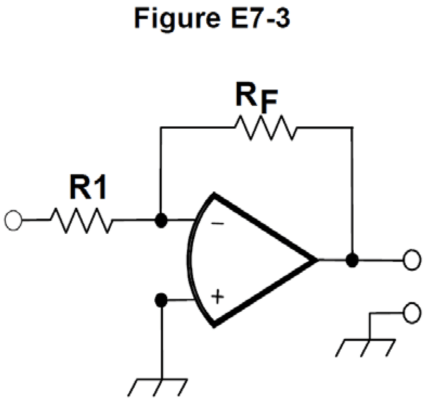
These concepts are relatively easy to learn. but there are also two questions on filter “ringing.” Honestly, you’re better off just memorizing the answers to those questions unless you have a real interest in active filters that use op amps. Wading into the mathematics isn’t all that hard, but when you consider this is only one of dozens of topics, you can see where doing any kind of in-depth study is going to take you months, if not years, to accomplish.
A modest proposal
The end result of this approach to testing is that we have many Extra Class licensees who know about a lot of things, but not in very much depth. Perhaps that’s OK. Perhaps that’s just what the question pool committee of the National Council of Volunteer Examiner Coordinators (NCVEC) was shooting for. If, however, we want an Extra Class license to denote that the licensee has some real technical expertise, I have a modest proposal.
Basically, my idea is that instead of testing on an incredibly wide range of topics, we test applicants on a set of basics, plus one or two particular topics. These would be topics that the person has expertise in already or enough of an interest in to study the topic in some depth.
Below are the topics that I would consider to be basic and some that I consider to be more specialized. This is, of course, not an extensive list.
- Basic questions (20 questions, everyone takes this part of the exam)
- Safety
- Rules and regulations
- Electrical principles/basic circuits
- Technical Interests (Choose two, 20 questions each)
- Antennas and transmission lines
- Radio wave propagation
- EMI/RFI
- Analog and digital design
- Digital communications and networking
- Software/software-defined radio
- Operating: contests, DXing, direction finding, etc.
- VHF/UHF
The questions in each of the technical interest question pools would be designed to really test the knowledge of the person taking the test. We’d have to figure out a way to make them difficult enough so that one couldn’t just simply memorize the answer. Questions could appear in one or more technical interest test. For example, a question on VHF/UHF propagation could appear in both the Radio Wave Propagation and VHF/UHF question pools.
Having said all this, I realize that this would not be easy to implement. You’d have to first decide on the topics and then enlist experts for each of the topics and get them to come up with a list of 80 – 100 questions each.
I realize that this has very little chance of being adopted, but it’s interesting to think about, no? And, we have four years to do this, so it could be possible.
Hi Dan,
I never understood the need for those opamp questions. Safety, grounding, and antennas, yes. I haven’t seen any use for op-amps since EE 251 30 years ago. If you want to build a radio then maybe, but the hobby is different than when Heathkit was king.
Well, those questions could be part of the “electronics design” track, but perhaps not part of the basic question set. It’s interesting to try and figure out the motivation behind some of the questions.
Modern day examinations should be designed to test whether or not the person being tested has mastered specific competencies to a prescribed level. The real question is “What competencies (knowledge base or ability to apply knowledge) should an extra exam applicant be able to demonstrate. Once that has been decided, a proper exam can be created. K8RQX
Absolutely. I think that should be part of this process. What we have now is a question pool that’s just being continually patched. Part of this proposal would be to get us to re-think the examination from the ground up.
I like this idea Dan. However, I wonder how answer memorization can be addressed in any type of multiple choice test. To me the only way to avoid memorization is to add a short answer aspect to the technical portion of the test. Makes grading more difficult, but I’m not sure about any other way.
I had considered putting something like that in the proposal, but hadn’t gotten around to it. This proposal is definitely not a fully-baked idea.
Dan
This is an excellent proposal. I’m not at all interested in building transceivers. My interest lies in broad band antenna construction and portable HF operations. I will likely spend the remainder of my time studying and experimenting in those areas. An extra exam focused on those areas would certainly focus learning and provide some incentive.
Dan, the chief advantage of the current test is that it gives broad exposure to just about everything in ham radio. Sure, there’s no time to go into any real depth, and the result is usually a lot of memorization, but students come out of the process knowing at least where to start digging if they come on the topic later.
At the top level of licensing, maybe that is the high bar we need. After all, it’s no shame to stay at General level. Having 80% of the HF bands available and 100% of the VHF-and-up, remaining at General is no particular handicap either.
The specialization can come later, in the actual practice of amateur radio. We all develop interests and sub-hobbies within the field. It’s good to know a little about what else is out there before getting too specialized.
I get where you’re coming from with this though, and I agree that too much of the test is soon-forgotten trivia about fields that don’t interest us. Maybe it would be better to ask questions about *why* you’d want to use an op-amp, rather than the details of its use.
I used to read each Radio Amateur’s Handbook like it was a novel, Several times. When I took the Technician test, it had been years since I had been able to read a Handbook. When the VE asked how I had done, I told him I aced it. He scored it and I had aced it.
Read that handbook. Everything you need to KNOW is in that book. Learn the material and the test just becomes time proving you know the material.
I had over 90% on my General exam, and for some reason I wasn’t told the score when I got my extra. Testing means just that. Testing your KNOWLEDGE of the class of license is what the testing is all about. Dahdahdididit Didididahdah!
I agree that the amateur testing process should be redesigned from the ground up. That it is a camel is beyond dispute. As Bruce (K8RQX) points out, the guiding principle should be the determination of minimum knowledge required to exercise the privileges of a particular license.
My background is FAA testing, which is a three-legged stool: multiple choice knowledge tests administered by commercial centers, an oral test by an examiner, followed by a practical skills demonstration. Flying, of course, includes safety-of-life considerations, necessitating more control. With the exception of the test bank content and practical test standards, all has been delegated to non-governmental employees.
As a newcomer to amateur radio, I am surprised at the lack of differentiation between license privileges. It strikes me that a (lower case) novice Technician should be permitted to use only Part 90 certificated devices. A General should be able to build or modify his or her own. An Extra should be allowed the highest power and operating spaces. A new pilot isn’t permitted to fly turbine aircraft; that takes more training and testing. Why should a Technician have 1.5 kW privileges the first day out?
Frankly, I am surprised that the FCC has ceded control over test content. One might naively believe that the community wants easier tests in order to draw more participants. The government’s interest would be to raise the standard in order to reduce complaints of other (paying) users of the airwaves. This is not the case. The test bank includes questions from the trivial to minutiae to the esoteric.
The FCC has apparently stepped away from all qualification of amateur candidates, save keeping track of their demographic information. This minimizes government expense by delivering instruments that measure only the candidate’s memorization skills. I argue that a fixed 350-question test bank does little to measure capability.
In 2022, adaptive tests are a much better way to discriminate levels of knowledge mastery. That, of course, would require all tests to be on-line. If the FCC went with adaptive tests, though, a candidate could register for a single test. At the conclusion of thirty-five questions in a single session, he or she could have three outcomes: no license, Technician, General, or Extra.
The agency wants a pencil and paper, multiple guess test, at minimum cost. This approach could be improved easily with the current technology. For each question, determine the desired response and five distractors. For each administration, select three distractors at random, then present the choices in random order. That’s a start. Easily doable. And cheap.
The current protocol of a known, fixed number of sub-elements with one question each invites gaming. If my goal is passage alone, I will simply skip studying any question of the form, “Which of the following carrier frequencies is illegal for…”
I can see the general criteria for test questions. Take the math for example. Technician candidate questions include r=e/i calculations without decimal prefixes. General candidates must use decimal prefixes and simple exponential calculations (i.e. squares and square roots). Extra candidates face questions in the complex domain, although no calculus is explicitly required. At this point I throw my my hands up. Asking random questions about the imaginary portion of impedance is pointless if the test-taker hasn’t taken the same first-semester calculus that an EE has.
The entire testing approach could be improved with some rudimentary data analysis. Look at three years’ testing results. Pick out the questions whose responses are most predictive of overall test performance. Drop the questions that are uniformly answered correctly; they tell you nothing. Ask yourself why certain questions are answered most infrequently. Then–and this is the hardest–ask what purpose each question serves. Does it promote safety? Will it reduce violations? Does it stimulate innovation? Does it reduce spurious emissions? Or is it a grown-up version of Trivial Pursuit?
I am happy to debate the topic with all comers, or if I am called, to serve in the planning and preparation of new test instruments.
Seventy-three
Robert
This is a bs post. Try getting your Extra class when there were no question pools. You had to learn the science. Many, many of us did it, and now just mimorizing questions is to hard for you lot. Pick up a boom and read, sit down and practice, and build a radio. Stop complaining. Ham radio is already to easy!
You obviously missed the point.
Now, the question pool contains such a wide variety of material, it would be impossible for the average person to “learn the science” as you say. I have a four-year degree in electrical engineering, and even so, my classes didn’t cover all of the topics that one might find on the Extra Class exam.
Expecting Extra Class candidates to know everything there is to know about every topic on the test is just unrealistic. If you were able to do it–and I think that you’re fooling yourself if you think you did–it’s because the test didn’t cover as much as it does now.
What I propose here is that Extra Class candidates demonstrate true knowledge in a particular area of the hobby. I think that is realistic, and passing the test would be a true challenge. And, that’s the way that most of us approach the hobby, anyway.
As was said earlier a tech or general license might be the right choice for some. These were not meant to get all done in a day or a year but a cumulative lifetime. It is a hobby of learning and exploring. The more of that you do the higher the privilege class you achieve. They did away with many classes of license and now reading this perhaps that was a mistake.
I am a EE and while I don’t do a lot of RF for work I do enjoy it immensely. I read several books (e.g. antenna theory, RF amps, SDR, radio design, etc.) cover to cover and designed several circuits for practice before taking the Extra. If means nothing of you don’t understand it. That behind said, I did this for myself not the FCC. I plan to build and experiment on nearly every aspect of the hobby so I NEED this knowledge. For someone who only plans to buy commercial equipment and operate it I think the exam is adequate. So decide what you ultimately want out of Ham and learn what you’ll need to know. Oh, and then there’s the test to keep out the channel 6 CB types.