
I’ve been working CW for a long time. So long, that I don’t really remember how difficult or easy it was to learn the code. My recent experience with operating satellites—or trying to, anyway—may be giving me some perspective, however. I feel like I’m making some progress, but I have yet to actually make a satellite contact.
Let me describe what I’ve done so far:
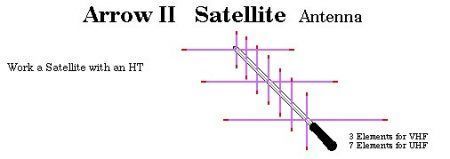
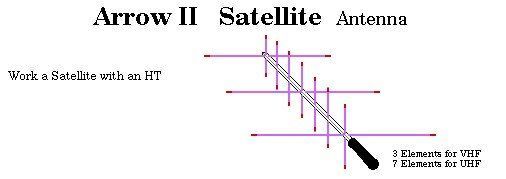
- After consultation with the Twitter gods of satellite operation, I decided to purchase an Arrow II 146/437-10WBP Handheld Yagi w/ Duplexer antenna. I purchased it from the AMSAT website, because AMSAT gets a little cut of the sale. It was delivered about a week ago.
- I didn’t get around to playing with it for a couple days, and when I did, I realized that I didn’t have the right adapters to connect the antennas to my HTs.
- Purchased the adapters from Amazon (BNC-SMA, BNC-reverse SMA). I received these on Saturday.
- Yesterday, I assembled the antenna (very simple) and programmed my radio for the new ISS cross-band repeater. For help in doing so, I found this great blog post.
- Next, I had to figure out when the ISS was going to be overhead. I got a bunch of recommendations from the Twitter gods, and Mike suggested N2YO.Com. I like N2YO.Com. Using it, I was able to determine that the ISS would be passing nearly over head a little after 0030Z last night.
- I thought that tracking the ISS was going to be easy. At 0000Z, the sky was clear, and I was assured by a local ham, who happens to be a professor emeritus of astronomy at the University of Michigan, that the ISS would be the brightest object in the sky. Unfortunately, by 0030Z, the sky had clouded over, and I never actually saw the satellite.
- I did actually hear several stations using the ISS repeater, though. I called a few times, but I don’t think that anyone heard me.
- Today, I tried again during the 1715Z pass, but this was a much lower and shorter pass, and again, wasn’t successful.
- I also monitored an earlier pass of AO-91. The signals were quite good on this pass, but I didn’t have my radio programmed to transmit, so I didn’t have any chance of making a contact.
During the passes, it was kind of like working a pileup. People were just throwing their callsigns out, but only rarely did two stations connect. If there’s some method to this madness, I’d love to have someone explain it to me.
Another thing that I’m thinking is possibly the reason no one can hear me is that I have my radio programmed to low power, which is only about a watt and a half. I’m thinking that I’ll try high power (5W) and see how that goes.
Anyway, I’m just getting started here. It would have been cool to make a contact on my first go, but I realize that’s not usually how it works. I keep telling CW newcomers to stick with it and “practice, practice, practice,” and that’s what I intend to do here.
There is also an SSTV event going on right now from the International Space Station http://ariss-sstv.blogspot.com/ There are much more elegant ways to play but all you really need to do is track the ISS with your Arrow and your HT tuned to 145.8 MHz. I use the free Robot36 app to decode the signal on my android phone. I clip my HT (a cheap Baofeng) to my coat or shirt or whatever with the volume at a decent level and as long as the app is running and close enough to your HT to hear the signal through the phone’s microphone you will get magic space pictures. If you have a choice, stand over grass until you get it down so you don’t break anything if you start dropping things.
Hi Dan,
I’m a relatively new satellite operator also and I find that using the linear birds (SSB or CW) to be much easier to work than the FM birds. Think of the FM birds as a repeater in the sky moving very quickly. Only one person at a time can use them, hence the crazy free-for-all you witnessed. The linear birds have a wide passband so multiple CW and SSB conversations can be happening simultaneously. Of course, a simple HT won’t let you use the linear birds. Ideally, you’d have a full duplex VHF/UHF rig with SSB and CW capability, such as the IC-9700.
I see your point, but I have HTs. To work those linear transpoders, I’d have to spend a bunch of money on something like the IC-9700, and even then, that’s not really portable.
I’m new to satellites, and spent a month listening to passes (AO-91, AO-92, SO-50, ISS, PO-101). I lashed together the booms of two antennae, 70cm 9 element Tonna and a homebrew 3 element yagi for 2m. In that month, I monitored about 30 passes, heard over 90 callsigns in 21 different countries. The ISS cross band repeater is manic- as you have discovered. I find SO-50 to be nearly as bad for chaos and not many completed QSOs. Discipline on AO-91 for some reason seems to be better (although it is still busy). About 10 days ago, I was lucky enough to make 2 QSOs on my first every attempt to work through a satellite (AO-91), but I have also had passes since then where I couldn’t get in at all. I am running 5W from a Yaesu FT70. Making those first contacts left me feeling over the moon. I hope it won’t be long before you do the same.
First off the Twitterverse is full of AMSAT people and they are a really great community. I follow a bunch of them and really enjoy hearing about their adventures. My attempts at sats have been unsuccessful as well. I have a feeling it has to do with the New England geography. Too many hills , mountains,, and trees in the way to get much of a clear shot.
There are different apps and different websites to try depending on what type of phone you have and what bird you are trying to hit. I think it’s all part of the adventure figuring this stuff out. Have fun with it!