
• Skip to primary navigation
  • Skip to main content
  • Skip to primary sidebar
  • Skip to footer

KB6NU's Ham Radio Blog

KB6NU's Ham Radio Blog
  • HOME
  • Study Guides
  • Teach a One-Day Tech Class
  • W8SRC Repeater Guide
  • Advertise
  • Hire Me

Getting loaded (antenna-wise, anyway)

April 21, 2019 By Dan KB6NU 10 Comments

A couple of years ago, I homebrewed a “Cobra” antenna. It’s a doublet antenna, meaning that it consists of two elements connected to a center insulator, where it connects to a feedline. The unique thing about the Cobra antenna is that each element consists of three parallel conductors connected in series.

My antenna uses a lightweight, three-conductor rotor cable that used to be available from Radio Shack. The feedline is 450 Ω ladder line that connects to an antenna tuner to give me multi-band operation.

Connecting the conductors in this way is is supposed to provide “linear loading.” Somehow, running the conductors in parallel is supposed to increase the antenna’s effective length. My antenna is only 73-ft. long, but it easily tunes up on 80m.

The ARRL Antenna Book has a short section on linear loading. It says that linear loading is a “little understood” alternative to inductive loading that can be applied to almost any type of antenna. Furthermore, “…it introduces very little loos, does not degrade directivity patterns, and has low enough Q to allow reasonably good bandwidths.”

As I mentioned, I’ve been using this antenna with good results for a little more than two years now. When I first put it up, someone mentioned the concept of linear loading to me, but not being an antenna guru, I didn’t ‘give it much thought. About a week ago, though, I ran across a link to the page Short Ham Antennas for HF. That got me thinking about the topic again.
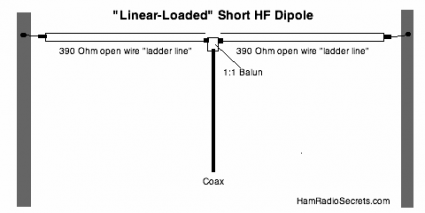
This page describes a way to build a linearly-loaded dipole antenna with a feedpoint impedance of approximately 35 Ω. This allows you to feed it with coax instead of the ladder line that I use. The author uses 390 Ω ladder line for the elements. He says it’s commonly available, but I don’t think I’ve ever seen 390 Ω ladder line. You could probably use 450 Ω ladder line by adjusting the element lengths a little.

At that point, I started Googling. The next linear-loaded antenna design that I ran across is a design from M0PZT. He built his elements from some sturdy wire and homebrewed spacers made from PVC pipe. He’s used this design for the 40m elements of a fan dipole covering the 40m, 20m, 15m, and 12m bands. Only the 40m elements are linear-loaded.

I also found a design for a linear loaded vertical antenna for 40m and 80m. This antenna is only 7.736m, or 25.4 ft. tall. Of course, it requires a good radial system to work well, but it will work a lot better for DX than a low doublet or dipole.

Finally, there’s an eHam discussion on linear loading. Unlike a lot of eHam discussions, this one is quite civil. It’s worth reading if you’re interested in the topic.

So, if you’re thinking of getting loaded, errrrr, I mean loading your antennas, here’s a method for you to consider. It works!


Related posts:

  1. A short 80m antenna for my lot
  2. Why do my antenna tuner settings change over time?
  3. Got an indoor antenna? Help me out here.
  4. Extra Class question of the day: miscellaneous antenna questions

Filed Under: Antennas Tagged With: linear loading

Reader Interactions

Comments

  1. Terry VA3TYB says

    April 21, 2019 at 9:38 pm

    There are more options now for spacers than PVC pipe. I can imagine you can 3D print your own spacers similar to Ladder Snap (http://www.dtsohio.com/73cnc/laddersnap.html), but could even space 3 wires. And yes with the right spacing could even make 390 ohm ladder line!

    Reply
    • Dan KB6NU says

      April 22, 2019 at 6:54 pm

      You’re certainly right about 3D printing spacers. I wonder, though, if it’s not more trouble to 3D print them than it is to drill some PVC?

      Reply
  2. Dave New, N8SBE says

    April 22, 2019 at 1:36 pm

    Hmm. Those wire antennas like like ‘folded’ dipoles, to me, because the return wire is not connected at the center. Linear loading would be using fat conductors (something more than 1% width/length ratio) to increase the bandwidth and decrease the length.

    Reply
    • Dan KB6NU says

      April 23, 2019 at 8:11 pm

      I think folded dipoles are connected in the center, like a squashed loop.

      Reply
      • David HK1A says

        March 1, 2023 at 10:38 am

        Yeap, It is more like a bent dipole

        Reply

Leave a Reply Cancel reply

Your email address will not be published. Required fields are marked *

This site uses Akismet to reduce spam. Learn how your comment data is processed.

Primary Sidebar

No Nonsense Technician Class License Study Guide (for tests given between July 2026 and June 2030)

New No Nonsense Technican Class Study Guide now available!

The 2026 version of my Tech Class study guide is now available, and as always, the PDF version is FREE!. The ePub version costs $9.97, and a Kindle version and paperback version will be available on Amazon shortly.

Click here to get all of my "No Nonsense" study guides.

Also available: The CW Geek's Guide to Having Fun with Morse Code

W5SWL.Com
Retevis Ailunce H1 DMR Radio
DXpander: Cobweb antennas, Laser Cutting

You’ve got mail!

Enter your email address below and get an email every time I publish a new post.

Email


I frequently teach classes to help newcomers get their licenses. The next class will take place on Saturday, February 7, 2026 on the University of Michigan campus. Click here for more information.

If you can't make the class, subscribe to the mailing list to be notified of when the next class will be held.

You can always download my free study guide, and if you have any questions about the classes, or amateur radio in general, please feel free to email me directly.

Support KB6NU.Com

Donate $7.30 and get two of these cool stickers. Measuring 4.25-in. W by 2.75-in. H, it's perfect for your car, your shack, or wherever!

Contact me

If you have a question or comment about one of my blog posts, or a question about any of the material in my study guides, or just a question about ham radio in general, you can email me at [email protected].

Blogs You Should Also Read

  • AE5X: A CW-centric blog from Kingswood, Texas
  • K0LWC Blog
  • LA3ZA Ham Radio Blog
  • Little Radios, Big Fun – WB3GCK
  • Mr. Vacuum Tube's Blog
  • Radio Artisan – K3NG
  • The K0NR Weblog
  • VE3WDM's QRP Ham Radio Blog
  • W2LJ’s Blog

Ham Radio Websites

  • Dashtoons – The Hammin' Comedy by Jeff K1NSS

Podcasts

  • ICQ Podcast
  • Linux in the Ham Schack
  • No Nonsense Amateur Radio Podcast
  • Resonant Frequency Amateur Radio Podcast

Recent Comments

  • Skip K4EAK on Button, button. Who’s got the button?
  • Ed K8MEJ on Is anyone running for the board this year in the Great Lakes Division?
  • Skip Behnke on 2020 Extra Class study guide: E9F – Transmission lines: characteristics of open and shorted feed lines; coax versus open-wire; velocity factor; electrical length; coaxial cable dielectrics
  • Mike on Map your contest QSOs
  • Phillip Cardwell on J-Poles

Meta

  • Log in
  • Entries feed
  • Comments feed
  • WordPress.org

Footer

Copyright © 2026 Daniel M. Romanchik, KB6NU · Log in