
On our club mailing list, a member asked,
I am teaching myself how to send iambically. Any experts out there with some hints?
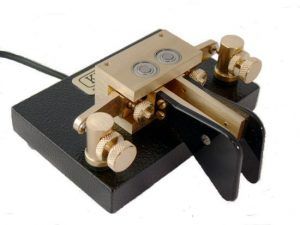
Before we answer this, let’s discuss what it means to send Morse Code iambically. First of all, to send Morse Code iambically, you need an electronic keyer and a key called a dual-lever paddle (shown at right).
Electronic keyers are really wonderful devices. By simply closing a switch, they’ll send perfectly-spaced dits and dahs automatically. Paddles have one switch for dits and one for dahs. A single-lever paddle only allows you to close one switch at a time by moving the lever back and forth, but a dual-lever paddle allows you to close both switches simultaneously.
Why would you want to close both switches simultaneously? After all, the keyer can only send a dit or a dah, but not both at the same time. The answer is that most electronic keyers these days not only make dits and dahs automatically, they also have “iambic modes.” In iambic mode, a keyer will allow you to slip a dit in between two dahs or a dah between two dits.
Iambic modes allow you to send certain characters with fewer hand motions. Take the letter K, for example. K is dah-di-dah. With a single lever paddle, you’d close the dah switch, move the paddle the other way to make the dit, then back to make a dah. There are seven characters that you can send iambically: C, F, K, L, Y, Q, and R.
So, now let’s answer my friend’s question. My reply was:
I don’t think that there’s any magic bullet when it comes to any aspect of CW, be it learning the code, increasing your speed, or learning to send iambically. My experience is that you just have to make up your mind to do it and then practice, practice, practice. When I started sending iambically, I just sent the easy characters, the characters that started and ended with a dah: K, Y, Q. I sent the other iambic characters—C, F, L, and R—with a back and forth motion. Then about a year or so ago, I decided to just start sending all the iambic characters iambically. I made mistakes, but eventually I got the hang of it.
Since I wasn’t really satisfied with my answer, I decided to ask it on the CWops mailing list. The best advice was from Peter, W2CDO:
It’s been many a year since I switched over to an iambic paddle but I still remember the advice my OM gave: take it slow. Practice slow. Until your wrist and fingers get the habit and you don’t have to think about counting dits and dahs but feel the rhythm of each letter and number. Then you can work for speed and don’t try to go faster than your fingers are comfortable. Expect progress to be up and down with good days and bad days. Don’t be discouraged if you plateau for a while.
After this, the discussion went off topic, with several guys pooh-poohing the need for iambic sending at all. The argument seems to be that the advantage of iambic keying not really worth the bother of learning how to do it. I’ll leave that for you to decide on your own.
wow, this is my first introduction to this. thank you very much. keep up with more information on this type of sending
tom dornback K9MKX
Very helpful, thanks. I’m signed up for CwOps course & new to paddle key. Practicing before the course starts, but very challenging. Had to set the speed down to 15 wpm although I’m using kosh at 20 wpm to push my sending speed up.
I guess some punctuation & procedure characters also benefit from squeeze . I found this during practice with
72/3 Ray, G3NDS