• Skip to primary navigation
  • Skip to main content
  • Skip to primary sidebar
  • Skip to footer

KB6NU's Ham Radio Blog

KB6NU's Ham Radio Blog
  • HOME
  • Study Guides
  • Teach a One-Day Tech Class
  • W8SRC Repeater Guide
  • Advertise
  • Hire Me
  • Shop
    • View Cart

CW

Operating notes: Homebrew keys, callsign fun

December 1, 2021 By Dan KB6NU Leave a Comment

Homebrew cootie key cuts through QRN, QRM

A couple of days ago, I worked a guy who said he was using a homebrew sideswiper, or cootie, key. I looked him up on QRZ.Com, where he featured a photo of his key (see right). After seeing this photo, I tweeted:

Just worked a guy using this homebrew cootie key. It really cuts through the QRM and QRN.

I included the photo in the tweet.

That really caught the eye of my followers. More than two dozen have either liked or commented on it.

Homebrew paddle uses hard disk drive bearing

Last night, I worked a fellow who also noted that he was using a home brew paddle. He said that it was similar, but not exactly like the paddle built by N2HO (shown at left).

The unique thing about this key is that it uses the magnet and bearing from a hard disk drive. I don’t know if or how the magnetic tension is controlled, but I think the design is quite unique.

Callsign fun

In the past week or so, I’ve worked stations with fun callsigns. the first is AI5IN. Joe’s call not only spells a word, but it is palindromic, if you consider the sequence of dits and dahs.

Last night, I worked K5EMI. Bill didn’t mention why he chose this particular call, and I wonder if he knew that EMI is an acronym for electromagnetic interference. I may have to email him about that.

Filed Under: Building/Homebrew, CW Tagged With: cootie key

Amateur radio videos: ARRL Foundation, CW Academy, “brain” transplant for the IC-245

November 28, 2021 By Dan KB6NU Leave a Comment

RATPAC: ARRL Foundation

Mike Ritz, W7VO, Northwest Division Director and member of the board of the ARRL Foundation, discusses the foundation and the grants that it makes.


Master Morse Code with CWops

Joe Fischer, AA8TA, headmaster of the CWops’ CW Academy, joins the All Portable Discussion Zone podcast and talks about how to break through the struggles of learning Morse code.


A brain transplant for the ICOM IC-245

The IC-245 is an all-mode 2m transceiver. This video shows how [IMSAI GUY] replaces the microprocessor board in his transceiver with an Arduino Nano-based board to get a little more functionality. There’s also a second video that shows the initial trial of the board.

Filed Under: ARRL, CW, Gear/Gadgets Tagged With: ARRL Foundation, CW Academy, IC-245

Nominate someone for the CWops Award for Advancing the Art of CW

November 16, 2021 By Dan KB6NU Leave a Comment

CWops is pleased to announce that it is now accepting nominations for the prestigious CWops  Award for Advancing the Art of CW for the year 2022.

The purpose of the award is to recognize individuals, groups, or organizations that have made the greatest contribution(s) toward advancing the art or practice of radio communications by Morse code.

Criteria

Candidates for the award may be one or more of the following:

  • Authors of publications related to CW
  • CW recruiters, trainers, mentors, coaches and instructors
  • Public advocates of CW
  • Organizers of CW activities
  • Designers and inventors who advance the art or practice of CW
  • Other contributors to the art or practice of CW

Note: The award is not limited to amateur radio operators or their organizations.

Nomination

Nominations may be made by anybody (not limited to CWops members).  Nominations should be emailed to <[email protected]> with a copy to <[email protected]>.  An email confirmation will be sent acknowledging receipt of each nomination.  In order to be considered, a nomination should be received by March 18, 2022 and include:

  • A detailed explanation supporting nominee qualifications according to the above criteria.
  • Name(s) and call sign(s) (if applicable) of nominee(s), and contact information including their postal address(es), email address(es), and telephone number(s).
  • Name, telephone number, email address, and call sign (if applicable) of the person submitting the nomination.

Presentation of Award

A plaque will be presented at the Dayton Hamvention.  If the recipients are not present, it will be sent to them.

Filed Under: CW Tagged With: CWOps

Operating notes: Still getting faster, working Africa, broadcaster in the 30-meter band

October 24, 2021 By Dan KB6NU 1 Comment

Still getting faster

Tonight, I had a couple of 27 wpm QSOs—one with Joe, K7JOE, and the other with Mitch, WB0GKH. These were nice contacts. Both of these operators have a nice fist, which made copying so fast easier. And, at 25+ wpm, a CW contact is almost as fast as a phone contact.

It’s nice to know that I can continue to get faster as I’m getting older. The key—as I always say—is getting on the air and making CW contacts.

3DA0RU

Working DX

This last week was fruitful as far as working DX goes, in particular Africa. The new  country is the Kingdom of Eswatini (formerly known as Swaziland). As I often do, I avoided the pileups when they first got on the air, but managed to work them just fine a couple of weeks into the DXpedition.

I also managed to work 5T1GM in Mauritania, but I already had several 5T contacts in the log. The one I missed is the S9OK DXpedition, but I also have a couple of S9 contacts already.

3DA0RU makes 165 DXCC entities confirmed in LOTW. At this rate, I doubt I’m going to make the DXCC Honor Roll anytime soon, but perhaps I’ll get up to 200 during the upcoming sunspot cycle.

WWRB QRMing the 30-meter band

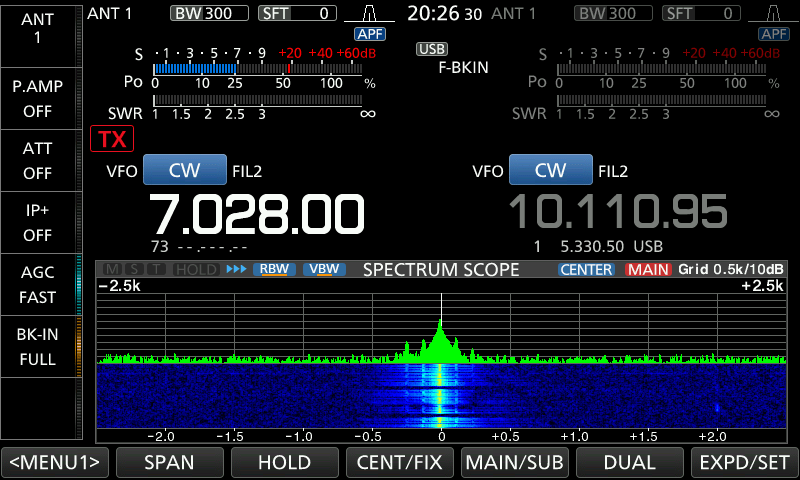
A couple of weeks ago, I noticed a broadcaster on 10.100 MHz (see above). It was kind of weak, but I could tell that it was a religious broadcaster. I tried to find this broadcaster by doing an internet search, but when the search didn’t come up with anything useful, I asked on Twitter. Someone mentioned that it was probably the second harmonic of WWRB, whose assigned frequency is 5.050 MHz.

Since then, I’ve noticed the harmonic several times. I’ve reported this interference to the ARRL Volunteer Monitor Program, but I’m not sure there’s much that they can do about this. Anyone have any suggestions? Perhaps if several of us reported this interference it would make more of an impression.

Filed Under: CW, DX

Operating notes: Bands heating up, IC-2820H, CW Skimmer

September 30, 2021 By Dan KB6NU 2 Comments

The bands finally seem to be heating up. I’ve managed to make European contacts nearly every day for the past week. Just last night, I called CQ on 40m just before 0000Z and got a reply from an LZ3. He was S5 here, but since I wasn’t expecting a DX call, I had to get him to repeat his call for me. Of course, it didn’t help that he’d only sent it once—DX style—in the first place.

Also, last night, the bands were open to the west. That’s an indication of good band conditions here, as I don’t usually do well to the west because of the way my antennas are situated. I worked both a CO and a CA station.

IC-2820H

As I noted in a previous post, I picked up an Icom IC-2820H at a recent hamfest. It’s an older radio, but I’m really starting to like it. For example, it has a dual-watch feature, meaning that I can monitor two frequencies at the same time.

It has a couple of other unique features, too. For example, there is a second antenna input, and if you connect a second antenna to the radio, it can do diversity reception. It also has a bandscope feature. I don’t think I’ve seen that on any other VHF/UHF radio. I haven’t used either feature yet, but they might be fun to play with.

It has a detachable head for mobile installation, which is a nice feature, but if you’re not using it detached, connecting the control head and microphone is a bit kludgey, as the connectors are behind the control head (see photo above). The data port is also hidden behind the control head. One of the reasons I bought this radio was that it had a data port. Now, I have to find the little DIN connector to use it.

The unit I bought has the optional UT-123 D-STAR board. Apparently, these are a bit rare and sought after. I have no intention of using it, so if you’d like to purchase it, let me know. I even have the original box for it.

CW Skimmer

Last December, I tried to get CW Skimmer working with my Flex 6400. Unfortunately, I wasn’t successful, and being both impatient and ambivalent about paying $75 for the program, I gave up on it after a little while.

Last night, I decided to give CW Skimmer another go. After reading several posts in the Flex Radio Community Forum, it looked like the thing to do was to get a third program called Slice Master 6000, which configures and launches third party applications, such as CW Skimmer, GRITTY, WSJT-X, and flDigi, automatically. By the way, it’s called Slice Master because Flex refers to their receivers as “slices.”)

I installed and ran Slice Master, but it failed to connect. Consulting the forum again, someone noted that the problem was probably with Windows Defender. Sure enough, after adding a rule to allow Slice Master to connect, it did indeed connect, and now I have CW Skimmer running.

I don’t really need CW Skimmer myself, but I would like to provide some input to the Reverse Beacon Network (RBN). I use RBN all the time, so it will be nice to give something back. I’ll probably pay for the full version of CW Skimmer tonight and then see about connecting to RBN.

Filed Under: CW, DX, Gear/Gadgets, Operating, Propagation Tagged With: CW Skimmer, IC-2820H, ReverseBeacon

Videos: An SDR BITX, CW tips from G4FON (SK)

August 12, 2021 By Dan KB6NU 1 Comment

Here’s another cool project from Farhan–an SDR BITX..

Ray, G4FON, passed recently. His CW Trainer is quite possibly the most popular CW training software of all time.

Filed Under: Building/Homebrew, CW Tagged With: G4FON, sBITX

Heal yourself while operating CW

May 11, 2021 By Dan KB6NU 8 Comments

A friend of mine recently sent me a link to The Healing Frequencies of the Human Body. It starts out:

Humans have understood for centuries that sound has a profound effect on the human body and mind. Ever since our discovery of music and shamanistic chanting, we have been pushing the boundaries of how the healing effects of sounds and frequencies can be measured.

So what are the healing frequencies of the human body? Certain frequencies of sound are used as part of therapies in order to manipulate human brainwaves to promote healing of the body and mind. Sound frequency healing has been used to treat several different kinds of ailments such as insomnia, anxiety, depression, and disorders of the nervous system.

The article lists 11 frequencies “that are regarded in alternative medicine to be particularly healing to the human body,” including 40 Hz, 174 Hz, 285 Hz, 396 Hz, 417 Hz, 432 Hz, 440 Hz, 528 Hz, 639 Hz, 852 Hz, and 963 Hz.

So, could using these frequencies as your CW sidetone improve your health? 40 Hz is probably too low to be practical, but the other frequencies might be usable. Here’s what the article has to say about these frequencies:

  • 174 Hz. 174 Hz is associated with the reduction of both pain and stress.
  • 285 Hz. 285 Hz is considered to be  instrumental in the healing of cuts, burns, and other physical wounds.
  • 396 Hz. 396 Hz helps transform negative feelings, such as  fear, grief, and guilt,  into positive, joyful ones.
  • 417 Hz. 417 Hz helps remove negative energy, such as the energy surrounding a past trauma or negative energies in the ambient environment.
  • 432 Hz. 432 Hz leads to greater levels of mental and emotional clarity and a higher level of spiritual development.
  • 440 Hz. 440 Hz aids in the listener’s cognitive development.
  • 528 Hz. Also known as the love frequency, 528 Hz is a sound associated with blessings.
  • 639 Hz. 639 Hz produces positive feelings and encourages clearer communication practices and situational awareness.
  • 852 Hz. 825 Hz keeps the mind from overthinking and helps remove intrusive thoughts, and negative thought patterns.
  • 963 Hz. 963 Hz is known as both the “pure miracle tone” and the “frequency of the gods.” and is associated with higher spiritual development.

Personally, I think 396 Hz, 432 Hz, and 639 Hz show the most promise. We all need more positive, joyful feelings, greater mental and emotional clarity, and certainly better communications! I’m going to give them a try. Beginners, on the other hand, might want to try 852 Hz as their sidetone. Overthinking and negative thought patterns can certainly be a hindrance to learning the code.

Being an engineer, I wonder what the tolerance is on these frequencies. For example, is 433 Hz OK, or does the tone have to be exactly 432 Hz? And, what about spectral purity? Fortunately, my Flex 6400 allows me to set the sidetone with 1 Hz resolution. Of course, to achieve that 432 Hz sidetone, I have to zero beat the incoming signal very accurately.

What do you think? What tones will you try?

Filed Under: CW Tagged With: sidetone

Operating notes: Slow down to bust contest pileup, panadapter helps work DX, HW U?

February 14, 2021 By Dan KB6NU 2 Comments

Slow down to bust a contest pileup

In the Minnesota QSO Party last weekend, there was a big pileup trying to work a station in some remote county. The operator was working about 23 – 25 wpm, so I replied at that speed. I even sped up a little thinking that I might be able to slip my call in before the others.

Well, after several unsuccessful calls, and hearing the MN station reply to several slower stations, I decided to slow down myself. Bingo! I got a reply to my first call at the slower speed. My guess is that the slower speed made my call easier to copy and to stand out from the others. I don’t know if this tactic would work in a bigger contest, but I’m going to use this tactic again in a future QSO party.

Panadapter helps work DX

Last night, I was trying to squeeze another QSO out of 40m, but not having a lot of success calling CQ just below 7030 kHz. Scanning the panadapter, I saw a lone signal down on 7012 kHz. From the pattern, I guessed that the station was calling CQ. Sure enough, I tuned down there (actually clicked on the signal in the panadapter) and found a YV5 calling CQ. We each gave each other 579 reports, and I had another DX QSO in the log.

HW U?

At the end of the first transmission, it’s customary to send HW? short for “how copy?” Well, if the signals are good, and I’ve worked the other station before and know the operator, I’ve started sending HW U? instead. This is short, at least in my book for, “How are you?”

This is a little more personal than just HW? and seems to elicit a more personal response. It’s definitely a better conversation starter, and you’ll certainly make a better impression on the operator at the other end. Give it a try. You never know what you’ll learn.

Filed Under: Contests, CW, Gear/Gadgets, Operating

Amateur radio in the news: Kids discover new (old?) way to communicate, training scouts

February 8, 2021 By Dan KB6NU Leave a Comment

Young students discover a different form of communication

In a year that has often been isolating, eight students from Foxboro are exploring a different way to communicate. They are taking a virtual course in Morse code through the [CWops] CW Academy.

Liam Polis, 11, a sixth-grader who is home-schooled this year, said his mother signed him up for the class, and at first, he wasn’t sure about it, but then found it to be fun. “It’s different than other classes because we learn on our own and then check in with the teacher, but it’s fun. I learned a lot about the history and use of Morse code and also the letters: a, e, i, o, s, t, n, m, y, l and number 1 for week one,” Liam said.

…read more

When Scoutmasters Got Trained to be Amateur Radio Operators

Did you know that amateur radio supplies can come in handy when the grid is down? In case you didn’t realize this fact before, now you do! Scott deMasi, the assistant scoutmaster, knew the right way to respond to such an alarming situation with the power down in Kingwood’s subdivision in Texas. In 2017, the devastating Hurricane Harvey (Category 4) had wreaked havoc in many parts of the region, including Scott deMasi’s subdivision.

After the water level decreased, the two assistant scoutmasters, David Godell and Scott deMasi, sat down and worked for a solution to effectively communicate with their troop of a hundred scouts. Scott deMasi had spent 15 years as an amateur radio operator and knew the effectiveness of the ham radio in times where one’s survival is at risk. The task left was to train their troop of 100 scouts and their parents to maneuver ham radios. With the power down and roads flooded with water, operating a ham radio was indeed a lifesaving skill.

…read more

Mississippi Valley Amateur Radio holds training in WXOW’s parking lot

LA CRESCENT, Minn. – The Mississippi Valley Amateur Radio Association set up camp in the WXOW parking lot on Saturday for the day. Vice President Bill Klein-Schmidt explained they can set up anywhere they want and they try to do it as often as they can.

“Basically what we are doing today is what they call the Minnesota QSO party and what that consists of is us trying to contact as many counties in the state of Minnesota that we can in a certain period of time,” said Klein-Schmidt.

He said trainings also help them practice setting up their gear quickly and in cold, bad weather. It is important because if communication were ever to go down, they would still be able to communicate with people through ham radio.

…read more

Filed Under: Contests, CW, Kids Tagged With: CWOps, MN QSO Party, scouting

It’s not a Begali, but….

February 7, 2021 By Dan KB6NU Leave a Comment

One of the questions I’m most frequently asked is, “What is a good paddle for a beginner?” My usual answer to this question is to look for a used Bencher BY-1 at a hamfest or on one of the online venues. You used to be able to get them for $60 or less. Now, however, there are few hamfests and the price has gone up. Now, used Benchers are close to $80.

Another option that newcomers might consider is the CW Morse paddle (shown in photo below). They cost $60 with a steel base ($43 without), and are available from 3rd Planet Solar and Gigaparts. I purchased one recently, and used it for a couple of days. To be honest, I was prepared to hate it, but it actually works pretty well. It’s not a Begali, but it’s good enough that I’d recommend it as a starter key.

It’s not a Begali Magnetic Pro (right), but the CW Morse dual-lever paddle (right) is worth considering as a first key.

These keys are mostly made from 3D-printed plastic parts. You can tell this from the finish. While not as bad as some 3D-printed parts, they do look a little rough. I wouldn’t be surprised if they go to molded parts, though, at some point. In high volumes, it has to be cheaper to mold the parts rather than print them.

The CW Morse key is mostly plastic, but uses metal where it counts.

The key does have metal parts where it counts, though. The contacts are all brass, the base is made from 1/2-in. cold-rolled steel, and the levers pivot on sealed ball bearings. My key weighed 22.5 oz (1.4 lbs.), and was quite stationary on the silicone mat that I use for my keys. The Begali is, of course, a lot heavier at nearly 60 oz. (3.75 lbs.).

A spring between the levers provides the tension. Two screws allow you to adjust the contact spacing. Unlike the Begali, whose adjustment screws have a very fine thread to give you plenty of adjustability, these screws are standard thread screws. What this means is that it can be a bit tricky to set the contact spacing. The screws are spring-loaded to prevent the adjustment from changing, but the springs don’t seem to be very beefy, and I can see where the adjustment might change after a lot of use.

The ball bearings give the key a nice action. During my tests, I had the speed cranked up to 23 wpm, and this key performed well at that speed. One thing I didn’t like very much is that the arms tend to flex more than I like, but I actually have the same problem with the plastic Begali finger pieces. That’s why I use the aluminum finger pieces on the Begali.

Overall, though, I’m quite happy with this key. And, for sixty bucks, which is about one-fifth of the price of a new Begali Magnetic Pro, I can certainly recommend this key to newcomers getting started in CW.

Filed Under: CW Tagged With: Begali, CW Morse

  • Go to page 1
  • Go to page 2
  • Go to page 3
  • Interim pages omitted …
  • Go to page 33
  • Go to Next Page »

Primary Sidebar

You got mail!

Get my blog posts
in your inbox every morning.

2020 version of the No Nonsense Extra Class Study Guide now available!

The new, updated version of my Extra Class study guide is available in PDF and Kindle versions, as well as "smart" flash cards.

Click here to get all of my "No Nonsense" study guides and "smart" flash cards

Also available: The CW Geek's Guide to Having Fun with Morse Code

On January 10, 1946, the US Army's Project Diana successfully bounced radio waves off the moon, firing the opening salvo in the Space Race and giving birth to radar astronomy.


KM4MPF Sales


In place of face-to-face classes, I’m now teaching online amateur radio classes. The Tech class consists of four, two-hour Zoom meetings, while the General class consists of eight, two-hour Zoom meetings.

I currently don’t have any classes scheduled, but if you would like to know when future classes will take place, subscribe to the Tech class mailing list or subscribe to the General class mailing list.

If you have any questions about the classes, or amateur radio in general, please feel free to email me directly.

Support KB6NU.Com

Donate $7.30 and get two of these cool stickers. Measuring 4.25-in. W by 2.75-in. H, it's perfect for your car, your shack, or wherever!

Contact me

If you have a question or comment about one of my blog posts, or a question about any of the material in my study guides, or just a question about ham radio in general, you can email me at [email protected].

Subscribe by e-mail

To get an e-mail whenever I post new content, enter your email address here:

Are you a ham radio club newsletter editor?

Sign up to get my monthly column

Blogs You Should Also Read

  • AE5X: A CW-centric blog from Kingswood, Texas
  • K0LWC Blog
  • LA3ZA Ham Radio Blog
  • Little Radios, Big Fun – WB3GCK
  • Mr. Vacuum Tube's Blog
  • Radio Artisan – K3NG
  • The K0NR Weblog
  • VE3WDM's QRP Ham Radio Blog
  • W2LJ’s Blog

Ham Radio Websites

  • Jeff K1NSS: Art for Shacks

Podcasts

  • ICQ Podcast
  • Linux in the Ham Schack
  • No Nonsense Amateur Radio Podcast
  • Resonant Frequency Amateur Radio Podcast

Recent Comments

  • Richard Bateman on A Wikipedia for ham radio?
  • Malcolm on Is Logbook of the World More Trouble Than It’s Worth?
  • Ed AB8OJ on A Wikipedia for ham radio?
  • Noji Ratzlaff on A Wikipedia for ham radio?
  • Noji Ratzlaff on A Wikipedia for ham radio?

Meta

  • Log in
  • Entries feed
  • Comments feed
  • WordPress.org

Footer

Copyright © 2021 Daniel M. Romanchik, KB6NU · Log in