• Skip to primary navigation
  • Skip to main content
  • Skip to primary sidebar
  • Skip to footer

KB6NU's Ham Radio Blog

KB6NU's Ham Radio Blog
  • HOME
  • Study Guides
  • Teach a One-Day Tech Class
  • W8SRC Repeater Guide
  • Advertise
  • Hire Me

Gear/Gadgets

Videos: The Heathkit story, how orchards became Silicon Valley, and a propagation monitor

May 5, 2026 By Dan KB6NU 2 Comments

The mistake that built Heathkit

I hadn’t heard the story about the boxcars of electronic components before.

How orchards became Silicon Valley

I worked in Silicon Valley right after I got out of college.It’s interesting to see how it’s changed since then.

Shortwave propagation monitor

I’m not sure how useful thing would actually be, but it’s a simple project and could be interesting.

Filed Under: Amateur radio business, Gear/Gadgets, Propagation Tagged With: Heathkit, Silicon Valley

From my inbox: Free antenna book, new zBitx, how to get back into the hobby

April 23, 2026 By Dan KB6NU Leave a Comment

I’m on a lot of amateur radio mailing lists, so I get a flood of information every morning. Here are three items I found amusing in this morning’s email…..Dan


Free antenna booklet

Jukka Siitari, OH2AXE/SV9RMU, has just published Amateur Radio Antenna Systems, and it is available as a free PDF. This 62 page guide was written for beginners, but more seasoned radio amateurs will find useful information, too. For example, I found the chapter on selecting and locating an antenna interesting.

This illustrated guide is available in English, Spanish, Portuguese, German, and Greek. Should you need versions in any of these languages, please get in touch with SRAL office by email: [email protected].

Drawing of a horizontal loop antenna.
This 62-page antenna booklet contains many photos and illustrations.

HF Signals releases the zBitx v2

According to Ashar Farhan, the zBitx v2 is finally here! He writes:

The zbitx v2 is two things : it is an upgrade of the original zBitx radio and it is also a new zBitx software that  fixes almost all the issues reported by the users.e to the supply problems around the display and the raspberry pi zero 2W and increased freight and duties all around, our price to be be increased. the zBitx v2 now retails for $269 (including shipping).

This does look like a nice update to this very small rig. For more information, visit the HF Signals website.

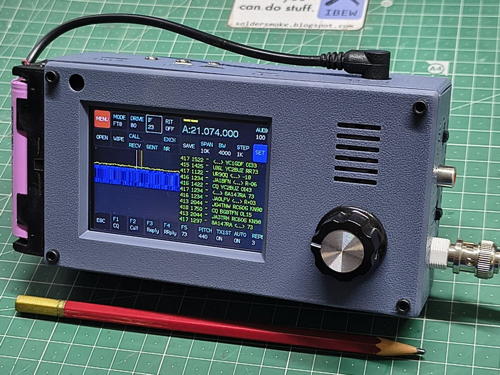
Picture of a small radio.
The zBitx measures just 6.5”x3”x1.5” and runs off two LiPo batteries.

Redditor asks for help getting back into the hobby

Redditor Cold-Description-586 writes:

An old teacher of mine that became a friend had an interest in ham radio. He gained his technician license, bought a radio, antenna, power supply, and wired everything into a shed. It was fun and enjoyable enough that I became interested in it and passed my technician test while he got his general and started transmitting 10 meters. I found this to be really interesting, however, he passed way and my enjoyment of the hobby ended. I’m curious how I could rekindle my enjoyment for the hobby being I have no immediate friends that like amateur radio and have forgotten many techniques of the art.

Here are some of the replies:

  • Get into POTA!
  • If you still have some gear, just turn it on and start listening. Make a few contacts. If you don’t have any radios, tune around on a WebSDR and listen. See if that interest is still there.
  • Identify which part(s) of [the hobby] intrigue you, and focus on those.

What suggestions would you have for Cold-Description-586?

Filed Under: Antennas, Gear/Gadgets Tagged With: OH2AXE/SV9RMU, zBitx

Operating Notes, January 5, 2026

January 5, 2026 By Dan KB6NU Leave a Comment

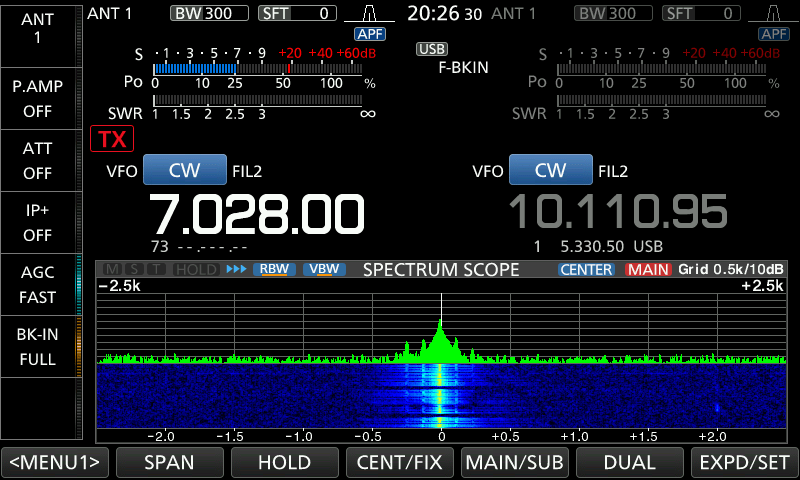
Screen shot of an IC-7610 band scope.
I’d recognize this signal anywhere.

It used to be that you could recognize an operator by the sound of their fist. That is to say the distinctive way that they sent dits and dahs while operating Morse Code. With the advent of the electronic keyer, fists have become less distinctive, but it’s still possible.

But, there’s another way you can now sometimes recognize an operator. You don’t even have to hear them send a single dit or dah. The key is what their signal looks like on your waterfall.

Yesterday, just after I turned on the radio, I saw a signal around 7022 kHz. Immediately, I knew who it was. I tuned it in, and sure enough I was right. This signal is a little more recognizable because it’s from a homebrew rig, but even so, other signals can probably be determined from how they look on the waterfall if they’re strong enough.

Straight Key Night 2026

As I’ve mentioned before, the only time I use a straight key on the air is Straight Key Night. This year, I only made four contacts before I put the Bunnel #9 back on the shelf. Even though I made only four contacts, two were notable:

  • I1MMR. If you live in the eastern U.S. and operate 40 meter CW at all, chances are you’ve worked Mauro, I1MMR. This was my 42nd contact with Mauro. This wasn’t strictly an SKN contact, but I’m counting it.
  • N0AX. Ward Silver is one of those hams that everyone seems to know. He’s the author of Ham Radio for Dummies and has edited the ARRL Handbook. Signals were S9 both ways and we had a nice chat before my wrist started to quit on me.

Short skip on 40 meters

Every once in a while, I get some really short skip on 40 meters in the evening. A couple of days ago, I worked a fellow who lives near Lansing, MI that QRZ.Com said was about 50 miles away. That’s gotta be too far away for ground wave, so it must be really short skip.

Right after that contact, I worked a guy near Bad Axe, MI, which is in “The Thumb.” (Take a look at a Michigan map, and you’ll see what I’m talking about.) He was only 110 miles away, according to QRZ.Com. Both stations were S9 here in Ann Arbor.

Filed Under: CW, Gear/Gadgets, Operating, Propagation Tagged With: short skip, Straight Key Night

Videos: 44 years of 44Net, Linux HT, Super Rybakov antenna

December 17, 2025 By Dan KB6NU Leave a Comment

44 Years of 44 Net

44 years ago, Hank Magnuski, KA6M, asked for some IP addresses for ham radio experimentation. He was assigned a /8 block, or 16,777,216 addresses. We now know this block addresses as 44Net.

The Linux HT

Can you really run Linux on an HT? Yes! Watch this video and see how it’s done.

The Super Rybakov

This talk by Max, G4SDX, to the Halifax & District Amateur Radio Society introduces a hands-on build of the “Super Rybakov” – an improved version of the classic end-fed vertical antenna. This looks like a great limited space antenna with efficient, multiband, HF performance.

Filed Under: Antennas, Digital Communications, Gear/Gadgets, Software, VHF/FM/Repeaters Tagged With: 44Net, LinHT, Rybakov

It’s almost like I have a new radio

October 10, 2025 By Dan KB6NU Leave a Comment

Man sitting at a picnic table in front of an amateur radio set.
Yours truly hunched over my KX3 at a picnic table at Grand Mere State Park. Photo: Dinesh, AB3DC.

A couple of months ago, Dinesh, AB3DC, and I were talking about our IC-7610s. Both of these radios were early production units and the displays exhibited the “image retention” problem. (Oddly, even though it was widely discussed when the IC-7610s first came out, I wasn’t able to find anything on the internet describing the problem, although there were several posts with the warranty repair notice.)

As we discussed this, it occurred to me that we have an authorized Icom Service Center here in Michigan (SAR Technical Services), and that we might be able to have both radios serviced at the same time and avoid shipping charges by driving the radios over to SARTS. So, I emailed Matt at SARTS and proposed this to him. He was very agreeable to this, and after checking the serial numbers of our units to make sure they qualified for the warranty repair, he replied that it would be a couple of months before he could get the displays.

A couple of weeks ago, I got an email from Matt saying that he now had the parts, and we arranged to bring the radios over to him yesterday, October 9. In order to make sure that he could get both radios serviced, Matt suggested that we get there by 9:00 am. Because it takes about two hours and fifteen minutes to get to St. Joseph, MI, where SARTS is located, from Ann Arbor, MI, where I live, we started out while it was still dark. After an uneventful drive, we got there just after 9:00am and dropped off our radios.

Since we had five or  six hours to kill, I had suggested that we take our POTA gear along and activate a couple of parks. The park closest to St. Joseph is Grand Mere State Park, so we stopped there first, arriving a little before 10:00 am. It’s a rather small park, without a lot of amenities, and as it turns out, it was quite a hike to get to the beach from the parking lot. We got partway in, and after trudging up one sand dune, and finding that it was still a long way to get the to beach, we retreated to a picnic shelter close to the parking lot. We set up my 66-ft. doublet antenna, making sure to avoid any poison ivy, and I made 13 CW contacts in a little less than 20 minutes.  I then passed the antenna over to Dinesh, who made 13 FT-8 contacts in about 25 minutes. We then packed up and headed to Warren Dunes State Park.

Warren Dunes is a great park. Since we were there on a Thursday afternoon in the fall, there weren’t many people there, but I can imagine that it gets quite crowded on a warm summer weekend. You can tell that it was made to hand a lot of people. It even has a gift shop!

Man sitting at a picnic table on the beach at Warren Dunes State Park.
Dinesh, AB3DC, enjoying the sunshine, the beach, and the propagation at Warren Dunes State Park.

We set up on picnic tables just outside a pavilion, and I pounded in the stakes holding up my telescoping mast easily into the sand there. I managed 14 CW contacts in 19 minutes and then passed the antenna over to Dinesh, who made about 20 FT-8 contacts in a little over 20 minutes. By the time we packed up, it was a little after 12:30 pm and time for lunch. We found a little brewpub in a nearby town and enjoyed a glass of beer with our sandwiches.

After lunch, we stopped to charge my friends car (he drives an EV), and just as we were on our way to the charging station, Matt from SARTS called and said that our radios were ready. After charging the car, we headed back to St. Joseph to pick up the radios.

When we got there, Matt explained what he had done. For me, Matt had not only replaced the display, but also the clock battery (free of charge). In addition, he upgraded the firmware to the latest version. The invoice also noted that he tested transmit and receive functions, the antenna tuner and antenna tuner connector, the CI-V connector, and the USB and DVI ports. My friend’s radio received the same services, except his clock battery was good, so it was not replaced.

Matt also replaced the power connector on my radio (he called while we were at Grand Mere SP to get my approval), as the tabs holding it to the back panel had become compressed and was kind of just floating there. The charge for that was $35.

I was pretty tired when I got home, so I took a nap, then ate dinner before hooking the radio back up again. When I did, the first thing I noticed is how bright the screen is. Seriously, it almost feels like I have a new radio. I had to actually turn down the brightness to operate it comfortably.

An amateur radio sitting on a desktop.
My “almost like new” IC-7610 in action.

Having to get a radio serviced is usually a real pain. You have to box it up and hope it gets there in one piece. Then, you have to wait for the radio to be worked on and for it to be shipped back to you. By contrast, this was a really nice experience.  Although the drive was a little long, we were able to get our radios serviced the same day, and we each activated two new parks. The weather even cooperated. I was a little concerned that it would be kind of cool, but with the temperature in the lower 60s, it was just fine. Thanks to my friend who did all the driving and to Matt for a great service experience.

Filed Under: Gear/Gadgets Tagged With: AB3DC, IC-7610, SAR Technicial Services

Zero Retries Digital Conference to be held on Saturday, September 13, 2025 in Everett, WA

August 15, 2025 By Dan KB6NU Leave a Comment

I should have posted this sooner. My bad. If you’re in the Northwest and are interested in digital communications, please consider attending this conference in person. If you’re not, you can still sign up to attend the sessions virtually. There’s even an option for your club to attend virtually….Dan


We are pleased to invite you to the Zero Retries Digital Conference (ZRDC) that will be on Saturday, September 13, 2025 at the Edward Hansen Conference Center in Everett, WA. Due to the pandemic and other reasons, there has not been an in-person Amateur Radio digital conference for several years or any known plans for upcoming conferences. With GNU Radio hosting their conference at the same venue the week prior to ZRDC, Zero Retries seized the opportunity to bring back the in-person Amateur Radio Digital Conference to the Pacific Northwest. However, if people are unable to travel, there are alternative means to participate on the conference page link below and on the registration form.

About Zero Retries

Zero Retries is a unique independent newsletter that promotes technological innovations in Amateur Radio. The Editor, Steve Stroh N8GNJ, writes the majority of the newsletter with an occasional submission by one of his readers. Steve refers to Amateur Radio as, literally, a license to experiment with and learn about radio technology. He often jokes, but is serious, that radios are now computers… with antennas.

About the ZRDC

Planned presentations and demonstrations will be designed to enhance the skills and knowledge of the participants with topics such as but not limited to the IP400 Networking Project, M17 Digital Voice/Data system, MMDVM-TNC data system, ARDC’s 44Net VPN, software defined radio (SDR) and AREDN, HamWAN and other Amateur Radio microwave networking.  Attendees will have the opportunity to connect with peers, and discover innovative technologies that are shaping the future of Amateur Radio. A call for papers has been sent, which will provide the opportunity to learn from leading experts. The ZRDC 2025 will highlight the resilience and adaptability of the Amateur Radio community in the Pacific Northwest by embracing new platforms and technology that continue to foster the passion for radio communication.

In closing, I have created various ticket prices and multiple ways to participate. Please share this information as you see fit with others that might be interested. I have included the links below for registration and the conference. If you have any questions, please don’t hesitate to contact me. Thank you for your time and consideration and hope to see you at the conference.

Sincerely,
Tina Stroh KD7WSF
Business / Conference Manager
[email protected]

Zero Retries Newsletter
https://www.zeroretries.org

Zero Retries Digital Conference 2025
https://www.zeroretries.org/p/conference

Registration for ZRDC 2025
https://lp.constantcontactpages.com/ev/reg/7852x9m

Filed Under: Digital Communications, Hamfests

The 2025 Four Days in May Symposium: An Introduction to LTspice, A Tube Transmitter for SOTA, SSB for the QMX, and more

May 22, 2025 By Dan KB6NU Leave a Comment

In years past, you could always count on a QRP-ARCI Four Days in May (FDIM) talk by Rev. George Dobbs, G3RJV. You might never know what the subject would be, however. As Bill, N8ET, put it, “He always submitted a paper for the FDIM Proceedings, but would often talk about something completely different.”

G3RJV became a Silent Key in 2019, but Jack Purdum W8TEE, Ashhar Farhan VU2ESE, and Hans Summers G0UPL have all stepped in and picked up the slack. All three have become FDIM regulars, and each presented interesting talks at this year’s FDIM. And, to round out the lineup, we were treated to talks by N8ET, WA5BDU, AI6XG, NT7S, and VK1UN as well.

Click on the video link next to each title to watch the recorded video.

The T41EP: Seven Years Later (video)

Jack W8TEE and Al AC8GY presented a short history of the T41, their software-defined transceiver (SDT) that they’ve been working on for the past seven years. Jack recalled that the T41 had its birth on the drive home from a Field Day trip in 2018. During that trip, Jack and Al hashed out some of the basic requirements, including:

  • It would be a software-defined transceiver (SDT).
  • It would have a spectrum/waterfall display capable of displaying up to 192 kHz of bandwidth.
  • It would be self-contained and not need a PC or laptop.
  • It would support CW and SSB with up to 20 W output power.
  • It would operate on the 80-meter, 40-meter, 20-meter, 15-meter, and 10-meter bands.
  • Both the hardware and software would be open-source.
  • It would be affordable for someone whose income was mowing lawns over the summer.

They explained how they made their design decisions, including how the hardware and software has evolved over the years. They also discussed some of the benefits of sticking with a project over several years. I think that this approach has certainly paid off. There are more than 1,000 T41 units currently in the field, and if this talk is any indication, there will be more in the future.

A QRP Messaging System Using FT8 Technology (video)

In this talk, Farhan, VU2ESE, described his software for passing short messages using FT8 technology. He has currently implemented this software on the zBitx transceiver, but it is still in beta mode.

VU2ESE’s paper is not, unfortunately in the proceedings, but if you’re interested in obtaining a copy, you can contact Farhan directly. Look for Farhan’s specification for his messaging software in the next issue of QRP Quarterly.

An Introduction to LTspice (video)

Nick, WA5BDU, then introduced the crowd to the wonders of LTspice, a free software package that allows you to simulate analog circuits. In addition to the analog simulator, the package includes a graphical interface that allows you to input circuit schematics and view waveforms. This software is being developed and maintained by Analog Devices and is available for Windows and Mac OS.

In his talk, Nick quickly ran through the features of LTspice using a simple transistor amplifier as an example. He also showed how to analyze crystal filters using the software.

In his paper, the author asks the question, “Is it (LTspice) hard to learn?” His answer is, “You can learn to draw a schematic and run a simulation in 30 minutes or less. You can also use it off and on for several decades and still have a lot more to learn. Sort of like electronics itself.” As this talk demonstrated, this is certainly the case.

A Project for the Decades: A SOTA CW Tube Transmitter (video)

This talk was a lot of fun. This project had its genesis in an article found in the March 1967 issue of Electronics Illustrated titled, “A 1 Bottle Xmitter for 40.” Dan Koellen, AI6XG, took that circuit and adapted it for portable operations, namely Summits on the Air (SOTA).

One of the challenges Dan faced was powering the transmitter with a 12 V battery so that it could be operated portable. The original project plugged into an AC outlet and included a power transformer to supply the 6.3 V filament voltage and the high voltage on the plate. Providing the correct filament voltage was easy—Dan used a 12AQ5 instead of a 6AQ5.

Supplying the high voltage was a bit trickier. Fortunately, he found a DC-DC converter designed to power Nixie tubes, which require a voltage of approximately 180 V. Not only did he find one—the Omnixie NCH6300HV—that could output up to 230 V, they were electrically quiet as well.

To implement the transceiver functionality, Dan used a QRP Labs QCX as the receiver and keyer, along with a T/R switch and bandpass filters that he designed for this project, Dan successfully activated W6-NC-402. He made seven 40-meter CW contacts, including two summit-to-summit QSOs. According to Dan, “The fun factor was a Spinal Tap 11 out of 10.”

A History of FDIM (video)

Right after lunch, Bill, N8ET, ran through some of the history of Four Days in May, dating back to when it started in 1996 at the Days Inn Dayton South. The organizers planned for 50 attendees, and were quite surprised when more than 100 registered! Bill attributes this to the great slate of presenters, including L.B. Cebik W4RNL, Dick Pascoe G0BPS, George Dobbs G3RJV, Gary Breed K9AY, George Heron N2APB and Joe Everhart N2CX, and Rex Harper W1REX.

The proceedings has the tables of contents for most of the symposium proceedings, and I’d encourage you to get a copy if you weren’t fortunate enough to attend the event. It’s really quite impressive the number of quality talks and projects that FDIM has supported over the years.

Beyond the ‘612 (video)

Since its release in 1987, the SA612 Gilbert Cell mixer, and all its variants, have been used in countless QRP projects. This era is, however, coming to a close. No new parts have been manufactured since 2022, and soon, new parts will be unobtainium.

This situation prompted Jason Mildrum, NT7S, to search for an alternative. His search was made more difficult because so many radios now are software-defined radios (SDRs) and don’t require mixers the way that superheterodyne radios do. Fortunately, Jason discovered the Maxim MAX268x series. Although designed for microwave applications, Jason concluded that the parts could be used for HF QRP radio projects after a fairly comprehensive series of tests. Using these parts, he built a QRP transceiver, with which he has completed several successful POTA activations.

At the end of his talk, Jason hinted that a return of Etherkit, his kit company, might be in the cards. Stay tuned for that.

Bringing SSB to the QMX (video)

Hans, G0UPL, opened his talk by apologizing for taking nine whole months to implement SSB on his QMX transceivers. I don’t know about you, but I think it’s rather remarkable that he was able to do it in such a short time! It would have taken anyone else much longer to do it.

Hans then launched into an explanation of how he was able to achieve this feat. After a review of digital signal processing (DSP) basics, he jumped into an explanation of polar modulation, the technique used in the QMX to generate single sideband. Hans’ paper in the proceedings includes references to papers which really get into the details of how polar modulation works, if you’re so inclined to read them.

Hans also got into some detail on his development process. After some initial failures, he decided to simply try the code that runs then uSDX and was quite surprised that it actually worked on the QMX. That began a series of improvements that resulted in the software that QMX users can now download and run on their radios.

I can’t really say that I understand everything that’s going on, but I think that with some review of Hans’ paper and some of the others that he references, I could get a better handle on it. I do know that his talk has inspired to complete the QMX kit build that I started months ago.

Stealth Operations from Hotel Rooms and Other Unlikely QTHs (video)

Ross Valentine, VK1UN presented the last talk of the day. It described his operations using QRP radios and short wire antennas from a number of “unlikely” locations that he’s been in around the world.

As far as radios go, small and light are the ticket. He has a selection of QRP Labs’ QCX and QDX radios, and uses small lithium batteries to power them. To run digital modes, he uses a Raspberry Pi 400 with a small LED/LCD display.

For antennas, he favors wire-wrap wire, often wound on a fishing reel. He notes that the wire is light and very difficult to see, even in bright sunlight. He tunes the antennas with a variety of homebrew tuners, including simple LC tuners, Z-match tuners, and FRI-match tuners, some using homebrew variometers for the inductors.

With this simple gear, Ross’s results have been impressive. He showed plots of his WSPR signal being spotted all around the world.


If these talks don’t inspire, I don’t know what will. I mentioned earlier that Hans’ talk has inspired me to finally get my QMX working, but I’m now also motivated to play around with LTspice, and I have some ideas for tube circuits that I want to build as well. The trick is going to be completing these projects before next year’s FDIM, when I’m sure another all-star lineup of presenters will inspire me to tackle yet more projects.

To get a copy of this year’s proceedings, contact Bill, N8ET at [email protected]  or   [email protected].

Filed Under: Gear/Gadgets Tagged With: HF Signals, QRP Labs, QRP-ARCI, T41-EP, WSPR

Buttons are back, baby!

April 21, 2025 By Dan KB6NU 3 Comments

Several years ago, I got a good deal on a Flex 6400 and thought I’d give it a try. It’s a great radio, and I enjoyed using it, but after a couple of years, I decided to give it up and buy an Icom IC-7610 instead. The main reason was the user interface—the IC-7610 has real knobs and buttons instead of just a computer screen to control its functions. Maybe I’m just being old school (I am certainly getting old), but I prefer real knobs and buttons, even if those knobs and buttons are just providing digital inputs to the processor controlling the radio.

Recently, I’ve run across a couple of articles that back me up on this. The first, “Touchscreens are out, and tactile controls are back,” is an interview in IEEE Spectrum with Rachel Plotnick, an associate professor of cinema and media studies at Indiana University in Bloomington, and a leading expert on buttons and how people interact with them.

She says that while touchscreens are a useful interface, people are becoming somewhat fatigued by the use of them. “People seem to have a hunger for physical buttons,” she says, “both because you don’t always have to look at them—you can feel your way around for them when you don’t want to directly pay attention to them—but also because they offer a greater range of tactility and feedback.”

She also said something else I found interesting. “Buttons tend to offer you a really limited range of possibilities in terms of what you can do. Maybe that simplicity of limiting our field of choices offers more safety in certain situations.”

I might say that it also makes the user interface more straightforward and easy to understand and use. Take the receiver incremental tuning (RIT) control, for example. I use this control frequently on my IC-7610, I press a button to turn it on and a knob to set the offset. On the Flex, however, using the SmartSDR software, I’d have to go to the X/RIT menu, click on the RIT button on the screen, then set the offset by clicking right or left arrows or by typing in a text box. It’s just not as simple to do as on the IC-7610, so I found myself using that control less often.

ICOM IC-7610 transceiver
On my IC-7610, the RIT controls are conveniently located in the lower right-hand corner.

The second article is “Subaru is bringing back physical knobs and buttons in its cars.” The article begins, “To the relief of practically anybody who drives a car regularly, Japanese carmaker Subaru has brought back physical buttons and knobs for its 2026 Outback midsize SUV. It’s yet another sign that carmakers are finally starting to listen, ditching massive touchscreens that have taken over a vast number of vehicle controls in favor of tactile buttons, switches, and knobs.”

Of course, touchscreens are the appropriate choice for many transceiver functions. The IC-7610 touch screen not only displays the waterfall, but also lets you select a signal by touching it on the screen. That works great for me.

The lesson to be learned here is that a good user interface can help increase sales. These days, almost all of the radios from the major manufacturers are so good that the average ham can’t really detect a difference in performance. That leaves the user interface as one of the differentiating features, and you’d think that a more usable user interface would sell more radios. And, it appears that physical, tactile buttons and knobs are going to be a part of that user interface.

Filed Under: Gear/Gadgets Tagged With: buttons, IC-7610, Icom

Will tariffs affect the cost of ham gear?

April 17, 2025 By Dan KB6NU 6 Comments

A friend of mine asked me the other day how the proposed tariffs will affect the cost of ham gear. Not being an economics guy, I really have no clue, except to say that prices will probably go up.

Well, today I came across an email from Connect Systems, who import radios for digital communications.

Here’s their analysis:

Tariffs

The mark-up for amateur products in not very high. The following is how we figure the cost of the product:

CS750 cost to manufacture…….$115.00
Shipping………………………………..$15.50
Credit Card Cost ………………………$9.56
Tariffs at 25% ……………………….$28.75

Total out of pocket cost………….$168.81

Selling Price …………………………$239.00

Profit = 239 – 168 = $71

Now lets assume the tariffs are at 100%. The analysis is now as follows:

CS750 cost to manufacture…….$115.00
Shipping………………………………..$15.50
Credit Card Cost ………………………$9.56
Tariffs at 100% ……………………$115.00

Total out of pocket cost………….$255.06

Selling Price ………………………….$239.00

Profit = 239 – 255.06 = $(16.06)

If I don’t change the selling price, I would loose $16.06 for each radio sold.

The above analysis does not cover the cost of things such as cost of running the on-line store, salary, and other business expenses.

While I do not expect the tariffs to be set at 100%, I would be very surprised if the tariffs do not increase from the current rate.

We anticipated the tariffs and we bought a large stock of our standard products. We will keep the price the same until we run out of stock. While I cannot predict the selling price in the future because I do not know what the tariff rates are going to be, you can expect some type of increase.

When you buy direct from a Chinese company, you will not see a price increase. However, the tariffs are going to be paid by you before it is delivered.

Of course, who knows what the final tariffs, if any, will be, but this is something to keep in mind. It was reported this morning that car sales have jumped in anticipation of the tariffs raising automobile prices. Crazy times.

Filed Under: Gear/Gadgets

Videos: Single sideband, HAMNET update, HF propagation

March 21, 2025 By Dan KB6NU Leave a Comment

Introduction to SSB

This is an Air Traffic Command instructional video describing the theory behind single side band (SSB) modulation. Dig that jazzy intro music!

HAMNet Update

HAMNET (Highspeed Amateur radio Multimedia NETwork) is a fully-independent amateur radio wireless network that provides data services. It’s a wireless internet, so to speak. It covers many regions in Europe and is even now growing fast beyond its European border. Hamnet is using international coordinated IP-address space of the AMPRNet (44.0.0.0/8) and Autonomous System (AS) numbers out of the 16-bit and 32-bit private AS number space to interconnect active regions by external Border Gateway Protocol (BGP) routing.

Here is an up date on HAMNET given at the recent FOSDEM conference.

Rohde & Schwarz on HF Propagation

Rohde & Schwarz produces some of the finest RF instrumentation in the world. They also produce great videos on RF topics. This one explains HF propagation.

Filed Under: Communications Theory, Digital Modes, Networking, Propagation, Videos Tagged With: HAMNet, single sideband

  • Page 1
  • Page 2
  • Page 3
  • Interim pages omitted …
  • Page 59
  • Go to Next Page »

Primary Sidebar

No Nonsense Extra Class License Study Guide: for tests given between July 2024 and June 2028

New No Nonsense Extra Class Study Guide now available!

The 2024 version of my Extra Class study guide is available in PDF, ePub, Kindle, and print versions.

Click here to get all of my "No Nonsense" study guides.

Also available: The CW Geek's Guide to Having Fun with Morse Code

W5SWL.Com
Retevis Ailunce H1 DMR Radio
DXpander: Cobweb antennas, Laser Cutting

You’ve got mail!

Enter your email address below and get an email every time I publish a new post.

Email


I frequently teach classes to help newcomers get their licenses. The next class will take place on Saturday, February 7, 2026 on the University of Michigan campus. Click here for more information.

If you can't make the class, subscribe to the mailing list to be notified of when the next class will be held.

You can always download my free study guide, and if you have any questions about the classes, or amateur radio in general, please feel free to email me directly.

Support KB6NU.Com

Donate $7.30 and get two of these cool stickers. Measuring 4.25-in. W by 2.75-in. H, it's perfect for your car, your shack, or wherever!

Contact me

If you have a question or comment about one of my blog posts, or a question about any of the material in my study guides, or just a question about ham radio in general, you can email me at [email protected].

Blogs You Should Also Read

  • AE5X: A CW-centric blog from Kingswood, Texas
  • K0LWC Blog
  • LA3ZA Ham Radio Blog
  • Little Radios, Big Fun – WB3GCK
  • Mr. Vacuum Tube's Blog
  • Radio Artisan – K3NG
  • The K0NR Weblog
  • VE3WDM's QRP Ham Radio Blog
  • W2LJ’s Blog

Ham Radio Websites

  • Dashtoons – The Hammin' Comedy by Jeff K1NSS

Podcasts

  • ICQ Podcast
  • Linux in the Ham Schack
  • No Nonsense Amateur Radio Podcast
  • Resonant Frequency Amateur Radio Podcast

Recent Comments

  • Mike on Map your contest QSOs
  • Phillip Cardwell on J-Poles
  • Dan KB6NU on Dayton Hamvention 2026: Day 1, Wednesday, May 13
  • Randy Shake on Dayton Hamvention 2026: Day 1, Wednesday, May 13
  • John Hislop on New edition of my No Nonsense Technician Class License Study Guide now ready for review

Meta

  • Log in
  • Entries feed
  • Comments feed
  • WordPress.org

Footer

Copyright © 2026 Daniel M. Romanchik, KB6NU · Log in