• Skip to primary navigation
  • Skip to main content
  • Skip to primary sidebar
  • Skip to footer

KB6NU's Ham Radio Blog

KB6NU's Ham Radio Blog
  • HOME
  • Study Guides
  • Teach a One-Day Tech Class
  • W8SRC Repeater Guide
  • Advertise
  • Hire Me

Gear/Gadgets

Videos I’ve been watching: HF propagation, how to use a NanoVNA, Hallicrafters’ world of SW radio

September 1, 2024 By Dan KB6NU Leave a Comment

W3LPL on HF propagation

At an hour and a half, this video is kind of long, but if you’re interested in propagation, it’s worth watching.

W2AEW on how to use a NanoVNA to measure a filter’s characteristics

Alan, W2AEW, shows how to use a NanoVNA, which is one of the most useful tools for characterizing RF components and circuits.

Hallicrafters World of SW Radio

Back in the day, Hallicrafters was arguably the biggest name in amateur and shortwave radio. Unfortunately, this is just an audio file, but I guess, radio is audio so just close your eyes and imagine that you’re listening to this on a Hallicrafters receiver.

Filed Under: Computers, Propagation, Software, Test Equipment Tagged With: Grace Hopper, nanoVNA

Partly-baked idea: Earning the “ham radio hacker” title

August 16, 2024 By Dan KB6NU 5 Comments

Last week, I attended DEFCON, where I gave my “Ham Radio for Hackers” talk and mingled with a number hacker types. This talk seems to have struck a chord. It was featured on Hack-a-Day, and recently, Steve Stroh, N8GNJ, commented that I am “fast becoming the Amateur Radio Evangelist of techies / hackers / makers.”

All this has got me thinking, though, that perhaps I’m not really walking the walk, so to speak. After all, I’m using an Icom IC-7610 in the shack and an Elecraft KX-3 out in the field. I am using a K3NG keyer that I built as my main keyer, and I have been building my own antennas and baluns, but to really earn the title “ham radio hacker” perhaps I need to step up a little more.

A piece of electronic equipment.
The VU2ESE sBitx is very hackable.

So, how do I really earn that title? What comes to mind is that I could sell my current closed-source gear (dare I say appliances) and go with all homebrew and/or open-source gear. For example, for the shack, I could sell my IC-7610 and purchase an HF Signals sBitx. The sBitx is a 40 W, fully open source, high performance HF SDR transceiver with built-in digital modes, including FT8, RTTY, PSK31, and more, in addition to CW and SSB. Based on a Raspberry Pi 4, this radio is very hackable.

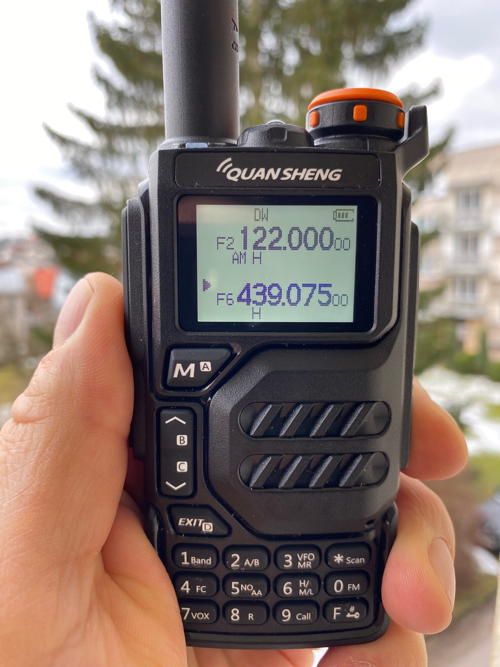
For VHF/UHF operation, I could go with any of the radios that support OpenRTX. Open RTX supports M17 on some radios, too. There’s also the Quansheng UV-K5. There are many open-source firmware hacks for this radio.

Antennas I pretty much have covered. I bought a Buddipole about 15 years ago, but aside from HT antennas, that’s the only commercial antenna that I currently own.

These are all just partly-baked ideas at this point. I don’t know if I’ll ever actually do this, but now that I’m retired, I certainly have the time to do it. Please let me know what you think. Are there other cool open-source/homebrew projects out there that I should also consider?

Filed Under: Building/Homebrew, Gear/Gadgets, Software Tagged With: open source

Random stuff: Make your first CW contacts, subscribe to the ORI newsletter, FD publicity

July 22, 2024 By Dan KB6NU Leave a Comment

Get the ORI newsletter

Open Research Institute, Inc. (ORI) is a non-profit 501(c)(3) research and development organization which provides all of its work to the general public under the principles of open source and open access to research. Their projects include, but are not limited to, amateur radio projects. The amateur radio projects include Ribbit, a new digital text messaging mode for VHF/UHF simplex and repeater communication, and RF BitBanger, a low-power high-frequency digital radio.

To stay informed on these and other projects, go to https://www.openresearch.institute/newsletter-subscription/ and subscribe to their newsletter. On that page, you’ll also find links to back issues.

Field Day gets many mentions

This year, Field Day got more publicity this year than any year that I can remember. My Google Alerts was almost overflowing with links to stories in local newspapers. One of the stories that got mentioned a lot was “Colorado’s ham radio operators are ready for an emergency—just don’t call them amateurs.” It’s worth reading.


Filed Under: CW, Digital Communications, Emergency Communications / Public Service, Gear/Gadgets, Promotion & PR

How to troubleshoot a jumper wire

July 4, 2024 By Dan KB6NU 2 Comments

Tuesday, my friend Paul, KW1L, texted me, and asked if I could come over to his house and help him with his new antenna. He had just purchased and installed a Cobra Ultra-Lite Junior, and he didn’t think that it was performing as well as it should.

A piece of wire with alligator clips on each end.
The suspect jumper wire.

I won’t go into all of the details, but one of the checks he had made was to measure the continuity of the feed line, which is 80 feet of 18-gauge, 450 Ω ladder line. To do this, he connected the jumper wire in the photo at right across the ladder line in his shack and then measured the resistance at the antenna feed point.

The measurement that he came up with was 16 Ω. Well, the National Institute of Science and Technology (NIST) says that the resistance of 18-gauge solid wire should be about .0064 Ω/ft. Using that figure, the resistance should be somewhere near 1 Ω.

So, Paul asked me to bring over my DMM, which I did yesterday. We dropped the antenna, put my Fluke 79 across the feed point, and measured close to 16 Ω.

It didn’t make much sense, but the only reasonable explanation was that the problem with this measurement was the jumper wire. This was somewhat troubling to Paul, as he had a sentimental attachment to this jumper wire. It was given to him by a fellow who worked for him at Xerox, and he pointed out to me how well-made it was. He noted, for example, that each end of the wire had been tinned before it was screwed to the alligator clip.

I agreed that it was well-made, but certainly one or both of the connections could have oxidized, resulting in a high-resistance connection. And guess what? When I measured the resistance of the jumper, it turned out to be about 15 Ω!

I then unscrewed the wire at one end and measured again. It measured 15 Ω. I unscrewed the wire at the other end, and voilá, I measured 0 Ω. I screwed the alligator clips back on, and the overall resistance was near 0 Ω again. My guess is that the second connection was a little loose, and that over the years, some oxidation built up on both the wire and the alligator clip.

Whenever we do something like this, Paul likes to ask, “So, what did we learn from this?” In this case, I think what we learned is that even jumper wires can go bad. It’s also a validation of the KB6NU Theory of Electronic Failures, i.e. at least 80% of the problems associated with electronic equipment are problems with cables or connectors.


Filed Under: Antennas, Gear/Gadgets, Test Equipment Tagged With: KW1L

A different kind of public service for ham radio clubs

May 24, 2024 By Dan KB6NU Leave a Comment

Amateur radio is supposed to be all about public service, but it doesn’t always have to include radio. At this year’s Ann Arbor Creativity and Making Expo, I ran into Dale Grover of Maker Works, a non-profit makerspace here in Ann Arbor, MI. He mentioned that he’d recently gotten a grant to repair assistive devices for people with communication and access needs.

These devices are used in schools that generally don’t have a big budget for repair. It seemed like a good opportunity for ARROW members to use their electronic skills for a good cause, so I told him that I’d try to find some volunteers to help out.

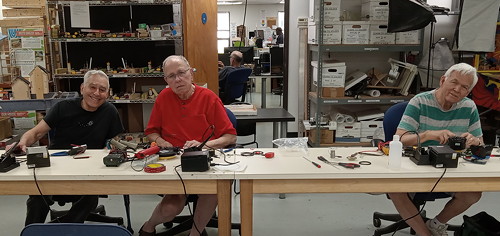
I got a great response to my call for volunteers, and yesterday afternoon, four ARROW members met at Maker Works to fix assistive devices. Shown below is Paul, KW1L; Rick, K8BMA; and Ron, K8RCF. Yours truly is taking the picture.

Three men sitting at a workbench.
Typically, devices have a big switch that the user presses to play a pre-recorded message. The problems are generally easy to diagnose, and the repairs are generally simple repairs. Rick, for example, replaced the plugs on several of the devices, and Paul and Ron replaced the speakers in several of the units.

One of the devices that I tackled came with a note that read, “Won’t play or record, even with a new battery.”

A defective battery clip in an electronic device.As we all know, the first step in troubleshooting is to verify the problem. So, I obtained a new battery and opened the battery compartment. As shown in the photo at right, it was clear that the problem was a defective battery clip. Somehow, someone managed to tear the negative contact off the clip. I replaced the battery clip and brought the device back to life!

Overall, we probably fixed close to ten devices, including the pushbutton switches. We probably could have fixed more, but it took us some time to learn how to disassemble and then reassemble the devices.

Even though the fixes are usually simple, they can also be a bit frustrating. For example, the device that I replaced the battery clip on wouldn’t go back together very easily. It looked to me as though the screws holding the device together just aren’t long enough. Other devices had similar design issues.

Our first repair session was a fun and interesting exercise, and we plan to go back in the future. There are many more devices to fix. I asked Dale, our contact at Maker Works, if we might schedule an evening session so that our members who are still working can attend. After all, why should us retired guys have all the fun?


Having said all that, I have to believe that there are public-service opportunities like this in your community that your clubs could help with. Keep your eyes open and get your clubs involved. If there’s an expense, for say equipment or replacement parts, you can always apply for a club grant from the ARRL or ARDC. I’d be happy to help you write the proposal, if you need help.

If you do find similar opportunities, please let me know, and I’ll spotlight them here on my blog. These kinds of projects provide a real public service even if they don’t involve radio.

Filed Under: Emergency Communications / Public Service, Equipment Maintenance Tagged With: makerspace, troubleshooting

Dayton 2024 had it all: Four Days in May

May 23, 2024 By Dan KB6NU Leave a Comment

On Thursday, May 16, I attended Four Days in May (FDIM), an event put on by the QRP Amateur Radio Club International (QRP ARCI). The first FDIM was held in 1996, and QRP ARCI has held it every year since, excluding the Covid years. This year, nearly 300 people attended the event.

Like the name implies, there are FDIM events on Thursday, Friday, Saturday, and Sunday, but the main event is the series of talks on Thursday. These start at 8 am and run until 5 pm. This year, the talks included:

  • The Construction and Use of a WhoZat by Jack Purdum, W8TEE. Jack is a retired professor from Purdue University, a frequent speaker at FDIM, and the designer of many microcontroller-powered ham radio projects, including transceivers and antenna analyzers. This year, he talked about his latest design, the WhoZat. WhoZat is a portable, battery-powered device that allows an operator to type in a call sign prefix and obtain information about the country associated with the callsign. It will give you the country name, and the azimuthal bearing from your location to that country. One of the takeaways from this talk is that the WhoZat is powered by a Raspberry Pi Pico, and Jack encouraged everyone to consider the Pico for future projects because it has more computing power and more memory than most Arduinos.In addition to talking about the WhoZat, Jack was promoting his latest book, Digital Signal Processing and Sofware Defined Radio. It’s available on Amazon for $45.
  • Top 10 Junkbox Projects by Hans Summers, G0UPL. Hans is the genious(?), madman(?), entrepreneur(?) behind QRP Labs. In this talk, he extolled the virtues (as I have done) of a well-stocked junkbox. The project that resonated the most with me is the one-tube transmitter.The reason it resonates with me is that I’ve been threatening to build one for years myself. Hans actually did it, though. In fact, he made his first QSO with a transmitter he built from an ECL82 tube.At the end of his talk, Hans gave a little plug for his newest transceiver, the QMX+. The embedded SDR rig covers 160 – 6m, in a slightly bigger form factor than the QMX, for only $125. It’s incredible, really.
  • zBitx–A Portable Station for the CW Operator by Ashar Farhan, VU2ESE of HF Signals. In this talk, Ashar described his zBitx, a portable CW/FT8 SDR transceiver. This isn’t a radio that Ashar is selling (yet!), but it does look like a complete design. And, of course, that design is completely open source, something he ribbed one of the other presenters about.
    A small radio with a smart phone user interface.
    The zBitx is a very small, portable CW/FT8 radio that uses a smart phone for an enhanced user interface.

    This radio is powered by a Raspberry Pi, specifically the Raspberry Pi Zero 2 W. This module costs $15 and runs Linux. Ashar says, “If Arduino was a matchbox RC car, this Raspberry Pi is an Airbus A380, both in terms of size and speed. It can run WSJT X, fldigi, and full-stack SDR.” The radio also takes advantage of the WiFi capablity of the RPi. There’s an app that runs on a smart phone that acts as a front panel.

    At the end of his talk, instead of flogging a product, Ashar passed out a small PCB assembly called the sBitx Hat. Designed to plug into a Raspberry Pi, it includes an Si5351 clock generator and a 96 kbps, dual-channel audio codec. It looks it will be a fun thing to play with.

  • Adventures of a QRP Evangelist by Cliff Batson, N4CCB, proprietor of the QRP School YouTube channel. Cliff gave us a primer on QRP operation and on how to make YouTube videos. He encouraged us all to go out and make videos. I’m not so sure about this myself. It seems to me that there is already too many ham radio videos to watch.
  • Amplifying Your Adventures, Minimizing Your Power by noted YouTuber Tom Witherspoon, K4SWL. In his presentation, Tom concentrated on the personal and operating aspects of QRP, not the technical. The conclusion published in the proceedings does a good job of summarizing his talk. It reads, “Since my journey into ham radio began in 1997, I’ve encountered countless naysayers proclaiming, ‘That won’t work’ or ‘Life’s too short for QRP.’ These discouraging words often came from individuals who lacked firsthand experience in the field. Rather than accepting the pessimistic views, I’ve treated them as a checklist of challenges to overcome. my approach has been simple: get out there, experiment, and fully immerse myself in the moment. It’s through this hands-on exploration that I’ve discovered the true joy and potential of QRP operations.”
  • Designing the Elecraft KH1: From Vision to Reality by Wayne Burdick, N6KR. Wayne certainly needs no introduction. His talk concentrated on how he made some of the decisions he made in designing the Elecraft KH1 hand-held HF transceiver. It was a great talk that gave quite a bit of insight into the design process. Personally, I’m not sold on the KH1, but Elecraft can’t make them fast enough, so I guess that tells you how valuable my opinion is.
  • The Amazing Thermionic Valve by Greg Latta, AA8V. Greg is a professor emeritus of electrical engineering from Frostburg State University. He delved into some of the theory of how vacuum tubes work and some of the practical applications.
  • Stealth Operation from Hotel Rooms and Other Unlikely QTHs by Ross Ballantyne, VK1UN.

Unfortunately, Ross was unable to present, either in person or via Zoom. According to the paper in the proceedings, Ross was part of several peace-keeping missions to remote spots around the world. On these trips, he operated from many hotel rooms and gained quite a bit of experience doing so. For example, he writes that virtually all of his antennas are made from wirewrap wire, which he gets from Ali Express. To couple the wire antenna to the transmitter, he uses a Z-match tuner or a modified Z-match tuner called the FRI match ATU. It’s a shame that Ross wasn’t able to adress us in person, as he sounds like quite an interesting fellow.

A walk with VU2ESE

After the talks, I decided to take a walk and stretch my legs. Just as I got to the street, I ran into a friend of mine, Arun, W8ARU, and Ashar, VU2ESE. We decided to walk together, and ended up walking about a mile and a half or so.

Arun and Farhan have been friends for many years. In fact, Arun hired Ashar to work for a company that Arun owned when he lived in India. (Arun now lives in Ann Arbor, MI, which is how I got to know him.) Arun once told me the taught Farhan how to solder. I confirmed that story at Hamvention last year when Ashar visited the ARDC booth.

In addition to all his development activities, Farhan recently joined the board of directors of Amateur Radio Digital Communications (ARDC), the private foundation that I retired from last May. We had a great chat about the future of ARDC and amateur radio in general, among other topics. It will be interesting to see in which direction the new board members take ARDC.

Vendor Night

Thursday evening, FDIM holds Vendor Night. It’s a great deal for vendors. There’s no charge to participate as a vendor, and it’s a lot of fun. A couple of years ago when I did Vendor Night, I also shared a booth with the Dayton Makerspace on Friday and Saturday at Hamvention and ended up selling more books in 2 hours at the FDIM Vendor Night than I did in 2 days of Hamvention.

This year, I sold about $150 worth of books. What was even better was meeting everyone, including those who have used my books to get licensed or to upgrade. For example, Tom, K4SWL, came over and shared his story with me.

He said that one year his wife said that she would also get her ticket as an anniversary present. He gave her my study guide and ten days later, she had her license. How cool is that?


Kudos to QRP ARCI for another successful FDIM. If you’d like to get a copy of this year’s proceedings, you can contact them by emailing [email protected] or [email protected]. QRP ARCI also has some other goodies, if you’re interested, in their Toy Store.

Filed Under: Gear/Gadgets, On the Internet, Videos Tagged With: FDIM, Hamvention, QRP-ARCI

Amateur radio in the news: Hackable ham radio, ham radio at the museum, club hosts Scouts

April 5, 2024 By Dan KB6NU Leave a Comment

The Most Hackable Handheld Ham Radio Yet

The [Quansheng] UV-K5, released last year, might be the most hackable handheld ever, with a small army of dedicated hams adding a raft of software-based improvements and new features. I had to have one, and $30 later, I did.

Like Baofeng’s 5R, Quansheng’s K5 as a radio transceiver is fine. (I’m using K5 here to refer to both the original K5 and the new K5(8) model.) The key technical distinction between the 5R and K5 is a seemingly minor design choice. With Baofeng’s 5R, the firmware resides in read-only memory. But Quansheng stores the K5’s firmware in flash memory and made it possible to rewrite that memory with the same USB programming cable used to assign frequencies to preset channels.

…read more


ICHMS collaborates with IRARC

CASPIAN, MI – The Iron County Historical & Museum Society (ICHMS) will have two new exhibits this summer thanks to a collaboration with the Iron Range Amateur Radio Club (IRARC) and a grant from the Crystal Falls/Dickinson Area Community Foundation. “We couldn’t be any more excited about this collaboration and the exhibits that will come from it”, states museum director Kathlene Long. The club members are in here helping build the exhibits and are bringing their expertise along with their own artifacts to build these exhibits in time for this coming summer season.

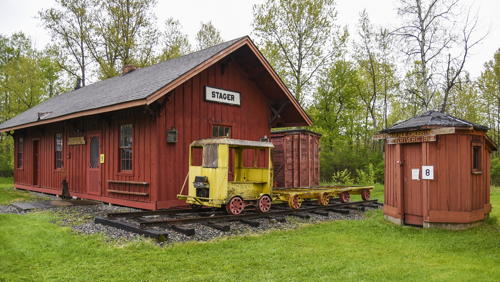
Railroad depot building
The Stager Depot at the Iron County Historical Museum in Caspian, MI.

The Club is building a working ham radio station in the museum. It will be fully functional. Museum visitors will be able to see the exhibit and signs will help visitors understand the importance ham radios – and amateur operators – have played in our county’s, and our country’s history. They will also learn why they continue to be so important. In addition, the Club is recreating a display of a vintage WIKB studio from pieces they have collected over the years. All of this is being paid for, in part, from a $500 grant from the Crystal Falls/Dickinson Area Community Foundation. “All in all, this is a lot of moving parts finally coming together to make this happen.” Long explains.

…read more


SIERA hosts Scout amateur radio merit badge day

METROPOLIS, IL — Boy Scouts talked to amateur radio operators as far away as Puerto Rico and Arizona during a radio merit badge class hosted by the Southernmost Illinois Emergency Radio Association (SIERA). Five scouts from Troop 2007, out of St. Thomas More Catholic Church in Paducah, attended the class on Saturday, March 23, at Trinity Church in Metropolis.

Scouts experimented with tuning forks and a wave generator and had the opportunity to talk on both handy-talkie and high-frequency base radios during the class. They also learned about the science and mechanics of radio as well as important safety measures.

…read more


Filed Under: Amateur Radio in the News, Clubs, Gear/Gadgets, VHF/FM/Repeaters Tagged With: Illinois, Iron County, Michigan, Quansheng UV-K5, scouting

Operating Notes: Bandscope observations, a pirate on 2m, VU2

March 31, 2024 By Dan KB6NU 1 Comment

Bandscope observations

If you who read my blog regularly, you know I’m a big fan of bandscopes. Here are a couple of relevant observations:

  1. I almost missed a DX contact because the DX station called about 250 Hz below my frequency. Because I had my bandpass set to 300 Hz (+/-150 Hz), I couldn’t hear him at all. I did seem him on the bandscope, though, and after I adjusted my receive incremental tuning (RIT), I worked him just fine.
  2. Not having a radio with a bandscope can lead you to be more pessimistic about ham radio than you should be. I worked a fellow who lamented how quiet the band was and how no one operated CW anymore. I found this baffling, as the band looked pretty active to me. It turns out that the guy was using a radio without a bandscope and when he tuned around, he couldn’t hear anything. I, on the other hand, could see the activity.

A pirate on 2m?

I am the main net control station for our club’s Monday night 2-meter net. (The net convenes every Monday night at 8 pm Eastern time on the 146.96- repeater. Join us if you can hit the repeater.)

Last week, a fellow checked in the call sign K1TKE. Since I have a computer in the shack, I like to call up the QRZ.Com page for people I haven’t worked before. There was no page for K1TKE.

Now, I know that there are some licensed amateurs that don’t have a QRZ page for one reason or another, so when it was K1TKE’s turn, I gave him a call. I got no response, so I’m guessing that this guy was unlicensed. That’s the first time this has happened to me.

VU2!

After all these years, I finally worked a VU station, logging VU2GSM on March 10 on 30-meter CW. I know this isn’t the biggest accomplishment in my ham radio career, but nonetheless it’s pretty cool to me.

I must say that Kanti had great ears. He wasn’t all that strong here, so I imagine that I was equally weak there. Even so, he got my call correctly the first time.

Filed Under: DX, Gear/Gadgets, Operating, VHF/FM/Repeaters Tagged With: bandscope

Operating Notes: I’m twitch-y, bye-bye X-6100, bring on the toroids

March 19, 2024 By Dan KB6NU 2 Comments

I’m Twitch-y!

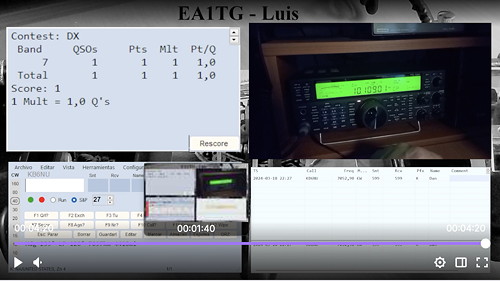
Last night, I worked Luis, EA1TG, and this morning, he sent me a link to a video on Twitch that he made of our contact. (Click on the image to go to Twitch. For some reason, I couldn’t embed the Twitch video here.)

This is kind of cool. I’ve been thinking of setting up my own Twitch channel to stream my contacts. I’m not sure if anyone would actually watch them, but who knows?

Bye-bye X-6100

Last summer, I purchased a Xiegu X-6100 from Radioddity when they put it on sale. I had a lot of fun using it. In some ways, it’s  more fun to use than my Elecraft KX-3. I attribute that mainly to the brightly-colored waterfall display.

It’s just not the radio that the KX-3 is, however. For one thing, the KX-3’s antenna tuner is much better than the X-6100’s antenna tuner. The KX-3 tuner almost always achieves an SWR of 1.1:1 or less with my 66-ft. doublet antenna, while the Xiegu is satisfied once it hits 1.5:1. The color choices are also terrible, making it hard to read, especially in bright sunlight.

So, after making 36 contacts with it on my latest POTA activation, I sold the X-6100 last week. I hope that the new owner will have as much fun as did with it. And, find its shortcomings less annoying.

Bring on the toroids!

To replace the X-6100, I purchased a QRP Labs QMX kit. For less than $100, the QMX provides five band coverage (either 80m – 20m or 20m – 10m), CW and digital modes, an SDR receiver, a 24-bit 48 ksps USB sound card, CAT control, and synthesized VFO with TCXO reference. Since I’ll be using this for POTA, and propagation on the higher bands is headed in the right direction, I opted for the 20m – 10 version.

I also purchased the enclosure and power cord, so the price came to just short of $140, including shipping. Even so, that’s quite a deal, I think.

When I told my friends Rick and Paul about my purchase they jumped all over me about the toroids. One of them in particular has a trifilar winding and is supposed to be difficult to fabricate. I’m not a big fan of winding toroids, but I’m not scared of them either. Bring on the toroids!

In the meantime, I’ve been watching this video:

After watching it, it seems to me that the biggest thing to watch out for is how crowded everything is inside the radio. For example, there are several warnings about how close some of the components and traces are to one another. Forewarned is forearmed, though, so at least I’ll know what to look out for.

Stay tuned for reports on how I get along with the kit. Who knows? Maybe I’ll live-stream my toroid-building on my YouTube or Twitch channel.

Filed Under: Building/Homebrew, Gear/Gadgets, Kits, Operating, Parks on the Air Tagged With: EA1TG, QMX, QRP Labs, Twitch, X-6100, Xiegu

Amateur radio videos: ARDC Interview, microwaves, operating 160 meters

February 27, 2024 By Dan KB6NU Leave a Comment

A Free VPN Service from ARDC

This interview took place at the 2024 HamCation.

Amateur Microwave It’s easier than you think

Can You Do 160 Meters on Two Wolf River Coils?

K8MRD connects two Wolf River loading coils in series to see if he can use that lashup to tune on 160 meters.

Filed Under: Antennas, ARDC, Digital Communications, Microwave Tagged With: VPN, Wolf River

  • « Go to Previous Page
  • Page 1
  • Page 2
  • Page 3
  • Page 4
  • Page 5
  • Interim pages omitted …
  • Page 60
  • Go to Next Page »

Primary Sidebar

No Nonsense Technician Class License Study Guide (for tests given between July 2026 and June 2030)

New No Nonsense Technican Class Study Guide now available!

The 2026 version of my Tech Class study guide is now available, and as always, the PDF version is FREE!. The ePub version costs $11.97, and a Kindle version and paperback version will be available on Amazon shortly.

Click here to get all of my "No Nonsense" study guides.

Also available: The CW Geek's Guide to Having Fun with Morse Code

W5SWL.Com
Retevis Ailunce H1 DMR Radio
DXpander: Cobweb antennas, Laser Cutting

You’ve got mail!

Enter your email address below and get an email every time I publish a new post.

Email


I frequently teach classes to help newcomers get their licenses. The next class will take place on Saturday, October 10, 2026 on the University of Michigan campus. Click here for more information.

If you can't make the class, subscribe to the mailing list to be notified of when the next class will be held.

You can always download my free study guide, and if you have any questions about the classes, or amateur radio in general, please feel free to email me directly.

Support KB6NU.Com

Donate $7.30 and get two of these cool stickers. Measuring 4.25-in. W by 2.75-in. H, it's perfect for your car, your shack, or wherever!

Contact me

If you have a question or comment about one of my blog posts, or a question about any of the material in my study guides, or just a question about ham radio in general, you can email me at [email protected].

Blogs You Should Also Read

  • AE5X: A CW-centric blog from Kingswood, Texas
  • K0LWC Blog
  • LA3ZA Ham Radio Blog
  • Little Radios, Big Fun – WB3GCK
  • Mr. Vacuum Tube's Blog
  • Radio Artisan – K3NG
  • The K0NR Weblog
  • VE3WDM's QRP Ham Radio Blog
  • W2LJ’s Blog

Ham Radio Websites

  • Dashtoons – The Hammin' Comedy by Jeff K1NSS

Podcasts

  • ICQ Podcast
  • Linux in the Ham Schack
  • No Nonsense Amateur Radio Podcast
  • Resonant Frequency Amateur Radio Podcast

Recent Comments

  • Dan KB6NU on The EMF Explorer: A badge for ham radio?
  • Travis Good on The EMF Explorer: A badge for ham radio?
  • MARTIN ROBERT ROTHFIELD on The EMF Explorer: A badge for ham radio?
  • Mike Chen on Operating Notes, January 5, 2026
  • Rob W4ZNG on The EMF Explorer: A badge for ham radio?

Meta

  • Log in
  • Entries feed
  • Comments feed
  • WordPress.org

Footer

Copyright © 2026 Daniel M. Romanchik, KB6NU · Log in