• Skip to primary navigation
  • Skip to main content
  • Skip to primary sidebar
  • Skip to footer

KB6NU's Ham Radio Blog

KB6NU's Ham Radio Blog
  • HOME
  • Study Guides
  • Teach a One-Day Tech Class
  • W8SRC Repeater Guide
  • Advertise
  • Hire Me

Test Equipment

Articles: Scrappy circuits, ham radio inspires student, why measurements are important, why copper is important

September 12, 2024 By Dan KB6NU Leave a Comment

Here are some articles I found intersting. The first details a cheap way to teach kids (and adults, too!) about circuits….Dan

Scrappy circuits

Circuit components made from dollar-store items.
The best dollar you can spend on a child’s STEAM education is to take them to the dollar store, buy an electronic item, and then take it apart. Learning how a handheld fan, LED light, remote control, or headphones work will help show how wind turbines, traffic lights, speakers, keyboards, and other modern devices function. The next step is to take apart a dollar store item and make it better — combine two items, replace a switch, create something new and unique. Scrappy Circuits is the perfect way to get started. I first developed Scrappy Circuits with Chris Connors and Eva Luna while working at Xraise, an education outreach program at Cornell University. What began as an exploration of DIY switches ended later as a self-made invention system sourced from a fifty-cent LED tea light. Educators can build it with their class for about $20. Anyone with access to office supplies and a dollar store can make the five Core Bricks for about $1. Here’s how to create each one.

…read more


I think that we short-change ham radio’s usefulness in getting people to pursue STEM careers…..Dan

Ham radio inspired this Scranton University student to pursue engineering

Many college students participate in sports, listen to music, or play video games in their spare time, but IEEE Student Member Gerard Piccini prefers amateur radio, also known as ham radio. He’s been involved with the two-way radio communication, which uses designated frequencies, since his uncle introduced him to it when he was a youngster. His call sign is KD2ZHK.

…read more


I’ve always been something of a measurement nerd……Dan

Why measurements are important

Practically everything you use in your everyday life works because of measurement science. Without precise measurements, your car wouldn’t run, your phone wouldn’t work, hospitals couldn’t function, and the ATM would fail. NIST is the national measurement institute of the United States. Most people in the U.S. have no idea that there is a single organization within the federal government that makes sure all measurements in the U.S. are correct and trustworthy — and that they are accepted by other governments worldwide.

…read more


Copper is one of those things that we take for granted…..Dan

Copper: Conductivity Benefits and Environmental Impact

Most circuit designers probably aren’t thinking about, much less worrying about, the metal copper. But as the electrification of the world continues, copper conductors used in applications from microchips, other components and circuit boards, to household, industrial, and automotive wiring, and critical workhorses like batteries and electric motors, points to the need to spotlight its starring role.

…read more

Filed Under: Gear/Gadgets, People, Test Equipment Tagged With: copper, NIST, Scranton University, STEM

Videos I’ve been watching: HF propagation, how to use a NanoVNA, Hallicrafters’ world of SW radio

September 1, 2024 By Dan KB6NU Leave a Comment

W3LPL on HF propagation

At an hour and a half, this video is kind of long, but if you’re interested in propagation, it’s worth watching.

W2AEW on how to use a NanoVNA to measure a filter’s characteristics

Alan, W2AEW, shows how to use a NanoVNA, which is one of the most useful tools for characterizing RF components and circuits.

Hallicrafters World of SW Radio

Back in the day, Hallicrafters was arguably the biggest name in amateur and shortwave radio. Unfortunately, this is just an audio file, but I guess, radio is audio so just close your eyes and imagine that you’re listening to this on a Hallicrafters receiver.

Filed Under: Computers, Propagation, Software, Test Equipment Tagged With: Grace Hopper, nanoVNA

How to troubleshoot a jumper wire

July 4, 2024 By Dan KB6NU 2 Comments

Tuesday, my friend Paul, KW1L, texted me, and asked if I could come over to his house and help him with his new antenna. He had just purchased and installed a Cobra Ultra-Lite Junior, and he didn’t think that it was performing as well as it should.

A piece of wire with alligator clips on each end.
The suspect jumper wire.

I won’t go into all of the details, but one of the checks he had made was to measure the continuity of the feed line, which is 80 feet of 18-gauge, 450 Ω ladder line. To do this, he connected the jumper wire in the photo at right across the ladder line in his shack and then measured the resistance at the antenna feed point.

The measurement that he came up with was 16 Ω. Well, the National Institute of Science and Technology (NIST) says that the resistance of 18-gauge solid wire should be about .0064 Ω/ft. Using that figure, the resistance should be somewhere near 1 Ω.

So, Paul asked me to bring over my DMM, which I did yesterday. We dropped the antenna, put my Fluke 79 across the feed point, and measured close to 16 Ω.

It didn’t make much sense, but the only reasonable explanation was that the problem with this measurement was the jumper wire. This was somewhat troubling to Paul, as he had a sentimental attachment to this jumper wire. It was given to him by a fellow who worked for him at Xerox, and he pointed out to me how well-made it was. He noted, for example, that each end of the wire had been tinned before it was screwed to the alligator clip.

I agreed that it was well-made, but certainly one or both of the connections could have oxidized, resulting in a high-resistance connection. And guess what? When I measured the resistance of the jumper, it turned out to be about 15 Ω!

I then unscrewed the wire at one end and measured again. It measured 15 Ω. I unscrewed the wire at the other end, and voilá, I measured 0 Ω. I screwed the alligator clips back on, and the overall resistance was near 0 Ω again. My guess is that the second connection was a little loose, and that over the years, some oxidation built up on both the wire and the alligator clip.

Whenever we do something like this, Paul likes to ask, “So, what did we learn from this?” In this case, I think what we learned is that even jumper wires can go bad. It’s also a validation of the KB6NU Theory of Electronic Failures, i.e. at least 80% of the problems associated with electronic equipment are problems with cables or connectors.


Filed Under: Antennas, Gear/Gadgets, Test Equipment Tagged With: KW1L

Random ideas and observations: Ice on the antenna, what happens to a signal in a scope, the Anarchist Radio Relay League.

January 19, 2024 By Dan KB6NU 2 Comments

Ice on antennas

Last Friday, we got about six inches of snow here. That was followed by the rain, covering everything— including antennas—with a coating of ice. Ice, in general is not a good thing on antennas or feedlines.

We noticed this last Monday night on our weekly club net. Stations that were not really strong into the repeater, including yours truly, sounded scratchy. Those that were marginal before, were unreadable.

The temperature hasn’t gotten above freezing here since then, and I can still see ice on my 2m antenna. That being the case, I hope it warms up enough to melt the ice by this coming Monday evening.

Understanding the Journey of a Signal

What happens between the tip of a scope probe and the scope screen?

This white paper explains everything that happens to your signal inside a digital storage oscilloscope (DSO). Having this fundamental knowledge will help you make accurate measurements by correctly selecting the probes and oscilloscope that will work best for your test needs.

You do have to fill out a form with some personal information, but you can easily fake the information if you’re skittish about it.

Anarchist Radio Relay League

Radio amateurs tend to be very conservative, but not all of us are. Case in point: the Anarchist Radio Relay League. On their website, you’ll find their zine, For an Anarchist Radio Relay League.

It’s really not a zine, per se, but rather an introduction to the radio world for those whose politics may be a little to the left of the average radio amateur. It does a good job of explaining what radio waves are, the different frequency bands, how to get a license, what’s the difference between HF and VHF/UHF, how to build some basic antennas, etc.

What makes it anarchist? Well, the zine compares the two ARRLs. It says,

An Anarchist Radio Relay League, we think, would have a similar function to the original ARRL, but in the spirit of mutual aid and solidarity, and with an explicit anticapitalist and anti authoritarian orientation.

This has the potential to take many forms.

I’ll let you read the rest for yourself.

Filed Under: Antennas, Clubs, Test Equipment Tagged With: Anarchist Radio Relay League, ice, oscilloscope

Random stuff: a little ham humor, handheld EMF meter, repeat customer

January 12, 2024 By Dan KB6NU 5 Comments

A little—and I do mean little—ham humor

I got this from /r/amateurradio:

What do you call an apology written in dots and dashes?
Re-Morse Code.

HF-B3G Triple Axis HF RF Analyzer

Handheld EMF meter

On the Tech test, question T0C06 reads:

Which of the following is an acceptable method to determine whether your station complies with FCC RF exposure regulations?
A. By calculation based on FCC OET Bulletin 65
B. By calculation based on computer modeling
C. By measurement of field strength using calibrated equipment
D. All these choices are correct

The correct answer is D. All these choices are correct.

When I teach classes, after giving the students the answer, I quickly qualify it by saying that calculation based on computer modeling is usually impractical because the software is generally pretty expensive and requires some expertise to use effectively. The same is true of measuring the field strength using calibrated equipment.

But, maybe it isn’t. I recently came across the HF-BG3 Triple-Axis HF RF Analyzer on Amazon. The product description says that is has a frequency range 50 MHz to 3.5 GHz and a measurement range of 38 mV/m to 20 V/m. If this meter cost $30, I would have bought one to play with, but  at $165, it’s a little outside my “what the heck” range.

It’s still an interesting possibility, though. Have any of you ever purchased or used a similar instrument?

I love repeat customers!

I love getting feedback from readers and repeat customers. This message appeared in my inbox a couple of hours ago:

Hi Dan –

Last year we purchased 15 of your Tech guides to teach a class. We had three instructors, and did a 1-day tech license class. Of our 13 students, 12 are now licensed and have radios… and a good number of those are planning to operate during Winter Field Day with our club!

This year we’d like to help a few of those new hams move up to General by teaching a more extensive course.

How can we place an order for [15] of your No-Nonsense General Class License Study Guide?

First of all, it’s great that they had 12 of 13 pass the test, second that many of them want to get Generals, and third, they’re going to use my study guide to take the course! I replied that the deal is the same for the General Class study guide as it is for the Tech study guide. And that deal is that they can order as many copies as they’d like for $10 per copy, shipping included. If you have a class coming up, consider taking advantage of this deal yourself.

Filed Under: Classes/Testing/Licensing, Test Equipment Tagged With: humor

From the trade magazines: Semiconductor workforce shortage, vector network analyzer intro, DC-DC converters

August 16, 2023 By Dan KB6NU Leave a Comment

U.S. Semiconductor Workforce Shortage Reaching Critical Stage

The U.S. is on the brink of a new semiconductor manufacturing boom, leaving companies in urgent need of technicians to staff their new fabs and engineers to design the chips that these facilities will churn out. And unless things change, there soon may not be enough skilled chip workers in the U.S. to go around.

A top trade group for the U.S. semiconductor industry issued a report claiming there will not be enough skilled engineers and other workers to support their expansion plans, leaving it 67,000 workers short by 2030.

The way the semiconductor industry is growing, it will need a U.S. workforce of about 460,000 by the end of the decade, up from about 345,000 this year, according to a new study released by the Semiconductor Industry Association (SIA) and Oxford Economics.

…read more

Wayne Green, W2NSD, publisher of 73 Magazine, always used to tout the opportunities that an amateur radio license afforded hams. I’m sure that he’d be writing about this topic if he were still with us and editorializing today…Dan


An Introduction to the VNA and Vector Network Analysis

Most design engineers are familiar with tools of the trade such as voltmeters, oscilloscopes, signal generators, and spectrum analyzers. Some may not have had the opportunity to use a vector network analyzer (VNA). It’s the intent of this article to introduce VNA measurement and present a few typical applications.

What you’ll learn:

  • What does a VNA measure?
  • What can one do with the measured data?
  • What devices are measured with a VNA?

…read more

Although written by a a company that makes engineering-grade VNAs, you might find this an interesting article to read if you just purchased a nanoVNA…Dan


DC-DC Converter Design Basics (Part 1): Buck Converters

DC-DC converters are widely used to efficiently produce a regulated voltage from a source that may or may not be well-controlled to a load that may or may not be constant. This article shows how DC-DC converters can be built using the Renesas SLG47105 GreenPAK programmable mixed-signal matrix.

DC-DC converters are high-frequency power-conversion circuits that use high-frequency switching and inductors, transformers, and capacitors to smooth out switching noise into regulated DC voltages. Closed feedback loops maintain constant voltage output even when changing input voltages and output currents. At 90% efficiency, they’re generally much more efficient and smaller than linear regulators. Their disadvantages are noise and complexity.

…read more


Filed Under: Antennas, Electronic Components, Electronics Theory, Test Equipment Tagged With: Jobs, VNA

100, 50, and 25 years ago in QST: Electric filters, SWR meter project, clubs

July 10, 2023 By Dan KB6NU 1 Comment

I love this feature in QST. Not only can you feel the history of amateur radio by reading these articles, many of them still impart useful technical information. Read on and you’ll see what I mean.

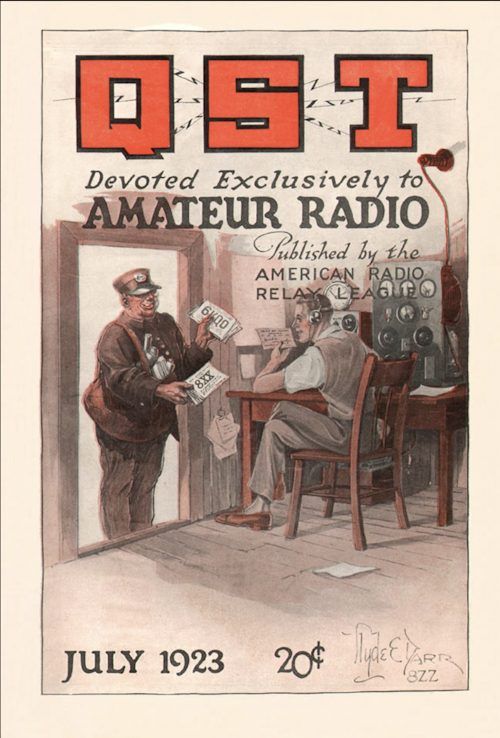
July 1923

The article that I chose from this issue is “Electric Filters” by F.S. Dellenbaugh, Jr. He writes, “Most thing in amateur radio have gotten beyond guesswork; reliable information is available. A glaring exception is the electric wave filter…” He then goes on to give a relatively rigorous explanation of LC filters in many different forms. This is all good stuff and still relevant today.

Also notable in this issue are the articles:

  • Why Inflict Keying Thumps on Your Neighbor? This is perhaps one of the first articles on RFI.
  • Bureau of Standards Explores Short-Wave Region. Early amateurs were relegated to wavelengths below 200 meters, which at that time were thought to be useless for wireless communications. It wasn’t long, however, before radio amateurs proved that to be incorrect.

July 1973

You might thing that the article, A Simple Computing SWR Meter, describes one of the first amateur radio applications of a microprocessor, but  you’d be wrong. Instead, the article gives plans for an SWR/power meter that uses op amps to perform analog computations. The beauty of this approach, according to the authors, is that the SWR reading are independent of the forward power.

July 1998

Two articles in this issue are aimed at helping clubs:

  • Where Radio is Fun. This article brings home the point that to be a successful club, members have to have fun. If your  club is failing, perhaps it’s because you’re not having enough fun.
  • Anatomy of a Special Event Station. I like special event stations, so I’m highlighting this article. The deck reads, “Is your club stuck in a rut? Looking for a project to pep things up? Putting a special event station on the air will definitely pick up the pace….” This article gives a bunch of good advice about running a special event station that’s as relevant today as it was 25 years ago. One such bit of advice is, “Design QSL cards and certificates early in the process—and determine how and when they’ll be printed.”


Filed Under: Clubs, Electronic components, EMI/RFI, Special Events, Test Equipment Tagged With: filters, SWR

ICQ Podcast Episode 401- MFJ8504 Review and Understanding HF Controls

April 25, 2023 By Dan KB6NU 1 Comment

In this episode, i joined Martin Butler M1MRB, Caryn Eve Murray KD2GUT and Ed Durrant DD5LP to discuss the following:

  • Ria Jairam, N2RJ, joins ARDC Board

  • Your MultiMeter Might be Lying to You

  • Vacuum Tube-Making on the Comeback in the US

  • FCC Takes a Deeper Dive into Satellites

  • Electrocuted While Helping Another Amateur

Other news includes:

  • Three Hams Chosen for Artemis Moon Mission

  • RSGB Coronation Activities

  • National Voice of America Museum of Broadcasting Open during 2023 Dayton Hamvention

This episode’s feature is MFJ8504 Review and Understanding HF Controls.

Filed Under: ICQ Podcast, Safety, Satellites, Test Equipment Tagged With: ARDC

A little of this, a little of that: 8-yo talks to astronauts, SHF transceiver from ICOM, Raspberry Pi logic analyzer

August 24, 2022 By Dan KB6NU 4 Comments

8-year-old girl in Kent, England, has an out of this world story to tell her friends

This is a great story. Kjell Lindgren has been doing a great job on the ISS amateur radio station.

ICOM debuts SHF transceiver

Icom showed a mockup of this transceiver, capable of operation at up to 10 GHz at Dayton. Apparently, it got a good enough response that they’re going to start manufacturing it. How much would you pay for a rig like this?

$4 Logic Analyzer Based on Raspberry Pi Pico

In a recent EE Journal, Steven Leibson writes:

Here’s a truly inspired project. Dr. Agustín Gimenez Bernad, a Senior Developer in ServiZurich S.A. in Spain, has created one of the most brilliant hacks I’ve seen yet. He’s built a 24-bit logic analyzer that samples at 100 Msamples/sec and stores 32K samples from nothing more than a $4 Raspberry Pi Pico board and some clever code. There’s a lot to learn from this project, which is posted with some very fine documentation on GitHub, but if you just need a $4 logic analyzer, there’s still a lot to be admired.

For four bucks, why wouldn’t you want to have a logic analyzer in your shack, especially if you do any microcontroller projects at all.

Filed Under: Gear/Gadgets, Test Equipment, VHF/FM/Repeaters Tagged With: IC-905, ISS, logic analyzer

5 mistakes to avoid when buying a low-cost scope

June 3, 2022 By Dan KB6NU 1 Comment

Keysight has a new application note—5 Common Mistakes to Avoid When Buying a Low-Cost Oscilloscope—that you might want to get if you’re going to buy a scope, or even if you use a scope. This free app note covers the following five topics:

  • selecting an oscilloscope with insufficient bandwidth
  • settling for a USB oscilloscope
  • underestimating usability
  • running the risk of equipment support difficulties
  • focusing solely on specifications

Make sure you have enough bandwidth

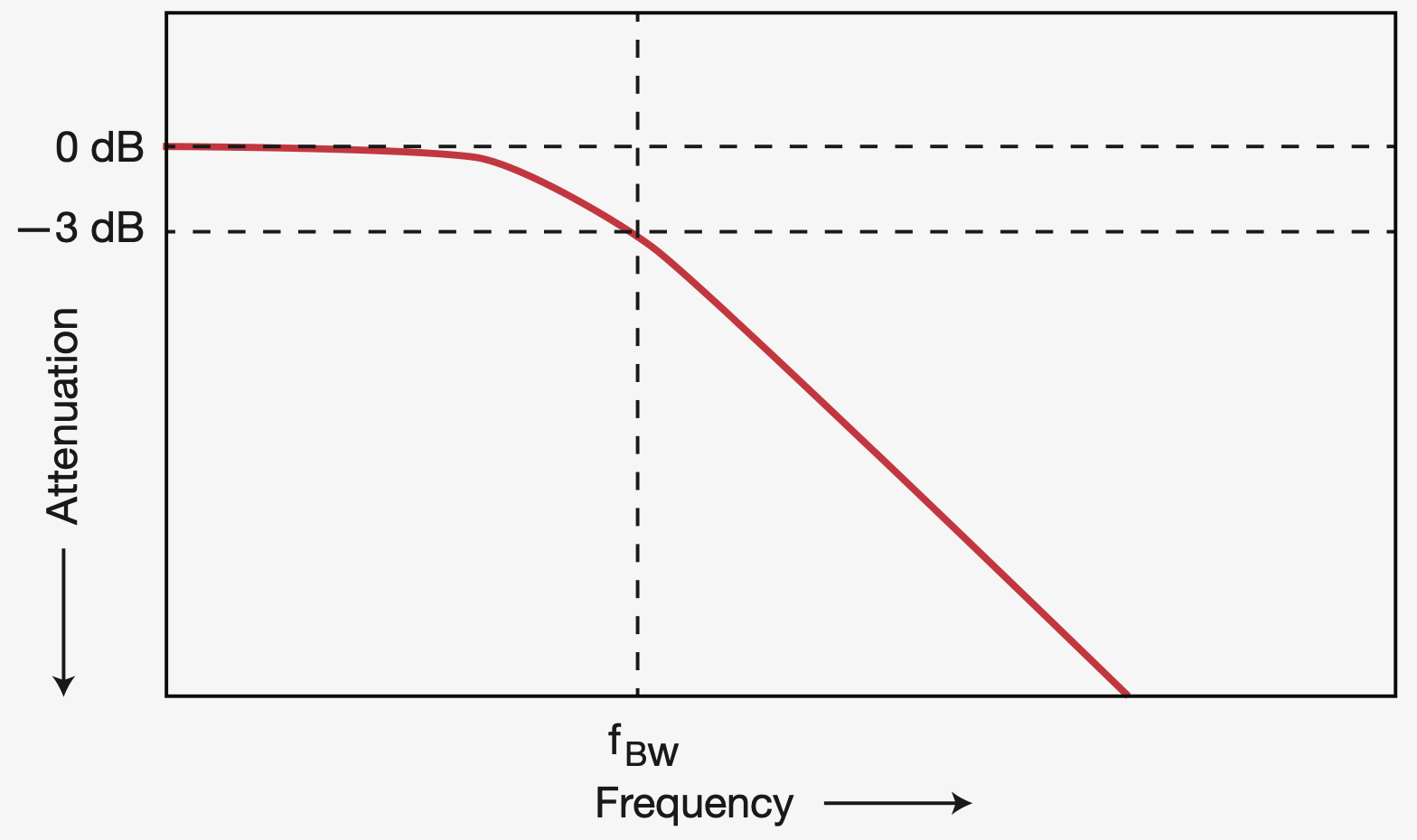
A scopes’s bandwidth is the frequency at which the input signal sine waves attenuate by -3 dB (30%) as shown here:

From a practical point of view, what this means is that if you need to measure the amplitude of a 146.96 MHz signal with some accuracy, don’t settle for a 150 MHz scope. The amplitude measurement at that frequency could be up to 30% off. You’ll probably want to purchase a scope with at least 200 MHz bandwidth to make that measurement.

And, when measuring digital signals, having a scope with a high bandwidth is especially important. The reason for this is that while a digital signal may have a relatively low frequency, they contain higher frequency components. Keysight recommends choosing a scope with a bandwidth at least five times the highest clock rate in your system.

Don’t settle for a USB scope

USB scopes are generally cheaper than stand-alone scopes with similar specifications, but remember that you’ll need a computer to provide the user interface. For one thing, it’s not going to be as portable as a stand-alone scope.USB scopes have their place, but probably not for general-purpose use.

Don’t underestimate usability

Even if you only use a scope occasionally, or perhaps especially if you only use a scope occasionally, consider the usability of the scope you intend to buy. Keysight notes that there are several factors contribute to an intuitive and detailed graphical user interface (GUI). These include display quality, display size, resolution, update rate, viewing angle, color versus monochrome, and user-specified display modes such as variable and infinite persistence. Additionally, a multi-language GUI can better contribute to the user’s interaction with the oscilloscope. Ideally, you’d like to be able to play with a scope for a while before buying it.

Make sure that you can get support

Before you plunk down your cash, make sure that you can get support should the scope you buy be DOA or fails after you start using it. Research the support and services offered by the vendor before buying to avoid these  issues. A cheap scope with little or no support is not a bargain.

Don’t focus solely on specifications

Keysight warns, “Specifications do not tell the whole story. You need to dig deeper, read between the lines, and ask questions when researching oscilloscopes to select one that best fits your needs.”

Ask  your friends what kind of scopes they have and if they like using them. You can also head over to the EEVBlog Test Equipment Community Forum. It now has more than a half million posts (!), and test equipment nerds from all over the world hang out there.

This is just a quick review of the Keysight app note. I’d suggest that you download and read the entire thing before buying your next cheap scope.

Filed Under: Test Equipment Tagged With: oscilloscopes

  • Page 1
  • Page 2
  • Page 3
  • Interim pages omitted …
  • Page 15
  • Go to Next Page »

Primary Sidebar

No Nonsense Technician Class License Study Guide (for tests given between July 2026 and June 2030)

New No Nonsense Technican Class Study Guide now available!

The 2026 version of my Tech Class study guide is now available, and as always, the PDF version is FREE!. The ePub version costs $11.97, and a Kindle version and paperback version will be available on Amazon shortly.

Click here to get all of my "No Nonsense" study guides.

Also available: The CW Geek's Guide to Having Fun with Morse Code

W5SWL.Com
Retevis Ailunce H1 DMR Radio
DXpander: Cobweb antennas, Laser Cutting

You’ve got mail!

Enter your email address below and get an email every time I publish a new post.

Email


I frequently teach classes to help newcomers get their licenses. The next class will take place on Saturday, February 7, 2026 on the University of Michigan campus. Click here for more information.

If you can't make the class, subscribe to the mailing list to be notified of when the next class will be held.

You can always download my free study guide, and if you have any questions about the classes, or amateur radio in general, please feel free to email me directly.

Support KB6NU.Com

Donate $7.30 and get two of these cool stickers. Measuring 4.25-in. W by 2.75-in. H, it's perfect for your car, your shack, or wherever!

Contact me

If you have a question or comment about one of my blog posts, or a question about any of the material in my study guides, or just a question about ham radio in general, you can email me at [email protected].

Blogs You Should Also Read

  • AE5X: A CW-centric blog from Kingswood, Texas
  • K0LWC Blog
  • LA3ZA Ham Radio Blog
  • Little Radios, Big Fun – WB3GCK
  • Mr. Vacuum Tube's Blog
  • Radio Artisan – K3NG
  • The K0NR Weblog
  • VE3WDM's QRP Ham Radio Blog
  • W2LJ’s Blog

Ham Radio Websites

  • Dashtoons – The Hammin' Comedy by Jeff K1NSS

Podcasts

  • ICQ Podcast
  • Linux in the Ham Schack
  • No Nonsense Amateur Radio Podcast
  • Resonant Frequency Amateur Radio Podcast

Recent Comments

  • Michael Burkhardt on One lump or two (or three)?
  • Eric on POTA notes, 7/27/26
  • Steve KB3JC on How to “ragchew” on CW
  • Dan KB6NU on Yaesu FT-710: What’s the big deal?
  • Andrei on Yaesu FT-710: What’s the big deal?

Meta

  • Log in
  • Entries feed
  • Comments feed
  • WordPress.org

Footer

Copyright © 2026 Daniel M. Romanchik, KB6NU · Log in