
• Skip to primary navigation
  • Skip to main content
  • Skip to primary sidebar
  • Skip to footer

KB6NU's Ham Radio Blog

KB6NU's Ham Radio Blog
  • HOME
  • Study Guides
  • Teach a One-Day Tech Class
  • W8SRC Repeater Guide
  • Advertise
  • Hire Me

nanoVNA

Videos I’ve been watching: HF propagation, how to use a NanoVNA, Hallicrafters’ world of SW radio

September 1, 2024 By Dan KB6NU Leave a Comment

W3LPL on HF propagation

At an hour and a half, this video is kind of long, but if you’re interested in propagation, it’s worth watching.

W2AEW on how to use a NanoVNA to measure a filter’s characteristics

Alan, W2AEW, shows how to use a NanoVNA, which is one of the most useful tools for characterizing RF components and circuits.

Hallicrafters World of SW Radio

Back in the day, Hallicrafters was arguably the biggest name in amateur and shortwave radio. Unfortunately, this is just an audio file, but I guess, radio is audio so just close your eyes and imagine that you’re listening to this on a Hallicrafters receiver.

Filed Under: Computers, Propagation, Software, Test Equipment Tagged With: Grace Hopper, nanoVNA

Interesting stuff I found in my inbox

December 30, 2020 By Dan KB6NU Leave a Comment

I’m on a lot of ham radio mailing lists, and people are constantly sending me interesting things to read and to watch. Here are some of the coolest from the past couple of weeks…..Dan

Smallest transceiver ever?

This is very cool. Adam, K6ARK, has designed a surface-mount version of the Pixie transceiver. (There are many different designs, but to get an idea of what a Pixie is, here’s a circuit description of a more recent design.) What’s really amazing about this video is the number of contacts that Adam makes with this little radio out in the boonies. I mean we’re talking less than a watt output and a receiver that’s as wide as a barn door. Very impressive.

Beginner’s Guide to the NanoVNA

The Absolute Beginner’s Guide to the NanoVNA by Martin Svaco, 9A2JK is a wonderful introduction to this cool, little instrument. It not only includes instructions on how to use a NanoVNA, there is a short history of the instrument and the different version out there as well as a brief theory of operation. If you have a NanoVNA, you should get this guide.

Easy ISS SSTV Reception

I know that this is a little late for this series of ISS SSTV transmissions, but I’m sure that they’ll do it again sooner or later.

Filed Under: Gear/Gadgets, QRP, Test Equipment Tagged With: ISS, nanoVNA, Pixie

More videos: NanoVNA, SK – then what?, retro ESD

December 16, 2020 By Dan KB6NU 1 Comment

Introduction & Tutorial to the NanoVNA

In this talk given to the Fair Lawn (NJ) Amateur Radio Club, Alan, W2AEW, tell you everything you need to know to get started with the NanoVNA.

Silent Key – then what happens?

Randy, K7AGE, gives us some advice on how to make it easier for those we leave behind deal with the equipment we leave behind.

ESD with Dan Anderson

This is a blast from the past. Dan Anderson was one of the first to preach the benefits of controlling electrostatic discharge (ESD) in electronics manufacturing facilities. As you’ll see in this video, he was a real huckster, too. I ran across Dan Anderson when I was a technical editor for Test&Measurement World magazine. He had a little kit that he would give the editors that consisted of a wrist strap, a transistor radio, and some kind of probe that could detest electrostatic charges. I still have the radio and wrist strap and use the wrist strap whenever I’m puttering around with circuits.

Filed Under: Building/Homebrew, Test Equipment, Videos Tagged With: ESD, nanoVNA

Amateur radio videos: nanoVNA edition

September 20, 2020 By Dan KB6NU Leave a Comment

Here are a couple of videos on how to use the NanoVNA. The first is from Alan, W2AEW, who does such a great job with his videos. One cool thing to note is that it looks like Alan is using a guitar pick tethered to his NanoVNA to make changing settings easier to do. I also like the way he’s using the NanoVNA to show how an antenna tuner affects the impedance at the end of a feedline.

This video compares the NanoVNA to an antenna analyzer, in this case the MFJ 259B. You can see that the two instruments give very similar results. The question is which one is the more accurate?  

And finally, here’s an app note from Tektroniix, “Introduction to VNA Basics.” It explains a little bit about how a VNA works, the types of measurement that you make with a VNA, and how they are unique compared to other RF test equipment. It also discusses S-parameters and why you have to calibrate a VNA, and how to do it.

Filed Under: Test Equipment Tagged With: nanoVNA

From the “pro” magazines: LM386 regen, IEEE Spectrum on ham radio, measure resonator Q factor

June 9, 2020 By Dan KB6NU 4 Comments

Create radio receiver circuits with the LM386 audio amplifier

I didn’t have much luck using an LM386 as an audio amplifier (I needed more output power), but perhaps I’ll have more success using it to make a regenerative receiver. I think that I even have all the parts in my junk box.

Here’s a schematic from the article:

Is Ham Radio a Hobby, a Utility…or Both? A Battle Over Spectrum Heats Up

This was actually last summer’s controversy, but while the arguments about WinLink have cooled down, it’s still an issue. I used to be quite anti-WinLink, but since it seems to really be useful for emergency communications, I’m less strident about it than I used to be. I just searched fcc.gov to see if I could find out what’s going on with RM-11831, and was surprised to see that as recently as April 3, 2020, there were still comments being filed. So, I guess it ain’t over until it’s over.

Determining Resonator Q Factor from Return-Loss Measurement Alone

The author uses an expensive VNA from his employer, Copper Mountain Technologies, but with a little ingenuity, you can probably do with your $60 NanoVNA.

Filed Under: Building/Homebrew, Rules, Regulations, Enforcement, Test Equipment Tagged With: nanoVNA, regen, WinLink

Got my NanoVNA!

April 14, 2020 By Dan KB6NU 5 Comments

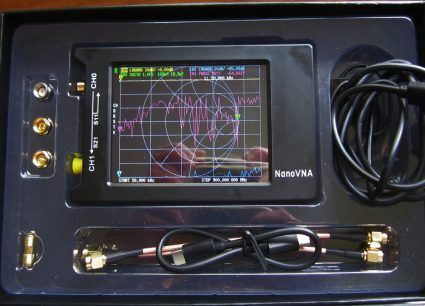
After waiting more than a week, my NanoVNA arrived yesterday! It’s a NanoVNAH4 from R&L Electronics. With shipping, it cost me $67.80.

I haven’t really had a chance to do anything with it yet, but so far, I’m pretty impressed. It came in a nice box, and included the following accessories:

  • USB Type-C data cable
  • 2 – 15cm SMA male to male RG316RF cable
  • SMA male calibration kit – OPEN, SHORT, LOAD
  • SMA female to female connector
  • Type-c to Type-c cable

It does not come with SMA – UHF or SMA – BNC adapters. I just happen to have an SMA-UHF adapter, but I wish I’d also purchased an SMA – BNC adapter. If you plan on purchasing this unit, you might want to consider what kind of adapters you’ll need and get them at the same time.

It does not come with a user manual, which is par for the course these days, but it did have a sheet showing how to navigate the menu system, which allowed me to play around with it. This morning, after a bit of googling, I found the github repository and the user guide.

As I say, I haven’t had a chance to put it through its paces, but I did put the LOAD, which is a 50 Ω load, and read a pretty flat 1:1 SWR from 50 kHz – 1.5 GHz.

One of the big complaints about the NanVNA has been the small screen. Not only is the small screen hard to read, the on-screen menu buttons are practically useless for most users who have big fingers. That’s why I paid extra for the larger screen. With reading glasses, I found the 4-in. screen relatively easy to read, and since I have relatively small fingers, I am actually able to navigate the menus using the on-screen buttons.

Next, I’m going to connect it to my 2m/70cm j-pole and see what kind of frequency response it has. After that, I’ll probably check out some bandpass filters.

If you already have a NanoVNA, what have you used it for? What “gotchas” should I be aware of?

Filed Under: Test Equipment Tagged With: nanoVNA

Amateur radio videos I’ve been watching: NanoVNA, calling CQ, 1970s ham radio

April 10, 2020 By Dan KB6NU 1 Comment

I just ordered a NanoVNAH4 from R&L Electronics. While waiting for it to arrive, I decided to watch a few videos. I haven’t watched a ton of them yet, but two things occur to me. First the really basic videos are almost too basic for me. I’m an electronics engineer by training, though, so what’s too basic for me might be a really good introduction for most. The second thing is that since it’s open source, nanoVNA designs are changing on the fly, so videos made six months ago may be woefully out of date.

Having said that, I like this video because W0QE is an engineer and he brings that experience to this video. He talks my language. He points out some of the shortcomings of the unit he bought (and nanoVNAs in general), but overall thinks they are worthwhile tools.

This is a good look at one of our most basic operating practices.

This is an amusing look back on ham radio in the 1970s.

Filed Under: History, Operating, Test Equipment Tagged With: nanoVNA

Primary Sidebar

No Nonsense Technician Class License Study Guide (for tests given between July 2026 and June 2030)

New No Nonsense Technican Class Study Guide now available!

The 2026 version of my Tech Class study guide is now available, and as always, the PDF version is FREE!. The ePub version costs $11.97, and a Kindle version and paperback version will be available on Amazon shortly.

Click here to get all of my "No Nonsense" study guides.

Also available: The CW Geek's Guide to Having Fun with Morse Code

W5SWL.Com
Retevis Ailunce H1 DMR Radio
DXpander: Cobweb antennas, Laser Cutting

You’ve got mail!

Enter your email address below and get an email every time I publish a new post.

Email


I frequently teach classes to help newcomers get their licenses. The next class will take place on Saturday, October 10, 2026 on the University of Michigan campus. Click here for more information.

If you can't make the class, subscribe to the mailing list to be notified of when the next class will be held.

You can always download my free study guide, and if you have any questions about the classes, or amateur radio in general, please feel free to email me directly.

Support KB6NU.Com

Donate $7.30 and get two of these cool stickers. Measuring 4.25-in. W by 2.75-in. H, it's perfect for your car, your shack, or wherever!

Contact me

If you have a question or comment about one of my blog posts, or a question about any of the material in my study guides, or just a question about ham radio in general, you can email me at [email protected].

Blogs You Should Also Read

  • AE5X: A CW-centric blog from Kingswood, Texas
  • K0LWC Blog
  • LA3ZA Ham Radio Blog
  • Little Radios, Big Fun – WB3GCK
  • Mr. Vacuum Tube's Blog
  • Radio Artisan – K3NG
  • The K0NR Weblog
  • VE3WDM's QRP Ham Radio Blog
  • W2LJ’s Blog

Ham Radio Websites

  • Dashtoons – The Hammin' Comedy by Jeff K1NSS

Podcasts

  • ICQ Podcast
  • Linux in the Ham Schack
  • No Nonsense Amateur Radio Podcast
  • Resonant Frequency Amateur Radio Podcast

Recent Comments

  • Dan KB6NU on The EMF Explorer: A badge for ham radio?
  • Travis Good on The EMF Explorer: A badge for ham radio?
  • MARTIN ROBERT ROTHFIELD on The EMF Explorer: A badge for ham radio?
  • Mike Chen on Operating Notes, January 5, 2026
  • Rob W4ZNG on The EMF Explorer: A badge for ham radio?

Meta

  • Log in
  • Entries feed
  • Comments feed
  • WordPress.org

Footer

Copyright © 2026 Daniel M. Romanchik, KB6NU · Log in