• Skip to primary navigation
  • Skip to main content
  • Skip to primary sidebar
  • Skip to footer

KB6NU's Ham Radio Blog

KB6NU's Ham Radio Blog
  • HOME
  • Study Guides
  • Teach a One-Day Tech Class
  • W8SRC Repeater Guide
  • Advertise
  • Hire Me

Building/Homebrew

A thrift shop find

January 11, 2026 By Dan KB6NU 1 Comment

My wife, Silvia, and I occasionally visit the Kiwanis Thrift Sale here in Ann Arbor. Over the years, I’ve purchased all manner of things there that have proven useful in my amateur radio operations.  I have purchased computer keyboards for $2, hand weights that I use to anchor the ends of my inverted-V doublet on POTA activations, and a roll of 300 Ω twinlead.

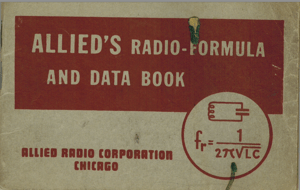
Cover of the book Allied's Radio-Formula and Data Book.
My latest Kiwanis Thrift Sale find cost me only 50 cents.

My latest purchase, as you can see from the photo at right is the 1953 edition of Allied’s Radio-Formula and Data Book. This little booklet contains a wealth of information, much of it still very useful, and it only cost 50¢! The table of contents list the following:

  • Bare copper wire table, which lists the dimensions, resistivity, and weight for copper wire from 1 gauge to 44 gauge.
  • Resistor and condenser color codes
  • Algebraic formulas, trigonometric relationships and a three-place log table. There were no electronic calculators back in 1953@
  • Decibel table
  • and much more

For example, on the page titled “Miscellaneous Formulas, there is a formula for calculating the capacitance of a vertical antenna shorter than a quarter wavelength. There is also a page for calculating the characteristic impedance, capacitance, inductance, and attenuation of two-wire, open-air transmission lines:

Page showing equations for calculating the characteristic impedance, inductance, capacitance, and attenuation of two-wire, open-air transmission lines.

Click here to download a scanned version of the book. It’s 35 Mbytes, so be warned that it could take some time to download.


Filed Under: Books and Magazines, Electronics Theory Tagged With: Allied, Handbook

Interesting battery failure

August 1, 2025 By Dan KB6NU 8 Comments

My wife, Silvia, is a stickler for keeping the garage door closed, even if I’m just outside doing some gardening. So, I have a garage door control that I keep in my gardening toolbox, so that I can close the door when I’m outside and then get back in when I’m done.

The other day, the control quit working. That’s not unusual, really. The 9 V battery that powers the thing doesn’t last forever. In this case, though, I found it odd because I replaced the battery not long ago. That got me thinking that perhaps the electronics had gone bad somehow, and that I’d have to replace the control altogether. That could be a problem, since the garage door opener is so old. I’m not sure that I could get a replacement.

Anyway, last night I opened the case, and found the battery shown at right. Somehow, the negative terminal became disconnected from the battery. Very strange, no? I’ve never seen a battery fail this way.

I plan to send an email to Duracell and see what they have to say. I’ll update this post if I get a reply. If you have had a battery fail like this, or in some other weird way, please add a comment below.

Filed Under: Batteries Tagged With: batteries

How do we encourage more experimentation in amateur radio?

February 7, 2025 By Dan KB6NU 8 Comments

WARNING: What follows is a partly-baked idea.
Please help me more fully bake it. 😀

In January, I hooked up again with Amateur Radio Digital Communications (ARDC), joining their Grant Evaluation Team (GET). Today at our GET meeting, we heard from ARDC’s board president, Bdale Garbee, KB0G, who spoke to us about ARDC’s values and  mission.

One of those values is encouraging experimentation. Experimentation is part of the fabric of amateur radio. Part 97.1 (b) notes that one of the bases and purposes of amateur radio is the “continuation and extension of the amateur’s proven ability to contribute to the advancement of the radio art.” Recognizing this, many of ARDC’s grants go to groups who are developing amateur radio and digital communications technology.

Many bemoan the fact that there isn’t much experimentation going on in amateur radio and that hams don’t build their own gear anymore. I’m not so sure that’s really true, though. There are lots of ongoing projects that are “advancing the state of the radio art.” The M17 Project and FreeDV are two projects that have been funded by ARDC grants. WSJT-X has been around a long time, but the developers are still pushing it forward. Commercially, QRP Labs and HF Signals are both developing interesting hardware and software. And, there are still some QRP clubs, such as the Four State QRP Group (4SQRP), CalQRP, and the Michigan QRP Club that promote home brewing and experimentation.

Perhaps what’s needed is something like “Experimenting 101 for Ham Radio Operators.” This would be kind of the opposite to what I’ve been doing lately, that is teaching ham radio to hackers.  This would be more along the lines of teaching hacking to ham radio operators.

Along those lines, here are some partly-baked ideas that have come to mind:

  • Is it possible to teach people how to become good experimenters? What are some of the characteristics of a good hacker?
  • Could we set up some kind of “ecosystem” to promote hacking in ham radio? I envision this ecosystem giving both financial and psychological support to ham radio hackers.
  • What do I mean about financial support? Well, inevitably hackers are going to blow things up at some point. Our hacker ecosystem could perhaps help soften the financial losses somehow.
  • What do I mean by psychological support? Having a hack go wrong can take a mental toll on a hacker. Our ecosystem would help the nascent hacker get over the disappointment and discouragement and get on with their hacking. I’m not sure how exactly, but providing some kind of support group would go a long way.
  • Parts of this ecosystem may already be in place in the form of makerspaces and public libraries. Maybe I could get an ARDC grant to develop this kind of class to be taught at one of the two makerspaces here in Ann Arbor.

As I say, these are partly-baked thoughts. Please comment if you have any thoughts about this.

Filed Under: ARDC, Building/Homebrew Tagged With: ARDC, hacking/making

From the trade journals: The rise and fall of Heathkit, Antennas 101, circular polarization

January 22, 2025 By Dan KB6NU Leave a Comment

The Rise and Fall of Heathkit

Steve Leibson begins this six-part series with, “If you came of age in the 1960s or 1970s and then later became an EE, chances are you’re more than casually acquainted with Heathkit. Many engineers started their budding careers by building one or more kits made by the Heath Company. I certainly did.”

Since this is a ham radio blog, I’d say, “If you came of age in the 1960s or 1970s and then later became radio amateur, chances are you’re more than casually acquainted with Heathkit. Many hams started their budding careers by building one or more kits made by the Heath Company. I certainly did.”

This is a remarkable series based on an interview with Chas Gilmore. Gilmore started as a design engineer at the Heath Company in 1966 and worked at the Heath Company on and off for more than two decades. He eventually became vice president of product development, marketing, and sales.

…read more


Antennas 101

Lou Frenzel, W5LEF (SK), was a prolific writer and editor. He was also a ham. Here, he explains antennas in way that we call can understand.

He writes, “Antennas are much more than simple devices connected to every radio. They’re the transducers that convert the voltage from a transmitter into a radio signal. And they pick radio signals out of the air and convert them into a voltage for recovery in a receiver.”

…read more


Understanding circular polarization

John Dunn writes, “An electromagnetic wave or signal traveling from “here” to “there” has an electrostatic field component that we call its E-field and whose direction we assign as the signal’s polarity. Often, the E-field is either vertical or horizontal as developed by a dipole structure or a ground plane antenna, but it can also be rotary which means it can be rotating around the signal’s axis of travel. The conventional terminology for that case however is not the word “rotary”, it is the word “circular”. We thus speak of vertical polarization, horizontal polarization, and circular polarization.”

I’m still not sure that I understand circular polarization after reading this article, but take a look for yourself.

…read more


Filed Under: Antennas, Building/Homebrew, Vintage Radio

Videos: QRP FT-8 Transceiver, vintage FD video, QSO with SV8ANW

January 19, 2025 By Dan KB6NU 1 Comment

DX FT8: A QRPp, five-band, standalone transceiver

I recently swapped some email with a fellow who purchased a quantity of Tech study guides for a class he’s teaching (only $11/copy!). In addition to talking about the study guides, we got to talking about microcontroller projects. He wrote, “I assume you’ve seen the microcontroller based, standalone FT8 transceiver already, but if not it’s worth a peek: https://www.youtube.com/watch?v=8b2WOxESAVU.”

Well, I hadn’t heard of it, so I did give it a peek. The DX FT8  looks like a very cool project. If I didn’t already have a dozen half-finished projects already, I might give this one a go.

Vintage Field Day 1962

This video reminds me of the home movies that my dad used to take back in the 1960s. Instead of Christmas and birthday parties, however, these show hams setting up and operating on Field Day 1962. Like the video says, there are “lots of vintage ham radio equipment, antennas, portable generators (look at the size of that thing at the 6:00 mark!), baked beans, and radio fun.

Couple observations:

  • The participants seem to be, on average, younger than today’s FD participants.
  • Note that there are two hams per station, one operating and one logging on paper. We do this by computer now.
  • There was probably more cigarette smoking and beer drinking than you’d find at today’s Field Day operations.

KB6NU de SV8ANW

Shortly after working Dimitris (Jim), SV8ANW, he sent me an email with a link to a YouTube video of our contact. Notice that he has a very nice bug fist.

Filed Under: Building/Homebrew, Digital Modes, Operating Tagged With: DX, Field Day, FT8

What CAD software do you use?

January 14, 2025 By Dan KB6NU Leave a Comment

Two rectangular pieces of blue plastic with holes in them.
I plan to use these 3D-printed end insulators on my POTA antenna.

On Sunday, I went down to the Ann Arbor District Library to attend their open 3D printing lab. I was kind of amazed. they had at least a dozen 3D printers.

I took with me an STL file that I’d downloaded from Thingiverse for an antenna end insulator. (They call it a dipole wire insulator.) I plugged in my USB drive, and about five minutes later, I had an end insulator. There were a lot of people there who wanted to print things, so they were telling people that they could only print one thing. Since mine was so small, though, they let me print another.

So, now I have to end insulators for my POTA antenna. Pretty cool.

I asked them what program they would suggest that I use to actually design something, and they gave me a link to TinkerCAD. I played around with TinkerCAD for a bit, and it seems capable enough for simple things. It was pretty simple to learn, but perhaps a bit too simple.

So, I started looking around for other free CAD software. One package I came across was FreeCAD. I downloaded it and played around with it a little. FreeCAD is certainly more full-featured, but a lot more capable, but a lot more complicated as well.

So, I asked my club’s members what they use. Here’s what they had to say:

  • Alibre
    • “That is what I used for the design of the antenna center that I printed for you.”
    • “I’ve used Alibre in the past and liked it.”
  • Autodesk Fusion 360
    • “There’s a free version of Autodesk Fusion 360 for personal use. “
    • “I think Fusion 360 is probably the most feature rich hobby level software. The value for the company here is that they want to hook you and convince you (or your employer) to start paying for server time to do stuff like generative modeling or CFD. They have tons of paid integration with industry level tools.”
  • FreeCAD
    • “I have worked a bit with an older version of FreeCAD.  A rather steep learning curve, with buggy behavior at times, but very powerful and of course, free.  I’m curious to see how well the new version 1.0.0 works.”
    • “I bounced around through a few apps before I landed on FreeCAD. There’s a few good tutorials on YouTube that help with the operation, and also the thought process behind designing parts.”
    • “I found FreeCAD so hard to use I set it down almost immediately.”
  • Onshape CAD
    • “Onshape is my daily driver. The full feature version is free as long as you don’t mind your designs being publicly visible and copy-able. Effectively you are paying for use by adding to their model catalog. Its in browser, so you never have to worry about losing your files.”
  • OpenSCAD
    • “If you want something with a 5-10 minute learning curve, try OpenSCAD.”
  • TinkerCAD
    • “I’ve heard TinkerCAD is great for simple things, but starts lacking when you get to complex geometry.”

As you can see there’s really no consensus. I guess that I’m just going to have to try them all and see which one I like best. What do you guys use?

Filed Under: 3D Printing, Building/Homebrew Tagged With: CAD

Funk is German for radio

December 10, 2024 By Dan KB6NU 3 Comments

“Funk” is German for radio, and I’ve been in a funk lately. That’s why it’s been so long since I’ve posted here. This happens to me every year at this time, when the days get shorter and darker. (Here’s an interesting tidbit of information: While the shortest day of the year is December 21, the sun sets earliest on December 8.)

Even though I’m in a funk, I thought I’d put a post together from some random thoughts and links. Here goes….

Project backlog

small radio
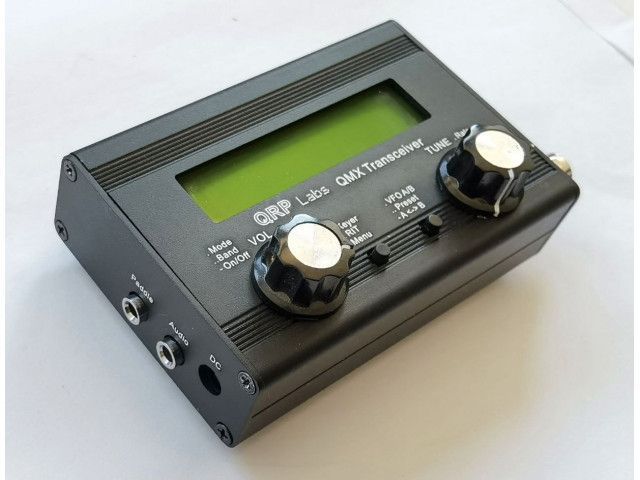
The QMX on my bench looks nothing like this………yet.

My lack of motivation has resulted in  a backlog of projects. First of all there’s the QRPLab’s QMX kit that is sitting on my workbench. After finishing the toroids, I decided to take a break, and I’ve just never gotten back to it. My goal now is to finish it be the end of February, so I’ll be ready to take it on POTA activations.

The lack of progress on this kit is not stopping me from getting started on other projects. The next new project on my list is the Pi-Pico RX. I’ve ordered the parts for this project, and am hoping to receive them soon, so I can get breadboarding.

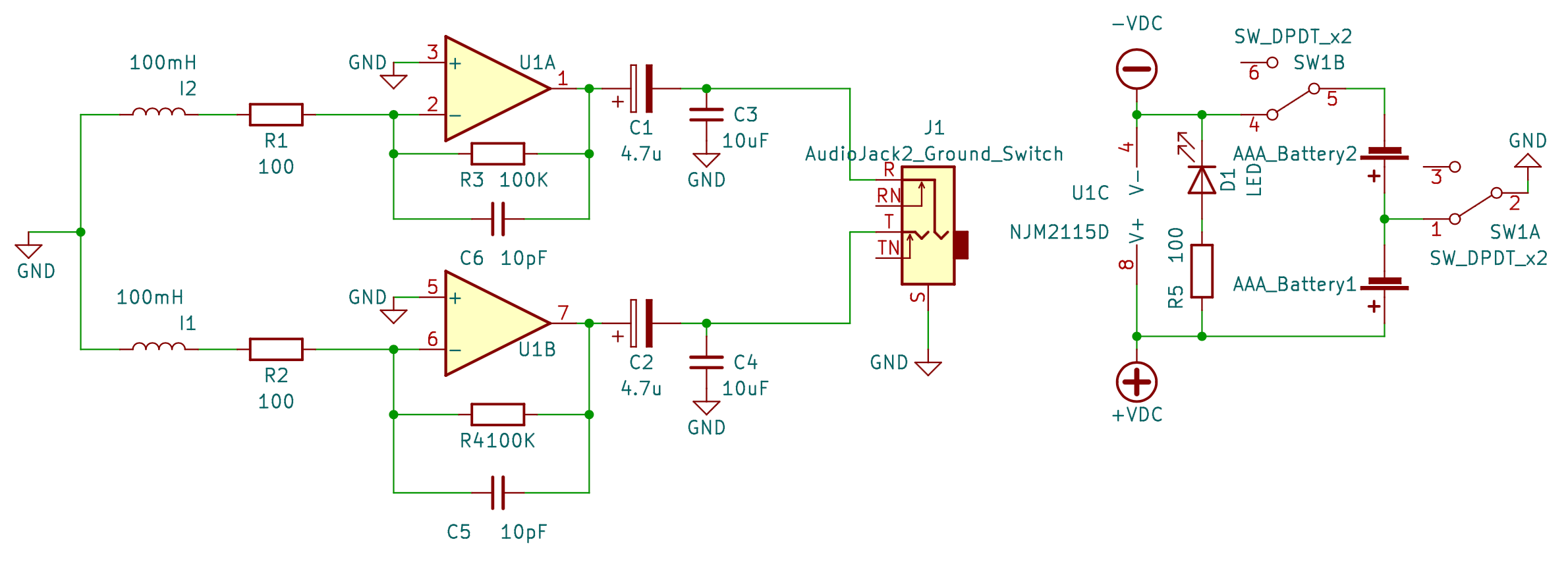
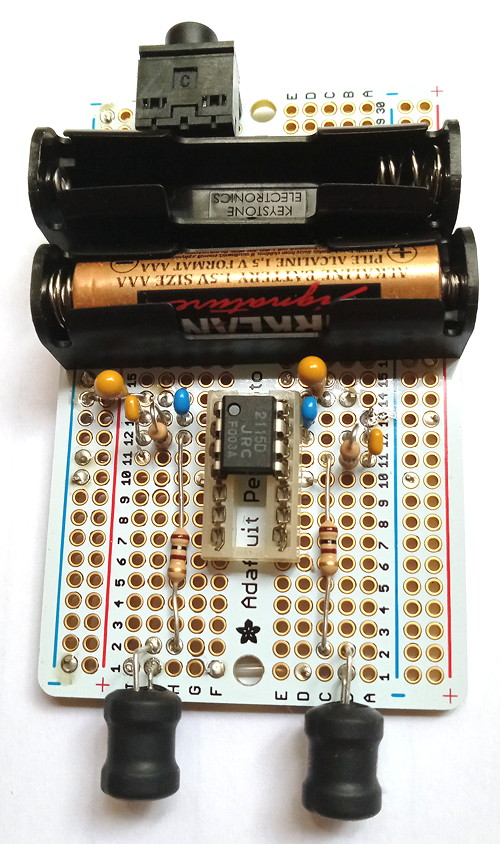
I also ordered parts to build up the circuit for the EMF Explorer Badge. I like this project because it’s pretty simple to build, and eminently hackable. I would love to find someone that’s good with KiCAD to design a PCB with a ham radio theme and then maybe build and sell some of them at Dayton next year. If you’re interested, please get in touch.

More Pico

I went to a ham swap a week ago Sunday, and a guy I know was selling Raspberry Pi Picos, and I bought a Pico W for $12. It’s connected to this computer right now. I followed the Getting started with your Raspberry Pi Pico W tutorial on the Raspberry Pi website, and in about an hour, I had the Pico W serving a web page.

It was a fun little exercise. Now, I’d like to figure a ham radio application for this litte microcontroller. Maybe I could make a wireless remote-control for my transceiver. If you have a cool idea, let me know.

Social(?) media

cartoon of a man sending Morse Code
This is my icon on Mastodon and BlueSky.

So, I deactivated my Twitter account last week. I was kind of sorry about that as I had quite a few followers there, but it’s turned into such a pit that I felt it was the right thing to do.

Several months ago, I joined Mastodon several months ago. I’m @[email protected]. I currently have 632 followers there, and I think that’s pretty good.

I’ve been hearing all this stuff about BlueSky, though, so I decided to sign up there. I’m @cwgeek.bsky.social there. I just signed up and haven’t really participated much there yet, so I can’t really comment on how useful it is, but please follow me there, and I’ll follow you back.


Filed Under: Building/Homebrew, Microcontrollers, On the Internet

Amateur radio in the news: MFJ, turn an Android phone into an HT, Delta County emcomm

November 2, 2024 By Dan KB6NU Leave a Comment

Starkville man ends reign as king of ham radio parts: ‘It was rough trying to say goodbye’

In 1972, Martin Jue was a young entrepreneur who decided to use his electrical engineering expertise to start a new business, MFJ Enterprises, in Starkville, his adopted hometown.

The cottage industry he cultivated grew into a global enterprise that catered to ham radio enthusiasts, which will be missed now that he has shut down manufacturing operations and is gradually unloading the remaining merchandise.

…read more


Turn your Android phone into a ham radio with this open-source project

Vance Vagell, an experienced UX professional at Google, is the brains behind the kv4p HT project. Distributed under the GPL 3.0, the kv4p HT is a homebrew VHF ham radio that can be attached to an Android smartphone via a USB-C port for turning it into a portable radio transceiver.

…read more


Delta County ham radio group ready for emergencies

ESCANABA, Mich. (WLUC) – An old form of communication is vital in hurricane recovery efforts as amateur radio operators across North Carolina and Florida connect rural areas with needed resources. A similar safety net operates across Michigan and the Upper Peninsula to keep residents safe.

Bob Petersen, a licensed amateur or ham radio operator, says his “shack in a box” can mobilize emergency radio communications in just 15 minutes. “It works great for emergency communications because I can quickly and easily go where the communication is needed,” Petersen said.

While Petersen‘s “shack” is portable, the main radio shack is in the Antique Village at the U.P. State Fairgrounds in Escanaba. That’s where Petersen and other amateur radio operators in the Delta County Amateur Radio Society coordinate communications on the state-wide emergency radio net.

…read more (and watch video)

Filed Under: Amateur radio business, Amateur Radio in the News, Building/Homebrew, Emergency Communications / Public Service Tagged With: Android, MFJ, Michigan

Another kilo (of POTA QSOs, that is)

August 26, 2024 By Dan KB6NU 2 Comments

One of the things that makes Parks on the Air (POTA) so successful is the way that they use their database to keep folks involved. It’s very easy for activators to upload their logs, and once uploaded, the website takes it from there, generating myriad awards for participants. There are awards for all kinds of things including activating or hunting early in the day (Early Shift) and later in the day (Late Shifter). There are “rover” awards for operators who like to operated from many different parks and “repeat offender” awards for those that tend to operate from a single park or a small handful of parks.

And, if you’re a repeat offender—which I tend to be—there are awards for making at least 1,000 contacts from a particular park. They call these the “Kilo” awards. Earlier this year—June 20, to be exact—I earned my first kilo at Island Lake State Recreation Area, US-3315. Today, I earned my second at the Pinckney State Recreation Areas, US-3322.

I worked fairly hard to do this. Since June 20, when I completed my first kilo, I activated US-3322 14 times, making a total of 667 contacts, almost all of them on CW. My most productive activation was 82 contacts on August 2. My least productive activation was 11 contacts on August 17.

Man sitting at picnic table holding an umbrella in front of a ham radio.
This picture was taken on August 17 after it started drizzling and just before it started to pour. Photo: Silvia Ruiz.

This activation was a short one because of the weather. Just after I made the seventh contact, it started to sprinkle. Thinking that it might blow over, my wife handed me an umbrella (see above). Just as I made the ninth contact, however, it started to pour. I was just able to squeeze in two more contacts before I decide the best course of action would be to shut everything down before it was drenched.

My 51 contacts today put me over the top.

What’s next?

Now that I’ve made it to 1,000 at two parks, I’m pondering what I should do next.  I could go for 2,000 at US-3315 or US-3322. US-3322 is really a pleasant place to operate.

I could also expand my park selection. There are several nice parks that are only a little further away than Island Lake or Pinckney. I have, for example,  52 contacts from Waterloo State Recreation Area, US-3331, and Maybury State Park, US-1518, is purported to be a nice place to operate from.

Something else that I’m working on is coming up with some new gear for POTA. I’m currently working on building a QRP Labs’ QMX transceiver kit. Last night, I managed to wind and install the first toroid, T501 (see below).   Only 10 more to go!

printed circuit board
Assembling and installing T501 is a lot harder than it looks in this photo.

I’m also going to have to purchase or assemble a tuner to go along with the radio. Maybe once I get it all built, I can start on my first 1,000 using only gear that I’ve built. Maybe I could suggest that POTA add an award for making so many contacts with homebrew or kit rigs.


Filed Under: Building/Homebrew, Parks on the Air Tagged With: QMX, US-1518, US-3312, US-3315

Why aren’t electronic badges more of a thing in #hamradio?

August 19, 2024 By Dan KB6NU 6 Comments

Electronic circuit board with LED screen and buttons.
DEF CON 32 electronic badge.

I attended DEF CON 32 a week or so ago, and like many “hacker” conferences, attendees got an electronic badge. This year’s badge was built around the new Raspberry PI microcontroller, the RP2350. It actually works like a GameBoy, and you can add games like you would a GameBoy. Here are a couple of videos that talk about the DEF CON 32 electronic badge:

  • https://www.youtube.com/watch?v=WWxjNNbiQ5Y
  • https://www.youtube.com/watch?v=tPrIO0fhikE

Some of the “villages” or special interest groups, such as the Aerospace Village created their own badges.

At DEF CON, I attended a talk by a fellow who’s created an open-source design—both hardware and software—upon which you can build a badge for your event. He calls his badge OpenTaxus, and you can find the documentation here.

Since these things are so popular at hacker conferences, I wonder why they aren’t more popular at amateur radio events? Is it because hams are just too cheap to buy something like this? Or, maybe, it’s because hams are just not as “creative” as hackers.

At any rate, I’m thinking about coming up with some kind of electronic badge for the 2025 Dayton Hamvention. If any of you have ideas for the badge—or would perhaps be interested in working on the badge hardware or software—let me know. If we are going to do a badge, it would probably be a good idea to get started on it now.

Filed Under: Hamfests, Microcontrollers Tagged With: badges, DEFCON, Hamvention

  • Page 1
  • Page 2
  • Page 3
  • Interim pages omitted …
  • Page 69
  • Go to Next Page »

Primary Sidebar

No Nonsense Technician Class License Study Guide (for tests given between July 2026 and June 2030)

New No Nonsense Technican Class Study Guide now available!

The 2026 version of my Tech Class study guide is now available, and as always, the PDF version is FREE!. The ePub version costs $11.97, and a Kindle version and paperback version will be available on Amazon shortly.

Click here to get all of my "No Nonsense" study guides.

Also available: The CW Geek's Guide to Having Fun with Morse Code

W5SWL.Com
Retevis Ailunce H1 DMR Radio
DXpander: Cobweb antennas, Laser Cutting

You’ve got mail!

Enter your email address below and get an email every time I publish a new post.

Email


I frequently teach classes to help newcomers get their licenses. The next class will take place on Saturday, February 7, 2026 on the University of Michigan campus. Click here for more information.

If you can't make the class, subscribe to the mailing list to be notified of when the next class will be held.

You can always download my free study guide, and if you have any questions about the classes, or amateur radio in general, please feel free to email me directly.

Support KB6NU.Com

Donate $7.30 and get two of these cool stickers. Measuring 4.25-in. W by 2.75-in. H, it's perfect for your car, your shack, or wherever!

Contact me

If you have a question or comment about one of my blog posts, or a question about any of the material in my study guides, or just a question about ham radio in general, you can email me at [email protected].

Blogs You Should Also Read

  • AE5X: A CW-centric blog from Kingswood, Texas
  • K0LWC Blog
  • LA3ZA Ham Radio Blog
  • Little Radios, Big Fun – WB3GCK
  • Mr. Vacuum Tube's Blog
  • Radio Artisan – K3NG
  • The K0NR Weblog
  • VE3WDM's QRP Ham Radio Blog
  • W2LJ’s Blog

Ham Radio Websites

  • Dashtoons – The Hammin' Comedy by Jeff K1NSS

Podcasts

  • ICQ Podcast
  • Linux in the Ham Schack
  • No Nonsense Amateur Radio Podcast
  • Resonant Frequency Amateur Radio Podcast

Recent Comments

  • Dan KB6NU on Finally, a Loop for 10m.
  • Dan KB6NU on 1930s cards for my collection of QSLs from stations whose callsigns spell words
  • Sean on Finally, a Loop for 10m.
  • Bill Waslo on 1930s cards for my collection of QSLs from stations whose callsigns spell words
  • C M Wetzel KD8TNF on The Wesco BN-1

Meta

  • Log in
  • Entries feed
  • Comments feed
  • WordPress.org

Footer

Copyright © 2026 Daniel M. Romanchik, KB6NU · Log in