• Skip to primary navigation
  • Skip to main content
  • Skip to primary sidebar
  • Skip to footer

KB6NU's Ham Radio Blog

KB6NU's Ham Radio Blog
  • HOME
  • Study Guides
  • Teach a One-Day Tech Class
  • W8SRC Repeater Guide
  • Advertise
  • Hire Me

Vintage Radio

From the trade journals: The rise and fall of Heathkit, Antennas 101, circular polarization

January 22, 2025 By Dan KB6NU Leave a Comment

The Rise and Fall of Heathkit

Steve Leibson begins this six-part series with, “If you came of age in the 1960s or 1970s and then later became an EE, chances are you’re more than casually acquainted with Heathkit. Many engineers started their budding careers by building one or more kits made by the Heath Company. I certainly did.”

Since this is a ham radio blog, I’d say, “If you came of age in the 1960s or 1970s and then later became radio amateur, chances are you’re more than casually acquainted with Heathkit. Many hams started their budding careers by building one or more kits made by the Heath Company. I certainly did.”

This is a remarkable series based on an interview with Chas Gilmore. Gilmore started as a design engineer at the Heath Company in 1966 and worked at the Heath Company on and off for more than two decades. He eventually became vice president of product development, marketing, and sales.

…read more


Antennas 101

Lou Frenzel, W5LEF (SK), was a prolific writer and editor. He was also a ham. Here, he explains antennas in way that we call can understand.

He writes, “Antennas are much more than simple devices connected to every radio. They’re the transducers that convert the voltage from a transmitter into a radio signal. And they pick radio signals out of the air and convert them into a voltage for recovery in a receiver.”

…read more


Understanding circular polarization

John Dunn writes, “An electromagnetic wave or signal traveling from “here” to “there” has an electrostatic field component that we call its E-field and whose direction we assign as the signal’s polarity. Often, the E-field is either vertical or horizontal as developed by a dipole structure or a ground plane antenna, but it can also be rotary which means it can be rotating around the signal’s axis of travel. The conventional terminology for that case however is not the word “rotary”, it is the word “circular”. We thus speak of vertical polarization, horizontal polarization, and circular polarization.”

I’m still not sure that I understand circular polarization after reading this article, but take a look for yourself.
…read more


Filed Under: Antennas, Building/Homebrew, Vintage Radio

Videos: POTA with 1930s gear,

October 24, 2024 By Dan KB6NU Leave a Comment

Think you need modern gear to do POTA? Think again.

Rattlegram: Text over FM

Send text via an FM radio using an app on your Android or iPhone.

Go to https://www.aicodix.de/cofdmtv/rattlegram/ for more info.

Hallicrafters: The Amazing World of Shortwave Radio

This isn’t a video, per se. It’s a video made from an audio recording originally released on a 45 rpm vinyl record. It gives you a taste of what shortwave broadcasting used to be.

Filed Under: Digital Modes, Parks on the Air, SWLing, Vintage Radio Tagged With: Halicrafters, Rattlegram

ICQPodcast #371: vintage radios, Greek stamps, Avro Lancaster special event

February 28, 2022 By Dan KB6NU Leave a Comment

In this episode, I joined Martin Butler (M1MRB), Edmund Spicer M0MNG, and Ed Durrant DD5LP to discuss:

  • Enthusiast’s Radio Collection in the Press

  • New Postage Stamps Feature Amateur Radio in Greece

  • Amateur Radio – A Life-Long Technical Hobby

  • Avro Lancaster 80th Anniversary of the 1st operational sortie

  • Amateur Radio in Ukraine

We didn’t discuss the situation of amateur radio in Ukraine because we recorded this episode before the Russian invasion began. Colin, M6BOY, does report on this in the news in brief section of the podcast, though.

This episode’s feature is about improving your SSB contact ratio.

Filed Under: ICQ Podcast, Vintage Radio

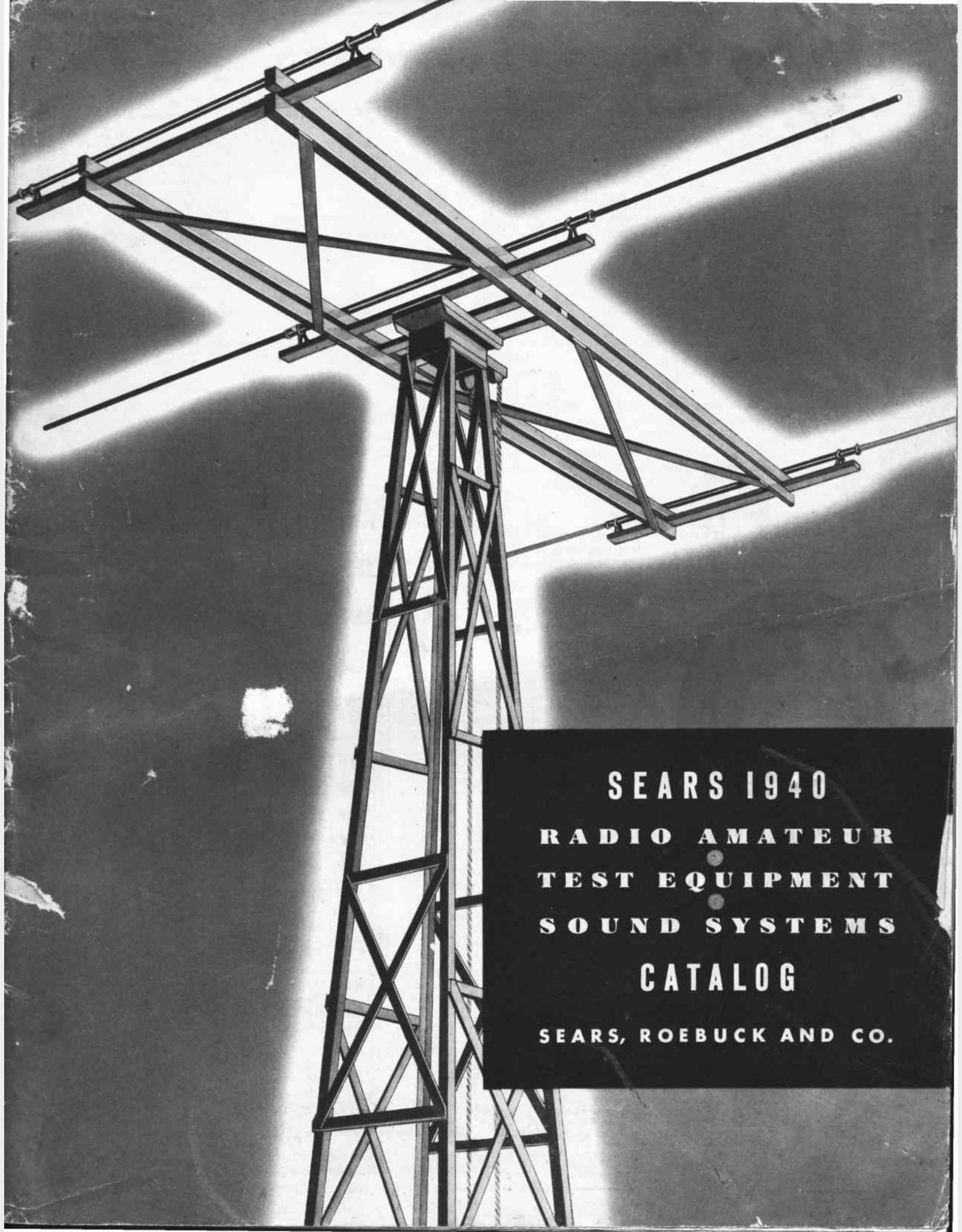
Sears sold ham gear?

March 17, 2021 By Dan KB6NU 6 Comments

Click for larger image.

Who knew that Sears once sold amateur radio gear?

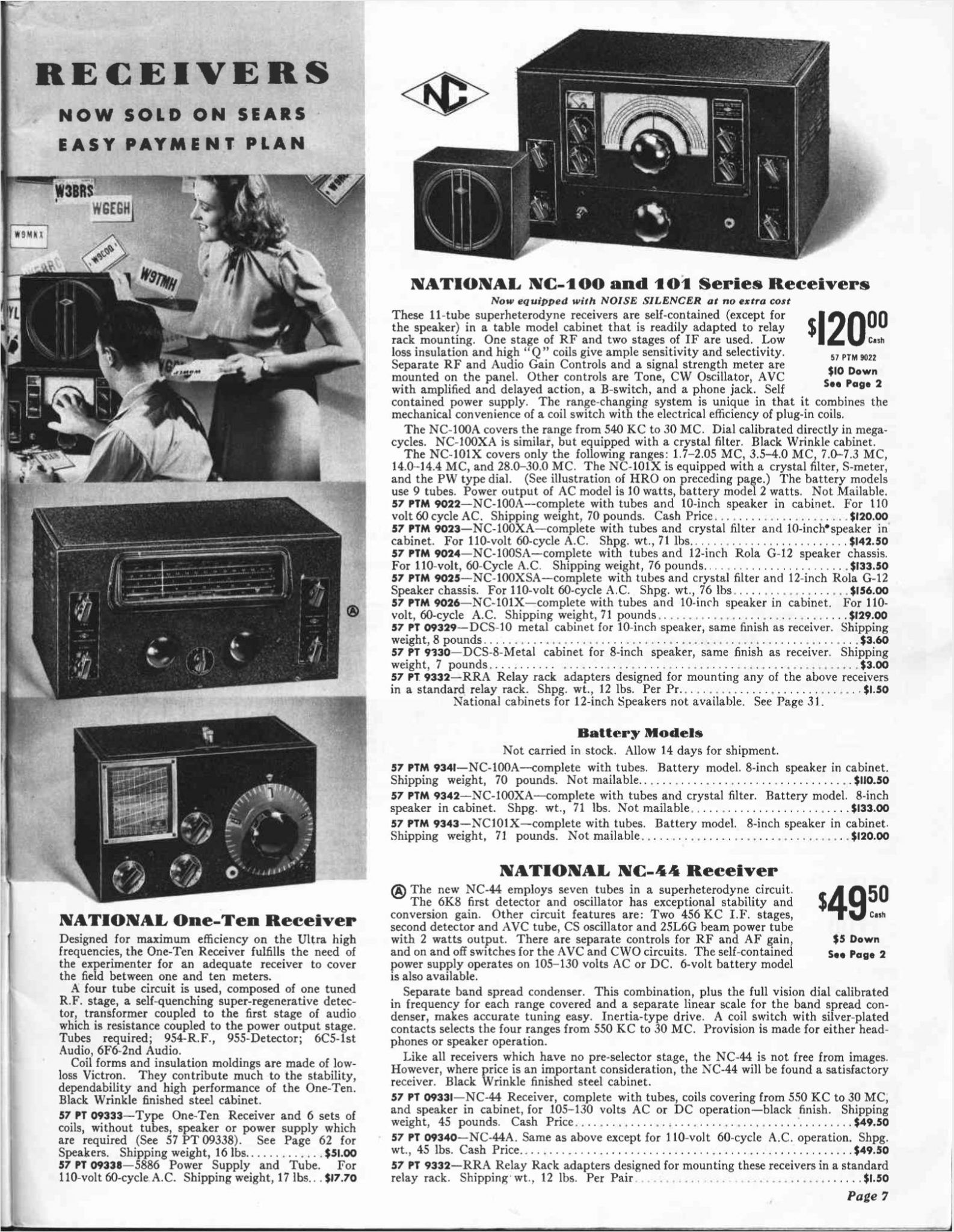
On the CWops mailing list this morning, someone posted a link to the Sears 1940 Radio Amateur/Test Equipment/Sound Systems Catalog. I knew that Sears sold lots of things in the past, but I”d never heard that they sold ham equipment.

This catalog features gear from a lot of major manufacturer of the day, including:

  • Hallicrafters
  • National
  • Meissner
  • Hammarlund
  • Stancor

The prices look pretty good, too. On page 7, you see that the National NC-100 costs only $120. But, wait a second, that’s in 1940 dollars. Most inflation calculators say a 1940 dollar is worth $18.61 today, so that makes the price of that NC-100 $2,232 in 2021 dollars, and for that price, you’re only getting the receiver. Don’t worry, though. As you can see, you can buy that radio on Sears’ Easy Payment Plan.

Click for larger image.

Sears also parts, like tubes, crystals, capacitors, and coils. An RCA 807 21 W transmitting tube sold for $3.50. An 806, which had a maximum plate dissipation of 150 W, went for $22.

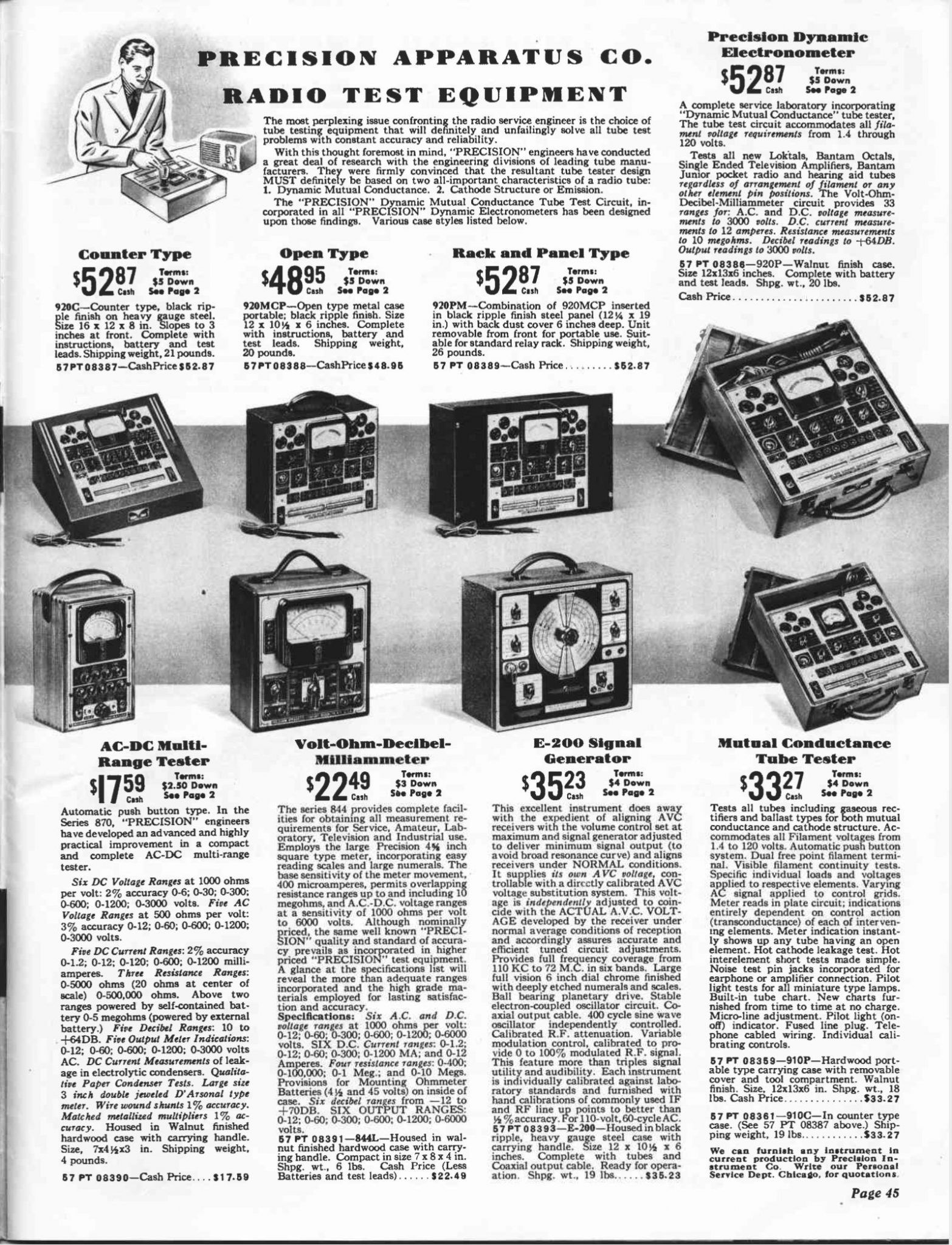
Sears sold test gear, too. The catalog includes 12 pages of test equipment, including gear from Triplett, Weston, Hickok, and RCA, but also lesser-known names, such as Precision Apparatus, Radio City Products, Supreme Test Equipment and ReadRite. I’d never heard of these last four manufacturers, and I consider myself somewhat of a test-equipment geek. Below is a page showing testers from Precision Apparatus. As you can see, Precision Apparatus made a wide variety of gear, including voltmeters, signal generators, and tube testers.

Click for larger image.

Many items are reasonably priced. One of my friends commented that the Speed-X keys were very economically priced. The top of the line straight key—the Speed-X 320—cost only $1.91, while the Speed-X 545 Speed Key, or bug, was only $5.44.

There’s lots of other cool stuff in the catalog, too. Download it, browse through it, and let me know what you found interesting.

Filed Under: Vintage Radio Tagged With: Sears

A classic key restored

October 15, 2018 By Dan KB6NU 2 Comments

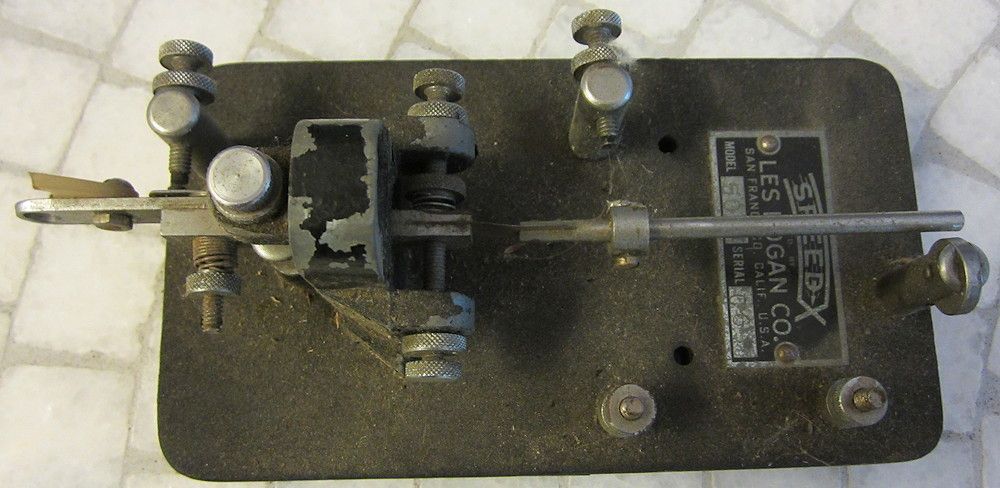
About a month ago, I blogged about finding the carcass of a Les Logan Speed-X bug in my father’s garage. It was in pretty rough shape (see below), but I really hate to throw these things away, so, I posted this story to the CWOps mailing list, and asked if anyone thought it would be worth trying to restore.

Jim, N4TMM, replied that he had just acquired and restored a similar key, and told me the story of how he did it. He added:

Here is another thought. If you don’t want to go through rebuilding, I am happy to buy it from you, because the screws are what I need, primarily. I will pay you whatever is fair, somewhere between $50 and $100, for instance.

As much as I love ham radio, I’m really not very good at restoring things. I have a bunch of old electronics on shelves here waiting for me to get around to them. I could have added the Speed-X to the list, but it would have been so far down that I rather doubt that I would have gotten to in in my lifetime. So, I offered to sell it to Jim for $50, plus shipping. He sent me $65, and I sent him the key.

About a week ago, I got the following email from Jim:

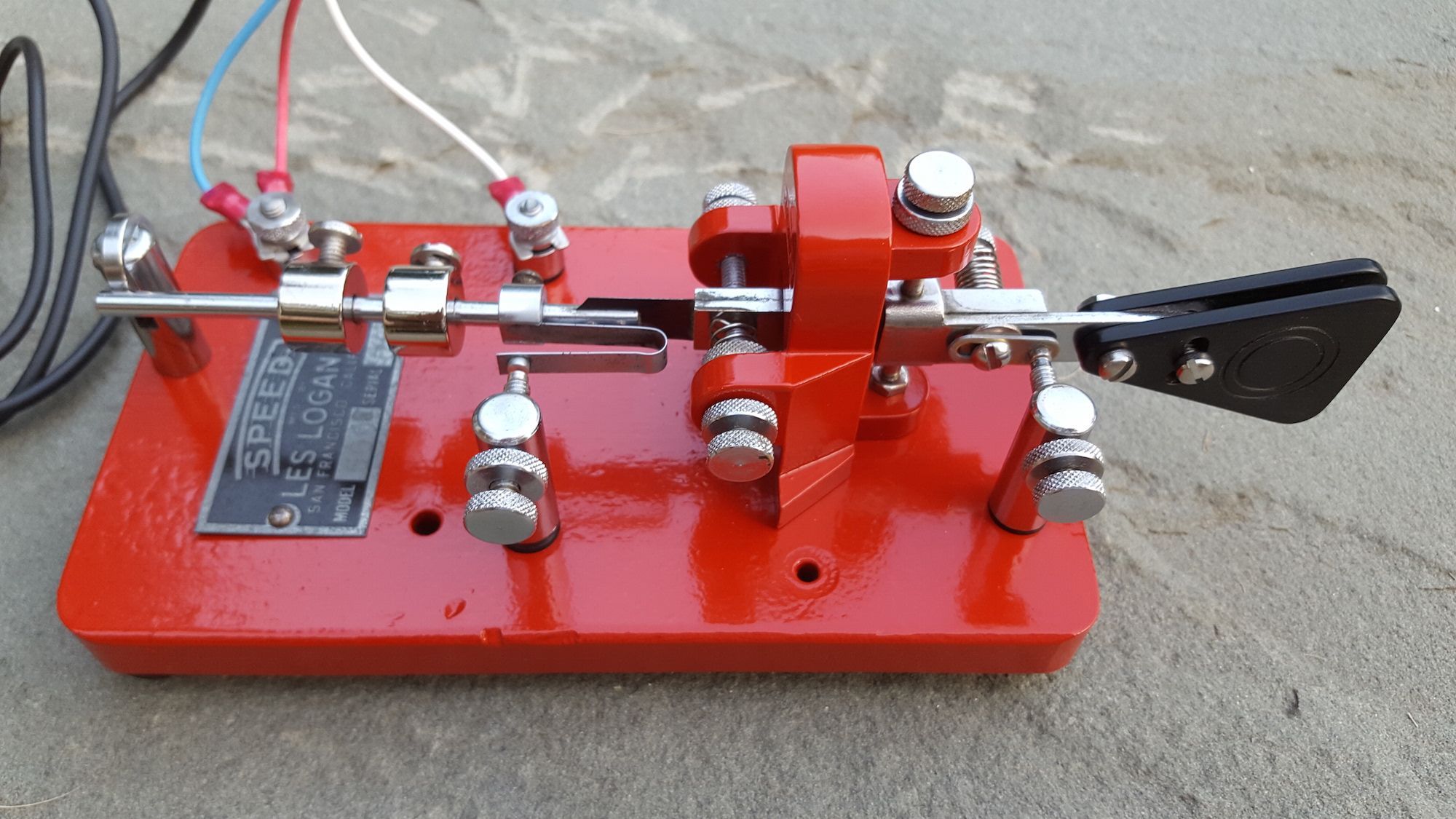
I completed the Les Logan today, after letting the red engine paint cure for 7 days.  I am attaching two photos.  I wanted you to be the first to see them.  What I did was to mill the top of the pendulum frame with a diamond burr to a Fibonacci 8:5 bridge curve, then take the trunnion frame and base down to the metal with Strypeze and sandpaper, then 2 coats of primer followed by 2 coats of Rustoleum engine red enamel.  The pendulum, posts, screws, springs I hand polished with Flitz – the nickel plating was fortunately in great shape so took the polishing well.  New finger/thumb bulls eye pieces, and new feet, from Donnie at 2B Radio Parts.  Donnie gave me a great deal of advice and parts for this key, including a new base when I broke off a thread tap in one of the nameplate holes.  The hairpin spring and weights came from the other Les Logan, in which I had replaced them with a 1.9oz weight from Donnie and Vibroplex spring.  This particular key had a bent pendulum blade, which is tough to replace, and which reduces somewhat the frequency at which the pendulum oscillates.  But it’s perfect with the weights you see on it for 20wpm or so CW.  As I had heard would be the case, and like my other Les Logan, it runs really smooth, very forgiving and a pleasure to operate.   I wanted you to be the first to see photographs of it.  Thanks again for letting me take it off your hands.

Here’s what the key looks like now:

What I say is thanks, Jim, for doing such a great job restoring this key to its former glory.

Filed Under: CW, Vintage Radio Tagged With: Les Logan, Speed-X

Radio as art

September 25, 2017 By Dan KB6NU Leave a Comment

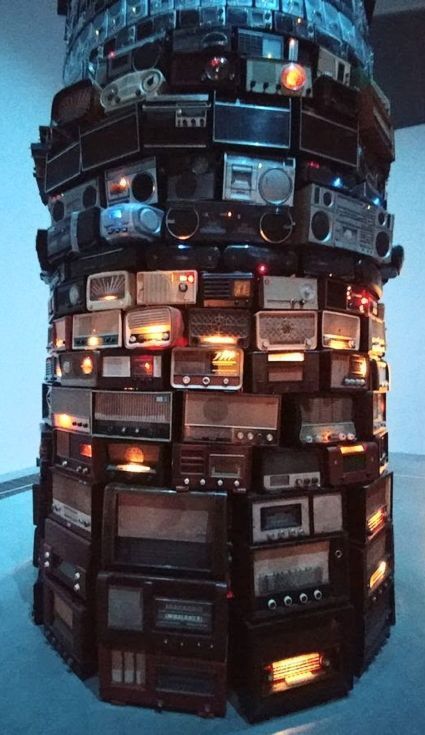
A reader, Richard, K3IND, sent me this yesterday. He noted that it’s from an exhibit at the Tate Modern Museum in London. I love it…Dan


The piece is called Babel (2001) and is the work of Cildo Meireles.  The Tate website notes:

BABEL 2001

This vast tower of radios, each tuned to a different channel and adjusted to the minimum volume at which it is audible, relates to the biblical story of the Tower of Babel: a tower tall enough to reach the heavens. Affronted by this structure, God caused the builders to speak in different languages and, ceasing to understand one another, become divided and scattered across the earth. According to myth, this inability to communicate became the cause of all mankind’s conflicts.

Babel consists of around 800 radios of varying ages, from the beautiful, large, valve radios which make up the bottom tiers of the tower to the smaller mass-produced electronic radios of recent years which form its summit. By using radios of decreasing size from the floor to the ceiling, Meireles emphasises the perspective and the sheer height of the work.

Furthermore, Babel constitutes a survey of radios from the 1920s to the present day, which in turn presents what the artist has described as ‘an archaeological sample of events’. Due to the time-based nature of the medium of radio, no two experiences of this work are ever the same.

Filed Under: Everything Else, Vintage Radio Tagged With: art, Tate

From the trade magazines: EM model of the human head, vintage electronics history

February 7, 2017 By Dan KB6NU Leave a Comment

Create an EM model for a human head. A model of the human head was created for studying specific absorption rates of EM energy from wireless sources.
Concern for the growing use of wireless devices, such as mobile phones, that expose a user’s head to electromagnetic (EM) field energy has motivated a number of studies on the effects of EM radiation on the brain. An important part of that research is to develop accurate models of the human head for simulating the effects of EM radiation on human tissues.

Amateur radio operators need to be concerned about RF safety—if only to debunk all the misconceptions that are floating around out there. With that in mind, I found this to be an interesting read….Dan

Electronics through the ages: A history of vintage technology in pictures. The history of consumer electronics goes back to the early 20th century, most precisely the 1920s. It was then when radio broadcasting incorporated the first major consumer product that went to mass production: The broadcast receiver.

Ready to start programming and configuring that Red Pitaya open instrument platform? Here’s a new blog series to help. The Zynq-based Red Pitaya open instrumentation board gives you a programmable platform like an Arduino or a Raspberry Pi, but with the added kick of high-speed ADCs and DACs for analog instrumentation projects.

Filed Under: Computers, Gear/Gadgets, Test Equipment, Vintage Radio Tagged With: Red Pitaya, simulation

My father-in-law’s S-52

December 19, 2016 By Dan KB6NU 3 Comments

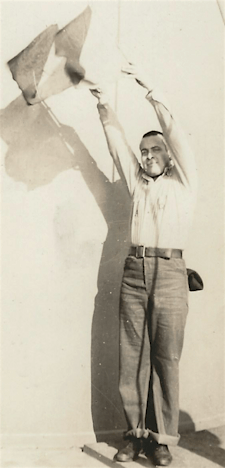
Although my father-in-law, Alfonso Ruiz, was born in the United States, he was of Mexican descent, and for a while lived in Guadalajara, where he met and married my mother-in-law. He served as a Seaman Signalman in the U.S. Navy during World War II (the photo at right shows him aboard ship in 1944), and after the war, he and my mother-in-law moved to Detroit. Detroit was booming then. Jobs were plentiful, and his sister already lived here.
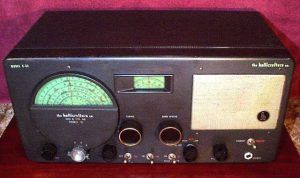
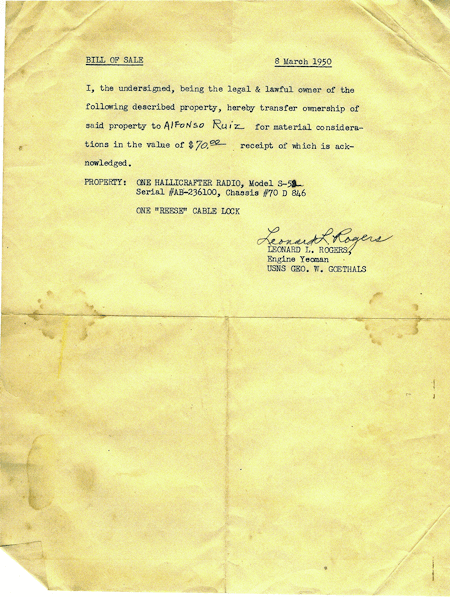
In 1950, he purchased a Hallicrafters S-52 shortwave radio so that he and my mother-in-law could listen to shortwave broadcasts from Mexico. He gave that radio to me about 15 years ago.

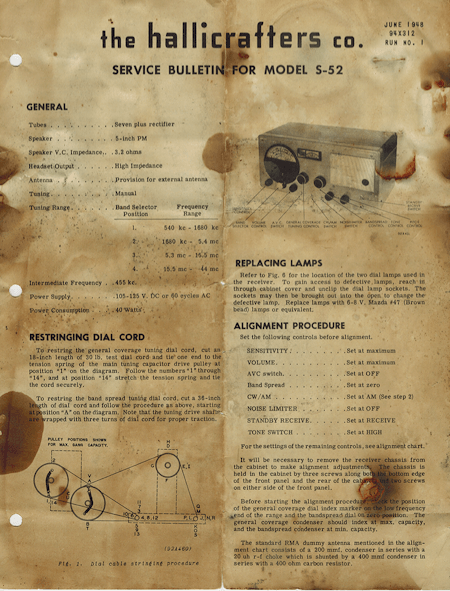
The S-52 is a single conversion general coverage receiver, and is the AC-DC marine version of the S-40 First built in 1948, the set covers 4 bands from AM broadcast to 44 MHz. It uses nine tubes, including a plug-in ballast that was selected for either 120 volt or for 240 volt operation. The 1948 price was $99.50 (about $1,000 today).
My father-in-law passed away five years ago. He was very proud of his service in the Navy, and we were happy that we could bury him in the Great Lakes National Cemetery.

My mother-in-law passed away a little over a month ago, and in going through the house that they lived in for more than 60 years, my brother-in-law found the bill of sale for the radio:

He also found the service bulletin for the radio:

Email me if you’d like to get the complete PDF. It’s more than 20 Mbytes, so I didn’t want to post it here.

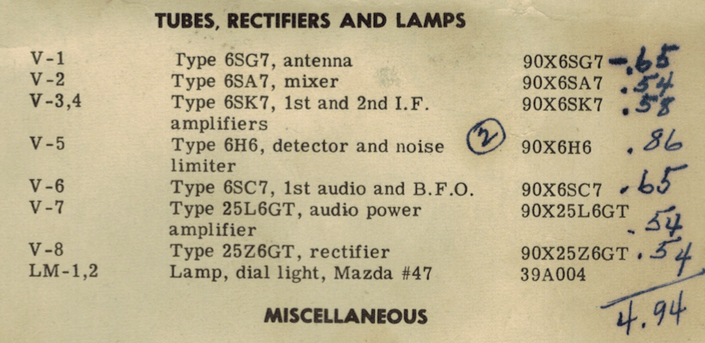
It includes alignment instructions, a complete parts list, and schematic. On the parts list, my father-in-law calculated the cost of a set of replacement tubes:

They would certainly cost more than $5 today.

I haven’t turned it on for a while, but I’ll do so this holiday season. HF Underground lists a few Mexican shortwave stations that might still be on the air, although I’m not sure how successful I’ll be. Even if I don’t hear anything, it will bring back memories of my in-laws and how this radio helped them keep in touch with their homeland.

Filed Under: People, Vintage Radio Tagged With: Hallicrafters, Mexico, Ruiz, S-52

One tube covers them all: the 807

November 13, 2015 By Dan KB6NU Leave a Comment

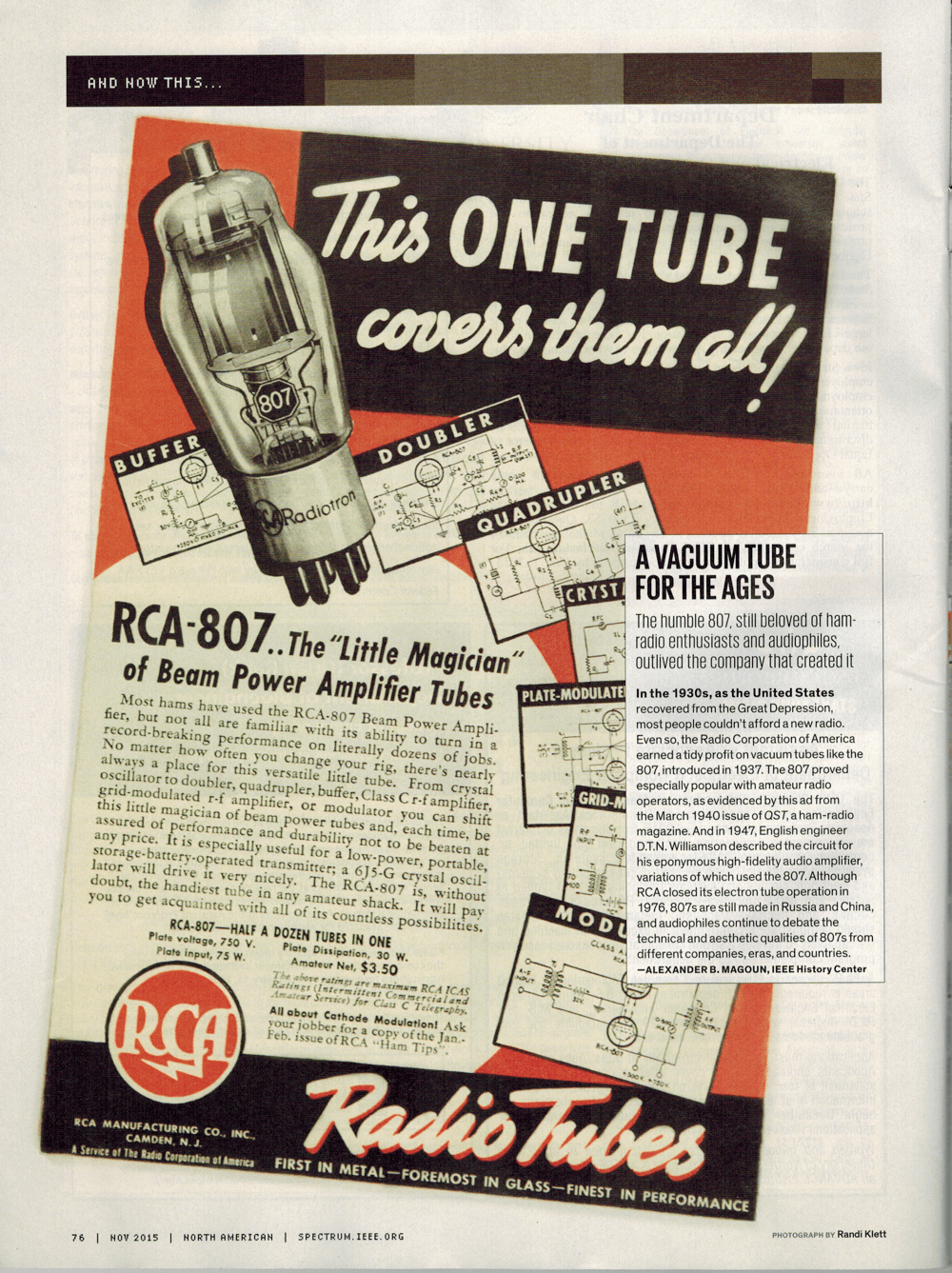
Imagine my surprise when I turned the page while reading Spectrum, the IEEE magazine that covers all the latest technology and found this ad for the RCA-807 from the March 1940 issue of QST. Note that the amateur price is $3.50. In 2015 dollars, that’s almost $60 per tube. (Click to see a larger image of the ad.)

rca-807

Filed Under: Tubes, Vintage Radio

July 2015 QST Classifieds: Sigtomics, CPO museum, copy CW in your head

June 19, 2015 By Dan KB6NU Leave a Comment

From time to time, I peruse the QST classifieds looking for new items. Here are two from the July 2015 QST, plus one that I’ve seen before:

CW Operators. Learn to copy in your head. Exercises on USB flash drives. Audio and visual displays. Use with Windows Media. $20. Free shipping.  Carl Dahlberg, N7AGK, P.O. Box 753, Bonners Ferry, Idaho 83805. Email [email protected]

This sounds interesting to me. I always advise guys to learn to copy in their heads. I think I’ll have to email N7AGK and get more info as it doesn’t appear that he has a website…Dan

“SOFT START YOUR RADIO from SIGTOMICS.com or (607) 785-7085 WA2LTD”

WA2LTD sells several different devices that limit the start up current to devices…Dan

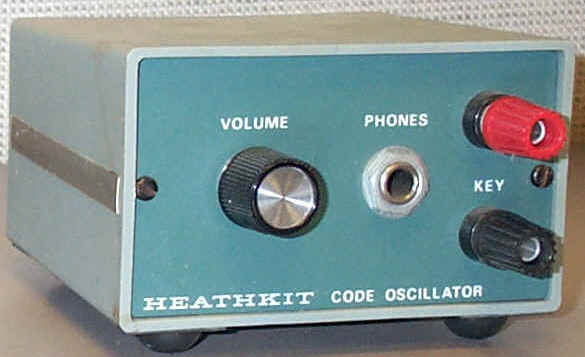
I have a couple of these beauties, which I use for CW demonstrations. For more information on the Heathkit HD-1416, visit the Code Practice Oscillator Museum.

CODE PRACTICE OSCILLATOR MUSEUM http://www.n4mw.com

The Code Practice Oscillator Museum is actually at http://www.n4mw.com/cpo.htm. It has photos of hundreds of different code practice oscillators. Some have little writeups or documentation. For example, along with the photo of the Knight-Kit Star Roamer receiver is the following:

The thoughtful designers at Knightkit decided that a beginner’s receiver would be used to learn to receive morse code.  But what about sending practice?  They cleverly and cheaply built in a “code/normal” switch and a terminal strip to connect a key (see inset picture below).  In the “normal” position, received sound is emitted from the speaker or headphones.  In the “code” position, the audio output is interrupted by the open key circuit.  To practice code, put the switch in “normal”, tune in a carrier and adjust for a constant beat note.  Then switch to “code” and operate the key.  No special oscillator involved, unless you count the distant station emitting the received carrier wave. 

Filed Under: CW, Gear/Gadgets, Vintage Radio

  • Page 1
  • Page 2
  • Page 3
  • Page 4
  • Go to Next Page »

Primary Sidebar

No Nonsense Technician Class License Study Guide (for tests given between July 2026 and June 2030)

New No Nonsense Technican Class Study Guide now available!

The 2026 version of my Tech Class study guide is now available, and as always, the PDF version is FREE!. The ePub version costs $11.97, and a Kindle version and paperback version will be available on Amazon shortly.

Click here to get all of my "No Nonsense" study guides.

Also available: The CW Geek's Guide to Having Fun with Morse Code

W5SWL.Com
Retevis Ailunce H1 DMR Radio
DXpander: Cobweb antennas, Laser Cutting

You’ve got mail!

Enter your email address below and get an email every time I publish a new post.

Email


I frequently teach classes to help newcomers get their licenses. The next class will take place on Saturday, February 7, 2026 on the University of Michigan campus. Click here for more information.

If you can't make the class, subscribe to the mailing list to be notified of when the next class will be held.

You can always download my free study guide, and if you have any questions about the classes, or amateur radio in general, please feel free to email me directly.

Support KB6NU.Com

Donate $7.30 and get two of these cool stickers. Measuring 4.25-in. W by 2.75-in. H, it's perfect for your car, your shack, or wherever!

Contact me

If you have a question or comment about one of my blog posts, or a question about any of the material in my study guides, or just a question about ham radio in general, you can email me at [email protected].

Blogs You Should Also Read

  • AE5X: A CW-centric blog from Kingswood, Texas
  • K0LWC Blog
  • LA3ZA Ham Radio Blog
  • Little Radios, Big Fun – WB3GCK
  • Mr. Vacuum Tube's Blog
  • Radio Artisan – K3NG
  • The K0NR Weblog
  • VE3WDM's QRP Ham Radio Blog
  • W2LJ’s Blog

Ham Radio Websites

  • Dashtoons – The Hammin' Comedy by Jeff K1NSS

Podcasts

  • ICQ Podcast
  • Linux in the Ham Schack
  • No Nonsense Amateur Radio Podcast
  • Resonant Frequency Amateur Radio Podcast

Recent Comments

  • Dan KB6NU on Finally, a Loop for 10m.
  • Dan KB6NU on 1930s cards for my collection of QSLs from stations whose callsigns spell words
  • Sean on Finally, a Loop for 10m.
  • Bill Waslo on 1930s cards for my collection of QSLs from stations whose callsigns spell words
  • C M Wetzel KD8TNF on The Wesco BN-1

Meta

  • Log in
  • Entries feed
  • Comments feed
  • WordPress.org

Footer

Copyright © 2026 Daniel M. Romanchik, KB6NU · Log in