• Skip to primary navigation
  • Skip to main content
  • Skip to primary sidebar
  • Skip to footer

KB6NU's Ham Radio Blog

KB6NU's Ham Radio Blog
  • HOME
  • Study Guides
  • Teach a One-Day Tech Class
  • W8SRC Repeater Guide
  • Advertise
  • Hire Me

Parks on the Air

Videos: What’s next for POTA, ham radio helps rescue man trapped in cave

September 3, 2026 By Dan KB6NU 1 Comment

What’s next for POTA?

I sometimes claim partial credit for POTA because Thom, W8TAM, was in one of my General classes. Maybe that qualifies me for one-half of 1%? one-quarter of 1%? Thom always teases me that I’m “ham famous,” but I think his work on Parks on the Air (POTA) is making him way more ham-famous that I can claim to be. Here he is on the Q5 Worldwide Ham Radio video channel, explaining some of the changes coming to this popular program.

Amateur radio tech aids Canadian cave rescue

On the next episode of the ICQ Podcast, we are going to discuss an interesting cave rescue story. As it happens, we believe that five-watt QDX-M transceivers from QRP-Labs, operating on the 2200m band, were used to communicate through 100 meters of solid rock in the rescue operation at Rats Nest Cave in Alberta, Canada. The rescuers used  JS8-CALL digital mode to send and receive text  messages with the trapped man. Here’s a news report on the rescue:


The Calgary Herald also published a story on the rescue on August 21, 2026.

For more information on the technology, you might want to read the recent article in MAKE: magazine, “Cave Radio – Talking Through Solid Rock.”
Filed Under: Gear/Gadgets, Parks on the Air Tagged With: cave communications, QRP Labs, W8TAM

More POTA notes, 7/30/26

July 30, 2026 By Dan KB6NU 4 Comments

Here are a couple more POTA notes:

  • I’ve discovered the limits of my 9 Ahr BioEnno battery. I used it for the following activations:
    • July 22, 1 hour, 15 contacts
    • July 24, 1.5 hours, 31 contacts
    • July 25, 1.5 hours, 60 contacts
    • July 27, 2.5 hours, 52 contacts
    • July 29, 1.25 hours, 40 contacts

    About midway through this last activation, my KX3 began limitng the power output to 10 W. I guess that the battery couldn’t supply enough current to output the full 15 W. It did continue to work at 10 W, though, for the remainder of the activation. I recharged the battery overnight, and it worked just fine this morning.

  • My 40 contacts yesterday gave me 940 from the Iron Belle Trail (US-13184), so this morning, I decided to work the remaining 60 to get my “kilo” for the park. I made my first contact at 8:35 am, and for the next hour and a half, did pretty well. I made contact #59 at 10:05, which is close to 1 contact every minute and a half. Then, the band went south on me. Over the next half hour, I only managed 7 contacts.Even so, that put me over 1,000 QSOs for US-13184, so I’m happy about that. My 1,006 contacts and 29 activations don’t, however, get me onto the leader board, though. KE8VC leads with 117 activations and 6234 contacts!
  • After lunch, it was such a nice day that I managed to cajole my wife to head out to the Pinckney State Recreation Area (US-3322) with me. The bands weren’t as cooperative as they were in the morning, but I did manage to make 40 contacts over the course of two hours. I would have liked to make more contacts, but it was fun just chilling by the beach and enjoying the day.

    Towards the end of the activation, a young man and his son came up to me and started chatting. He mentioned that he was planning to take the Tech test soon. I gave him my card and encouraged him to download my free study guide. I also gave him a demo of my POTA setup and explained what POTA was all about. I hope that he will get his license soon and join us on the air.

Filed Under: Parks on the Air Tagged With: Iron Belle State Trail, Pinckney State Recreation Area, US-13184, US-3322

POTA notes, 7/27/26

July 27, 2026 By Dan KB6NU 78 Comments

Since the POTA gods (or in this case, a goddess) designated the Iron Belle State Trail (US-13184) a. POTA entity, this spring, I’ve been working a lot of POTA. The park is less than a mile from my house, and I can be on the air within 20 minutes of leaving my house. After this morning’s activation, I have a total of 900 contacts from US-13184.

This has given me a lot of time to make some observations about POTA operation. Here they are in no particular order:

  • I’m hoping to hit the kilo mark at US-13184 sometime this week, so that I can hit some of the other parks in the area again. Specifically, I want to head out to Pinckney State Recreation Area (US-3322). There’s a nice little lake with a sandy beach there, which is great for warmer weather.
  • Although there is more activity on the weekends, weekdays can be good days for activating as well. On Saturday, I made 60 contacts in an hour and a half. This morning, I made 52 contacts in about two hours and 15 minutes.
  • If I’m out early (say before 9 am), I begin operations on 40 meters. This lets me work close-in stations before the D-layer gets too hot for ionospheric propagation. I’ve also noticed that ground wave propagation can be good on 40 meters early in the day.
  • When it seems as though I’ve worked all the hunters on 40 meters, or when propagation begins changing, I’ll go to 20 meters. You  don’t want to wait too long to to this, but you don’t want to be too quick, either.
  • Being a CW guy, I mostly operate CW. The last couple of activations, though, I’ve given phone a try. With only 15 W from my KX-3, I’m certainly not the strongest signal on the band, but I have made contacts, and phone is a nice change of pace. Who knows? I might even give digital a whack one of these days.
  • 18 or 19 wpm seems to be the optimum speed at which to call CQ POTA. Calling at higher speeds could put off slower hunters. Calling at slower speeds is a bit aggravating for me.
  • Listen for the weak signals. Because you’re not asking for a long contact, QRP stations will call you for a contact. Other park activators will also have weaker signals on average. I don’t actually do this myself, but I’d say that always using headphones will help you hear the weaker stations. I really should because it’s kind of comical seeing me lean in to hear a weak one on the less-than-great KX3 speaker.
  • In general, there seem to be a higher percentage of women operating POTA. It’s not an incredibly higher percentage, but it is something that I’ve noticed.
  • My 9 Ahr battery is good for at least 4 activations. I could have gotten away with a much smaller battery, but it’s nice not having to recharge after every activation.
  • Activations can be more fun with a second operator, even if you’re working CW. A ham friend stopped by the park this morning, just as  I was wrapping up. We shared some observations, and when I was done, he set up his station. Next time, I’ll bring my 40-meter contest filter so that we can both operate at the same time without interfering with one another.

Now, here are a couple of observations directed at hunters:

  • If an activator doesn’t repsond to your first call, don’t get discouraged. Be patient, especially if you’re running low power.  If you hang in there, the activator will eventually get to you.
  • Hunters don’t need to repeat exchange, unless asked to do so. If you’re giving an activator a 559 report from Michigan, simply send “559 MI”, not “559 559 MI MI.”

Having said all that, I’d love to hear some of your observations. Please leave a comment below or email me directly.

Filed Under: Everything Else, Parks on the Air

Today’s POTA activation: A nice change of pace

July 11, 2026 By Dan KB6NU 1 Comment

This summer, I have been activating the Iron Belle Trail, US-13184, a lot.  This is a newly-added POTA entity and it runs through Bandemer Park, which is less than a mile from my house as the crow flies, and less than a mile and a half by car. I can be on the air in 20 minutes or less from the time I leave my house.

I popped over to the park this morning for a quick activation. I got all set up and made some CW contacts on 40 meters, but the action was kind of slow. I QSYed up to 20 meters, only to discover that there was some kind of contest going on. :( I made a contact or two there, then switched to 30 meters. I made a couple of contacts on 30 by hunting, but that still wasn’t all that satisfying.

Then, I thought, why not give phone a try? I QSYed to 40 meter phone, found a guy operating a special event station and worked him. He gave me a pretty decent signal report, so I decided to try calling CQ POTA. I made seven contacts calling CQ. As I was getting close to the hour that I allotted myself to operate this morning, I decided to try hunt a few more.

The first activator that I came across had three operators in North Carolina. Tuning down the band a little, I found another multi-operator activation that wasn’t even listed on the spots page. There were five ops there in Georgia. So, out of a total 29 contacts, 16 were SSB contacts, which I made in the last 23 minutes. Not too shabby for only running 15 W and a nice change of pace! My average report was 5-7.

A nice surprise

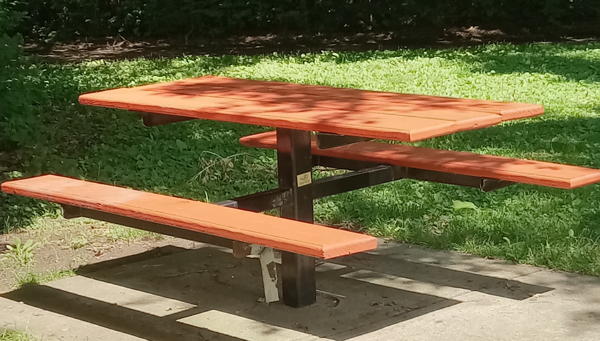
By the way, I had a nice surprise yesterday when I arrived at the park. The picnic table I’ve been operating from at Bandemer was in pretty bad shape. The wood had warped and gotten quite soft, and one of the benches even had a hole in it. I reported this to the city on the SeeClickFix website on Monday, and when I arrived at the park on Friday, the rotting wood had all been replaced.

Picnic table at Bandemer Park.
The newly restored picnic table that I operate from at Bandemer Park. You can see the Iron Belle Trail, US-13184, in the background.
I don’t know if this had anything to do with their prompt reply, but when I reported the issue, I noted that the hole in the bench could be a safety issue! At any rate, it’s even more of a pleasure to operate at Bandemer Park.

Filed Under: Operating, Parks on the Air Tagged With: Bandemer Park, Iron Belle Trail

Dayton Hamvention 2026: Day 2, Thursday, May 14

May 20, 2026 By Dan KB6NU 1 Comment

QRP-ARCI logo.
Four Days in May is an activity of QRP-ARCI.

Day 2 started out pretty early. The Four Days in May (FDIM) seminar starts at 8 am!

After a short drive from my hotel, I arrived at the DoubleTree Hotel a little after 7:30 am, expecting to sail in and claim a seat. I was, however, was surprised to see a line snaking down one of the hallways. Apparently, they weren’t letting people in yet.

As I walked down the hallway to take my place at the end of the line, I came across my friend Tom, W8TJB, who graciously let me take cuts. As it turned out, there were plenty of seats, though, so that was not a big deal. Here’s a short description of the talks I heard:

  • A Homebrewer’s Journey: How I got to where I am. Harold Smith, KE6TI, gave the first presentation of the day. He detailed his journey, from his high school days in the early 1960s to today. Harold’s talk included a lot of useful tips, but my big takeaway was, “When you’re homebrewing, you’re building for yourself.” With that in mind, Harold advised to not worry so much about how a project looks, or even how well it works. Focus on the enjoyment you had building something and what you learned from working on it.
  • Life is NOT Too Short for QRP if You Know a Few Tricks. Anthony Luscre, K8ZT, was responsible for this talk. He provided many, many tips for successfully operating QRP including how to select equipment, what antenna to use, what bands top operate, what modes to operate, and what times to operate. He also gave quite a few tips on operating technique. One tip that I plan to follow up on is his tip to use the 4X4XM Propagation Tools to better understand propagation.
  • The CFT1: the design philosophy and lessons in good user interface. Jonathan Kayne, KM4CFT, a young ham who recently graduated from Virginia Tech, told us the story of how he came to design the CFT1, a five-band, QRP transceiver. In this very interesting talk, he detailed his reason for designing the radio (a very noisy QTH which drove him to operate portable) and the entire design process. I enjoyed this talk so much that I thought that I might even buy one of his radios, but the kit cost $320, and since I still haven’t finished building my QMX, I decided not to.
  • Post-Hurricane Helene: The Role of Practical Preparedness and Community in Emergency Communications. Well-known QRPer, Thomas Witherspoon, K4SWL, lives in the mountains in western North Carolina, right in the path of Hurricane Helene. He spoke about how the hurricane affected him and his family, but perhaps more importantly, how the people of his community bonded to get through the crisis. As he was talking to an audence made up of hams, he talked quite a bit about the importance of communications in keeping that community together. “In a disaster,” he said, “communications is not just about passing information. It’s about holding a community together when everything else falls apart.”
  • Learn CW Like a Boss. In this talk, Jerry Weisskohl, AC4BT, gave us some tips on how to improve our ability to send and receive Morse code. He strongly recommended the use of Morse Runner and detailed  how he used the program to get better at receiving.
  • Vibe (AI) Coding for Radio Amateurs. AI is all the rage these days, and Dr. Stewart Bryant, G3YSX, showed us how we might use it for developing software for amateur radio projects. After introducing some of the concepts behind the current AI chatbots, he gave some examples of its use, including coding a VFO using an AD9851 and developing a GNU Radio script to display the spectrum of an audio input. Bryant is very big on the technology and urged us all to try it. I may just do that.

I say this every year, but FDIM really inspires me to be more of a builder/homebrewer/hacker. Maybe if I get more serious about it, I could even give a talk next year.

Let’s hit the park!

After sitting through these six talks, I was getting a little antsy, and seeing that the last two talks didn’t really interest me all that much, I decided to escape and activate a park. The park that looked the most promising was the Dayton Aviation Heritage National Historical Park (US-0732). At first I was a bit confused about the actual location of the park. The park actually consists of a couple of different locations, including the Wright-Dunbar Interpretive Center and the Huffman Prairie Flying Field. The POTA map shows the location of the Huffman Prairie Flying Field, which is out near Fairborn. Fortunately, I chose to go to the Wright-Dunbar Interpretive Center, which is in the Germantown section of Dayton. There is a nice, little park there next to the museum, which is perfect for POTA.

Man sitting in front of a radio on a picnic table.
It was a beautiful day for a POTA activation at the Dayton Aviation Heritage National Historical Park.

As I pulled into the small parking lot, I noticed a ham (whose call I don’t remember, unfortunately) there already. I got out of the car and walked over. He was trying to make some contacts with an Elecraft KH1 and and AX-1 antenna. He said that he wasn’t having much success but encouraged me to set up and give it a try, so I went back to my car and got my stuff. We chatted a bit more while I was setting up, and he seemed interested in my doublet antenna. After I got on the air and made a couple of contacts, he left.

Not long after, a group of four hams—N3AIR, N3VQH, K3MET, and KC3RMC—exited the museum and walked over. They had driven in from Pennsylvania and were taking in the sights. They were a fun bunch. We did the HT thing, and I got a park-to-park QSO with all of them on both 2 meters and 70 cm. Then, one of them took the picture above. I wish I’d gotten a selfie with them all.

We were joined by another ham—a W6—and they chatted while I operated. Like the first fellow, I didn’t have a whole lot of luck on 20 meters, but when I switched to 40 meters, I started making quite a few contacts. That’s one advantage of having a full-size antenna like my doublet.

After the Pennsylvania contingent took off, I operated a while longer by myself. All in all, I managed to make 45 contacts in about an hour and a half. Not a bad afternoon’s work.

Meeting the CWops

Two older men and a woman smiling at the camera.
At the CWops Dinner, I met, Howard, W1HRB, and his wife, Barbara.

My next stop was the CWops dinner. I met a lot of great operators there, many of whom I’ve worked on the air and/or swapped email with. Just before dinner was served, I found a seat between Steve, KJ5T, and Howard, W1HRB. Howard, and his wife, Barbara are shown in the photo above.

Howard, as it turns out, lives not very far from me, and I tried to recruit him to operate at one of our Field Day stations. He was unsure of his availability for Field Day, but said that he’d try to come to one of our club meetings. I think he’d make a great ARROW member, so I really do hope he comes to a meeting.

The dinner broke up about 9:30, and I head back to the hotel to get some rest for Hamvention the following day.

Filed Under: Hamfests, Parks on the Air Tagged With: Dayton 2026, FDIM, W1HRB

Dayton Hamvention 2026: Day 1, Wednesday, May 13

May 18, 2026 By Dan KB6NU 2 Comments

Last Wednesday, I began my annual trek to the Dayton Hamvention. I live pretty close (three and a half hours driving), but I like to attend QRP-ARCI‘s Four Days in May on Thursday, so I head down early. I used to actually leave verrrry early on Thursday morning to get there by 8 am (and not have to pay for a night in a hotel), but I gave that up several years ago.

A couple of years ago, I started doing Parks on the Air (POTA), so I take the opportunity to stop at a couple of parks on the way. My first stop is Van Buren State Park, which is just north of Findlay. It’s right off the freeway (I-75) and very accessible. I arrived about 11:30 am.

Picnic shelter
This is the picnic shelter I use when I activate Van Buren State Park.

I set up in the picnic shelter (shown above) that’s near the entrance to the park. This was my third activation, and there’s never been anyone else using the shelter when I’ve operated from there. I set up my 66-ft. doublet at the far end of the shelter, by the trees.

That was my first mistake. I was in a bit of a hurry, since I wanted to get set up quickly, so that I could eat lunch while i was operating. In my haste, however, I didn’t anchor the mast very well, and it was very windy that morning. So, of course, the antenna blew over. Not only that, one leg of the antenna got caught in one of the trees that you can see in the picture. This particular tree sported some big thorns, which made disentangling the wire a bit of a challenge.

I did manage to get the antenna back in the air—and eat my lunch—but it was very chilly with the wind and all. I squeezed out 12 contacts in about 45 minutes, then decided to tear down and hit the road.

In 2024 and 2025, my next stop was Grand Lake St. Mary’s State Park near Celina, Ohio. It’s a lovely park, which oddly enough, has a small lighthouse on it. It’s more than 20 miles east of I-75, though, so I thought I’d try a different park this year for my second activation. That honor fell to Kiser Lake State Park.

Beautiful view of a lake.
It was kind of cloudy at Kiser Lake State Park when I got there.

Getting there was a bit of an adventure. Like many people, I use Google Maps for navigation. After leaving Van Buren State Park, I got back on I-75 for about 20 miles, at which point Google decided to direct me to the back roads. The closer I got to Kiser Lake State Park, the narrower the roads became. At one point, the road was so narrow that there wasn’t even a center line. The directions were true, though, and I arrived in good time.

It was still windy and chilly, though. I set up in a picnic shelter near the park entrance, making sure this time to securely anchor the mast. I was able to make 14 contacts in about 45 minutes, and then decided to call it quits.

The nice thing about operating from Kiser Lake State Park is that the route from there to Fairborn, where I was staying is short and takes the back roads, avoiding I-75. I got to the hotel in about 45 minutes. I headed over to the FDIM hotel, picked up my badge and then headed out to dinner. Overall, this was a great start to my Dayton 2026 adventure.

Filed Under: Hamfests, Parks on the Air Tagged With: Dayton 2026

Summertime, Summertime, Sum, Sum, Summertime

April 13, 2026 By Dan KB6NU Leave a Comment

I like wearing shorts whenever I can, even when it might a touch on the chilly side. When it’s chilly outside, and my wife sees my bare legs, she’ll say, “What, you think it’s summertime?” At this point, I break into song, singing the chorus of “Summertime, Summertime,” the 1958 hit of the Jamies.

Today, was a completely different story. It was 80 degrees this afternoon, and though a bit overcast, it really felt like summer. It was a perfect day to do my first POTA activation of the year.

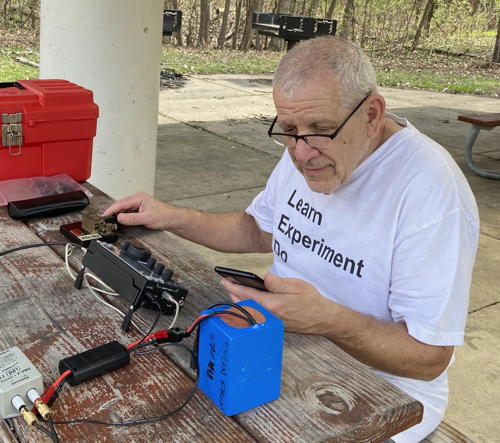
Dan, KB6NU, sitting at a picnic table operating his KX3 transceiver.
The beautiful weather made for a great start to the 2026 POTA season on the Iron Belle State Trail.

I activated a new (to me) park, too. As I reported last week, the Iron Belle State Trail is now a POTA park. The exciting thing for me is that the trail runs through Bandemer Park, which is about a mile and a half from me. So, this afternoon, I hopped in the car and drove over to make my first POTA activation of 2026.

I decided to head to the northern end of the park, where there’s a pavillion, just in case it decided to rain. They’ve made many improvements since I last visited the park, so it took me a few minutes to find the pavillion, but once I did, I got set up quickly and got on 20 meters.

Signals didn’t seem too bad, but I wasn’t generating any pileups. I did manage to work one Italian and several West Coast stations, but after about 45 minutes I’d only made 14 contacts, so I decided to give 40 meters a try.

That move really paid off. The first contact I made was a park-to-park (P2P) contact with WK2S in NY, and over the next 36 minutes,  I made 29 additional contacts. My last contact was with my friend Paul, KW1L. I almost missed his call, as I was about to close down, but he snuck in under the wire.

Overall, it was a great start for my POTA activations this year, and I’m looking forward to many more from the Iron Belle Trail this summer.


Filed Under: Operating, Parks on the Air Tagged With: Jamies

Exciting news for Michigan POTA ops!

April 5, 2026 By Dan KB6NU 3 Comments

Julie, WT8J, the Michigan Parks on the Air Map Rep, just dropped some exciting news on me. She writes:

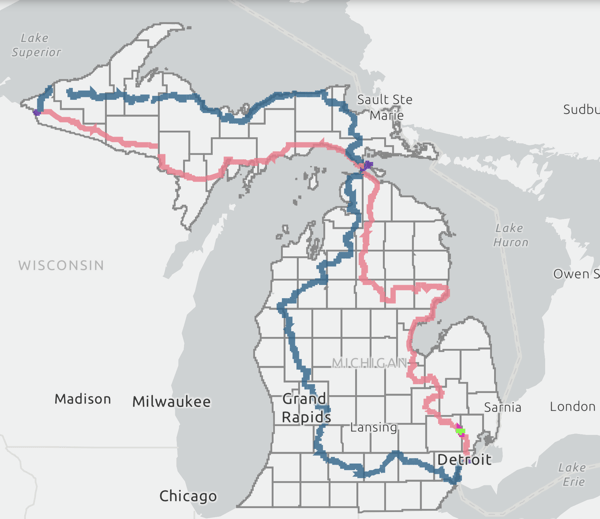
We’ve added Iron Belle State Trail to Parks On The Air bringing activation opportunities much closer to urban centers in Southeast Michigan and beyond. According to Michigan.gov,  “The Iron Belle Trail is the longest state-designated trail in the U.S., spanning over 2,000 miles from the western Upper Peninsula to Belle Isle in Detroit. The trail is currently more than 70% complete and connects over half of Michigan’s counties.” The Trail’s POTA designator is US-13184.

A map of the Iron Belle Trail.
The Iron Belle Trail is the longest state-designated trail in the U.S., spanning over 2,000 miles from the western Upper Peninsula to Belle Isle in Detroit.

This unique trail features two distinct routes: a biking route and a hiking route. The biking route travels along the eastern side of the state, using existing bike paths, lanes, and designated routes. Meanwhile, the hiking route follows the western side of the Lower Peninsula, incorporating sidewalks, trails and a significant portion of the North Country National Scenic Trail.”

The Iron Belle overlaps with several existing municipal trails, such as the Border to Border here in Washtenaw, the Downriver Linked Greenways, and the Detroit Riverwalk.

The trail also traverses many downtown city parks, including Riverside in Flint, Ojibway Island in Saginaw, and Defoe in Bay City. Additionally, it passes through several parks in Ann Arbor, such as Gallup, Fuller, and Bandemer. This means these municipal parks are now valid locations for Parks On The Air activations, provided you are within 100 feet of the trail.

Headed west out of Washtenaw, through downtown Jackson it picks up the MLK Equality Walk and continues down the Falling Waters Trail to Concord.  Here starts the patchwork of proposed and complete pathways until it hits the Calhoun County Trailway that takes it right through the heart of Battle Creek.

All this and that’s just a portion of this Parks On The Air reference.  I think that eventually this will be the most activated reference in Michigan!  2-meter pedestrian portable activations are now entirely possible in several communities.  And I just think that’s neat.

A map of the Belle Iron Trail as it passes through Ann Arbor.
The Belle Iron Trail passes through Ann Arbor less than a mile from my house.

As a reminder, the activation rules include that you must be on public land and within 100’ of the trail.  Good operator etiquette is a smaller footprint in urban areas for any portable station.

73 & POTA ON!
Julie WT8J
Michigan Parks On The Air Map Rep

This is really exciting for me as I live less than a mile from the Iron Belle State Trail. (On the map at right, I live very close to the left edge of the map.) If I was really ambitious, I could even hike over to Bandemer Park and activate there.

I’d be over there right now, if the weather was a little more accommodating today. Unfortunately, it’s overcast and 45°F, and while I hate to admit it, I’m pretty much a fair-weather POTA op. Be listening for me this summer, though, from US-13184.

Filed Under: Parks on the Air Tagged With: Belle Iron State Trail, US-13184

Two operating tips for new POTA CW Ops

September 2, 2025 By Dan KB6NU 3 Comments

Parks on the Air (POTA) logoOne of the cool things about Parks on the Air (POTA) is that the simple exchange  and lack of rules is encouraging some operators to try their hand at CW. Not only are some of newer operators working POTA, they’re also making regular CW QSOs as well. This is great for all CW ops as it increases activity on the bands.

The problem is that newer ops are not often familiar with common operating procedures, and the lack of rules can be confusing to new ops. For example, the POTA protocol is for “hunters” to send their call once when responding to a CQ POTA. Most of the time, the activators are able to get the call the first time, but if there is some fading or several stations call at the same, they might miss the call or not get the complete call.

When that happens, the protocol is for the CQing station to send “?” or “QRZ?” This means that the hunter should repeat their call sign. Many newer operators don’t seem to understand this, though, and they get confused. So, if you’re hunting, and you hear “?” or “QRZ?” jump right in there again with your call sign.

If the activator sends a partial call sign followed by a question mark, only reply if that partial call sign matches your call sign. For example, if an activator sent “KEB?” I’d know not to respond because that string isn’t part of my call sign. On the other hand, if the activator sent “KB6?” I’d know that they heard me, and I’d’ jump right in and send my call sign again. I’d maybe even send it twice for good measure.

Be patient

My second tip is to be patient with an activator. If they don’t reply to you on the first call, try again. Any number of things might cause an activator to not hear you, or they may hear you, but decide to reply to someone else first. Don’t disappear on the activator. Just wait till they’ve completed the QSO and try again. The activator wants to work you as much as you want to contact them.

When you call the second time, maybe try sending a little slower. That might help the activator pick you out of the noise or the pileup.

These are some tips that I’ve picked up over the years. I hope that you found them useful, and that they will help you make more CW POTA contacts.


Filed Under: CW, Parks on the Air

POTA, no POTA, POTA, POTA, POTA

July 20, 2025 By Dan KB6NU Leave a Comment

POTA Park Activator name tage for KB6NU.My birthday was last Wednesday, and for my birthday, I convinced my lovely wife, Silvia, to head “up north” (as we say here in Michigan). We spent four days in East Tawas on the shores of Lake Huron, going to the beach, enjoying our state parks, and, of course operating some Parks on the Air.

Bay City State Recreation Area (US-3305)

To get to East Tawas, you take I-75 north until you get close to Bay City, then head east on US-23. It only takes 2-1/2 hours to get there, but I thought I’d make a POTA stop along the way. I consulted the POTA app’s map feature and found exactly what I was looking for—the Bay City State Recreation Area (US-3305).

This park, located on the southern edge of Saginaw Bay, is just north of Bay City. To get there, Google Maps actually routed us through the city. The park has both a large campground and a day use area. The day use area has a couple of picnic shelters, and I was hoping to set up in one of the shelters, but since we were there on a Sunday, both shelters were reserved.

No matter. I found a nice, shady spot with a picnic table near the southernmost part of the park that was out of the way and set up there. I made my first contact just before 11:00 am and logged my 10th contact a little less than a half hour later. Overall, I made 26 contacts—10 on 40 meters and 16 on 20 meters—in an hour and 45 minutes.

That’s not a great rate, but I did take time out to go to the beach for a little bit and eat the lunch I brought with me. It also included a nice chat with a woman who stopped by to chat about ham radio. She was a Bay City resident who’d come down to enjoy the beach, and after talking with someone on the phone for a while, she came over to talk to me.

As it turned out, her late husband was a ham. I asked if she knew his callsign, but she said that she didn’t remember it. I should have written down her name, but that didn’t seem quite appropriate at the time. At any rate, it was a nice way to end my visit to Bay City.

East Tawas State Harbor (US-6812)

The place we stayed while we were in East Tawas was the Tawas Bay Beach Resort. One reason for choosing this spot is that it is right next to the East Tawas State Harbor (US-6812). I didn’t’ have to drive anywhere, just haul my stuff over to the park, which I did early the next morning. I activated this park last year, and while it wasn’t a great experience, I did manage a legal activation.

No such luck this time. The noise was S9+, and I couldn’t hear a single signal. I tried changing the orientation of the antenna and the noise blanker, but nothing worked. I packed up after about 15 minutes and headed back to my hotel room.

Tawas Point State Park (US-1545)

All was not lost, however. Silvia and I headed over to Tawas Point State Park (US-1545). The park is a short, scenic drive from our hotel.

Once we got there, we set up our beach chairs and headed out into the water for a while. After a bit of that, I set up the radio and made my first contact at 12:35 pm.

Over the next  three hours, I made 51 contacts, but the cool thing is that I had quite a few visitors, including two hams. I spent quite a bit of time with these visitors, so while my rate (17 contacts/hour) wasn’t all that great, I still had a lot of fun explaining Parks on the Air to both hams and non-hams.

Another cool thing about this state park is that it’s home to a lighthouse, meaning that I can also claim a lighthouse activation on the Amateur Radio Lighthouse Society website.. The Tawas Point Lighthouse was built in 1876 and will be celebrating it’s 150th anniversary next year. I plan to be back next year to help them celebrate.

Harrisville State Park (US-1501)

The next day, Silvia and I drove up to Harrisville State Park (US-1501). It’s about 45 minutes north of East Tawas. According to its website, the park was established in 1921 and is one of Michigan’s oldest state parks. The beach there is quite rocky, much rockier than the Tawas beaches, so I’m glad I brought my sand shoes.

We found a shady spot, and I headed out into the water for a bit. One of the things I like about Michigan beaches is finding fossils. Many of the rocks have visible fossils, and the Harrisville beach didn’t disappoint. I found two very nice rocks to add to my collection.

Harrisville has a nice picnic shelter, but I decided to set up in a clearing a short way away. Being a  little out of the way, I didn’t think that it would get much foot traffic,, meaning that people would be less likely to walk into my antenna. It was very shady there, too, which was nice.

I made my first contact there at 12:52 pm, and three hours and 20 minutes later, I made #40. That was a little disappointing, but again, I had a couple of nice visits. The first guy to wander over was a tower climber in his younger days. He said that he’d always been kind of interested in getting a  license, so I gave him one of my cards.

On the way home, I said to Silvia that I’m getting a lot more visitors here than I do when I activate parks closer to home. She replied, “Well, people here are on vacation and want to be entertained. You’re the entertainment!”

Tawas Point State Park (US-1545)

On Wednesday—my birthday—Silvia decided that she’d had enough POTA, so I drove over to Tawas Point SP by myself. This time, I thought I’d try to find a spot closer to the lighthouse. The problem is  that the lighthouse is located in a big, open space, and there’s not much shade. I did spot a shady  patch, though, and dragged a heavy picnic table about 50 feet over to it, only to find that there was a lot of poison ivy there. Since I’ve almost recovered from my last bout of poison ivy, I decided to abandon the picnic table and set up in my previous spot.

This day, the bands were in pretty good condition, and I made 55 contacts in just two hours, bringing my total to 172 contacts in 4 activations.

I also had several visitors during those two hours. One of them was also a ham who said that he was going to activate later that day. I just checked, and he did indeed activate, making 11 phone contacts.

This got me  thinking about who are the park leaders at the three parks that I activated this trip. As it turns out, I’m the park leader at the Tawas Point State Park with 165 contacts over four activations. I’m not even on the leader board at either Bay City or Harrisville.

I guess that I’m going to have to get back up there and activate those parks more. I’ve been trying to convince Silvia to buy a summer place up  there, and we saw something that looked almost perfect for us, but someone had already made an offer on the place. We’re going to keep looking, and if we do manage to find something, I’ll be able to extend my lead at Tawas Point SP, and maybe catch up a little at the other parks.

Filed Under: Parks on the Air Tagged With: Bay City State Recreation Area, Harrisville State Park, Tawas Point State Park

  • Page 1
  • Page 2
  • Page 3
  • Interim pages omitted …
  • Page 5
  • Go to Next Page »

Primary Sidebar

No Nonsense Technician Class License Study Guide (for tests given between July 2026 and June 2030)

New No Nonsense Technican Class Study Guide now available!

The 2026 version of my Tech Class study guide is now available, and as always, the PDF version is FREE!. The ePub version costs $11.97, and a Kindle version and paperback version will be available on Amazon shortly.

Click here to get all of my "No Nonsense" study guides.

Also available: The CW Geek's Guide to Having Fun with Morse Code

W5SWL.Com
Retevis Ailunce H1 DMR Radio
DXpander: Cobweb antennas, Laser Cutting

You’ve got mail!

Enter your email address below and get an email every time I publish a new post.

Email


I frequently teach classes to help newcomers get their licenses. The next class will take place on Saturday, October 10, 2026 on the University of Michigan campus. Click here for more information.

If you can't make the class, subscribe to the mailing list to be notified of when the next class will be held.

You can always download my free study guide, and if you have any questions about the classes, or amateur radio in general, please feel free to email me directly.

Support KB6NU.Com

Donate $7.30 and get two of these cool stickers. Measuring 4.25-in. W by 2.75-in. H, it's perfect for your car, your shack, or wherever!

Contact me

If you have a question or comment about one of my blog posts, or a question about any of the material in my study guides, or just a question about ham radio in general, you can email me at [email protected].

Blogs You Should Also Read

  • AE5X: A CW-centric blog from Kingswood, Texas
  • K0LWC Blog
  • LA3ZA Ham Radio Blog
  • Little Radios, Big Fun – WB3GCK
  • Mr. Vacuum Tube's Blog
  • Radio Artisan – K3NG
  • The K0NR Weblog
  • VE3WDM's QRP Ham Radio Blog
  • W2LJ’s Blog

Ham Radio Websites

  • Dashtoons – The Hammin' Comedy by Jeff K1NSS

Podcasts

  • ICQ Podcast
  • Linux in the Ham Schack
  • No Nonsense Amateur Radio Podcast
  • Resonant Frequency Amateur Radio Podcast

Recent Comments

  • Bulin 47 AI on ICQPodcast Episode 485 – World Cup Special Event Station
  • Jesse Alexander on What do you think of this artwork for the ham radio EMF Explorer
  • CADProps on My first go at 3D printing not quite a success
  • Dan KB6NU on A Media Guide to Amateur Radio
  • Steve Stroh N8GNJ on A Media Guide to Amateur Radio

Meta

  • Log in
  • Entries feed
  • Comments feed
  • WordPress.org

Footer

Copyright © 2026 Daniel M. Romanchik, KB6NU · Log in