Day 2 started out pretty early. The Four Days in May (FDIM) seminar starts at 8 am!
After a short drive from my hotel, I arrived at the DoubleTree Hotel a little after 7:30 am, expecting to sail in and claim a seat. I was, however, was surprised to see a line snaking down one of the hallways. Apparently, they weren’t letting people in yet.
As I walked down the hallway to take my place at the end of the line, I came across my friend Tom, W8TJB, who graciously let me take cuts. As it turned out, there were plenty of seats, though, so that was not a big deal. Here’s a short description of the talks I heard:
- A Homebrewer’s Journey: How I got to where I am. Harold Smith, KE6TI, gave the first presentation of the day. He detailed his journey, from his high school days in the early 1960s to today. Harold’s talk included a lot of useful tips, but my big takeaway was, “When you’re homebrewing, you’re building for yourself.” With that in mind, Harold advised to not worry so much about how a project looks, or even how well it works. Focus on the enjoyment you had building something and what you learned from working on it.
- Life is NOT Too Short for QRP if You Know a Few Tricks. Anthony Luscre, K8ZT, was responsible for this talk. He provided many, many tips for successfully operating QRP including how to select equipment, what antenna to use, what bands top operate, what modes to operate, and what times to operate. He also gave quite a few tips on operating technique. One tip that I plan to follow up on is his tip to use the 4X4XM Propagation Tools to better understand propagation.
- The CFT1: the design philosophy and lessons in good user interface. Jonathan Kayne, KM4CFT, a young ham who recently graduated from Virginia Tech, told us the story of how he came to design the CFT1, a five-band, QRP transceiver. In this very interesting talk, he detailed his reason for designing the radio (a very noisy QTH which drove him to operate portable) and the entire design process. I enjoyed this talk so much that I thought that I might even buy one of his radios, but the kit cost $320, and since I still haven’t finished building my QMX, I decided not to.
- Post-Hurricane Helene: The Role of Practical Preparedness and Community in Emergency Communications. Well-known QRPer, Thomas Witherspoon, K4SWL, lives in the mountains in western North Carolina, right in the path of Hurricane Helene. He spoke about how the hurricane affected him and his family, but perhaps more importantly, how the people of his community bonded to get through the crisis. As he was talking to an audence made up of hams, he talked quite a bit about the importance of communications in keeping that community together. “In a disaster,” he said, “communications is not just about passing information. It’s about holding a community together when everything else falls apart.”
- Learn CW Like a Boss. In this talk, Jerry Weisskohl, AC4BT, gave us some tips on how to improve our ability to send and receive Morse code. He strongly recommended the use of Morse Runner and detailed how he used the program to get better at receiving.
- Vibe (AI) Coding for Radio Amateurs. AI is all the rage these days, and Dr. Stewart Bryant, G3YSX, showed us how we might use it for developing software for amateur radio projects. After introducing some of the concepts behind the current AI chatbots, he gave some examples of its use, including coding a VFO using an AD9851 and developing a GNU Radio script to display the spectrum of an audio input. Bryant is very big on the technology and urged us all to try it. I may just do that.
I say this every year, but FDIM really inspires me to be more of a builder/homebrewer/hacker. Maybe if I get more serious about it, I could even give a talk next year.
Let’s hit the park!
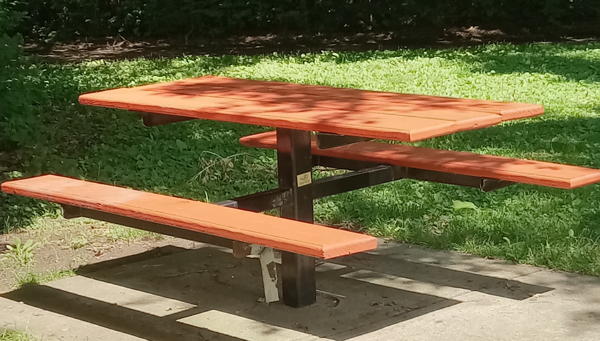
After sitting through these six talks, I was getting a little antsy, and seeing that the last two talks didn’t really interest me all that much, I decided to escape and activate a park. The park that looked the most promising was the Dayton Aviation Heritage National Historical Park (US-0732). At first I was a bit confused about the actual location of the park. The park actually consists of a couple of different locations, including the Wright-Dunbar Interpretive Center and the Huffman Prairie Flying Field. The POTA map shows the location of the Huffman Prairie Flying Field, which is out near Fairborn. Fortunately, I chose to go to the Wright-Dunbar Interpretive Center, which is in the Germantown section of Dayton. There is a nice, little park there next to the museum, which is perfect for POTA.

As I pulled into the small parking lot, I noticed a ham (whose call I don’t remember, unfortunately) there already. I got out of the car and walked over. He was trying to make some contacts with an Elecraft KH1 and and AX-1 antenna. He said that he wasn’t having much success but encouraged me to set up and give it a try, so I went back to my car and got my stuff. We chatted a bit more while I was setting up, and he seemed interested in my doublet antenna. After I got on the air and made a couple of contacts, he left.
Not long after, a group of four hams—N3AIR, N3VQH, K3MET, and KC3RMC—exited the museum and walked over. They had driven in from Pennsylvania and were taking in the sights. They were a fun bunch. We did the HT thing, and I got a park-to-park QSO with all of them on both 2 meters and 70 cm. Then, one of them took the picture above. I wish I’d gotten a selfie with them all.
We were joined by another ham—a W6—and they chatted while I operated. Like the first fellow, I didn’t have a whole lot of luck on 20 meters, but when I switched to 40 meters, I started making quite a few contacts. That’s one advantage of having a full-size antenna like my doublet.
After the Pennsylvania contingent took off, I operated a while longer by myself. All in all, I managed to make 45 contacts in about an hour and a half. Not a bad afternoon’s work.
Meeting the CWops

My next stop was the CWops dinner. I met a lot of great operators there, many of whom I’ve worked on the air and/or swapped email with. Just before dinner was served, I found a seat between Steve, KJ5T, and Howard, W1HRB. Howard, and his wife, Barbara are shown in the photo above.
Howard, as it turns out, lives not very far from me, and I tried to recruit him to operate at one of our Field Day stations. He was unsure of his availability for Field Day, but said that he’d try to come to one of our club meetings. I think he’d make a great ARROW member, so I really do hope he comes to a meeting.
The dinner broke up about 9:30, and I head back to the hotel to get some rest for Hamvention the following day.