
• Skip to primary navigation
  • Skip to main content
  • Skip to primary sidebar
  • Skip to footer

KB6NU's Ham Radio Blog

KB6NU's Ham Radio Blog
  • HOME
  • Study Guides
  • Teach a One-Day Tech Class
  • W8SRC Repeater Guide
  • Advertise
  • Hire Me

J-Poles

November 20, 2002 By Dan KB6NU 3 Comments

My biking and ham radio buddy, Mark, came over Monday evening. We had three objectives:

  1. measure the SWR of J-pole I built a couple of months ago,
  2. measure the SWR of the 2m/440 antenna I just purchased from Purchase Radio, and
  3. build a 2m J-pole for Mark

To measure the SWR, Mark brought over his MFJ 259 Antenna Analyzer. In some ways, it’s much nicer than the Autek Analyzer that I have. For one thing the display is much more informative. The Autek display consists of simply a five-digit numeric display, capable of displaying only one parameter at a time. The MFJ is a full alpha-numeric display and displays the test frequency, the measured SWR, and some other information simultaneously.
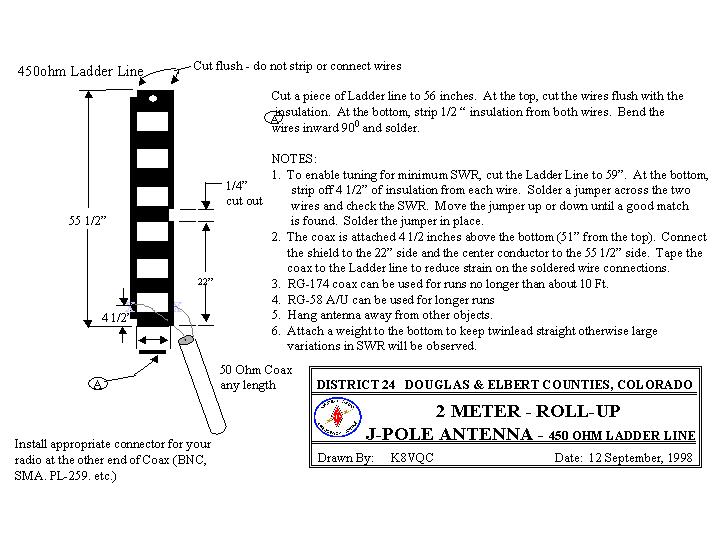
Here are the plans for the 2m j-pole antenna that we built.

The MFJ analyzer’s frequency range is also much greater. It covers the 2m and 440 MHz bands, while the Autek only goes up to 32 MHz. Mark doesn’t think it’s very accurate at 440, though.

The first thing we did was measure the SWR of the J-pole I’d built. I’ve been very happy with the antenna, so I was a little surprised that the first reading was slightly over 2.0. I did have it hanging very near to a fairly massive new barbecue grill we have, so surmising that the grill was detuning the antenna, I moved it away from the grill and the SWR did go down to about 1.5. Respectable in my opinion.

Next, we measured the SWR of the dual-band antenna. This antenna is a 5/8 wavelength antenna that I had mounted on a mast. Its SWR measured about 1.5 near the ARROW 2m repeater frequency of 14.96- MHz. I was happy with that, so we moved on to the antenna construction.

We built the J-pole from plans I found on the Net (shown above). You can build J-poles from 300 ohm twinlead, 450 ohm ladder line, and 1/2-in. copper pipe. The dimensions for each of these versions is slightly different, as the velocity factors are all different.

We opted to build ours with the ladder line because we each already had a hunk of it and it’s much easier to carve up some ladder line than solder up copper pipe. It’s not as sturdy, but it’s certainly sturdier than 300 ohm twinlead.

When I built mine, I did not have an SWR meter to tune the antenna with. So, I just built it to the recommended dimensions, and as mentioned earlier, it turned out to work pretty well. Since we had the analyzer when we built Mark’s we played around with the tuning stub, and it appears that he was able to get a slightly better match than I was.

Overall, it was mission accomplished.

Related posts:

  1. Finally, a Loop for 10m.
  2. From my Twitter feed: PCB printers, Prof. Yagi, Chinese QRP rig
  3. Are you using the right BNC connectors?
  4. Three from Twitter: OCF dipole covers 40-6 meters, generate your own azimuthal map, build an all-band receiver with an Arduino

Filed Under: Antennas

Reader Interactions

Comments

  1. Les says

    May 3, 2025 at 9:41 pm

    Nebie here. I want to build this antenna but doesn’t it need a balun for connecting coax to ladder line?
    Thanks for all your info!

    Reply
    • Dan KB6NU says

      May 11, 2025 at 3:22 pm

      Some people make a choke balun by coiling the coax near the antenna, but I’m using it without a balun, and it seems to work just fine.

      Reply
  2. Phillip Cardwell says

    May 19, 2026 at 2:36 pm

    I will need to attach the antenna to the side of a 6×6 in order to hide from HOA. How much loss am I going to have? I hope to be able to attach to 3rd floor and run coax to first.

    Reply

Leave a Reply Cancel reply

Your email address will not be published. Required fields are marked *

This site uses Akismet to reduce spam. Learn how your comment data is processed.

Primary Sidebar

No Nonsense Technician Class License Study Guide (for tests given between July 2026 and June 2030)

New No Nonsense Technican Class Study Guide now available!

The 2026 version of my Tech Class study guide is now available, and as always, the PDF version is FREE!. The ePub version costs $9.97, and a Kindle version and paperback version will be available on Amazon shortly.

Click here to get all of my "No Nonsense" study guides.

Also available: The CW Geek's Guide to Having Fun with Morse Code

W5SWL.Com
Retevis Ailunce H1 DMR Radio
DXpander: Cobweb antennas, Laser Cutting

You’ve got mail!

Enter your email address below and get an email every time I publish a new post.

Email


I frequently teach classes to help newcomers get their licenses. The next class will take place on Saturday, February 7, 2026 on the University of Michigan campus. Click here for more information.

If you can't make the class, subscribe to the mailing list to be notified of when the next class will be held.

You can always download my free study guide, and if you have any questions about the classes, or amateur radio in general, please feel free to email me directly.

Support KB6NU.Com

Donate $7.30 and get two of these cool stickers. Measuring 4.25-in. W by 2.75-in. H, it's perfect for your car, your shack, or wherever!

Contact me

If you have a question or comment about one of my blog posts, or a question about any of the material in my study guides, or just a question about ham radio in general, you can email me at [email protected].

Blogs You Should Also Read

  • AE5X: A CW-centric blog from Kingswood, Texas
  • K0LWC Blog
  • LA3ZA Ham Radio Blog
  • Little Radios, Big Fun – WB3GCK
  • Mr. Vacuum Tube's Blog
  • Radio Artisan – K3NG
  • The K0NR Weblog
  • VE3WDM's QRP Ham Radio Blog
  • W2LJ’s Blog

Ham Radio Websites

  • Dashtoons – The Hammin' Comedy by Jeff K1NSS

Podcasts

  • ICQ Podcast
  • Linux in the Ham Schack
  • No Nonsense Amateur Radio Podcast
  • Resonant Frequency Amateur Radio Podcast

Recent Comments

  • Skip K4EAK on Button, button. Who’s got the button?
  • Ed K8MEJ on Is anyone running for the board this year in the Great Lakes Division?
  • Skip Behnke on 2020 Extra Class study guide: E9F – Transmission lines: characteristics of open and shorted feed lines; coax versus open-wire; velocity factor; electrical length; coaxial cable dielectrics
  • Mike on Map your contest QSOs
  • Phillip Cardwell on J-Poles

Meta

  • Log in
  • Entries feed
  • Comments feed
  • WordPress.org

Footer

Copyright © 2026 Daniel M. Romanchik, KB6NU · Log in