
• Skip to primary navigation
  • Skip to main content
  • Skip to primary sidebar
  • Skip to footer

KB6NU's Ham Radio Blog

KB6NU's Ham Radio Blog
  • HOME
  • Study Guides
  • Teach a One-Day Tech Class
  • W8SRC Repeater Guide
  • Advertise
  • Hire Me

Map your contest QSOs

July 8, 2020 By Dan KB6NU 5 Comments

Shortly after Field Day ended, Bill WC3B posted a map of the contacts he made on Twitter. “How cool,” I thought, and asked him how he’d done it. As it turns out, the map was a function of the N3FJP Field Day logging program.

It then occurred to me that there must be mapping programs on the web. I did a quick Google to find two websites that would allow me to generate a map of my own: LogView by EI8IC and Log2Map by ON6ZQ.

Log View

LogView is a free, post-contest log-visualisation tool. It plots the QSOs in a Cabrillo-format contest-log on to one of 8 different maps by finding the position of each QSO from an online database of about 1,100,000 W/VE callsigns. Here’s the map generated by Log View:
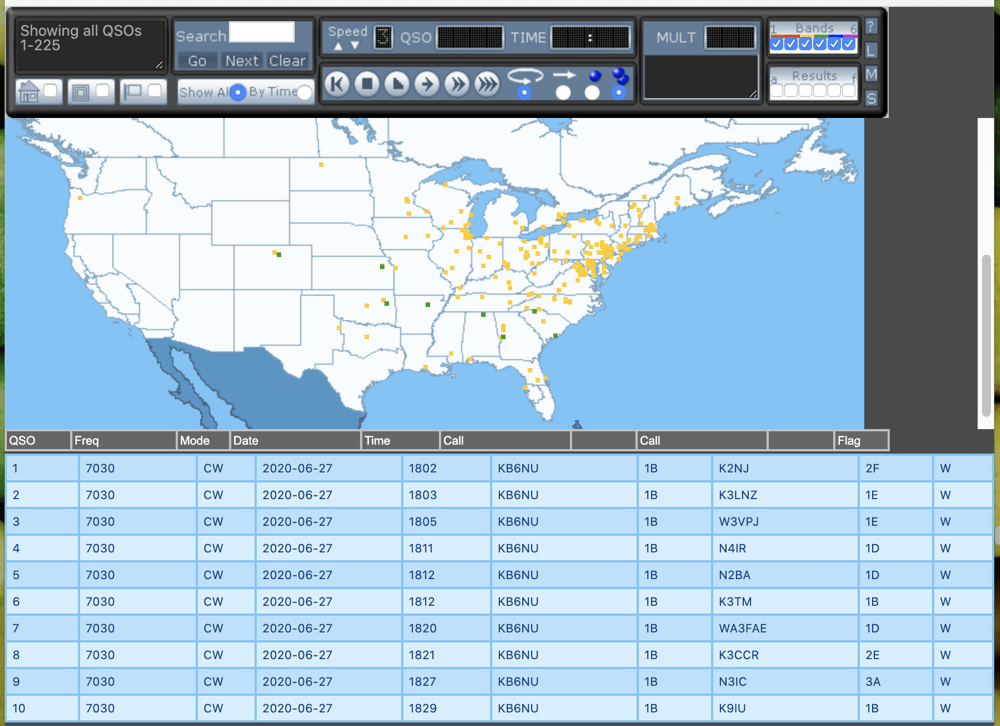
This tool can do more than just produce a map. It’s worth checking out if you want to analyze your contest logs.

Log2Map

Log2Map accepts both Cabrillo and ADIF files and generates a map like the one shown below:
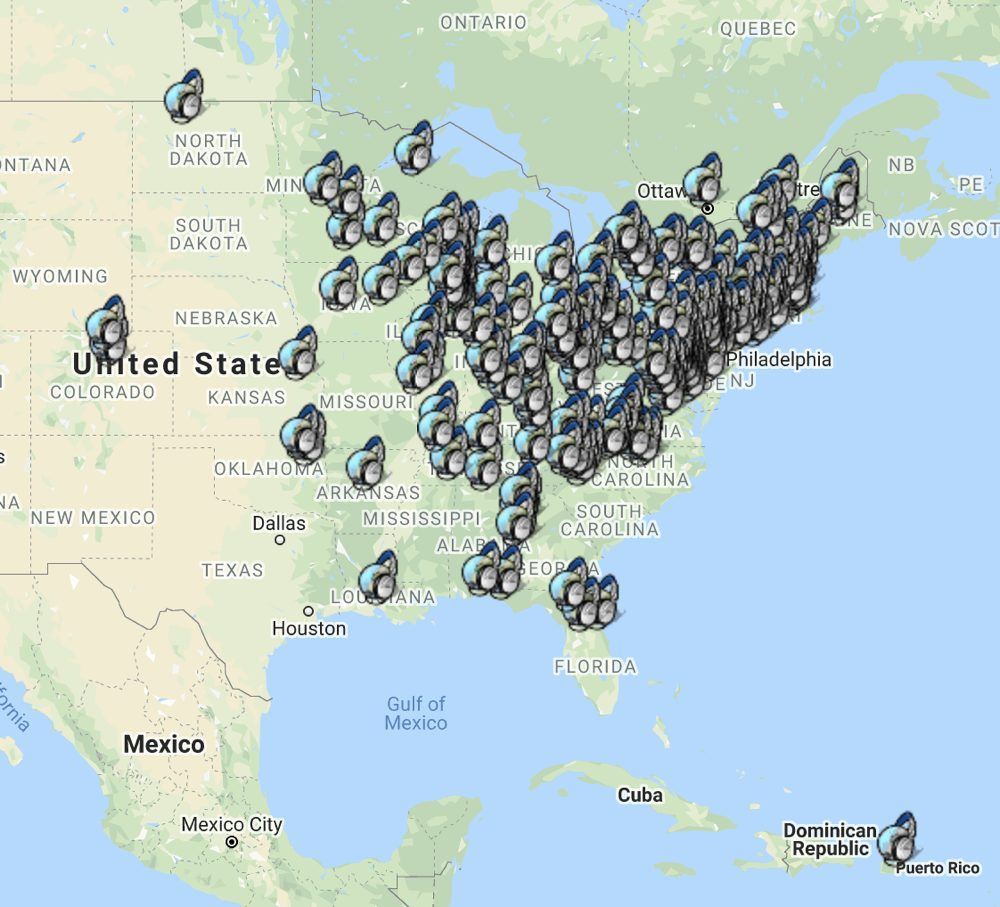
I kinda like this map better than the LogView map, but I wish that I could change the marker. I think the marker is a little bit big for this kind of map.

I found a couple of other mapping websites, but many of them wanted the log to contain the latitudes and longitudes. I didn’t know how to do that quickly, so I just moved on.

There must be others out there that I didn’t find. If you know of any others, please comment below.

Related posts:

  1. Send QSLs More Easily, Define Your Own Contest Log
  2. Map Your QSOs
  3. My First Contest
  4. My Four QSOs Yesterday

Filed Under: Operating Tagged With: ADIF, Cabrillo, EI8IC, maps, ON6ZQ

Reader Interactions

Comments

  1. Bas PE4BAS says

    July 8, 2020 at 4:12 pm

    It might be not good for USA use but here in Europe we make use of this online tool: http://tools.adventureradio.de/analyzer/

    73, Bas

    Reply
  2. Howard AE0Z says

    July 15, 2020 at 2:18 pm

    QSOMAP.org is popular among POTA operators. I post my ADIF file; they may support other formats. I also make a donation from time to time, since it is free.

    Reply
  3. Michael KT5MR says

    July 22, 2020 at 9:36 am

    One I really enjoy using for VHF work (i.e. plotting grids worked) is WG7J’s Gridmapper: http://wg7j.reinalda.net/gridmapper/gridmapper.php

    Reply
  4. Ken AB1J says

    July 23, 2020 at 12:12 pm

    If you have an ADIF with grid locs, you can use adif2kml to map to Google Earth.

    https://www.qsl.net/ct1gvn/adif2kml.htm

    There are other similar programs, but I have not used them.

    Reply
  5. Mike says

    June 1, 2026 at 8:46 am

    You can also try https://contestmap.org/

    Reply

Leave a Reply Cancel reply

Your email address will not be published. Required fields are marked *

This site uses Akismet to reduce spam. Learn how your comment data is processed.

Primary Sidebar

No Nonsense Technician Class License Study Guide (for tests given between July 2026 and June 2030)

New No Nonsense Technican Class Study Guide now available!

The 2026 version of my Tech Class study guide is now available, and as always, the PDF version is FREE!. The ePub version costs $11.97, and a Kindle version and paperback version will be available on Amazon shortly.

Click here to get all of my "No Nonsense" study guides.

Also available: The CW Geek's Guide to Having Fun with Morse Code

W5SWL.Com
Retevis Ailunce H1 DMR Radio
DXpander: Cobweb antennas, Laser Cutting

You’ve got mail!

Enter your email address below and get an email every time I publish a new post.

Email


I frequently teach classes to help newcomers get their licenses. The next class will take place on Saturday, October 10, 2026 on the University of Michigan campus. Click here for more information.

If you can't make the class, subscribe to the mailing list to be notified of when the next class will be held.

You can always download my free study guide, and if you have any questions about the classes, or amateur radio in general, please feel free to email me directly.

Support KB6NU.Com

Donate $7.30 and get two of these cool stickers. Measuring 4.25-in. W by 2.75-in. H, it's perfect for your car, your shack, or wherever!

Contact me

If you have a question or comment about one of my blog posts, or a question about any of the material in my study guides, or just a question about ham radio in general, you can email me at [email protected].

Blogs You Should Also Read

  • AE5X: A CW-centric blog from Kingswood, Texas
  • K0LWC Blog
  • LA3ZA Ham Radio Blog
  • Little Radios, Big Fun – WB3GCK
  • Mr. Vacuum Tube's Blog
  • Radio Artisan – K3NG
  • The K0NR Weblog
  • VE3WDM's QRP Ham Radio Blog
  • W2LJ’s Blog

Ham Radio Websites

  • Dashtoons – The Hammin' Comedy by Jeff K1NSS

Podcasts

  • ICQ Podcast
  • Linux in the Ham Schack
  • No Nonsense Amateur Radio Podcast
  • Resonant Frequency Amateur Radio Podcast

Recent Comments

  • Dan KB6NU on 2015 General Class study guide: Section G2E – Digital operating: procedures, procedural signals, and common abbreviations
  • Jimi on 2015 General Class study guide: Section G2E – Digital operating: procedures, procedural signals, and common abbreviations
  • Ali on Some Good Advice on Learning Morse Code
  • mike on Instant Character Recognition is the key to CW speed
  • Matt W1CDN on A completely different picture of Wayne Green, W2NSD (SK)

Meta

  • Log in
  • Entries feed
  • Comments feed
  • WordPress.org

Footer

Copyright © 2026 Daniel M. Romanchik, KB6NU ยท Log in