• Skip to primary navigation
  • Skip to main content
  • Skip to primary sidebar
  • Skip to footer

KB6NU's Ham Radio Blog

KB6NU's Ham Radio Blog
  • HOME
  • Study Guides
  • Teach a One-Day Tech Class
  • W8SRC Repeater Guide
  • Advertise
  • Hire Me

Propagation

Videos: The Heathkit story, how orchards became Silicon Valley, and a propagation monitor

May 5, 2026 By Dan KB6NU 2 Comments

The mistake that built Heathkit

I hadn’t heard the story about the boxcars of electronic components before.

How orchards became Silicon Valley

I worked in Silicon Valley right after I got out of college.It’s interesting to see how it’s changed since then.

Shortwave propagation monitor

I’m not sure how useful thing would actually be, but it’s a simple project and could be interesting.
Filed Under: Amateur radio business, Gear/Gadgets, Propagation Tagged With: Heathkit, Silicon Valley

Operating Notes, January 5, 2026

January 5, 2026 By Dan KB6NU Leave a Comment

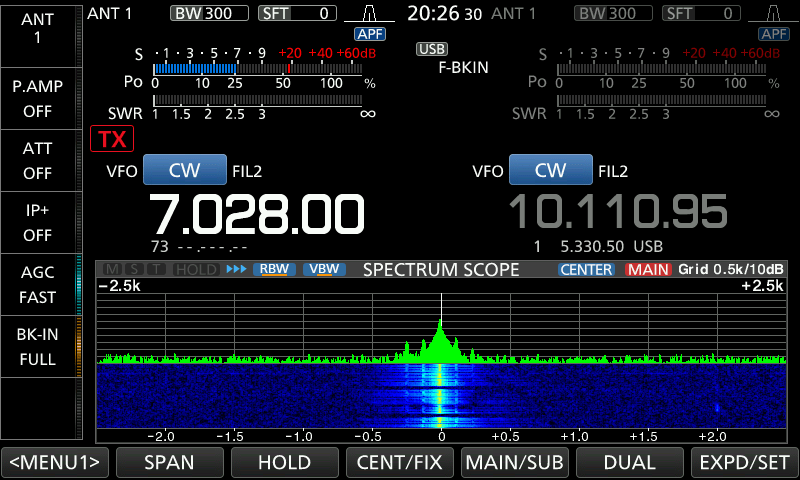
Screen shot of an IC-7610 band scope.
I’d recognize this signal anywhere.

It used to be that you could recognize an operator by the sound of their fist. That is to say the distinctive way that they sent dits and dahs while operating Morse Code. With the advent of the electronic keyer, fists have become less distinctive, but it’s still possible.

But, there’s another way you can now sometimes recognize an operator. You don’t even have to hear them send a single dit or dah. The key is what their signal looks like on your waterfall.

Yesterday, just after I turned on the radio, I saw a signal around 7022 kHz. Immediately, I knew who it was. I tuned it in, and sure enough I was right. This signal is a little more recognizable because it’s from a homebrew rig, but even so, other signals can probably be determined from how they look on the waterfall if they’re strong enough.

Straight Key Night 2026

As I’ve mentioned before, the only time I use a straight key on the air is Straight Key Night. This year, I only made four contacts before I put the Bunnel #9 back on the shelf. Even though I made only four contacts, two were notable:

  • I1MMR. If you live in the eastern U.S. and operate 40 meter CW at all, chances are you’ve worked Mauro, I1MMR. This was my 42nd contact with Mauro. This wasn’t strictly an SKN contact, but I’m counting it.
  • N0AX. Ward Silver is one of those hams that everyone seems to know. He’s the author of Ham Radio for Dummies and has edited the ARRL Handbook. Signals were S9 both ways and we had a nice chat before my wrist started to quit on me.

Short skip on 40 meters

Every once in a while, I get some really short skip on 40 meters in the evening. A couple of days ago, I worked a fellow who lives near Lansing, MI that QRZ.Com said was about 50 miles away. That’s gotta be too far away for ground wave, so it must be really short skip.

Right after that contact, I worked a guy near Bad Axe, MI, which is in “The Thumb.” (Take a look at a Michigan map, and you’ll see what I’m talking about.) He was only 110 miles away, according to QRZ.Com. Both stations were S9 here in Ann Arbor.

Filed Under: CW, Gear/Gadgets, Operating, Propagation Tagged With: short skip, Straight Key Night

Videos: Single sideband, HAMNET update, HF propagation

March 21, 2025 By Dan KB6NU Leave a Comment

Introduction to SSB

This is an Air Traffic Command instructional video describing the theory behind single side band (SSB) modulation. Dig that jazzy intro music!

HAMNet Update

HAMNET (Highspeed Amateur radio Multimedia NETwork) is a fully-independent amateur radio wireless network that provides data services. It’s a wireless internet, so to speak. It covers many regions in Europe and is even now growing fast beyond its European border. Hamnet is using international coordinated IP-address space of the AMPRNet (44.0.0.0/8) and Autonomous System (AS) numbers out of the 16-bit and 32-bit private AS number space to interconnect active regions by external Border Gateway Protocol (BGP) routing.

Here is an up date on HAMNET given at the recent FOSDEM conference.

Rohde & Schwarz on HF Propagation

Rohde & Schwarz produces some of the finest RF instrumentation in the world. They also produce great videos on RF topics. This one explains HF propagation.

Filed Under: Communications Theory, Digital Modes, Networking, Propagation, Videos Tagged With: HAMNet, single sideband

Videos: Dick Norton N6AA on the ARRL, KL7AJ on the ionosphere, new HT has 10 m SSB capability

January 31, 2025 By Dan KB6NU 3 Comments

Dick Norton, N6AA, on the state of the ARRL

Every year, Dick Norton, N6AA, the Southwest Division Director, reports on the ARRL at Quartzfest. As one of the audience members noted, this is perhaps the bleakest report that Dick has ever given on the state of the League.

One item that you might want to especially note is that at the 25:30 mark, Dick comments on the ARRL’s shift from a membership-based organization to being a corporation. If we’re no longer a membership-based organization, why pay to be members?

Eric Nichols, KL7AJ, on the ionosphere

The ionosphere is more complex than just a simple mirror for radio waves.

New Quansheng HT has 10-meter SSB capability

OM0ET gives us a little teaser video about an upcoming release from Quansheng. The TK-11 will operate on 70 cm, 2 m, 6m, and 10 m, including SSB capability on the 10-meter band. He notes that he’s not sure whether the firmware will be modifiable as it is for the Quansheng UV-K5.

Filed Under: ARRL, Gear/Gadgets, Propagation, VHF/FM/Repeaters Tagged With: ionosphere, Quansheng

Videos I’ve been watching: HF propagation, how to use a NanoVNA, Hallicrafters’ world of SW radio

September 1, 2024 By Dan KB6NU Leave a Comment

W3LPL on HF propagation

At an hour and a half, this video is kind of long, but if you’re interested in propagation, it’s worth watching.

W2AEW on how to use a NanoVNA to measure a filter’s characteristics

Alan, W2AEW, shows how to use a NanoVNA, which is one of the most useful tools for characterizing RF components and circuits.

Hallicrafters World of SW Radio

Back in the day, Hallicrafters was arguably the biggest name in amateur and shortwave radio. Unfortunately, this is just an audio file, but I guess, radio is audio so just close your eyes and imagine that you’re listening to this on a Hallicrafters receiver.

Filed Under: Computers, Propagation, Software, Test Equipment Tagged With: Grace Hopper, nanoVNA

FCC seeks comments on effects of May 2024 geomagnetic storm

May 29, 2024 By Dan KB6NU Leave a Comment

The FCC recently released this public notice:

PUBLIC SAFETY AND HOMELAND SECURITY BUREAU SEEKS COMMENT ON THE IMPACTS OF THE MAY 2024 GEOMAGENTIC STORM ON THE U.S. COMMUNICATIONS SECTOR
PS Docket No. 24-161

Comments Due: June 24, 2024

The Federal Communications Commission’s Public Safety and Homeland Security Bureau (PSHSB or Bureau) seeks comment on any observed impacts to communications that resulted from the May 2024 severe geomagnetic storm. On Thursday, May 9, 2024, the National Weather Service Space Weather Prediction Center (SWPC) issued a severe (G4) Geomagnetic Storm Watch, forecasting a series of coronal mass ejections (CMEs) that merged with the Earth’s electromagnetic fields between May 7-11, 2024.1 On May 11, 2024, the storm reached extreme (G5) conditions, the first time this severity has been observed since 2003.2 According to the SWPC, CMEs are large expulsions of plasma and magnetic field from the Sun’s corona.3 Electromagnetic currents generated by CMEs, when merged with the Earth’s electromagnetic fields, may distort the propagation of radio frequency waves.

On May 11, 2024, the FCC High Frequency (HF) Direction Finding Center, which supports the public safety community and federal partners by locating interference to radio spectrum below 30 MHz, observed significant disturbance in the propagation of HF radio signals. This disturbance resulted in the disruption of voice and data communications passed over HF frequencies. To better understand the impacts of the geomagnetic storm on the U.S. communications sector, the Bureau is requesting information from communications service providers and the public regarding disruptions in communications between May 7 and 11, 2024, that it believes to be a result of the storm. The Bureau is encouraging commenters to provide any available evidence, particularly electromagnetic spectrum analyses, imagery, or chronological logs relating the storm’s impacts. Where possible, the Bureau asks that commenters include the description of the impacts; make and model of affected communications equipment, which could include transmitters, receivers, transceivers, switches, routers, amplifiers etc.; make, model, and type of affected antennae and their composition; frequencies affected; type and composition of cable adjoining communications equipment and the antennae, if applicable; duration of the impact; and any residual effects observed in the hours following restoration.

You can find the entire document, including footnotes and instructions on how to file a comment, at https://docs.fcc.gov/public/attachments/DA-24-493A1.pdf. It will be interesting to see a report on this after the comments are in.

Filed Under: Propagation Tagged With: FCC, solar flare

Operating Notes: The sun giveth and the sun taketh away

May 6, 2024 By Dan KB6NU Leave a Comment

The good news about this point in the sunspot cycle is that the sun is more active, meaning that in general, band conditions are pretty good. Except when they’re not.

According to the NOAA:

There are several types of space weather that can impact HF radio communication. In a typical sequence of space weather storms, the first impacts are felt during the solar flare itself. The solar x-rays from the sun penetrate to the bottom of the ionosphere (to around 80 km). There the x-ray photons ionize the atmosphere and create an enhancement of the D layer of the ionosphere. This enhanced D-layer acts both as a reflector of radio waves at some frequencies and an absorber of waves at other frequencies. The Radio Blackout associated with solar flares occurs on the dayside region of Earth and is most intense when the sun is directly overhead.

This seems to be happening frequently in the last week or so. You can go to the NOAA site or SolarHam to learn more than you probably want to know about this.

Radio blackouts are no fun, but they’re especially disappointing if you’ve hauled your gear out for a POTA activation. I went up to the Island Lake Recreation Area (US-3315) on Saturday afternoon and fought the conditions for a while. I was also competing for calls from the Indiana, New England, and 7th Call Area QSO parties.

I started out on 20 meters, but after making only five contacts, I decided to try 17 meters, where I was able to scratch out a couple more.  I then tried 15 meters, but had absolutely non success there, so I went back to 20 meters.

By hunting around for some park-to-park contacts, I was able to make 20 contacts overall, but it took me two and a half hours to do it. I’m not sure if the conditions or the contest competition was the main culprit, but activating on a big contest weekend was probably not the smartest thing to do.

Activating the AACME

Conditions weren’t all that much better Sunday morning, when three of us—Joe AC8ES, James AE8JF, and yours truly—set up to demo amateur radio at the Ann Arbor Creativity and Making Expo (AACME).  Joe had brought his Xiegu G90 and Alex Loop, but we were barely able to hear anything.

Two hams standing behind a table demonstrating amateur radio.
Joe, AC8ES, and Dan, KB6NU, at the 2024 Ann Arbor Creativity and Making Expo. Photo: James, AE8JF.

We attributed this to two factors. First, we were trying to operate the loop inside the building. Second, there had been reports of solar flares that morning that were adversely affecting HF propagation.

Despite that, we had a great time. Joe had brought his latest project—a QRP dummy load/wattmeter—that’s going to be our club’s next build project. And, I brought various keys and code oscillators to demonstrate Morse Code and get kids (and adults) to send their names in Morse Code.

A little after 1 pm, I decided to set up my KX-3 and see what I could do with it. Before the event started, I had set up my 66-ft. doublet in the courtyard just outside where our table was located. Over the next hour and a half, I managed to scratch out eight contacts, all on 20 meters, and all with participants in the New England QSO Party.

Overall, I think our participation in the AACME was a success. We were able to spread the word about amateur radio and our club. I passed out some flyers for my June 1 Tech class, and met some other interesting people.

Filed Under: Promotion & PR, Propagation Tagged With: G90, solar flare

Operating Notes: W1AL, sunset propagation changes, new CW ops

March 4, 2024 By Dan KB6NU 3 Comments

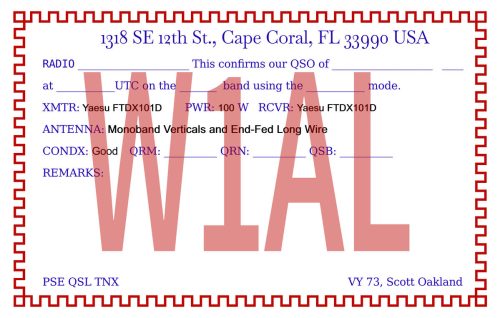
A couple days ago, I worked Scott, W1AL. When I looked him up on QRZ.Com, I found this:

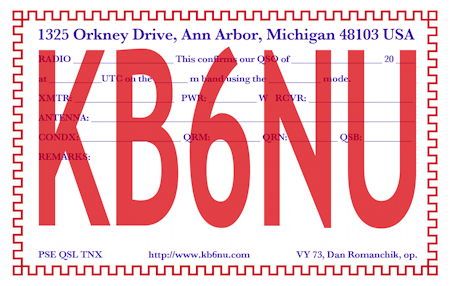
That looked remarkably like my “retro QSL:”

Retro QSL #2

so I emailed him and asked him if I’d sent it to him. He replied, “I thought your call sounded familiar!”

Propagation at sunset

If you’re like me, you’ve noticed how radically propagation can change around sunset. One transmission, a station is just booming in. On the next transmission, however, they’re down in the mud. I would love for someone to explain to me the mechanics of that.

Showing a new op the ropes

Earlier this evening, a station answered my CQ by simply sending his call a single time. Normally, I don’t reply to those stations, but I decided to this time for some reason. I’m glad I did.

This fellow was not a ragchewer at all. He didn’t know the standard protocol for a CW contact, and he admitted as much. He said that he’d operated in CW contests, but hadn’t really done any ragchewing.

So, I took the opportunity to teach him how to do it. For example, he’d just stop sending when he was finished with what he had to say. He didn’t send BK or even K. I explained why that was important, and by the end of the contact, he was doing this correctly.

I’m glad I took the time to explain things to him, instead of just blowing him off. After all, how else is he going to learn how to do it? He seemed like an interesting fellow, and I hope that I hear him on again sometime. I’m going to send him a copy of my CW Geek’s Guide to Having Fun with Morse Code, and hope that that encourages him to do more ragchewing.

Filed Under: CW, Propagation, QSLs

Amateur radio videos: Make the most of solar cycle 25, backyard ISS contact, build a mini-HF loading coil

February 3, 2024 By Dan KB6NU Leave a Comment

How to make the most of Solar Cycle 25

It’s no secret that the bands have been in great shape lately. In this video, W3LPL shows how to make the most of it.

Michigan ham talks to astronauts aboard the ISS from his backyard

This video has been gotten a lot of press, but I think it’s pretty cool, so I’m posting it here. It’s kind of cool that KB8M happens to be in Michigan, my home state.  You can tell how geeked Doug was about the contact.

How to build a mini HF loading coil

Here’s another video on how to build your own version of a Buddipole or Wolf River loading coil. VA5MUD has a lot more interesting videos on his YouTube channel, Mr MuDs Radio Time.

Filed Under: Antennas, Propagation, Satellites Tagged With: ISS, KB8M, loading coil, VA5MUD, W3LPL

HamSCI 2023: Some first impressions

March 20, 2023 By Dan KB6NU Leave a Comment

I’m on my way home from the HamSCI 2023 Conference, and while waiting in the airport, I thought I’d record some first impressions. As the date approached, I was feeling kind of reluctant about going. In fact, I almost didn’t go. In the end, though, I’m glad I did.

Impressions:

  1. Scranton seems to be typical of a lot of East Coast and Midwest cities that enjoyed an industrial past, but are not as vibrant today as they once were. It’s in a beautiful spot, and the people are very nice, and I’d say that things will get better in the future.
  2. Scranton is called The Electric City. This is partly due to their steel works’ early adoption electrical power and because they opened they opened what was was recognized as the first street car system in the country to run exclusively on electric power in 1886.
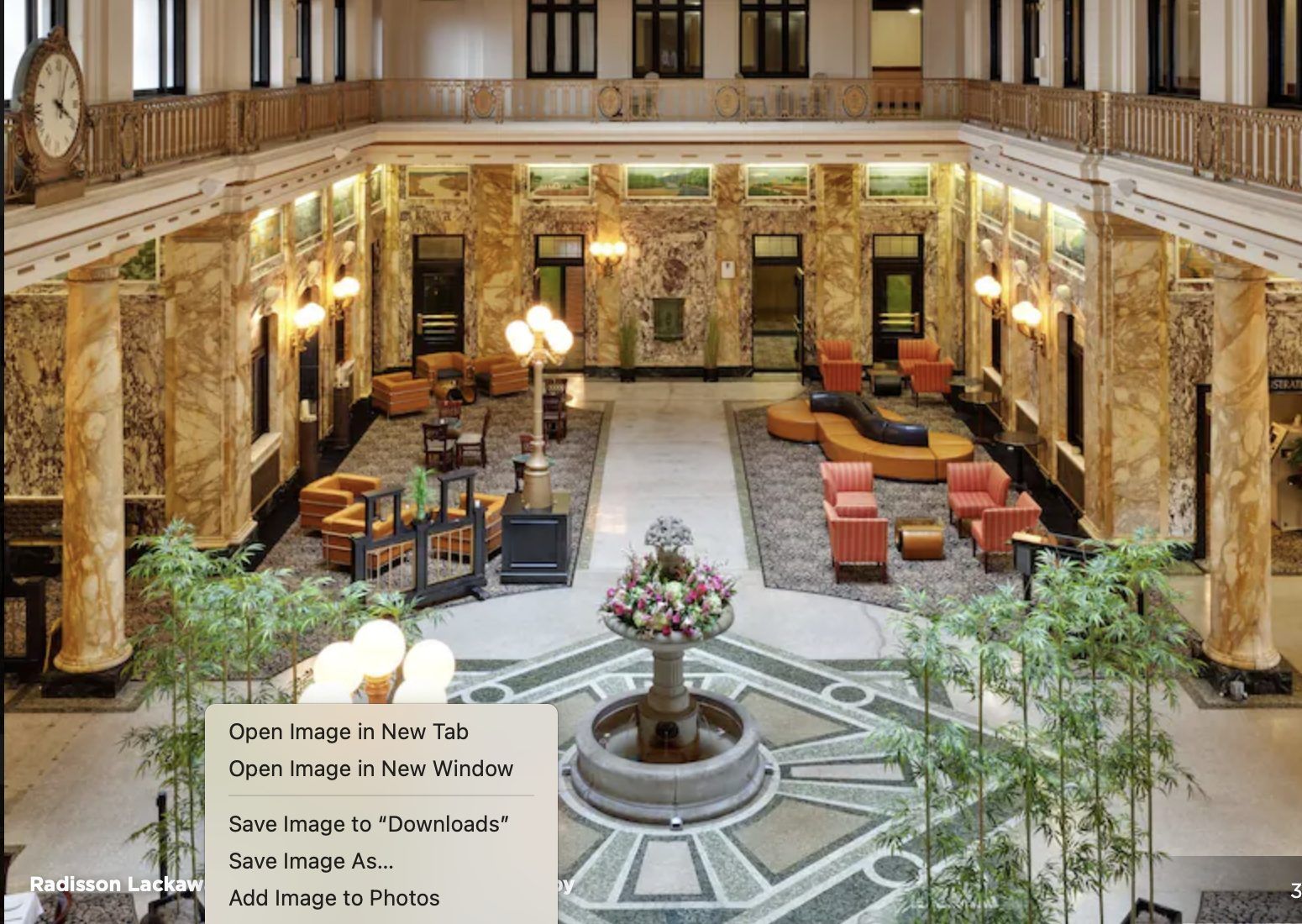
  3. I stayed at the Radisson Lackawanna, which is a very cool hotel (see right). It used to be a train station for the Delaware, Lackawanna and Western Railroad that ran from Hoboken, NJ to Buffalo, NY. From its construction, you can see how prosperous Scranton was at its peak. One of the unique features of this station/hotel are the 36 ceramic portrayals of scenes along the  railroad line. The first depicts the Hoboken ferry. The 36th depicts a resort near Buffalo.
  4. This was a small, but mighty conference. There were lots of presentations because they used the academic format, which gives presenters only 20 minutes instead of the hour that’s usually given to presenters at ham radio conferences.
  5. The focus was on ionospheric research, but there were topics of more general interest as well. For example, because the Doppler shift is of interest when describing the behavior of the ionosphere, there’s also an interest in accurately measuring signal frequencies.
  6. There were lots of students, as you may expect. The median age was, therefore, much lower than at many ham gatherings.
  7. The attendees were more diverse, too. There were many women and people of color present.

As a result of attending this conference, I’ve added a couple of things to my list of projects I’d like to do at some point. The first is connecting a GPS disciplined oscillator (GPSDO) to my IC-7610 in order to make my frequency measurements more accurate.The second is to play around with VLF reception and listen to some of the naturally-occuring phenomena that produce  RF signals, such as “whistlers.”

Filed Under: Antennas, Propagation Tagged With: HamSci, ionosphere, PA, Scranton, VLF

  • Page 1
  • Page 2
  • Page 3
  • Interim pages omitted …
  • Page 12
  • Go to Next Page »

Primary Sidebar

No Nonsense Technician Class License Study Guide (for tests given between July 2026 and June 2030)

New No Nonsense Technican Class Study Guide now available!

The 2026 version of my Tech Class study guide is now available, and as always, the PDF version is FREE!. The ePub version costs $11.97, and a Kindle version and paperback version will be available on Amazon shortly.

Click here to get all of my "No Nonsense" study guides.

Also available: The CW Geek's Guide to Having Fun with Morse Code

W5SWL.Com
Retevis Ailunce H1 DMR Radio
DXpander: Cobweb antennas, Laser Cutting

You’ve got mail!

Enter your email address below and get an email every time I publish a new post.

Email


I frequently teach classes to help newcomers get their licenses. The next class will take place on Saturday, October 10, 2026 on the University of Michigan campus. Click here for more information.

If you can't make the class, subscribe to the mailing list to be notified of when the next class will be held.

You can always download my free study guide, and if you have any questions about the classes, or amateur radio in general, please feel free to email me directly.

Support KB6NU.Com

Donate $7.30 and get two of these cool stickers. Measuring 4.25-in. W by 2.75-in. H, it's perfect for your car, your shack, or wherever!

Contact me

If you have a question or comment about one of my blog posts, or a question about any of the material in my study guides, or just a question about ham radio in general, you can email me at [email protected].

Blogs You Should Also Read

  • AE5X: A CW-centric blog from Kingswood, Texas
  • K0LWC Blog
  • LA3ZA Ham Radio Blog
  • Little Radios, Big Fun – WB3GCK
  • Mr. Vacuum Tube's Blog
  • Radio Artisan – K3NG
  • The K0NR Weblog
  • VE3WDM's QRP Ham Radio Blog
  • W2LJ’s Blog

Ham Radio Websites

  • Dashtoons – The Hammin' Comedy by Jeff K1NSS

Podcasts

  • ICQ Podcast
  • Linux in the Ham Schack
  • No Nonsense Amateur Radio Podcast
  • Resonant Frequency Amateur Radio Podcast

Recent Comments

  • Rob W4ZNG on The EMF Explorer: A badge for ham radio?
  • STW on You know POTA. You know SOTA. How about BOTA?
  • Dan KB6NU on Some Ham-Vention History
  • David Pompea on Some Ham-Vention History
  • Walter Underwood on One lump or two (or three)?

Meta

  • Log in
  • Entries feed
  • Comments feed
  • WordPress.org

Footer

Copyright © 2026 Daniel M. Romanchik, KB6NU · Log in