

Description
The “No Nonsense” series of amateur radio license study guides has become famous for helping people pass the tests. Written in a simple, easy-to-understand style, this study guide will help you upgrade to Amateur Extra Class in no time. I guarantee it! If this book doesn’t help you pass the test, I’ll give you your money back.
Here’s a sample of the text:
Calculating the gain and output voltage of an op amp circuit is relatively straightforward. The gain is simply RF/Rin. In the op amp circuit shown in Figure E7-3, Rin = R1. The output voltage of a circuit is then the input voltage times the gain.
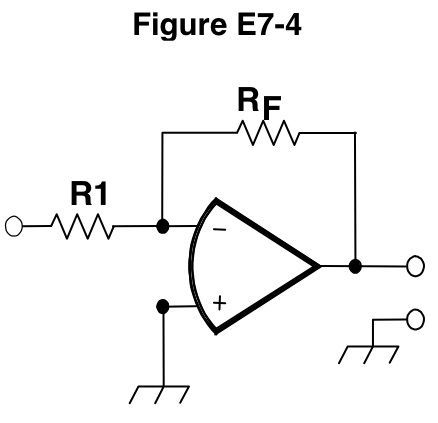
QUESTION: What magnitude of voltage gain can be expected from the circuit in Figure E73 when R1 is 10 ohms and RF is 470 ohms? (E7G07)
ANSWER: 47
If R1 is 10 ohms and RF is 470 ohms, the gain is 470/10, or 47.
While the gain of an ideal operational amplifier does not vary with frequency, op amps in the real world do have a finite bandwidth. Some modern op amps can be used at high frequencies, but many of the older ones can’t be used at frequencies above a couple of MHz. To find out if you can use an op amp at the frequency of your signals, check out the gain-bandwidth specification. The gain-bandwidth specification is the frequency at which the open-loop gain of the amplifier equals one.
QUESTION: How does the gain of an ideal operational amplifier vary with frequency? (E7G08)
ANSWER: It does not vary with frequencyQUESTION: What is the gain-bandwidth of an operational amplifier? (E7G06)
ANSWER: The frequency at which the open-loop gain of the amplifier equals one
NOTE: This is the PDF version. It is also available as an ePub file. Purchase that version if you wish to read the book on Amazon Kindle and Barnes&Noble Nook e-book readers. This book is also available as a paperback directly from Amazon.



Reviews
There are no reviews yet.