• Skip to primary navigation
  • Skip to main content
  • Skip to primary sidebar
  • Skip to footer

KB6NU's Ham Radio Blog

KB6NU's Ham Radio Blog
  • HOME
  • Study Guides
  • Teach a One-Day Tech Class
  • W8SRC Repeater Guide
  • Advertise
  • Hire Me

Books and Magazines

New edition of my No Nonsense Technician Class License Study Guide now ready for review

May 7, 2026 By Dan KB6NU 3 Comments

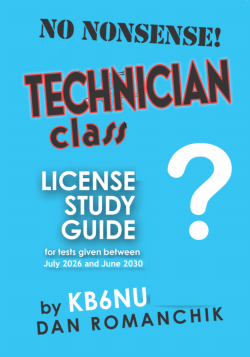
The 2026 edition of my No Nonsense Technician Class License Study Guide is now available for review. I would love for you  to download it, read through it, and comment on it, either here in this post or directly by email.

I’ve improved some of the explanations in the text (at least I think that I’ve improved them). But, please feel free to comment and suggest other topics that might need more explanation.

I have also added some illustrations. I was going to add more illustrations—and I may try to add more before I actually publish it—but illustrations take a lot of time. If there’s a topic that you think really needs an illustration let me know.

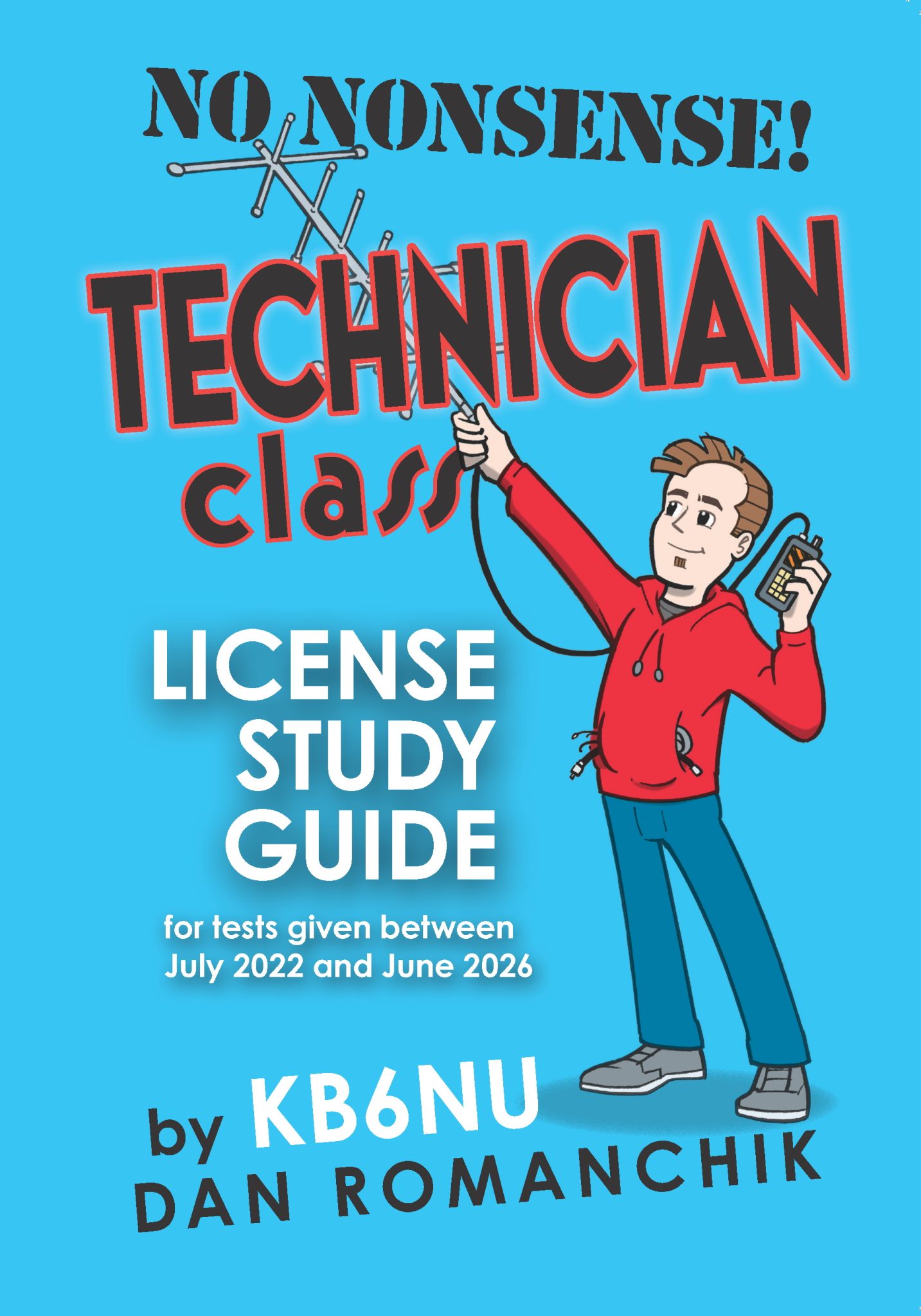
Finally, I’m looking for suggestions as to what to put on the cover. The last edition had a cartoon image of a young man holding a satellite antenna. That generated a little controversy about not being inclusive enough. I’m not sure it was all that bad, but I’d love to hear what you think would make a good cover.

Filed Under: Books and Magazines Tagged With: 2025 Tech study guide

This is why I keep producing study guides

February 10, 2026 By Dan KB6NU 3 Comments

When I first started publishing my No Nonsense license study guides, there were really only three of us producing amateur radio license study guides: the ARRL, Gordon West, and me. Now, there are many more. If you do a search on Amazon for “Technician Class license study guide,” you’ll see that there are at least a dozen other study guides out there.

As a result, of course, I’m making a lot less money. All these study guides have really eaten into my profits. And, on top of that, I’m a better author and radio amateur than I am a business man.

So, this year, when the NCVEC updated the Technician Class question pool, I seriously debated if I should update my study guide or just get out of the business.

Then, I received this email:

Dan, I very much appreciate your study guides. I have gone through your Tech guide a few times, and a few sections of it several times. I played with CB radio in the ’70’s and have experimented with various commercial and home made antennas for 11 meters and other applications over the years. I used a Radio Shack antenna book as my guide.

Due to the government shutdown I have not been able to take the Tech test since I began my ham study, but I have been able to very successfully pass online practice tests. I have purchased a Yaesu FT 710 radio and have been monitoring mostly 40-meter and 10-meter bands with my home made end-fed, half-wave (EFHW), 40-meter antenna with a loading coil for 80 meters and a 49:1 unun.

I like 40 meters the best, which is why I want to get my General asap. I have used another study guide for General, but found it lacking in formulas and algebraic explanation. Where the other guide left me frustrated and lost, yours clarified concepts that were difficult for me. Thank you.

Well, that did it. After reading this email, I decided that I had to keep doing my study guides. I replied:

Thanks for your kind words. Honestly, it’s emails like yours that keep me doing the study guides. If you have any questions about any of the material, please feel free to contact me. As far as operating goes, I am also a big fan of 40 meters, and because I’m mostly a CW operator, 30 meters. If you ever hear me on the air, please give me a call.

About a week and a half later, I got another email from this fellow titled, “Passed my Tech and General exams this morning.” He wrote:

Your study guides were a great help.  I think I might have gotten 1 or 2 wrong on the Tech exam, but I think I got 100% on the general. I am excited to start working on the Extra Class material to give me more confidence on working on my equipment and exploring the amazing analog and digital electromagnetic world out there.

Then, this morning, I got the following:

I decided to try to apply the information that I have gained so far in your Tech and General study guides and put off Extra until I have more experience.  My fairly extensive work and testing on my home-built antenna systems has paid off.

I have been working on tuning my 40-meter EFHW, and as a result, have made several 20- and 40-meter contacts, with 100 watts, between 200 and 800 miles. The antenna is made of old-schoo,l galvanized, electric fence wire and is only about 10 feet above my deck then 12 feet above the ground. I also have another antenna, which is C-shaped in the loft of my barn.

Both have proven effective. I might try using my metal barn roof as a reflector and string an EFHW above it, as per a suggestion from someone at NOSWR.net.

Thanks again for the courses and moral support. I still feel too much of a noob and outsider to say this, but here goes:   73

To which, I replied:

Hah! I see that you’re getting into the spirit of ham radio. Ham radio is a learn by doing kind of adventure, and I’m sure that all this tinkering with your antenna will certainly pay off in the end. It seems to me that you’ve learned every right to heartily say “73.”

I really love getting emails like this. It makes me feel like I’m really making a difference. So, I guess I’ll be publishing study guides until they pry the keyboard from my cold, dead hands.

Filed Under: Books and Magazines, Classes/Testing/Licensing

A thrift shop find

January 11, 2026 By Dan KB6NU 1 Comment

My wife, Silvia, and I occasionally visit the Kiwanis Thrift Sale here in Ann Arbor. Over the years, I’ve purchased all manner of things there that have proven useful in my amateur radio operations.  I have purchased computer keyboards for $2, hand weights that I use to anchor the ends of my inverted-V doublet on POTA activations, and a roll of 300 Ω twinlead.

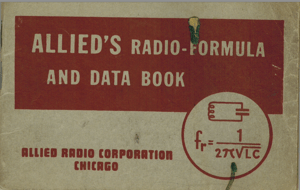
Cover of the book Allied's Radio-Formula and Data Book.
My latest Kiwanis Thrift Sale find cost me only 50 cents.

My latest purchase, as you can see from the photo at right is the 1953 edition of Allied’s Radio-Formula and Data Book. This little booklet contains a wealth of information, much of it still very useful, and it only cost 50¢! The table of contents list the following:

  • Bare copper wire table, which lists the dimensions, resistivity, and weight for copper wire from 1 gauge to 44 gauge.
  • Resistor and condenser color codes
  • Algebraic formulas, trigonometric relationships and a three-place log table. There were no electronic calculators back in 1953@
  • Decibel table
  • and much more

For example, on the page titled “Miscellaneous Formulas, there is a formula for calculating the capacitance of a vertical antenna shorter than a quarter wavelength. There is also a page for calculating the characteristic impedance, capacitance, inductance, and attenuation of two-wire, open-air transmission lines:

Page showing equations for calculating the characteristic impedance, inductance, capacitance, and attenuation of two-wire, open-air transmission lines.

Click here to download a scanned version of the book. It’s 35 Mbytes, so be warned that it could take some time to download.


Filed Under: Books and Magazines, Electronics Theory Tagged With: Allied, Handbook

Do we even need QST?

September 30, 2025 By Dan KB6NU 17 Comments

Cover of the October 2025 SWR MagazineA couple of days ago, I got an email from SWR Magazine, announcing their fifth edition. SWR is a publication produced by a group in Puerto Rico, including Editor Jose Candelaria NP4ET, Technical Editor Juan Montivo WP4OV, and Assistant Editor Serafin Martinez KP4FIE. This is the first issue that I’ve seen of this publication, and honestly, I’m impressed.

This issue has a number of great articles, including:

  • Building Your Own End-Fed Half-Wave Antenna by Isidro de Jesus WP4NXI
  • Understanding MUF by Juan Montijo WP4OV
  • Lightning Protection for the Amateur Radio Station by Serafin Martinez KP4FIE
  • and several more.

This isn’t the only self-published amateur radio magazines out there. Others that come to mind are:

  • QRP Quarterly, which is a benefit of joining QRP-ARCI.
  • SARC Communicator, published by the Surrey Amateur Radio Club (SARC) of British Columbia.
  • Ham Radio Ireland.

These magazines are so good, that I’m not really sure that we need QST anymore. I don’t know about you, but since they’ve gone electronic, I rarely feel the need to read QST. To be fair, the latest issue did have a couple of interesting antenna articles, but publications like the Communicator and SWR, coupled with the plethora of amateur radio YouTube channels and podcasts more than supply my need for information.

I urge you to subscribe to these magazines. Aside from QRP Quarterly, they are free. And, if you’re a writer, I urge you to contribute to these publications. The SARC Communicator usually includes one of my blog posts, and I have published articles in both QRP Quarterly and Ham Radio Ireland. I’d be happy to help you write an article for one of these magazines.

Filed Under: Books and Magazines Tagged With: Ham Radio Ireland, QRP Quarterly, SARC Communicator, SWR Magazine

Interesting FREE antenna stuff on the internet: Flowerpot antenna, antennas for the non-technical, W2FMI’s book in the Internet Archive

December 31, 2024 By Dan KB6NU 4 Comments

I hate to admit it, but lately, I’ve been getting a lot of my ideas for blog posts from Reddit posts to /r/amateurradio. The first post asked whether or not you should fold over the braid when making a flowerpot antenna. I had never heard of a flowerpot antenna, so I did some searching.

Diagram showing the dimensions for a 2-meter flowerpot antenna.
The flowerpot antenna consists of a half-wavelength length of coax, with an RF choke at the bottom.

The flowerpot antenna is so-called, I think, because the base of it is often inserted into a flowerpot to make it a stealth antenna. It is basically a half-wavelength length of coax inside a PVC pipe to obscure its actual purpose. At the bottom of the antenna, the coax is wrapped around the PVC to make an RF choke. The first post to come up in my search describes a 2-meter flowerpot antenna designed by VK2ZOI.

The reddit post actually asked about a 10-meter version of the antenna. I found a design on VK1NAM’s blog. The 10-meter antenna is, of course, a lot longer than the 2-meter antenna, so instead of a length of PVC pipe, this design uses a telescoping mast to support the antenna.

If you have some RG-58 lying around, or perhaps find some at a ham swap meet, this looks like a fun antenna to play with.

Not technical? Read this.

While searching for information on the flowerpot antenna, I happened to run acrosss Understanding Antennas For The Non-Technical Ham. This book was written by Jim Abercrombie, N4JA (SK) and is now freely available on the web. It lives up to its name, offering descriptions for commonly-used HF antennas in language about as non-technical as it can be. It’s worth every penny. :)

Books by Jerry Sevick, W2FMI

Book cover for The Short Vertical Antenna and Ground Radial by Jerry Sevick, W2FMI.
The Short Vertical Antenna and Ground Radial is one of 6 books written by Jerry Sevick, W2FMI (SK).

Jerry Sevick, W2FMI, was renowned for his work on short vertical antennas and transmission line transformers. Over the years, he wrote many articles and books on baluns and ununs, and many hams consider his book, Building and Using Baluns and Ununs: Practical Designs for the Experimenter, to be the bible on the topic. He received the Dayton Hamvention Technical Excellence Award in 2005 and became an SK in 2009.

This morning, I came across a reddit post asking for information on a short vertical antenna. Since I happen to have a copy of W2FMI’s The Short Vertical Antenna and Ground Radial, I did a search for where to buy a copy. Amazon had some used copies, but at ridiculous prices, so I continued my search.

Fortunately, I found it in the Digital Library of Amateur Radio and Communications, which is part of the Internet Archive. And, it’s available for free!

Sevick’s two other books, Building and Using Baluns and Ununs: Practical Designs for the Experimenter and Transmission Line Transformers can be borrowed from the Internet Archive’s library.

Have fun and make some antennas!


Filed Under: Antennas, Books and Magazines Tagged With: flowerpot antenna, N4JA, W2FMI

RSBG Operating Manual will help you have more fun with amateur radio

October 19, 2024 By Dan KB6NU Leave a Comment

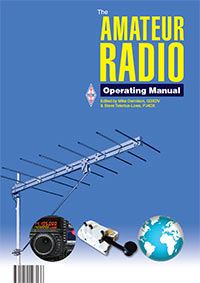
Ed Durrant, G8GLM/DD5LP/VK2JI. The  Amateur Radio Operating Manual (Nineth Edition). 2024. Radio Society of Great Britain (RSGB). £17.99.

A couple of months ago, Ed Durrant, DD5LP, my co-presenter on the ICQ Podcast, emailed me and told me that he was going to be the editor of the next edition of the RSGB’s operating manual. Knowing that I was a Parks on the Air (POTA) enthusiast, he asked if I would write the section on POTA. I quickly agreed. My payment was a copy of the book, which arrived a couple weeks ago.

The topics covered by this book are very similar to topics you’ll find in The ARRL Operating Manual for Radio Amateurs, and except for the chapter on regulations, all of the information in this book is applicable to radio amateurs no matter where they live and operate. There are chapters on:

  • what frequencies amateurs can use
  • what modes amateurs can use
  • how to make contacts
  • how signals propagate
  • how to work DX
  • contesting and awards
  • mobile and portable operation (where you’ll find what I wrote about POTA, as well as sections on SOTA, BOTA, IOTA, and more)
  • FM, repeater, VHF, UHF, and satellite operations
  • logging and QSLing

Plus, there is an appendix which list all of the DXCC entities and their call sign prefixes, as well as an appendix on how to make foreign language contacts, if you’re feeling adventurous.

My section aside, this would be a great book for a newcomer to amateur radio. It’s a great introduction to all of the operating fun we can have in our hobby. It might also be a good book for some of us old timers who may have gotten stuck in our ways. There’s always something new to try in amateur radio, and this book could help you get started in doing something new and fun.

Man sitting at a park’s picnic table.
This photo of yours truly operating POTA from US-1573 appears in this edition of The  Amateur Radio Operating Manual. I suggested to Ed that he might want to use a picture of a British ham operating from a British park, but he insisted on getting my picture into the book.

Filed Under: Books and Magazines, Operating Tagged With: rsgb

RSGB Logbook: Explorer gets hams involved

October 9, 2024 By Dan KB6NU Leave a Comment

I’m not really sure where I found out about the RSGB Logbook: Explorer, but I like it a lot. It’s sort of a British version of my 21 Things to Do After You Get Your Amateur Radio License, but it’s a workbook that hams can print out and then fill up as they go along. Here are the activities included in the RSGB Logbook:

  • Register online. In this step, the new ham is asked to set up accounts on QRZ.Com, Logbook of the World, the RSGB QSL Bureau, and EchoLink.
  • Build a wire antenna. This task is to build a simple wire antenna and then describe the antenna.
  • Make 10 contacts through a repeater and log them.
  • Make 10 contacts on 2-meter simplex and log them.
  • Make 10 POTA contacts and log them.
  • Make 10 Summits on the Air (SOTA) contacts and log them.
  • Make 10 Bunkers on the Air (BOTA) contacts and log them.
  • Worked All Britain. Make 10 contacts in 10 different grid squares in Britain and log them.
  • Use different modes on HF. Make 10 HF contacts using at least two of the following modes: CW, FM, FSTV, FT4, FT8, JS8, JT65, MFSK, packet radio (AX25), PSK31, RTTY, SSB and SSTV; you MUST use at least 2 bands from the following list: 40m, 30m, 20m, 10m.
  • Make 10 VHF/UHF contacts on any band but 2 meters and log them.
  • Take the RSGB Quiz. The quiz consists of 10 questions that invites the readers to do a little research on famous radio amateurs and a couple of technical topics.

I think that perhaps for the next edition of 21 Things I’m going to use this format. It’s more interactive, and it just might get more hams to try new things with their licenses. Of course, some of these activities don’t really apply to U.S. hams. The reason for this is that British hams get more HF privileges than U.S. hams, but perhaps I can slant the activities I  include to target those things that U.S. hams can do.

And, since everyone likes awards, I’ll design certificate for those that complete 75% of the logbook and submit proof of the activities that they’ve completed.

To see how one ham used the RSGB Logbook: Explorer, read read this article on the RSGB website.

Filed Under: Books and Magazines, Operating Tagged With: RSGB Logbook

A bookish life in amateur radio

September 15, 2024 By Dan KB6NU 3 Comments

book.
The 2023 ARRL Handbook is the 100th edition of this essential reference.

I enjoy reading essays, so when I saw a collection of essays from Joseph Epstein, Familiarity Breeds Content: New and Selected Essays, on the new books shelf at my local library, I checked it out. The essays were fine, although I’m not sure that I agree with David Brooks, who called the essays “funny” and full of “charming banter.” 

One essay in the book, “The Bookish Life,” did catch my eye. The essay discusses lists of books that a “well-read” person might be expected to have read. Epstein notes the difficulties with such lists and writes,

Such lists reveal a yearning for a direct route to wisdom. Brace yourself for the bad news: none is available. If one wanted to establish expertise in a restricted field—economics, say, or art history, or botany—such a  list might be useful.

I’m thinking that such a list might be useful for amateur radio, and I don’t think that I’ve ever seen such a list. So, let’s start one. 

Scanning my bookshelves, I offer the following:

  • The ARRL Handbook
  • The ARRL Antenna Book
  • The ARRL Operating Manual
  • The Art of Electronics, 3d edition. Horowitz and Hill.
  • Electronic and Radio Engineering, 4th edition, Terman. 
  • Antennas, 2d edition, Kraus
  • Experimental Methods in RF Design, Revised Edition; Hayward, Campbell, and Larkin.

I have not actually read all of these books, so I can’t claim to be a bookish radio amateur. I have cracked them open on occasion, though. Some I’ve cracked open more than others.

I’ve never owned a copy of Experimental Methods, but every time it’s mentioned, it seems to be mentioned with a certain reverence. That’s why I’ve included it in this list. It’s no longer in print, though, which is curious. If it’s such a great book, you’d think that the ARRL would continue selling it.

Anyway, I’d like to get your nomination for the essential amateur radio book list. Please comment below or email me directly. 

Filed Under: Books and Magazines

Things I’m working on and things I should be working on

December 12, 2023 By Dan KB6NU 2 Comments

As usual, I have a lot of projects that I’m working……and a bunch that I should be working on.

Projects that I’m currently working on include:

  1. I’m currently working on a section of the next RSGB operating manual.

    A chapter on POTA for the next edition of the RSGB Radio Amateur Operating Manual. I don’t have to write an entire book on the topic—it’s only going to be a few pages—but sometimes deciding what to include and what to leave out is harder than just writing more.

  2. Ham evangelist. What’s a ham evangelist, you ask? Well, I got a grant from ARDC, my former employer, to take my one-day Tech class on the road, brining amateur radio to places that should have more amateur radio. We’re in the process now of identifying those places.
  3. Raspberry Pi Pico version of the K3NG Keyer. I’m going to try to make a Raspberry Pi Pico do what the Arduino Nano does and more. Right now, I’m just focusing on learning Python.

Projects that I should be working on or will shortly have to start working  include:

  1. The 2024 edition of the No Nonsense Extra Class License Study Guide. The NCVEC has just published the updated question pool, and I’ll need to get started on that sooner or later.
  2. An outline for a book on microcontroller projects that I’ve been talking to the RSGB about.
  3. Lining up panelists for a forum at Dayton 2024 on different methods for learning Morse Code.
  4. Various projects around the house. There are enough of those to keep me busy for years.

Filed Under: ARDC, Books and Magazines, Building/Homebrew, Classes/Testing/Licensing, Everything Else, Parks on the Air

Random thoughts: The case for paper, CB for youth engagement, POTA/SOTA safety

December 8, 2023 By Dan KB6NU 1 Comment

The case for paper

As most of you know by now, the ARRL is going to start charging extra for the print version of QST in January—even if your membership expires after that date. While I am generally in favor of magazines going digital, paper does have its advantages.

For example, I’ve recently been plowing through my stack of paper QSTs, looking for interesting things before I toss them. In the process, I’ve come across several items of interest, including articles on building an inline RF current sensor and building a short vertical for 160 meters.

I’m not sure that you’d get this kind of serendipitous occurrence with digital magazines.

CB for youth engagement?

On reddit, someone asked if anyone had any information on successful programs for youth engagement. Someone replied, “Heard of a ham club that gave out old CB radios to young people in the area, and helped them with setting them up. Within 2 years, most of them were licensed hams!”

I think that in addition to just helping them get set up, you might also want to give the kids some structured activities, like showing them how to run a net or maybe do a hidden transmitter hunt, if such a thing is possible with CB radios. You’ll also want to be available if, or should I say when, there are problems with the radios.

This sounds like an interesting idea to me. I asked for more details. Have any of you heard of something like this?

SOTA/POTA Safety

A couple of weeks ago, I joined a Long Island CW Club Zoom meeting on portable operation. It was a great meeting, and a lot of good ideas were mentioned.

One of the best, I thought, was the reminder to be safe when doing a Parks on the Air (POTA) or Summits on the Air (SOTA) activation. One of the things that I do is to attached caution tape to my inverted-V antenna where there’s any chance that someone could come into contact with it.

Another fellow mentioned that he wears a blaze orange vest when he heads into the woods. This had not occurred to me, as I have been operating from open areas where no hunters are allowed. But, if there’s any chance that you might come into contact with hunters on your POTA/SOTA adventures, the orange vest is a good idea.

Filed Under: ARRL, Books and Magazines, Clubs, Kids, Parks on the Air Tagged With: SOTA

  • Page 1
  • Page 2
  • Page 3
  • Interim pages omitted …
  • Page 18
  • Go to Next Page »

Primary Sidebar

No Nonsense Extra Class License Study Guide: for tests given between July 2024 and June 2028

New No Nonsense Extra Class Study Guide now available!

The 2024 version of my Extra Class study guide is available in PDF, ePub, Kindle, and print versions.

Click here to get all of my "No Nonsense" study guides.

Also available: The CW Geek's Guide to Having Fun with Morse Code

W5SWL.Com
Retevis Ailunce H1 DMR Radio
DXpander: Cobweb antennas, Laser Cutting

You’ve got mail!

Enter your email address below and get an email every time I publish a new post.

Email


I frequently teach classes to help newcomers get their licenses. The next class will take place on Saturday, February 7, 2026 on the University of Michigan campus. Click here for more information.

If you can't make the class, subscribe to the mailing list to be notified of when the next class will be held.

You can always download my free study guide, and if you have any questions about the classes, or amateur radio in general, please feel free to email me directly.

Support KB6NU.Com

Donate $7.30 and get two of these cool stickers. Measuring 4.25-in. W by 2.75-in. H, it's perfect for your car, your shack, or wherever!

Contact me

If you have a question or comment about one of my blog posts, or a question about any of the material in my study guides, or just a question about ham radio in general, you can email me at [email protected].

Blogs You Should Also Read

  • AE5X: A CW-centric blog from Kingswood, Texas
  • K0LWC Blog
  • LA3ZA Ham Radio Blog
  • Little Radios, Big Fun – WB3GCK
  • Mr. Vacuum Tube's Blog
  • Radio Artisan – K3NG
  • The K0NR Weblog
  • VE3WDM's QRP Ham Radio Blog
  • W2LJ’s Blog

Ham Radio Websites

  • Dashtoons – The Hammin' Comedy by Jeff K1NSS

Podcasts

  • ICQ Podcast
  • Linux in the Ham Schack
  • No Nonsense Amateur Radio Podcast
  • Resonant Frequency Amateur Radio Podcast

Recent Comments

  • Mike on Map your contest QSOs
  • Phillip Cardwell on J-Poles
  • Dan KB6NU on Dayton Hamvention 2026: Day 1, Wednesday, May 13
  • Randy Shake on Dayton Hamvention 2026: Day 1, Wednesday, May 13
  • John Hislop on New edition of my No Nonsense Technician Class License Study Guide now ready for review

Meta

  • Log in
  • Entries feed
  • Comments feed
  • WordPress.org

Footer

Copyright © 2026 Daniel M. Romanchik, KB6NU · Log in