• Skip to primary navigation
  • Skip to main content
  • Skip to primary sidebar
  • Skip to footer

KB6NU's Ham Radio Blog

KB6NU's Ham Radio Blog
  • HOME
  • Study Guides
  • Teach a One-Day Tech Class
  • W8SRC Repeater Guide
  • Advertise
  • Hire Me

Batteries

Interesting battery failure

August 1, 2025 By Dan KB6NU 42 Comments

My wife, Silvia, is a stickler for keeping the garage door closed, even if I’m just outside doing some gardening. So, I have a garage door control that I keep in my gardening toolbox, so that I can close the door when I’m outside and then get back in when I’m done.

The other day, the control quit working. That’s not unusual, really. The 9 V battery that powers the thing doesn’t last forever. In this case, though, I found it odd because I replaced the battery not long ago. That got me thinking that perhaps the electronics had gone bad somehow, and that I’d have to replace the control altogether. That could be a problem, since the garage door opener is so old. I’m not sure that I could get a replacement.

Anyway, last night I opened the case, and found the battery shown at right. Somehow, the negative terminal became disconnected from the battery. Very strange, no? I’ve never seen a battery fail this way.

I plan to send an email to Duracell and see what they have to say. I’ll update this post if I get a reply. If you have had a battery fail like this, or in some other weird way, please add a comment below.

Filed Under: Batteries Tagged With: batteries

ICQ Podcast Episode 391 – Kick Start Ham Radio for 2023

December 6, 2022 By Dan KB6NU 2 Comments

In this episode, I join Martin Butler M1MRB, Caryn Eve Murray KD2GUT and Ed Durrant DD5LP to discuss the latest Amateur / Ham Radio news. Topics we discuss in this episode include:

  • Dr. Ulrich Rohde, N1UL/DJ2LR/DL1R, to Be Inducted to the Indian National Academy of Engineering

  • YOTA Month

  • Big Promise from Ultra-Tiny Battery

  • Santa HF Net is Coming to Town

  • Filmmaker makes a Documentary – Documentary makes a Future Ham

This episode’s feature is Kick Start Ham Radio for 2023.

Filed Under: Batteries, People, Podcasts, Videos Tagged With: batteries, Ulrich Rohde, YOTA

From the trade magazines: Automatic impedance matching, AC grounding, rechargeable batteries

June 2, 2021 By Dan KB6NU 3 Comments

Automatic impedance matching in RF design

Impedance (Z) matching is an essential part of most RF circuit design. Regardless of what you’re designing, getting as much power to a load is a top target. Impedances must be matched to transfer the maximum amount of signal power between stages. And in power amplifiers (PAs), impedance matching is critical to getting the maximum power to the final load and maintaining PA linearity. Impedance matching to an antenna in a receiver or transmitter is an essential process.

Some loads are constant; thus, a single fixed Z-matching circuit can be used. But in other applications, that final load may change, or the frequency of operation will change, meaning that a fixed Z-match circuit will not produce the desired results. For these applications, a variable matching network that you can adjust is needed. Better still is a variable and automatic Z-match circuit that adjusts itself to the immediate load or frequency conditions.

Auto Z matching is more common than you think. If you own a recent smartphone, you’re probably using an auto Z-match antenna tuner. However, there are other applications. Here’s a primer on this topic for your elucidation and cogitation.

…read more


AC grounding: essential, dangerous, or both?

Most electrical engineers learn early-on about the importance of what are referred to as circuit grounds. In many cases, whatever your problem, adding a ground or improving the one you have (meaning lower impedance) is a good thing that can’t hurt. That’s what circuit EEs have drilled into them as they work and debug bench circuits prototypes, and more, and learn to connect the analog ground to the digital ground at one point only to minimize unwanted ground-current flow and associated noise.

In most cases, such grounding does improve circuit performance, but as every experienced engineer knows, every rule has legitimate exceptions, and grounding is one of them. A large part of the confusion comes from the ambiguous and this sloppy terminology associated with that innocent-sounding seven-letter word.

…read more


Rechargeable batteries enable greener electronics

While batteries provide untethered power, enabling convenience, dependability, and mobility, environmental responsibility suggests that rechargeable batteries have the same benefits, but can save money while reducing the amount of waste. This article examines the benefits offered by rechargeable battery technology, enabling us to make life better.

…read more

Filed Under: Antennas, Batteries, Electronics Theory Tagged With: grounding

Cool stuff to distribute power, feed antennas

December 29, 2019 By Dan KB6NU 3 Comments

Radios are cool, but they don’t make contacts by themselves. you need antennas and other accessories to complete your station. Here are a three sources that I’ve come across recently.

True ladder line

For the past four years, my main HF antenna has been a “Cobra” doublet. It’s a great antenna, but one issue that I have with it is that when the 450 Ω ladder line gets wet, it’s characteristics change, and I have to retune the antenna as is gets wetter or dryer. Supposedly, this doesn’t happen with open-wire feeders. I guess because there’s less area between the actual conductors to get wet.

The big ham radio stores don’t sell open-wire feedline, but there are two sources for it. TrueLadderLine.com sells 100-ft. of 600 Ω feedline for $75. They also sell an 80-meter doublet with this ladder line for $125. The unique thing about the antenna is that there are no wire splices. The antenna element and the feedline are one continuous piece of wire.

To make your own open-wire feedline using 14 AWG THHN wire (solid or stranded) sold at home improvement stores, you might want to purchase Ladder Snaps. To make a feedline, you simply snap the wire into the spreader (shown below). A kit of 100 spreaders costs $35.


Devices distribute DC to PowerPoles, USB connectors

I’ve been using a RigRunner to distribute DC in my shack for quite a while now. I have since soured on West Mountain Radio. So, when one of my Elmerees asked about how to connect a DC power supply to several rigs, I did some Googling and found K9JEB’s website. He offers a number of different power-distribution products similar to, but with more features, at a better price, than other suppliers.

For example, you can get a simple power distribution kit, with just PowerPoles on it, or you can get a version that has both PowerPoles and USB connectors for devices that are powered via USB. He also sells what he calls the Power Transfer Charger Kit (shown below) that sits atop a sealed lead-acid battery or gel-cell battery. It includes a battery charging circuit, as well as up to six PowerPole ports and three USB power ports. Very cool!

Filed Under: Antennas, Batteries, Power Supplies

Yet another battery story

May 12, 2019 By Dan KB6NU 4 Comments

This isn’t really an amateur radio story, but it does have a battery in it, so it could be. :)

About six months ago, I noticed that my battery-powered shaver wasn’t holding a charge as well as it used to. Recently, I’ve had to just use it with that AC adapter to shave down my beard properly.

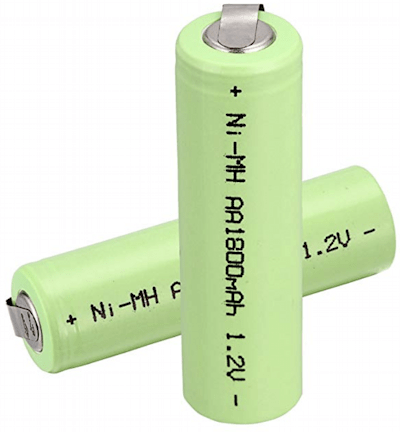
I cracked it open and found that it was powered by a single NiMH, AA cell, very much like the one shown in the photo. The  kicker is that it’s not a standard battery, but one with solder tabs.

My first response was to search for it on Amazon, and, of course, there are many choices for this kind of battery. Then, I remembered that we have a Batteries Plus store here in Ann Arbor. I’d had a Kenwood battery pack rebuilt there many years ago, and it seemed reasonably priced. I decided that even though the batteries were pretty cheap on Amazon that I’d buy one of these batteries from Batteries Plus, if it cost less than $10.

I couldn’t find the right battery on the Batteries Plus website, though, which I thought was kind of puzzling. I phoned the store on Thursday morning, explained what I was looking for, and the guy I talked to, said that they would be able to put some tabs on a battery for me. Since I was headed that way to meet some friends for lunch, I said that I would stop by later.

After lunch, I went to the store and showed a different guy what I wanted. He played around on his computer for about ten minutes, then said, “Sorry, we don’t have anything like that.” ARRRRGGH!!! What a complete waste of time.

When I got home, I ordered two batteries with solder tabs from Amazon for $7.50, shipping included because I’m a Prime member. They arrived yesterday, I put one in, and now my shaver is up to full power. And, I’m no longer a Batteries Plus customer.


Filed Under: Batteries, Building/Homebrew Tagged With: solder tabs

Learning about batteries

May 6, 2019 By Dan KB6NU 2 Comments

I often say that getting an amateur radio license is as much getting a license to learn as it is getting a license to operate on the amateur radio bands. Lately, I’ve been learning about batteries, LiPo batteries to be exact.

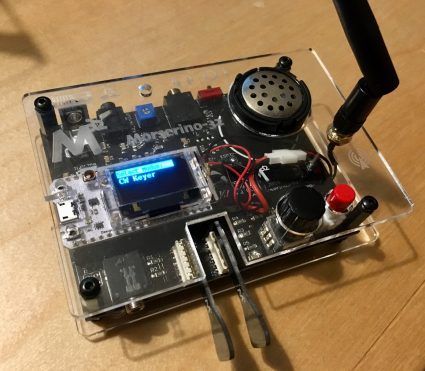
It all started when I purchased a Morserino. The Morserino is a feature-packed Morse Code learning aid. In addition to helping you learn the characters, it’s also supposed to help you learn how to copy in your head. It has a built-in touch keyer function, and a LoRa interface that lets you send and receive code from other Morserino units.

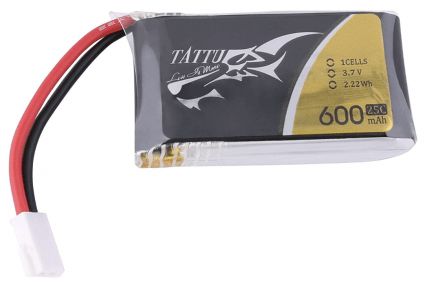
I’ll be writing more about the Morserino in a future blog post, but let’s get back to batteries. The kit did not come with a battery. Instead, it was suggested that one purchase a 600 mAh LiPo battery commonly used for powering drones. I found this battery on Amazon, and purchased a six pack of them, thinking that I’d find uses for the other five in some project or another.

Well, sooner than expected, I did find another application for one of the batteries. I’m building a little Arduino project for a client, and I reckon that this, or one with more capacity, will make a great power source for the project.

Now, I have two immediate challenges:

  1. Figure out how to charge the battery.
  2. Figure out how to connect it to the Arduino.

On the Morserino, the battery plugs directly into a connector on the bottom of the computer board (the white board with the LED display).  I knew that connecting the 5V line from the USB connector directly to the battery was a no-no, but I’d lent out the Morserino to a friend, and I didn’t have the schematics for the board. So,  how they managed to charge the battery from the USB port was a bit of a mystery.

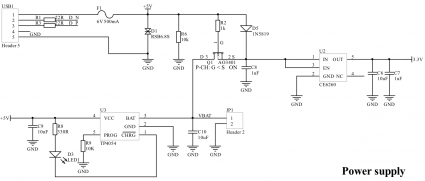
I emailed Willi, OE1WKL, the designer of the Morserino, and he sent me a wealth of information. There actually is a battery-management IC, the TP4054, on the board:

He also gave me the part number for the battery’s mating connector. He said, “The mating connector for the Molex connector on the battery is a Molex 51006. It is sometimes referred to by vendors as 51005 female, but 51005 is the connector on the battery.” You can, of course,buy pre-made cable assemblies on Amazon.

You can also buy lithium battery charging modules. These modules have a TP4056 on them, which is similar to the TP4054. It’s amazing to me that you can purchase ten of these things for less than seven bucks.

So, that’s where I’m at right now. Once I get the modules and cables, I’m going to hook it all up and get the Arduino system running from the battery. The next step will be to integrate a small solar panel and run the whole thing from solar power, hopefully.

Filed Under: Batteries, Circuit Design

Amateur radio videos: Urban explorers at Hara, G8BBC, DIY QRP battery pack

January 5, 2018 By Dan KB6NU Leave a Comment

Some urban explorers do some spelunking in the abandoned Hara Arena (former site of the Dayton Hamvention):

G8BBC recently re-opened at the British Broadcasting Corporation’s headquarters.

I need to learn more about these kinds of batteries:

Filed Under: Batteries, Building/Homebrew, Clubs Tagged With: G8BBC, Hara, Li ion

How dangerous are the new batteries?

February 7, 2017 By Dan KB6NU 3 Comments

On the KX3 mailing list, somone wrote:

For anyone who would like to know why Lithium batteries can be so dangerous I ran across this interesting video from PBS Nova. If you have not seen it yet take a look. It should be worth you time.

Another guy replied:

None would think lithium batteries were “so dangerous” were it not for what I call internet reporting. No one will much remember a story about a cell phone where the battery got hot and had to be discarded. If it blows up now that’s another story.

I’ve never understood how a cell phone can catch fire in someone’s pocket. Lithium batteries don’t get “hot and blow” up under a light load. And they don’t all of a sudden blow up. Hot pocket? Take it out.

The batteries in the hoverboards caught fire because of poor design. The battery not having the capacity to deliver the current required or the charger being faulty. Why would you keep both feet on the hoverboard if you noticed something wrong. Like getting hot, smells funny, hoverboard slows down or stops.

Lithium batteries are very tough and reliable if used according to specs and charged correctly.

In any case the flat packs seem to cause the most trouble. I see them sort of like a small dog vs. a big dog. Both can have aggressive and hostile tendencies. Small dogs don’t scare me. Big hostile and aggressive dogs do. Lithium batteries are little dogs.

I’m not a battery expert, but from what I’ve read, it seems like they can be dangerous, so handling and charging them with care seems appropriate. What do you think?

Filed Under: Batteries

Primary Sidebar

No Nonsense Technician Class License Study Guide (for tests given between July 2026 and June 2030)

New No Nonsense Technican Class Study Guide now available!

The 2026 version of my Tech Class study guide is now available, and as always, the PDF version is FREE!. The ePub version costs $11.97, and a Kindle version and paperback version will be available on Amazon shortly.

Click here to get all of my "No Nonsense" study guides.

Also available: The CW Geek's Guide to Having Fun with Morse Code

W5SWL.Com
Retevis Ailunce H1 DMR Radio
DXpander: Cobweb antennas, Laser Cutting

You’ve got mail!

Enter your email address below and get an email every time I publish a new post.

Email


I frequently teach classes to help newcomers get their licenses. The next class will take place on Saturday, October 10, 2026 on the University of Michigan campus. Click here for more information.

If you can't make the class, subscribe to the mailing list to be notified of when the next class will be held.

You can always download my free study guide, and if you have any questions about the classes, or amateur radio in general, please feel free to email me directly.

Support KB6NU.Com

Donate $7.30 and get two of these cool stickers. Measuring 4.25-in. W by 2.75-in. H, it's perfect for your car, your shack, or wherever!

Contact me

If you have a question or comment about one of my blog posts, or a question about any of the material in my study guides, or just a question about ham radio in general, you can email me at [email protected].

Blogs You Should Also Read

  • AE5X: A CW-centric blog from Kingswood, Texas
  • K0LWC Blog
  • LA3ZA Ham Radio Blog
  • Little Radios, Big Fun – WB3GCK
  • Mr. Vacuum Tube's Blog
  • Radio Artisan – K3NG
  • The K0NR Weblog
  • VE3WDM's QRP Ham Radio Blog
  • W2LJ’s Blog

Ham Radio Websites

  • Dashtoons – The Hammin' Comedy by Jeff K1NSS

Podcasts

  • ICQ Podcast
  • Linux in the Ham Schack
  • No Nonsense Amateur Radio Podcast
  • Resonant Frequency Amateur Radio Podcast

Recent Comments

  • Dan KB6NU on The EMF Explorer: A badge for ham radio?
  • Travis Good on The EMF Explorer: A badge for ham radio?
  • MARTIN ROBERT ROTHFIELD on The EMF Explorer: A badge for ham radio?
  • Mike Chen on Operating Notes, January 5, 2026
  • Rob W4ZNG on The EMF Explorer: A badge for ham radio?

Meta

  • Log in
  • Entries feed
  • Comments feed
  • WordPress.org

Footer

Copyright © 2026 Daniel M. Romanchik, KB6NU · Log in