
• Skip to primary navigation
  • Skip to main content
  • Skip to primary sidebar
  • Skip to footer

KB6NU's Ham Radio Blog

KB6NU's Ham Radio Blog
  • HOME
  • Study Guides
  • Teach a One-Day Tech Class
  • W8SRC Repeater Guide
  • Advertise
  • Hire Me

Learning about batteries

May 6, 2019 By Dan KB6NU 2 Comments

I often say that getting an amateur radio license is as much getting a license to learn as it is getting a license to operate on the amateur radio bands. Lately, I’ve been learning about batteries, LiPo batteries to be exact.

It all started when I purchased a Morserino. The Morserino is a feature-packed Morse Code learning aid. In addition to helping you learn the characters, it’s also supposed to help you learn how to copy in your head. It has a built-in touch keyer function, and a LoRa interface that lets you send and receive code from other Morserino units.
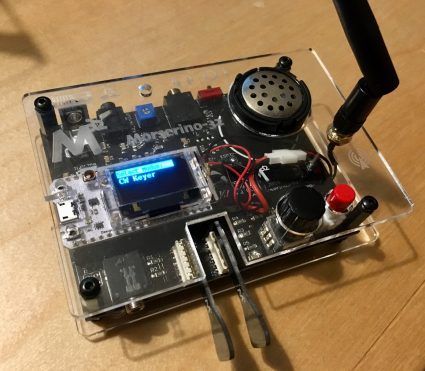
I’ll be writing more about the Morserino in a future blog post, but let’s get back to batteries. The kit did not come with a battery. Instead, it was suggested that one purchase a 600 mAh LiPo battery commonly used for powering drones. I found this battery on Amazon, and purchased a six pack of them, thinking that I’d find uses for the other five in some project or another.
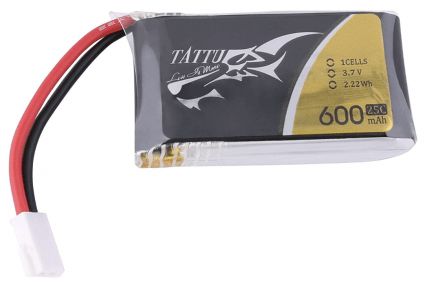
Well, sooner than expected, I did find another application for one of the batteries. I’m building a little Arduino project for a client, and I reckon that this, or one with more capacity, will make a great power source for the project.

Now, I have two immediate challenges:

  1. Figure out how to charge the battery.
  2. Figure out how to connect it to the Arduino.

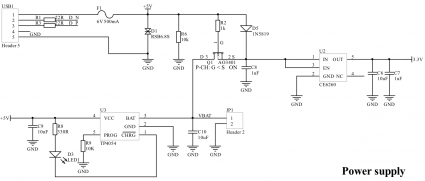
On the Morserino, the battery plugs directly into a connector on the bottom of the computer board (the white board with the LED display).  I knew that connecting the 5V line from the USB connector directly to the battery was a no-no, but I’d lent out the Morserino to a friend, and I didn’t have the schematics for the board. So,  how they managed to charge the battery from the USB port was a bit of a mystery.

I emailed Willi, OE1WKL, the designer of the Morserino, and he sent me a wealth of information. There actually is a battery-management IC, the TP4054, on the board:
He also gave me the part number for the battery’s mating connector. He said, “The mating connector for the Molex connector on the battery is a Molex 51006. It is sometimes referred to by vendors as 51005 female, but 51005 is the connector on the battery.” You can, of course,buy pre-made cable assemblies on Amazon.

You can also buy lithium battery charging modules. These modules have a TP4056 on them, which is similar to the TP4054. It’s amazing to me that you can purchase ten of these things for less than seven bucks.

So, that’s where I’m at right now. Once I get the modules and cables, I’m going to hook it all up and get the Arduino system running from the battery. The next step will be to integrate a small solar panel and run the whole thing from solar power, hopefully.

Related posts:

  1. Yet another battery story
  2. How dangerous are the new batteries?
  3. Batteries & QRP
  4. Batteries Just Cost Me Some Points!

Filed Under: Batteries, Circuit Design

Reader Interactions

Comments

  1. Dave New, N8SBE says

    May 7, 2019 at 2:30 pm

    Funny, I was just researching a 12V -> 5V supply for my QRPLabs kits (station clock and ultimate U3S WSPR xmtr). Both of these run off of 5V, but I’d like to run station 12V to the cases and convert to 5V inside, to avoid the fatal mistake of accidentally hooking up the case 5V input to 12V someday.

    Bonus points for having a Li-ion or Li-poly 3.7V battery on charge inside the case (especially the clock). Adafruit have buck/boost supplies for about $10 plus a battery, but I’m wondering about RF interference from the little switcher supplies, etc.

    Any ideas, experience?

    Reply
  2. Dan KB6NU says

    May 7, 2019 at 3:57 pm

    Sorry. I haven’t tried those buck/boost supplies. If you do give it a go, let me know.

    Reply

Leave a Reply Cancel reply

Your email address will not be published. Required fields are marked *

This site uses Akismet to reduce spam. Learn how your comment data is processed.

Primary Sidebar

No Nonsense Technician Class License Study Guide (for tests given between July 2026 and June 2030)

New No Nonsense Technican Class Study Guide now available!

The 2026 version of my Tech Class study guide is now available, and as always, the PDF version is FREE!. The ePub version costs $11.97, and a Kindle version and paperback version will be available on Amazon shortly.

Click here to get all of my "No Nonsense" study guides.

Also available: The CW Geek's Guide to Having Fun with Morse Code

W5SWL.Com
Retevis Ailunce H1 DMR Radio
DXpander: Cobweb antennas, Laser Cutting

You’ve got mail!

Enter your email address below and get an email every time I publish a new post.

Email


I frequently teach classes to help newcomers get their licenses. The next class will take place on Saturday, October 10, 2026 on the University of Michigan campus. Click here for more information.

If you can't make the class, subscribe to the mailing list to be notified of when the next class will be held.

You can always download my free study guide, and if you have any questions about the classes, or amateur radio in general, please feel free to email me directly.

Support KB6NU.Com

Donate $7.30 and get two of these cool stickers. Measuring 4.25-in. W by 2.75-in. H, it's perfect for your car, your shack, or wherever!

Contact me

If you have a question or comment about one of my blog posts, or a question about any of the material in my study guides, or just a question about ham radio in general, you can email me at [email protected].

Blogs You Should Also Read

  • AE5X: A CW-centric blog from Kingswood, Texas
  • K0LWC Blog
  • LA3ZA Ham Radio Blog
  • Little Radios, Big Fun – WB3GCK
  • Mr. Vacuum Tube's Blog
  • Radio Artisan – K3NG
  • The K0NR Weblog
  • VE3WDM's QRP Ham Radio Blog
  • W2LJ’s Blog

Ham Radio Websites

  • Dashtoons – The Hammin' Comedy by Jeff K1NSS

Podcasts

  • ICQ Podcast
  • Linux in the Ham Schack
  • No Nonsense Amateur Radio Podcast
  • Resonant Frequency Amateur Radio Podcast

Recent Comments

  • Matt W1CDN on A completely different picture of Wayne Green, W2NSD (SK)
  • Chana Walsh on Rethinking ham radio education
  • Rob WfourZNG on Videos: What’s next for POTA, ham radio helps rescue man trapped in cave
  • Dan KB6NU on The EMF Explorer: A badge for ham radio?
  • Travis Good on The EMF Explorer: A badge for ham radio?

Meta

  • Log in
  • Entries feed
  • Comments feed
  • WordPress.org

Footer

Copyright © 2026 Daniel M. Romanchik, KB6NU · Log in