• Skip to primary navigation
  • Skip to main content
  • Skip to primary sidebar
  • Skip to footer

KB6NU's Ham Radio Blog

KB6NU's Ham Radio Blog
  • HOME
  • Study Guides
  • Teach a One-Day Tech Class
  • W8SRC Repeater Guide
  • Advertise
  • Hire Me

FT8

Converting the shack computer to Linux, Part 4: WSJT-X

November 6, 2025 By Dan KB6NU Leave a Comment

I’m not a big FT-8 user, but what shack computer would be complete without an installation of WSJT-X? So, last night I installed the program. After selecting the correct audio input, I was seeing and decoding FT-8 signals on 20 meters.
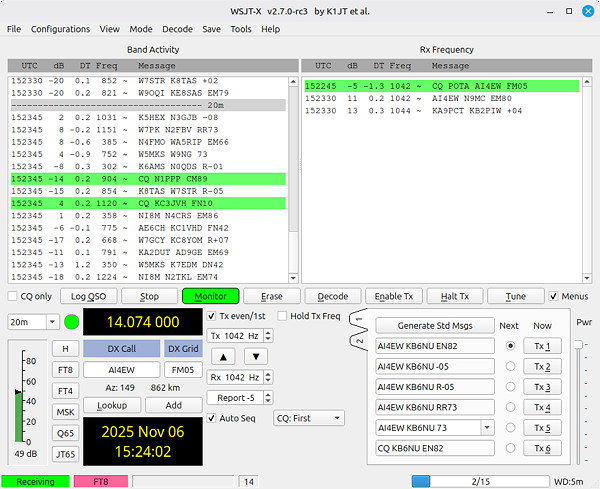
WSJT-X screen shot.
After selecting the appropriate audio input, I was receiving and decoding FT8 signals.

Even though I was receiving and decoding signals, I could see that the received audio level was a little low. A level of 30 dB is recommended (with the antenna disconnected), but mine was down near 18 dB. To get this up to 30 dB, you have to increase the USB AF/IF Output on the IC-7610,

To do this, you press the MENU button, then on the screen, press SET->Connectors->USB AF-IF Output Level->AF Output Level, then set the level. I set the level to 20%, and that did the trick.

Setting up for transmit

I tried selecting a station calling CQ and then replying to it, but I wasn’t getting any output. I found this YouTube video, “How to set up FT8 with WSJT X on the IC-7610 via USB,” which helped me get the application and the IC-7610 set up properly, but because the installation was on a Windows box, it didn’t really give me all the info that I needed.

In particular, I found that I had to set the USB MODLevel to a much different value than shown in the video. To set this level, you press the MENU button, then on the screen, press SET->Connectors->MOD Input->USB MOD Level, then set the level.

This level was set very low, so it’s no wonder that I wasn’t getting any power output.  I set this value to 15%, but noticed that I was getting some ALC. I reduced the value to 10%, and voila, I was transmitting. I made my first contact with KQ4VOB shortly afterwards. As I’m sitting here in the shack, I just made a contact with N3FAR, hopefully another QSL for my collection of QSLs from stations whose callsigns spell words.

Even though I’m making contacts, I’m still not quite sure that I have the otuput levels set quite right. I’m going to have to consult with some of the folks in our club who are more experienced FT8 operators.

I’m still want to work meteor scatter, too, and WSJT-X has a mode—MSK 144—for doing just that. The Leonid meteor shower has started already; it’s expected to peak November 16-17.  The Geminid meteor shower will peak in the middle of December. K5ND has a great page on how to work meteor scatter using WSJT-X.

Filed Under: Computers, Software Tagged With: FT8, WSJT-X

Videos: QRP FT-8 Transceiver, vintage FD video, QSO with SV8ANW

January 19, 2025 By Dan KB6NU 1 Comment

DX FT8: A QRPp, five-band, standalone transceiver

I recently swapped some email with a fellow who purchased a quantity of Tech study guides for a class he’s teaching (only $11/copy!). In addition to talking about the study guides, we got to talking about microcontroller projects. He wrote, “I assume you’ve seen the microcontroller based, standalone FT8 transceiver already, but if not it’s worth a peek: https://www.youtube.com/watch?v=8b2WOxESAVU.”

Well, I hadn’t heard of it, so I did give it a peek. The DX FT8  looks like a very cool project. If I didn’t already have a dozen half-finished projects already, I might give this one a go.

Vintage Field Day 1962

This video reminds me of the home movies that my dad used to take back in the 1960s. Instead of Christmas and birthday parties, however, these show hams setting up and operating on Field Day 1962. Like the video says, there are “lots of vintage ham radio equipment, antennas, portable generators (look at the size of that thing at the 6:00 mark!), baked beans, and radio fun.

Couple observations:

  • The participants seem to be, on average, younger than today’s FD participants.
  • Note that there are two hams per station, one operating and one logging on paper. We do this by computer now.
  • There was probably more cigarette smoking and beer drinking than you’d find at today’s Field Day operations.

KB6NU de SV8ANW

Shortly after working Dimitris (Jim), SV8ANW, he sent me an email with a link to a YouTube video of our contact. Notice that he has a very nice bug fist.

Filed Under: Building/Homebrew, Digital Modes, Operating Tagged With: DX, Field Day, FT8

Is this the beginning of the end for CW DXing?

November 10, 2022 By Dan KB6NU 7 Comments

In a recent thread on the CWops mailing list, a fellow wrote:

You wonder why more and more guys are getting on FTx mode? How about this?

    • MADAGASCAR, 5R. Eiki, JH8JWF is QRV as 5R8AS from Ivato, Talatamaty, IOTA AF-013, until November 6. Activity is on 80 to 6 meters using FT8. QSL via LoTW.
    • GHANA, 9G. Dave, AB0GC is QRV as 9G1SD from the Wenchi, Brong Region. Activity is on 17 to 6 meters using FT8 and FT4 at various times during the day. QSL direct to home call.
    • BANABA ISLAND, T3. Members of the Rebel DX Group are QRV as T33T until November 15. Activity is on 160 to 6 meters using FT8 in DXpedition mode. QSL via LoTW.
    • INDONESIA, YB. Amir, YB9IPY/p is QRV from the Rajaampat Islands, IOTA OC-239, until November 8. Activity is on the HF bands using only FT8. QSL direct to IK2DUW.

I’m not on FT modes, but if you like chasing DX and new band/countries, or ARRL DX Challenge, or even tracking weird and unexpected LP propagation on a “dead” band, stuff like this makes it start to become a rational decision.

Sigh….

What followed was a wide-ranging discussion of CW vs. the digital modes. Some thought that FT4 and FT8 were cheapening the value of DXCC and other DX awards (as if they had any real value to begin with). Others just brushed it off saying, “There are a steadily increasing number of ways to enjoy this hobby.  Pick your favorites for whatever reasons excite you.”

I’m more in the second camp than the first. If people get their kicks from operating FT8, then more power to them. It’s funny when you think about it. We CW operators often say that one reason for operating CW is that it’s easier to work DX on CW than phone. So, I guess it’s a bit hypocritical to bad mouth FT8 just because FT8 makes it even easier to work DX.

I’m not a big DXer, so it’s not a big deal if I don’t work Banaba Island this time around. And, overall, I think anything that gets people on the air is a good thing. Even so, not even having the chance to work these DXpeditions unless I fire up the FT8 software is a little disappointing.

What do you think?

Filed Under: CW, DX Tagged With: FT8

September 15, 2019 By Dan KB6NU 3 Comments

A couple of days, I witnessed this exchange on Twitter (names have been changed to protect the guilty):

Ham #1 @ham#1

It’s like they’re preaching at me!⁩ ⁦@kb6nu⁩


Ham #2 @ham#2

Replying to @ham#1 @kb6nu

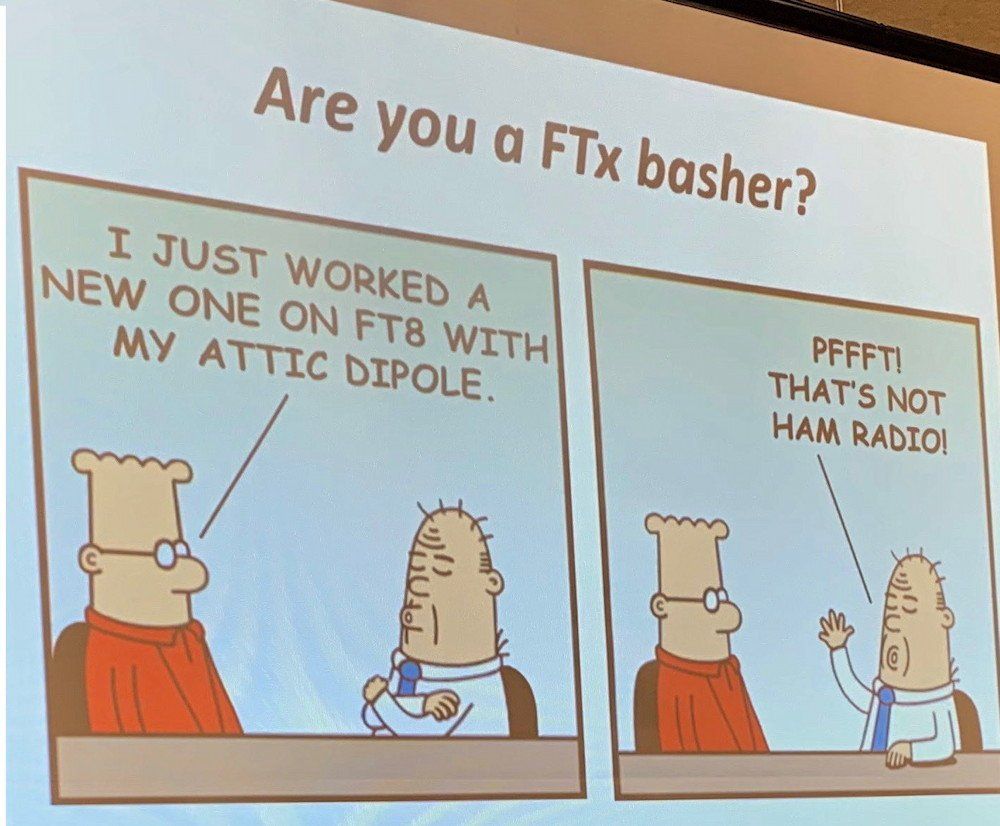
Think the thing I never get with ham radio is if you disagree even slightly with an aspect of a mode your a basher. FT-8 is a part of ham radio just like DStar, Fusion, DMRand CW. I do find it interesting though the lengths they will do to say it can’t be automated etc.


I’ve been thinking a lot about this since this Twitter conversation took place. I think the problem is that most hams have their own conception of what ham radio is based on what they do. The result is that what others do, then, is not real ham radio.

I empathize with Ham #1. I see the relative inactivity in the CW portions of the bands and how crowded the stations are on the FT8 frequency and sometimes think to myself, “What the heck is going on here?” Complaining about it, though, is not going to turn any of them into CW ops. A Yogi Berra quote comes to mind. He is purported to have said, “If people don’t want to come out to the ball park, there’s nothing you can do to stop them.”

Ham radio is just a hobby, after all. I’m going to continue to have fun with it in my way, and I hope that others might follow my lead. If they have other ideas, I’m still happy to help them have fun with ham radio in whatever way they choose.

https://www.kb6nu.com/21098-2/

Filed Under: Everything Else Tagged With: FT8

Cool stuff from my Twitter feed: Yet another Morse Code app, soldering, and a cartoon

October 19, 2018 By Dan KB6NU Leave a Comment

KF8JBB's avatar

KF8JBB – Julia :-)

@KF8JBB

Are you learning Morse Code or wanting to improve your speed? Check out this new website/app. Free. Easy. Smart phone friendly. morse.camp


NR9Radio's avatar

NR9Radio

@NR9Radio

All in fun #hamr #hamradio #ft8


digikey's avatar

Digi-Key Electronics

@digikey

Three Steps to Cleaning a #SolderingTip Read All About It –> dky.bz/2yoFdhI

Filed Under: Building/Homebrew, CW, Digital Modes Tagged With: FT8, soldering

FT8CALL: Now, we’re getting somewhere

September 9, 2018 By Dan KB6NU 4 Comments

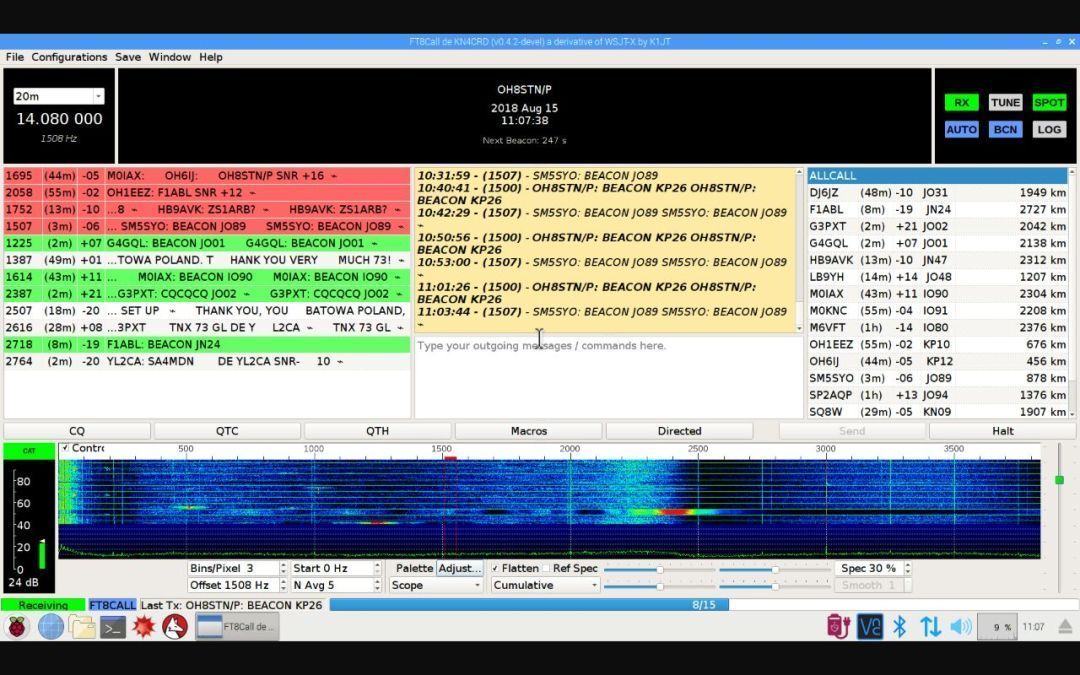
I’ve blogged about FT8 several times now, and while I found it to be an interesting mode, I kind of lost interest in it. I haven’t made an FT8 QSO in at least a month. Now, however, there’s a mode—called FT8Call— that has the weak-signal characteristics of FT8, but still lets you send more than just a grid square and a signal report.

Screenshot of the FT8Call program. One thing I like about this program is that it’s all in one window. Click for a larger image.

According to the FT8Call website:

The idea with FT8Call is to take the robustness of FT8 mode and layer on a messaging and network protocol for weak signal communication on HF with a keyboard-to-keyboard interface. FT8Call is heavily inspired by WSJT-X, Fldigi, and FSQCall and would not exist without the hard work and dedication of the many developers in the amateur radio community.

I decided to give it a go this morning.

Downloading the program was easy enough, but you have to download it from the files section of the FT8Call groups.io group. And, to do that, you have to join the group. The website says that the downloads will eventually be available from the website, though.

Installation and configuration was pretty smooth, too. I used the same parameters that I used for the FT8 program and it was talking to the radio in no time. As with the FT8 program, time syncing is very important, so make sure that your computer is time-synced properly.

Actually making contacts is a bit different than using FT8. For one thing, contacts aren’t automated. Because you can actually share information over FT8Call, you actually have to read what the other op sends you and compose a reply.

Another difference is that a message often uses more than one fifteen-second time slot. I didn’t really get this right away, and unfortunately, goofed up my first contact. The Send button will tell you how many time slots are needed to send your message, and give you an indication of which time slot is currently being transmitted.

There are lots of things that I still need to explore. For example, there’s a whole menu of  “directed” message that you use like macros when talking to another station. There are also user-defined macros.

There are also AUTO functions, which the program has borrowed from FSQCall. This feature allows users to send commands to other stations, such as asking for a signal report from a station that has also enabled the AUTO function. For example, to get a signal report from W1ABC, I’d send:

KB6NU: W1ABC?

and if W1ABC has enabled the AUTO feature, it would send back the signal report

W1ABD: KB6NU SNR +04

Cool, eh?

All of this is still in the beta stage, but I really like what’s been done so far and can’t wait to see what they come up with in the future. I think this is the start of something big. Kudos to Jordan, KN4CRD, and the rest of the developers.

Filed Under: Digital Modes Tagged With: FT8, FT8Call

Operating Notes: The AAs have it, FT8 notes, LOTW update

July 22, 2018 By Dan KB6NU 3 Comments

On Friday night, I worked AA9AA (palindromic callsign). Then on Saturday, my first two contacts were with AA1LL and AA0RQ (almost AA0RR). So, I guess the AAs have it!

FT8 notes

I think I’m finally getting the hang of working FT8. I’ve certainly been more successful with it lately.One thing I’ve started doing is to close all windows on the computer except for the WSJT program. The theory is that the computer needs all the resources it can muster when decoding FT8 signals.

It’s also a good idea to try to find stations that are in the clear. That is to say, stations that aren’t right up against other stations. I don’t know what your experience has been, but what I’m seeing is that if the signals overlap on the waterfall, WSJT seems to have trouble decoding them.

Another thing I need to remember to do is to turn off RIT. I use RIT all the time when operating CW, but it probably should be off when operating FT8.

Morning operation is different from evening operation. I got on 30m FT8 this morning. This is the first time I’ve tried it in the morning. Since the band wasn’t open yet for DX, there were a lot fewer stations, meaning that they were farther apart. I didn’t work any DX, but made more solid contacts.

My LOTW update

After uploading my log to Logbook of the World this morning, I decided to check my DXCC totals. I’m now up to 159 entities, both mixed and CW.  I don’t remember the last time I blogged about this, but I certainly wasn’t up to 159 then. Somehow, in the meantime, I managed to snag a couple more. What a great DXer I am, eh?

Filed Under: Awards, Digital Modes, DX Tagged With: FT8, lotw

FT8: New stats, new operating guide

January 31, 2018 By Dan KB6NU 5 Comments

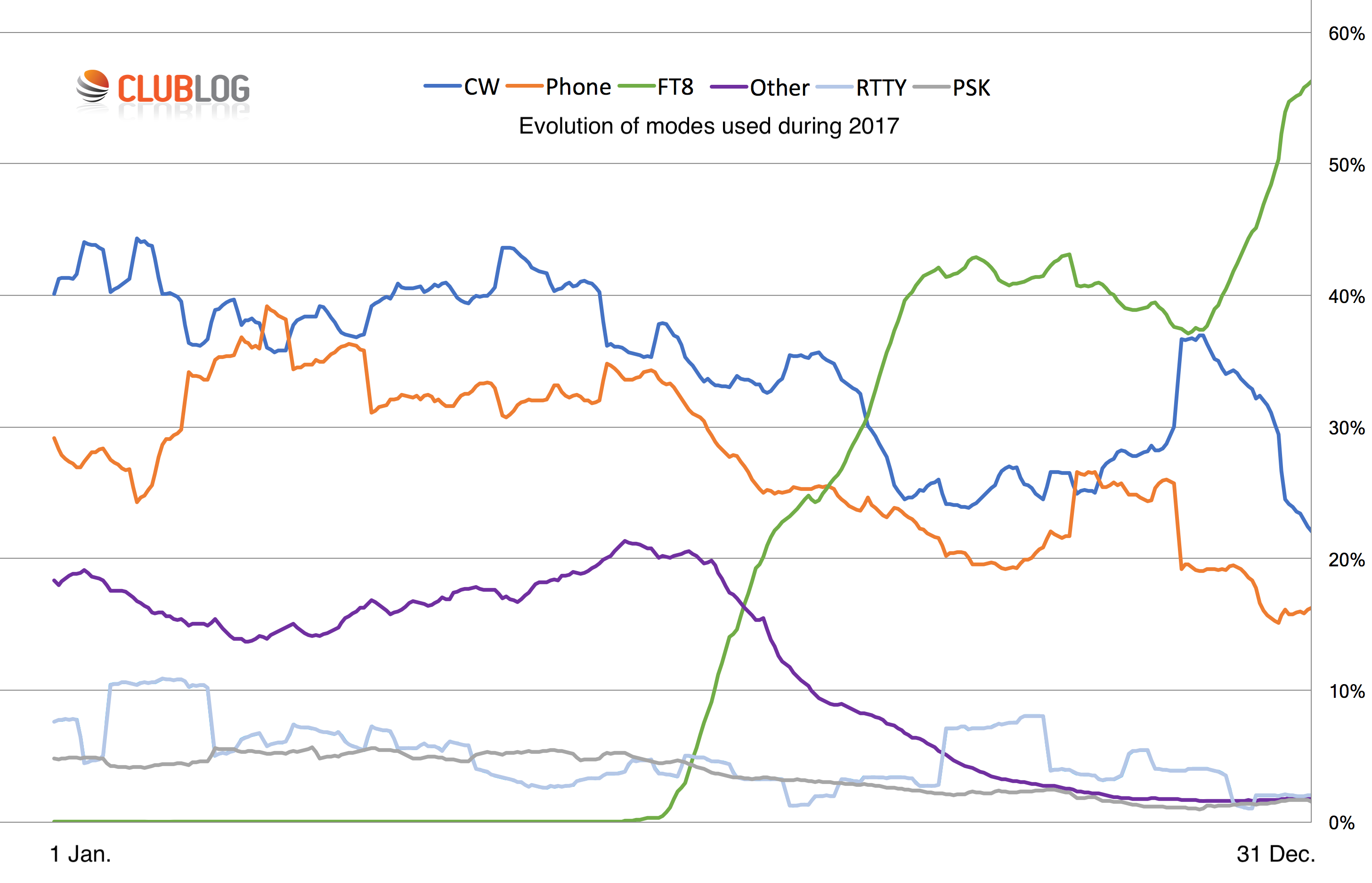
A couple of weeks ago, Michael, G7VJR, of ClubLog published an analysis of the contacts that were uploaded to ClubLog in 2017. These are summarized in the chart below:

Club Log graph showing modes used by radio amateurs in 2017, and the emergence of the FT8 digital mode

This is really fascinating information. As you can see, at the end of the year, more than 50% of the contacts uploaded to ClubLog were FT8 contacts.

As some of the commenters point out, there probably is some bias in the data. FT8 operators are more likely to update their contacts than are CW ragchewers, but even so, the trend—at least in the short term—is obvious.

It will be interesting to see if this FT8 activity can be maintained, or whether operators will tire of it after a while. What happens when every FT8 operator achieves DXCC?

New operating guide

To help us all convert over to FT8, Gary, ZL2IFB, has just published his FT8 operating guide. I haven’t read it all the way through yet, but I do like this sidebar:

Some of these tips (such as split operating, tail-ending and using low power) are contentious and not universally adopted by FT8 users–and that’s fine. To an extent, we are figuring this stuff out for ourselves as we go along, which for me is all part of the fun. These tips work for me. Your situation and preferences may differ. By all means try out different approaches … and do let me know if they work better.

I really do need to read this. As I’ve written before, my initial attempts at FT8 were mediocre at best. Perhaps this will help me be more successful at FT8.

If you do download and read this guide, don’t skip the appendixes. Appendix A and B dig into some of FT8’s technical details. Appendix D discusses some of the pros and cons of the mode.

Filed Under: Digital Modes, Operating Tagged With: FT8

Primary Sidebar

No Nonsense Technician Class License Study Guide (for tests given between July 2026 and June 2030)

New No Nonsense Technican Class Study Guide now available!

The 2026 version of my Tech Class study guide is now available, and as always, the PDF version is FREE!. The ePub version costs $11.97, and a Kindle version and paperback version will be available on Amazon shortly.

Click here to get all of my "No Nonsense" study guides.

Also available: The CW Geek's Guide to Having Fun with Morse Code

W5SWL.Com
Retevis Ailunce H1 DMR Radio
DXpander: Cobweb antennas, Laser Cutting

You’ve got mail!

Enter your email address below and get an email every time I publish a new post.

Email


I frequently teach classes to help newcomers get their licenses. The next class will take place on Saturday, February 7, 2026 on the University of Michigan campus. Click here for more information.

If you can't make the class, subscribe to the mailing list to be notified of when the next class will be held.

You can always download my free study guide, and if you have any questions about the classes, or amateur radio in general, please feel free to email me directly.

Support KB6NU.Com

Donate $7.30 and get two of these cool stickers. Measuring 4.25-in. W by 2.75-in. H, it's perfect for your car, your shack, or wherever!

Contact me

If you have a question or comment about one of my blog posts, or a question about any of the material in my study guides, or just a question about ham radio in general, you can email me at [email protected].

Blogs You Should Also Read

  • AE5X: A CW-centric blog from Kingswood, Texas
  • K0LWC Blog
  • LA3ZA Ham Radio Blog
  • Little Radios, Big Fun – WB3GCK
  • Mr. Vacuum Tube's Blog
  • Radio Artisan – K3NG
  • The K0NR Weblog
  • VE3WDM's QRP Ham Radio Blog
  • W2LJ’s Blog

Ham Radio Websites

  • Dashtoons – The Hammin' Comedy by Jeff K1NSS

Podcasts

  • ICQ Podcast
  • Linux in the Ham Schack
  • No Nonsense Amateur Radio Podcast
  • Resonant Frequency Amateur Radio Podcast

Recent Comments

  • Dan KB6NU on Finally, a Loop for 10m.
  • Dan KB6NU on 1930s cards for my collection of QSLs from stations whose callsigns spell words
  • Sean on Finally, a Loop for 10m.
  • Bill Waslo on 1930s cards for my collection of QSLs from stations whose callsigns spell words
  • C M Wetzel KD8TNF on The Wesco BN-1

Meta

  • Log in
  • Entries feed
  • Comments feed
  • WordPress.org

Footer

Copyright © 2026 Daniel M. Romanchik, KB6NU · Log in