
• Skip to primary navigation
  • Skip to main content
  • Skip to primary sidebar
  • Skip to footer

KB6NU's Ham Radio Blog

KB6NU's Ham Radio Blog
  • HOME
  • Study Guides
  • Teach a One-Day Tech Class
  • W8SRC Repeater Guide
  • Advertise
  • Hire Me

Converting the shack computer to Linux, Part 4: WSJT-X

November 6, 2025 By Dan KB6NU Leave a Comment

I’m not a big FT-8 user, but what shack computer would be complete without an installation of WSJT-X? So, last night I installed the program. After selecting the correct audio input, I was seeing and decoding FT-8 signals on 20 meters.
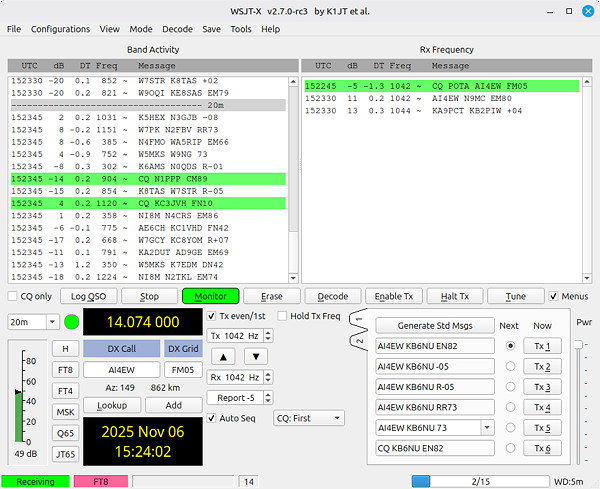
WSJT-X screen shot.
After selecting the appropriate audio input, I was receiving and decoding FT8 signals.

Even though I was receiving and decoding signals, I could see that the received audio level was a little low. A level of 30 dB is recommended (with the antenna disconnected), but mine was down near 18 dB. To get this up to 30 dB, you have to increase the USB AF/IF Output on the IC-7610,

To do this, you press the MENU button, then on the screen, press SET->Connectors->USB AF-IF Output Level->AF Output Level, then set the level. I set the level to 20%, and that did the trick.

Setting up for transmit

I tried selecting a station calling CQ and then replying to it, but I wasn’t getting any output. I found this YouTube video, “How to set up FT8 with WSJT X on the IC-7610 via USB,” which helped me get the application and the IC-7610 set up properly, but because the installation was on a Windows box, it didn’t really give me all the info that I needed.

In particular, I found that I had to set the USB MODLevel to a much different value than shown in the video. To set this level, you press the MENU button, then on the screen, press SET->Connectors->MOD Input->USB MOD Level, then set the level.

This level was set very low, so it’s no wonder that I wasn’t getting any power output.  I set this value to 15%, but noticed that I was getting some ALC. I reduced the value to 10%, and voila, I was transmitting. I made my first contact with KQ4VOB shortly afterwards. As I’m sitting here in the shack, I just made a contact with N3FAR, hopefully another QSL for my collection of QSLs from stations whose callsigns spell words.

Even though I’m making contacts, I’m still not quite sure that I have the otuput levels set quite right. I’m going to have to consult with some of the folks in our club who are more experienced FT8 operators.

I’m still want to work meteor scatter, too, and WSJT-X has a mode—MSK 144—for doing just that. The Leonid meteor shower has started already; it’s expected to peak November 16-17.  The Geminid meteor shower will peak in the middle of December. K5ND has a great page on how to work meteor scatter using WSJT-X.

Related posts:

  1. ARROW’s September Construction Project
  2. From my inbox: Morse Code, WWV, Raspberry Pi
  3. AE0S to establish amateur radio software award
  4. Videos I’ve been watching: HF propagation, how to use a NanoVNA, Hallicrafters’ world of SW radio

Filed Under: Computers, Software Tagged With: FT8, WSJT-X

Reader Interactions

Leave a Reply Cancel reply

Your email address will not be published. Required fields are marked *

This site uses Akismet to reduce spam. Learn how your comment data is processed.

Primary Sidebar

No Nonsense Technician Class License Study Guide (for tests given between July 2026 and June 2030)

New No Nonsense Technican Class Study Guide now available!

The 2026 version of my Tech Class study guide is now available, and as always, the PDF version is FREE!. The ePub version costs $9.97, and a Kindle version and paperback version will be available on Amazon shortly.

Click here to get all of my "No Nonsense" study guides.

Also available: The CW Geek's Guide to Having Fun with Morse Code

W5SWL.Com
Retevis Ailunce H1 DMR Radio
DXpander: Cobweb antennas, Laser Cutting

You’ve got mail!

Enter your email address below and get an email every time I publish a new post.

Email


I frequently teach classes to help newcomers get their licenses. The next class will take place on Saturday, February 7, 2026 on the University of Michigan campus. Click here for more information.

If you can't make the class, subscribe to the mailing list to be notified of when the next class will be held.

You can always download my free study guide, and if you have any questions about the classes, or amateur radio in general, please feel free to email me directly.

Support KB6NU.Com

Donate $7.30 and get two of these cool stickers. Measuring 4.25-in. W by 2.75-in. H, it's perfect for your car, your shack, or wherever!

Contact me

If you have a question or comment about one of my blog posts, or a question about any of the material in my study guides, or just a question about ham radio in general, you can email me at [email protected].

Blogs You Should Also Read

  • AE5X: A CW-centric blog from Kingswood, Texas
  • K0LWC Blog
  • LA3ZA Ham Radio Blog
  • Little Radios, Big Fun – WB3GCK
  • Mr. Vacuum Tube's Blog
  • Radio Artisan – K3NG
  • The K0NR Weblog
  • VE3WDM's QRP Ham Radio Blog
  • W2LJ’s Blog

Ham Radio Websites

  • Dashtoons – The Hammin' Comedy by Jeff K1NSS

Podcasts

  • ICQ Podcast
  • Linux in the Ham Schack
  • No Nonsense Amateur Radio Podcast
  • Resonant Frequency Amateur Radio Podcast

Recent Comments

  • Skip K4EAK on Button, button. Who’s got the button?
  • Ed K8MEJ on Is anyone running for the board this year in the Great Lakes Division?
  • Skip Behnke on 2020 Extra Class study guide: E9F – Transmission lines: characteristics of open and shorted feed lines; coax versus open-wire; velocity factor; electrical length; coaxial cable dielectrics
  • Mike on Map your contest QSOs
  • Phillip Cardwell on J-Poles

Meta

  • Log in
  • Entries feed
  • Comments feed
  • WordPress.org

Footer

Copyright © 2026 Daniel M. Romanchik, KB6NU · Log in