• Skip to primary navigation
  • Skip to main content
  • Skip to primary sidebar
  • Skip to footer

KB6NU's Ham Radio Blog

KB6NU's Ham Radio Blog
  • HOME
  • Study Guides
  • Teach a One-Day Tech Class
  • W8SRC Repeater Guide
  • Advertise
  • Hire Me

QRP

Operating Notes: QRP signals, using the BK prosign, QSY protocol

January 21, 2026 By Dan KB6NU 5 Comments

Does it seem to you that low power (QRP) signals are more affected by fading (QSB) than higher power signals? It does to me. If any of you know what mechanism is producing this effect, please let me know.

Speaking of QRP signals, I suggest that stations running QRP should follow the 3 x 3 protocol when responding to a CQ. By 3 x 3, I mean sending the CQing station’s call sign three times, then the QRP station’s call sign three times.

Several times lately, I’ve had a QRP station call me with only their call sign and only send it once or twice. The last time this happened, conditions were marginal, and I just wasn’t able to copy the other station’s call correctly. In addition to that, I’m never 100% sure that the station calling is calling me.

So, if you’re replying to my CQ, please send your call three times, followed by “DE” then your call three times. It doesn’t take that much extra time to send, and I’ll be sure that you’re calling me as well as copy your call sign properly.

QSY protocol

A couple of nights ago, I was working a station on 7028 kHz. He wasn’t very strong  and when another station popped up on frequency, I couldn’t copy him at all. I tried calling him 1 kHz up, but he didn’t follow me there.

With this in mind, I’d like to suggest the following protocol for dealing with this situation. First, tune up 1 kHz, and if the frequency is free, call the other station a couple of times. If no reply, listen 2 kHz down (1 kHz down from the original frequency), and if the frequency is free, call the other station a couple of times.

Having an agreed-upon protocol like this  might help stations reconnect when their QSO is interrupted by interference.

Using the BK prosign

I’ve noticed more stations using the BK prosign to denote that they’ve finished a transmission and to invite the other station to transmit. They’re using this instead of the more traditional “<your call> DE <my call> K,” or more simply “DE <my call> K”. I think that perhaps this is catching on because this is the accepted method for POTA contacts.

I think this is an entirely appropriate thing to do. The BK prosign is well understood, and the rules say that you only have to identify every ten minutes, so you’re not breaking the rules if you operate this way. And, in a ragchew, it might even be a more natural way for a conversation to flow.

I haven’t started doing this during all of my contacts, but I’m starting to do this more and more. If sending BK seems natural during a contact, I’ll just send it and let the other station take over. If it seems like it might be too abrupt, I might send “BTU BK” instead.
Filed Under: CW, QRP

ICQ Podcast Episode 422 – GB0ROC Bunkers on the Air Station

February 8, 2024 By Dan KB6NU Leave a Comment

In this episode, I  join Martin Butler M1MRB, Caryn Eve Murray KD2GUT, and Edmund Spicer M0MNG to discuss the following:

  • Young DXPeditioners Prep for Guyana

  • Some ARRL Reversals and Deferred Decisions

  • Ham Club Provides Mobile-Radio Donation to Humanitarian Effort

  • QRP Self-Spotting Website

  • Hams get Credit for Advancing the Information Age

  • HAMSCI Workshop to Review Annular Eclipse Findings

  • “Underground Radio” has a Different Meaning Inside a Bunker

This episode’s feature is GB0ROC Bunkers on the Air Station.

Filed Under: ARRL, Clubs, DX, History, ICQ Podcast, QRP Tagged With: HamSci

100, 50, and 25 Years Ago in QST

December 19, 2023 By Dan KB6NU 1 Comment

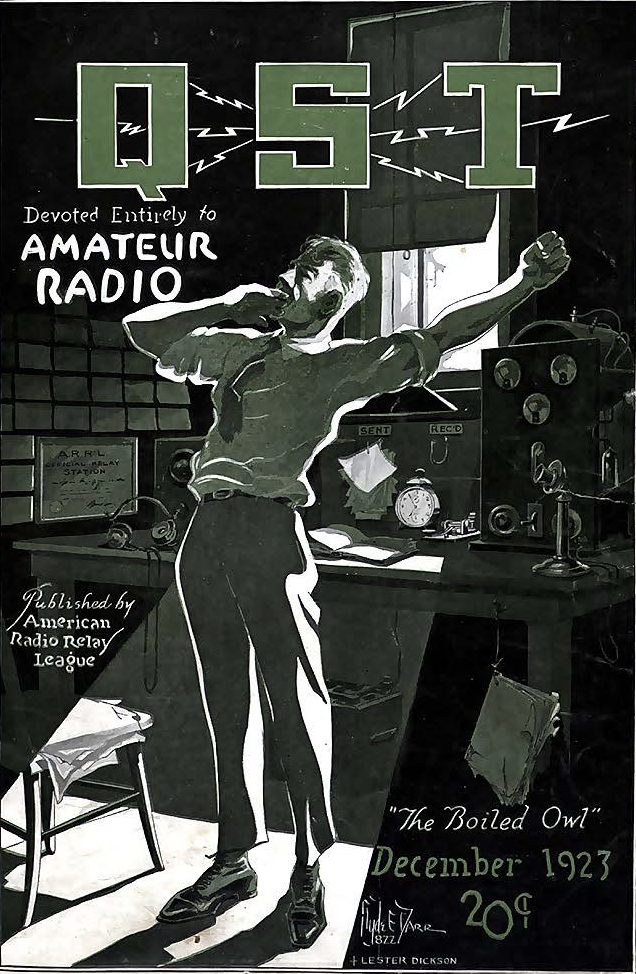
Here are some interesting articles from QST in December 1923, 1973, and 1998.

December 1923 QST

Shortwave Tuner Design by K.E. Hassel, 9ZN

Most, if not all new designs, are now software-defined, digital radios, but if you ever decide to build your own receiver, this might be a good article to consult. 9ZN gives a lot of good advice on how to make good coils and variable capacitors. This article caught my eye because of the call 9ZN because Bill Crane, W9ZN, a fellow who was a great CW operator, recently became an SK.

A High-Performance 20-, 40-, and 80-Meter Vertical System by J. Sevick, W2FMI

Jerry Sevick, W2FMI, wrote many articles and books about short vertical antennas. Here, he describes his design for a three-band antenna system consisting of one vertical for 80 meters and one for 20 meters/40 meters. He notes that they could be built separately. This article is worthwhile reading if you’re considering how to work more DX, especially on 80 meters.

Low Power, Crummy Antenna by Rob Henderson, KB7PWJ

Rob writes, “Ingenuity compensated for a limited budget in the Golden Age of Radio, and it’ll do the same today. The tools and techniques to make radio magic are everywhere. If your wallet is a bit thin, it’s time to indulge your creativity. According to Rob’s QRZ.Com page, he’s still using crummy antennas 25 years later.

Filed Under: Antennas, Building/Homebrew, Circuit Design, QRP, Receivers Tagged With: 9ZN, KB7PWJ, W2FMI

GQRP Club celebrates International QRP Day, June 17

June 14, 2023 By Dan KB6NU Leave a Comment

The UK’s GQRP Club invites all the QRP enthusiasts to a line-up of QRP activities, to salute the arrival of the new season. Details below. There will be plenty of puny signals out there, starting this weekend, so switch your rig on, get on the bands, fly the QRP flag, and have fun.

  • 17th June. International QRP Day. Almost two dozens Club members will activate the Club callsign G5LOW (England), together with its regional locators GM5LOW (Scotland), GW5LOW (Wales), Gi5LOW (Northern Ireland), GD5LOW (Isle of Man), and GU5LOW (Guernsey). All bands, from HF to UHF, and all modes (CW, SSB, AM, FM, and several digimodes), throughout the day. Just look out for the “LOWs”.
  • 17th June. The Club also runs the Suffolk Trophy, an activity reserved to members, with operation for six hours only in no more that two periods. Contacts are with any Region 1 country; normal QSO, no serial numbers. Each Region 1 country counts 1 point on each band. The total score is total of IARU countries on the bands used. Only one  contact per country per band is allowed irrespective of mode. The other station may be QRO. Please log Name, address, call, power used, equipment, time, call & band for each contact.
  • June 17th to June 25th. It’s time for the Summer Sizzler, a relaxed get-on-air QRP event, an ideal opportunity to meet and greet new and old friends, to test our latest homebrew creations, and to fill the bands with friendly QRP activity. Several certificates are awarded for contacts made using only homebrew equipment (Busy-Bee), only QRPp power levels (Tiny-Flea), only vintage rigs (Old Beetle), and while operating /P or /M (Iron-Knee). The special Ladybird certificate is awarded to the best log submitted by a member who has been licensed for less than three years.

The best overall log will be awarded the First GM3OXX Memorial Trophy.


Personally, I love the special event call signs, and I hope to get one or more in my log……Dan

Filed Under: QRP Tagged With: gqrp

ICQ Podcast Episode 403 – ARRL dues increase, RF exposure rules, QRP, KISS technology

May 28, 2023 By Dan KB6NU Leave a Comment

In this episode, I join Martin Butler M1MRB, Caryn Eve Murray KD2GUT, Edmund Spicer M0MNG and Ed Durrant DD5LP to discuss:

  • Congresswoman Lesko Reintroduces Bill to Replace Symbol Rate Limit with Bandwidth Limit

  • Get Ready for Another ARRL Dues Increase

  • Indian Amateurs Reunite Family after nearly 10 years

  • ARRL Offers Assistance to Hams for RF Compliance

  • RSGB supports International Women in Engineering Day

  • Celebrating the Power of QRP

This episode is kind of long, but we had quite spirited discussions about the ARRL dues increase, the RF exposure rules, and the symbol rate legislation.

This episode’s feature is KISS Technology.

Filed Under: ARRL, QRP, Rules, Regulations, Enforcement

Operating Notes: 30m DX, 1000 miles per watt

April 3, 2023 By Dan KB6NU 4 Comments

30 meters was hopping the night of March 27. I worked two all-time new ones (ATNOs): 9X5RU (Rwanda) and EY8MM. 9x5RU had a strong signal into Michigan and had decent pileup going. I set up the dual receive bandscope on my IC-7610 and was able to quickly find the frequency of a station he had just contacted and quickly tuned there. It only took me three calls before they heard me.

Just a little later, I heard EY8MM calling CQ just slightly up the band. I was surprised that he hadn’t created a pileup at all. I worked him on my first call.

I have both now confirmed via Logbook of the World, bringing my total to 169 countries.

All you need is….QRP

Another measure of how good the bands are are the number of QRP stations that I’ve been working lately. One such station is W3FSA in Maine. John was running about 5 W with a (tr)uSDX that he’d recently built. We had a very solid, 20-minute contact, with his signal averaging about S7 the entire time.

He paid me a nice compliment, too. He said, “I know we’ve worked before, but I can’t remember your name. You’re the teacher, though, right?”

1000 miles per watt!

Last night was also a good night for QRP on 30 meters. Dave, KC9FLI answered my first CQ, and I gave  him a 579 report. It turns out that he was running only 1 W with a Penntek TR-35.

He was so strong, that it occurred to me that he could probably qualify for  1000 mile per watt award. QRZ.Com said that he was 293.5 miles away from me, so I reckoned that if he could reduce power to 1/4 W, that should do it.

I suggested this to him, and he agreed to give it a try. He first reduced power to 500 mW. At that level, he was between S5 and S6. Next, he reduced power to 250 mW and he was still solid copy here in Ann Arbor, MI. How cool is that?

I then did a little searching for 1000 miles/watt awards and found two of them:

  1. North American QRP CW Club (NAQCC). The NAQCC 1000 Mile per Watt Award is free, but the rules state, “The power used to initiate a QSO is the power that counts is especially true for this award. You can’t start a QSO then keep lowering power to get a better MPW figure.” So, I guess our QSO doesn’t strictly qualify.
  2. QRP-ARCI. The QRP-ARCI 1000 Miles per Watt Award doesn’t appear to have that restriction, but they charge $10 for their certificate.

Even if he doesn’t get a certificate, Dave will have the satisfaction of knowing that he completed a 1000 mile per watt QSO.

Filed Under: DX, Operating, QRP Tagged With: 9X5RU, EY8MM, Rwanda, Tajikistan

Balun or no balun?

March 5, 2023 By Dan KB6NU 5 Comments

On the Elecraft-KX mailing list, an item popped up on a topic that I’ve been pondering for a while. Titled Balun necessary? Barry N1EU asked the question:

I’m planning some 40M-15M portable operation with a 44ft doublet fed with 25ft of twinlead into the KX2 ATU.  Is it, or is it not, necessary to use a balun between twinlead and KX2 antenna terminals for this application?

I’ve been pondering this very question myself, as my go-to antenna for portable operation with my KX-3 is a 66-ft. doublet fed with twisted pair. I’ve just been connecting the twin-led feed line directly to the radio with a BNC-binding post adapter, but it occurred to me last summer that I should perhaps be connecting the unbalanced output of the KX-3 to the balanced feed line. The antenna seems to work just fine without the balun, but I wonder in the antenna system would be more efficient with one. At 10 – 15 W out, you want your antenna system to be as efficient as possible.

As you might expect, this question generated a lot of replies. Many of the replies simply said, “A balun is preferred,” without really giving a reason for this. Many write that using a 1:1 balun or current choke would prevent common-mode currents on the feedline. The purpose of this being to reduce the chance of the feedline radiating and causing RFI or to reduce noise pickup.

I jumped into the conversation when it was well underway  and mentioned that I have been using a doublet with twisted-pair feed line. That prompted a private reply from Barry, and we struck  up a conversation on the relative merits of twisted-pair feedline vs. 300 Ω twinlead and whether or not to use a balun. In one of the emails, he wrote:

FYI Dan, did a little experiment. I set up a 44ft doublet on a summit yesterday and ran some 1 watt WSPR transmissions on 40, 20, and 15m using first a 300-ohm twinlead feedline and then a twisted pair feedline (PTFE insulated, harvested from surplus CAT5e cable). I’ve always been intrigued by the super lightweight twisted pair and several years ago used it once with very good results (high score in 2014 QRPTTF/SOTA event). But I always wondered about the loss involved, especially with the high SWR encountered in a non-resonant antenna.

I lacked sufficient time on the summit to be very thorough and methodical but I believe the data is valid. 30-45 minutes separated the transmissions for the different feedlines.

  • 40m – 24 reports for both – twisted pair averaged -3.75dB down from twinlead
  • 20m – 27 reports for both – twisted pair averaged -1.56dB down from twinlead
  • 15m – 13 reports for both – twisted pair averaged -4.15dB down from twinlead

Perhaps one day I’ll do a more thorough and methodical test but I think these results show that PTFE twisted pair is a viable balanced feedline and makes for an ultralight option for SOTA activation, although twinlead is preferred when weight is not an issue.

Other equipment used included an Elecraft KX2/ATU and Android phone running WSPR Beacon. The 300-ohm twinlead was connected using a homebrew dual FT140-43 core 4:1 Guanella current balun and the twisted pair was connected using a homebrew FT140-43 common mode choke (12 turns).

I should probably do some of my own testing. While scouring the shack for stuff to take to a hamfest a couple of weeks ago I ran across some quality 300 Ω twinlead, so I could make up a 66-ft. doublet with the twin lead feedline. I also have ferrite cores and try winding the twisted pair feedline around it to see if that makes any difference. Barry’s test show that the twin lead is more efficient, but twisted pair is easier to handle and does wind up into a smaller and lighter package for transporting to and from a POTA or SOTA site.

It would be interesting to do some testing with the 44-ft. doublet. In general, of course, the more wire in the air the better, but less wire again makes it more manageable. I’m going to have to download WSPR Beacon to my Android phone, too. In any event, it looks like I’ll have a lot of fun stuff to play with this summer when I can get out and do some activations.

Filed Under: Antennas, Operating, QRP Tagged With: baluns, twinlead, twisted pair

Operating notes: a compendium of recent interesting contacts

December 30, 2021 By Dan KB6NU 5 Comments

A couple of evenings ago, I had a couple of interesting contacts with stations running QRP. That wasn’t the most interesting thing about the contacts, though.

The contact with Kyle, KN6KJK, was remarkable for a couple of reasons:

  1. He was a Tech operating CW on 40m.
  2. He used my study guide to prepare for his Tech exam (and he thanked me for that.)
  3. KJK are actually his initials, and he was randomly assigned that callsign from the call sign pool.

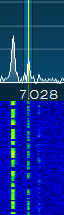
My next contact was with Jerry, KI4PS. He was operating an FT-818 at 5 W. The reason that this contact was interesting is that Jerry cut the contact short, complaining about QRM. There was indeed a signal operating very close to our frequency (see screenshot at left). I’m going to guess that that signal was about 250 Hz down from our frequency of 7028 kHz.

I didn’t hear that signal at all. I had my Flex 6400 filter set to 250 Hz, meaning that the QRM was outside of the passband. That’s a real tribute to the Flex filtering algorithms.

Finally, I worked a guy a couple of days after Christmas who has the following on his QRZ.Com page:

Don’t get the chinese virus vaccine it may contain ID2020 chip as immunity passport. It is part of the mark of the beast!

Seriously??

I had hoped that ham radio operators had more sense, but I guess not. My take on it is that even if there was an ID2020 chip, it wouldn’t be available due to the chip shortage.

Filed Under: Operating, QRP

Interesting stuff I found in my inbox

December 30, 2020 By Dan KB6NU Leave a Comment

I’m on a lot of ham radio mailing lists, and people are constantly sending me interesting things to read and to watch. Here are some of the coolest from the past couple of weeks…..Dan

Smallest transceiver ever?

This is very cool. Adam, K6ARK, has designed a surface-mount version of the Pixie transceiver. (There are many different designs, but to get an idea of what a Pixie is, here’s a circuit description of a more recent design.) What’s really amazing about this video is the number of contacts that Adam makes with this little radio out in the boonies. I mean we’re talking less than a watt output and a receiver that’s as wide as a barn door. Very impressive.

Beginner’s Guide to the NanoVNA

The Absolute Beginner’s Guide to the NanoVNA by Martin Svaco, 9A2JK is a wonderful introduction to this cool, little instrument. It not only includes instructions on how to use a NanoVNA, there is a short history of the instrument and the different version out there as well as a brief theory of operation. If you have a NanoVNA, you should get this guide.

Easy ISS SSTV Reception

I know that this is a little late for this series of ISS SSTV transmissions, but I’m sure that they’ll do it again sooner or later.

Filed Under: Gear/Gadgets, QRP, Test Equipment Tagged With: ISS, nanoVNA, Pixie

GQRP Club releases agenda for its 2020 Online Convention

August 11, 2020 By Dan KB6NU Leave a Comment

The GQRP Club, the British QRP club, has released a detailed agenda for its 2020  Online Convention, taking place on Saturday 5th and Sunday 6th September.

The online event, which replaces the club’s annual GQRP convention at Telford due to current Covid-19 restrictions, is open to existing members. There is a special rate for non-members which will include GQRP Club membership until January 2022.

The two-day event comprises a series of online presentations and knowledge-sharing meetings where people can share ideas.

The packed presentation list includes:

  • “Building QRP transceivers” with Hans Summers G0UPL, designer and manufacturer of the QCX QRP transceiver.
  • “HF propagation and QRP” with Steve Nichols G0KYA, author and chairman of the RSGB’s Propagation Studies Committee
  • “Homebrew SSB Transceivers” with Pete Juliano N6QW, co-presenter of the Soldersmoke podcast and a prolific home brewer.
  • “Vector Network analysers explained and the NanoVNA” with Alan Wolke W2AEW, a professional electrical engineer who works for Tektronix.
  • “Antennas for QRP” with Callum McCormick M0MCX, YouTube star and inventor and manufacturer of the DX Commander vertical antenna.
  • “FT8/FT4 for the QRPer” with Anthony Luscre K8ZT, who will take a detailed look at this the fastest-growing mode in amateur radio.

There will also be range of knowledge-sharing sessions, including “Using Antenna analysers” with Heather M0HMO, “Running a QRP DxPedition” with Dom M1KTA, “Battery technology for QRP portable” with Bill G4ERV, “Omni Directional antennas” with John G8SEQ and many more.

The event costs £4 for GQRP club members. Non-members can also sign up for the event and join the GQRP club for just £10 (or £17 for international participants).

To sign up for the event just go to the Eventbrite sign-up page at: https://www.eventbrite.co.uk/e/gqrp-club-2020-online-convention-tickets-115417887007

For more information and to view the full event schedule see http://www.gqrp.com/convention.htm

Filed Under: QRP Tagged With: gqrp

  • Page 1
  • Page 2
  • Page 3
  • Interim pages omitted …
  • Page 8
  • Go to Next Page »

Primary Sidebar

No Nonsense Extra Class License Study Guide: for tests given between July 2024 and June 2028

New No Nonsense Extra Class Study Guide now available!

The 2024 version of my Extra Class study guide is available in PDF, ePub, Kindle, and print versions.

Click here to get all of my "No Nonsense" study guides.

Also available: The CW Geek's Guide to Having Fun with Morse Code

W5SWL.Com
Retevis Ailunce H1 DMR Radio
DXpander: Cobweb antennas, Laser Cutting

You’ve got mail!

Enter your email address below and get an email every time I publish a new post.

Email


I frequently teach classes to help newcomers get their licenses. The next class will take place on Saturday, February 7, 2026 on the University of Michigan campus. Click here for more information.

If you can't make the class, subscribe to the mailing list to be notified of when the next class will be held.

You can always download my free study guide, and if you have any questions about the classes, or amateur radio in general, please feel free to email me directly.

Support KB6NU.Com

Donate $7.30 and get two of these cool stickers. Measuring 4.25-in. W by 2.75-in. H, it's perfect for your car, your shack, or wherever!

Contact me

If you have a question or comment about one of my blog posts, or a question about any of the material in my study guides, or just a question about ham radio in general, you can email me at [email protected].

Blogs You Should Also Read

  • AE5X: A CW-centric blog from Kingswood, Texas
  • K0LWC Blog
  • LA3ZA Ham Radio Blog
  • Little Radios, Big Fun – WB3GCK
  • Mr. Vacuum Tube's Blog
  • Radio Artisan – K3NG
  • The K0NR Weblog
  • VE3WDM's QRP Ham Radio Blog
  • W2LJ’s Blog

Ham Radio Websites

  • Dashtoons – The Hammin' Comedy by Jeff K1NSS

Podcasts

  • ICQ Podcast
  • Linux in the Ham Schack
  • No Nonsense Amateur Radio Podcast
  • Resonant Frequency Amateur Radio Podcast

Recent Comments

  • Mike on Map your contest QSOs
  • Phillip Cardwell on J-Poles
  • Dan KB6NU on Dayton Hamvention 2026: Day 1, Wednesday, May 13
  • Randy Shake on Dayton Hamvention 2026: Day 1, Wednesday, May 13
  • John Hislop on New edition of my No Nonsense Technician Class License Study Guide now ready for review

Meta

  • Log in
  • Entries feed
  • Comments feed
  • WordPress.org

Footer

Copyright © 2026 Daniel M. Romanchik, KB6NU · Log in