• Skip to primary navigation
  • Skip to main content
  • Skip to primary sidebar
  • Skip to footer

KB6NU's Ham Radio Blog

KB6NU's Ham Radio Blog
  • HOME
  • Study Guides
  • Teach a One-Day Tech Class
  • W8SRC Repeater Guide
  • Advertise
  • Hire Me

Gear/Gadgets

A blast from the past: the Icom TriBand Delta 1A.

September 16, 2023 By Dan KB6NU 2 Comments

So, I’ve recently been going through some old magazines and cam across this advertisement. I forget what issue it came from, but RigPix says that it was manufactured in the early 1990s. Aside from being a bit chunky—and probably pretty expensive—this looks like it could have been a great radio. And, just the thing to encourage more activity on 1.2 GHz.

Anyone remember this radio? How much did it cost? Did it work well?
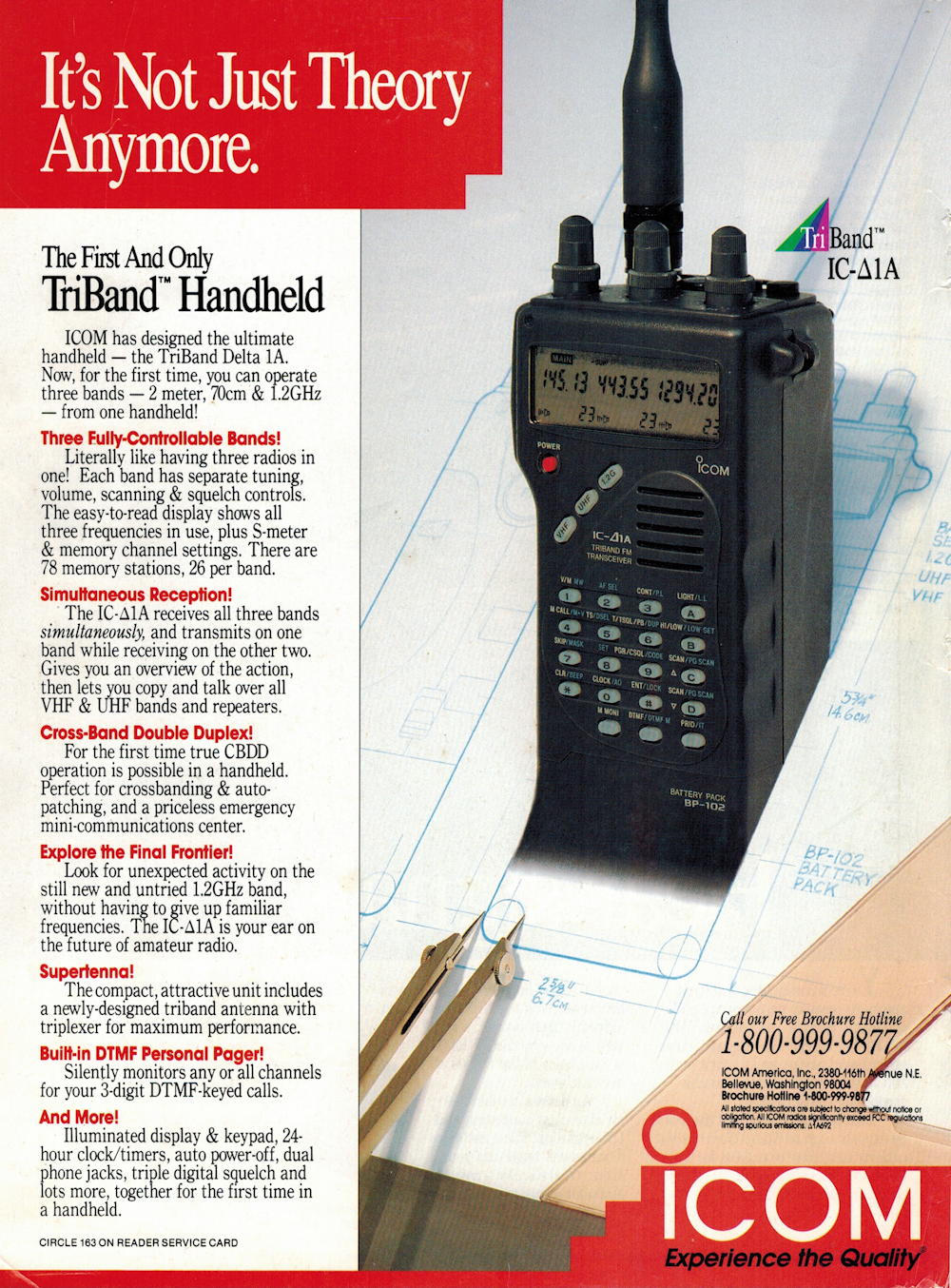
Click to see larger image.

Filed Under: Gear/Gadgets, VHF/FM/Repeaters Tagged With: 1.2 GHz, Icom

Amateur radio videos: A father and son get tickets, Slinky antenna, coiling cables

September 9, 2023 By Dan KB6NU 3 Comments

A software engineer and his father, a broadcast engineer, get their tickets and make their first contact. Thanks to Steve, N8GNJ, of Zero Retries for a pointer to this video.


When I first got back into ham radio, a friend of mine gave me a Slinky antenna. I used that antenna for quite a while, until it rusted….Dan


Learning how to coil cables properly can save you a lot of time when setting up a POTA or Field Day antenna.

Filed Under: Antennas, Classes/Testing/Licensing, Gear/Gadgets, Videos Tagged With: cables, Slinky antenna

From the trade magazines: Semiconductor workforce shortage, vector network analyzer intro, DC-DC converters

August 16, 2023 By Dan KB6NU Leave a Comment

U.S. Semiconductor Workforce Shortage Reaching Critical Stage

The U.S. is on the brink of a new semiconductor manufacturing boom, leaving companies in urgent need of technicians to staff their new fabs and engineers to design the chips that these facilities will churn out. And unless things change, there soon may not be enough skilled chip workers in the U.S. to go around.

A top trade group for the U.S. semiconductor industry issued a report claiming there will not be enough skilled engineers and other workers to support their expansion plans, leaving it 67,000 workers short by 2030.

The way the semiconductor industry is growing, it will need a U.S. workforce of about 460,000 by the end of the decade, up from about 345,000 this year, according to a new study released by the Semiconductor Industry Association (SIA) and Oxford Economics.

…read more

Wayne Green, W2NSD, publisher of 73 Magazine, always used to tout the opportunities that an amateur radio license afforded hams. I’m sure that he’d be writing about this topic if he were still with us and editorializing today…Dan


An Introduction to the VNA and Vector Network Analysis

Most design engineers are familiar with tools of the trade such as voltmeters, oscilloscopes, signal generators, and spectrum analyzers. Some may not have had the opportunity to use a vector network analyzer (VNA). It’s the intent of this article to introduce VNA measurement and present a few typical applications.

What you’ll learn:

  • What does a VNA measure?
  • What can one do with the measured data?
  • What devices are measured with a VNA?

…read more

Although written by a a company that makes engineering-grade VNAs, you might find this an interesting article to read if you just purchased a nanoVNA…Dan


DC-DC Converter Design Basics (Part 1): Buck Converters

DC-DC converters are widely used to efficiently produce a regulated voltage from a source that may or may not be well-controlled to a load that may or may not be constant. This article shows how DC-DC converters can be built using the Renesas SLG47105 GreenPAK programmable mixed-signal matrix.

DC-DC converters are high-frequency power-conversion circuits that use high-frequency switching and inductors, transformers, and capacitors to smooth out switching noise into regulated DC voltages. Closed feedback loops maintain constant voltage output even when changing input voltages and output currents. At 90% efficiency, they’re generally much more efficient and smaller than linear regulators. Their disadvantages are noise and complexity.

…read more


Filed Under: Antennas, Electronic Components, Electronics Theory, Test Equipment Tagged With: Jobs, VNA

An exhausting few days in Las Vegas

August 13, 2023 By Dan KB6NU 1 Comment

I just returned from Las Vegas yesterday, where I attended DEFCON and taught a one-day Tech class in the Ham Radio Village for the second year in a row. As it was last year, it was both exhilarating and exhausting. I arrived Wednesday afternoon, taught the class on Thursday, wandered about DEFCON on Friday, learned a few things, and left Saturday morning.

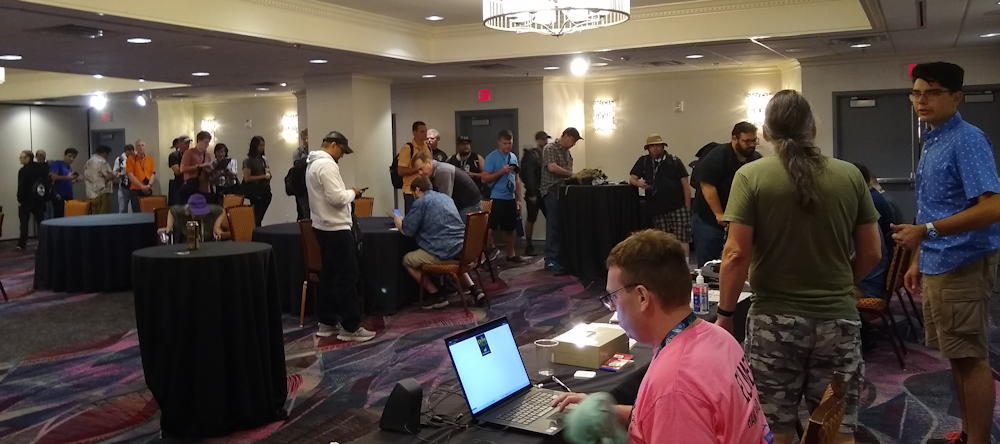
Students line up to register for the exam after my 2023 DEFCON one-day Tech class.

This year, there was another full house (pun intended) with 31 students in all. Unfortunately, only 24 passed the test. That’s a little lower than my usual pass rate, but come to find out that some of the students had never even looked at the study guide before the class. I know this because when I mentioned that I was following my study guide from front to back, several asked where they could get it.

I’m already thinking about next year. For example, I think with a little more publicity we could get 50 people to attend the class. Also, I probably should make up some slides to make up to show the students what resistors look like and what RF connectors look like. I usually have a goodie bag of components that I pass around for a local class, but it’s difficult to do that for a class somewhere other than Ann Arbor.

At lunch, an ICQPodcast listener joined me for lunch. That was nice. I told him that I was always surprised when people say they listen to us on the podcast. He replied that he was a relatively new ham, and that listening to the podcast helped him learn more about the community and become part of it. I hadn’t thought about that being one of our functions, but it’s something that I’m going to keep in mind on future episodes.

After the class, two study guide readers came up to me and thanked me for writing the study guides. One of them said that he used my study guides to pass all three tests. Now, he’s a VE with Ham Radio Village and giving back as well. How cool is that?

Hanging out at DEFCON

On Friday, I hung out at the conference and learned stuff. I learned a bit about quantum computing, how some people are using social media to chart the course of the war in Ukraine, and whether or not solid-state drives are actually more reliable than mechanical hard drives.

One of the other “villages” that I was really impressed with was the Hardware Hacking/Soldering Skills Village. They had at least a hundred people sitting at tables soldering and unsoldering things. Hamvention needs something like that.

While I’ll teach at DEFCON for as long as they’ll have me, I have never been a big fan of Las Vegas. I really have no desire at all to gamble anymore (I used to play a little blackjack), it’s incredibly hot in August (every day was over 100ºF), and the price for nearly everything is sky-high (I paid more than $20 for breakfast at a Dunkin Donuts!). Even so, it was packed to the gills. I was amazed that they get so many people there with such high temperatures and high prices.

Despite all that, DEFCON did get me pumped up about doing more hacking. For example, I’m going to look into purchasing a Xiegu X6100 and hacking on it. Apparently, the software runs on an internal Linux computer and can be user-modified. R1CBU has already hacked the X6100, adding features and improving the radio’s performance. I’m looking forward to learning more about this. I also have some other ideas, which I’ll be writing more about in the future.

UPDATE 8/15/23

I got this very nice email today:

Hi Dan,

Thank you for teaching your class @ DefCon! I was lucky enough to snag a spot at the very last minute; I got a lot out of the class but, since I had no prior knowledge of/experience with the subject and the exam was being offering for the duration of the con, I decided to hold off until I’d had a chance to review the material.

That said, I’m happy to share that I took & passed the exam on Sunday after re-reading your guide and taking a practice test.

So, thank you again for piquing my interest in ham radio & making it so accessible — I hadn’t expected to leave Las Vegas a licensed amateur radio technician!

I’ve since downloaded your “21 Things to do After” guide and look forward to getting started with my first radio.. : )

How cool is that? That bumps up my pass rate a little more  :)

Filed Under: Computers, Gear/Gadgets, Software-Defined Radio (SDR) Tagged With: DEFCON, hacking, Las Vegas

Amateur radio videos: Texas wants FCC to loosen rules on data rates, DIY USB-CIV cable, truth is stranger than fiction

July 30, 2023 By Dan KB6NU Leave a Comment

Texas wants FCC to loosen rules on data rates

I’m not sure who got the Texas Department of Public Safety to do this, but kudos to them.

DIY USB-to-CIV cable

I’m a big fan of building things like this yourself. Not only do you spend less money, you learn something in the process.

Truth is stranger than fiction

Watch and see what I mean.

Filed Under: Gear/Gadgets, Rules, Regulations, Enforcement, Videos Tagged With: CI-V, Icom, symbol rate, Texas

From my Mastodon feed: FutureSDR, ear training, WTF?

July 23, 2023 By Dan KB6NU 2 Comments

As Twitter descends into hellhole that Elon Musk is making it into, more hams are showing up on Mastodon, a “non-profit, abuse-free social network based on open web standards and principles.” I am @[email protected]. Mastodon.Radio is a space for the amateur (ham) radio community and anyone interested in shortwave listening (SWL). It’s run by Christopher, M0YNG. Thanks, Chris!

I’m finding it actually more interesting than Twitter for ham radio kinds of things. Here are three things that were in my feed yesterday.

FutureSDR WebAssembly SDR Live Coding

The author of FutureSDR, Bastian Bloessl, describes FutureSDR, as:

An experimental asynchronous SDR runtime for heterogeneous architectures that is:

  • Extensible: custom buffers (supporting accelerators like GPUs and FPGAs) and custom schedulers (optimized for your application).
  • Asynchronous: solving long-standing issues around IO, blocking, and timers.
  • Portable: Linux, Windows, Mac, WASM, Android, and prime support for embedded platforms through a REST API and web-based GUIs.
  • Fast: SDR go brrr!

Here, he does a little live coding that some of you might find interesting.


Open Ear

OpenEar is an open source ear training app for musicians that runs on Android phones and tablets. It includes exercises to help musicians master recognizing musical patterns. I’m wondering if it might also help those learning Morse Code. If you do download it and try it, let me know.


WTF?

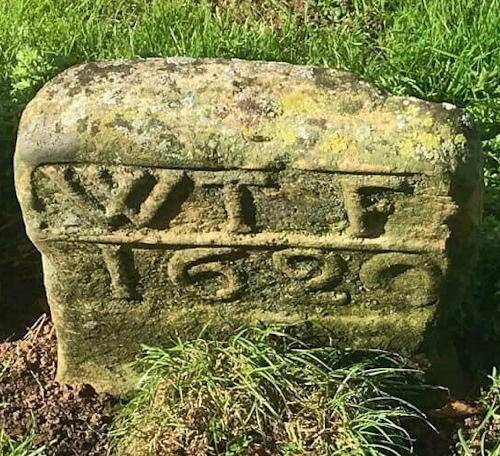
Flashdancer (@[email protected]) shared this photo, noting, “I’m assuming that 403 years ago this person died very unexpectedly.”

Filed Under: CW, Just for Fun, Software-Defined Radio (SDR) Tagged With: FutureSDR, Open Ear

100, 50, and 25 years ago in QST: Electric filters, SWR meter project, clubs

July 10, 2023 By Dan KB6NU 1 Comment

I love this feature in QST. Not only can you feel the history of amateur radio by reading these articles, many of them still impart useful technical information. Read on and you’ll see what I mean.

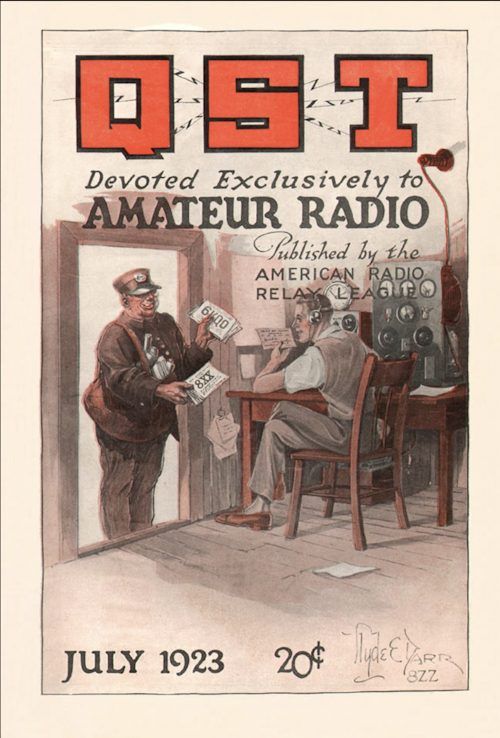
July 1923

The article that I chose from this issue is “Electric Filters” by F.S. Dellenbaugh, Jr. He writes, “Most thing in amateur radio have gotten beyond guesswork; reliable information is available. A glaring exception is the electric wave filter…” He then goes on to give a relatively rigorous explanation of LC filters in many different forms. This is all good stuff and still relevant today.

Also notable in this issue are the articles:

  • Why Inflict Keying Thumps on Your Neighbor? This is perhaps one of the first articles on RFI.
  • Bureau of Standards Explores Short-Wave Region. Early amateurs were relegated to wavelengths below 200 meters, which at that time were thought to be useless for wireless communications. It wasn’t long, however, before radio amateurs proved that to be incorrect.

July 1973

You might thing that the article, A Simple Computing SWR Meter, describes one of the first amateur radio applications of a microprocessor, but  you’d be wrong. Instead, the article gives plans for an SWR/power meter that uses op amps to perform analog computations. The beauty of this approach, according to the authors, is that the SWR reading are independent of the forward power.

July 1998

Two articles in this issue are aimed at helping clubs:

  • Where Radio is Fun. This article brings home the point that to be a successful club, members have to have fun. If your  club is failing, perhaps it’s because you’re not having enough fun.
  • Anatomy of a Special Event Station. I like special event stations, so I’m highlighting this article. The deck reads, “Is your club stuck in a rut? Looking for a project to pep things up? Putting a special event station on the air will definitely pick up the pace….” This article gives a bunch of good advice about running a special event station that’s as relevant today as it was 25 years ago. One such bit of advice is, “Design QSL cards and certificates early in the process—and determine how and when they’ll be printed.”


Filed Under: Clubs, Electronic components, EMI/RFI, Special Events, Test Equipment Tagged With: filters, SWR

Report sheds some light on Icom’s amateur radio strategy

June 21, 2023 By Dan KB6NU 6 Comments

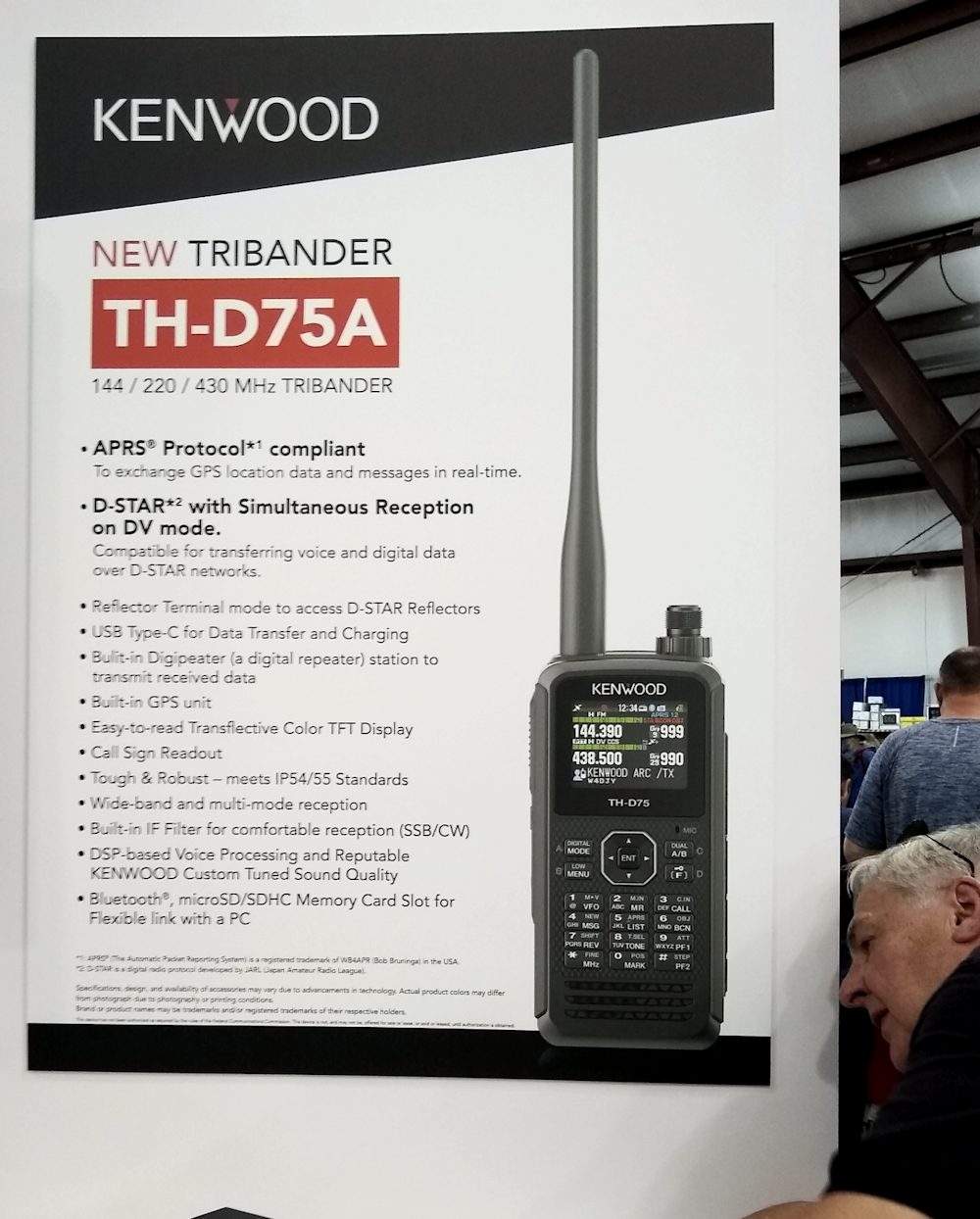
Many hams were disappointed that the big Kenwood announcement at Dayton was just another handheld.

A frequent topic of discussion in amateur radio circles is speculation about new products from major manufacturers. There was, for example, a lot of discussion before Dayton about a new product introduction by Kenwood. Many were hoping that they were going to introduce a new HF radio and were disappointed when the new product was just a new HT to replace the TH-D74 (see right).

Other manufacturers are equally opaque when it comes to their product plans. That just leads to a lot of guessing that rarely corresponds to reality.

Every once in a while, though, we get some tantalizing info out of manufacturers. I found an example of this in a recent post to the IC-7610 mailing list, “Interesting document on the Icom Japan website.” The topic points to a document, “Medium Term Business Plan 2026,” on the Icom Japan website. This report gives its fanboys (myself included) a little visibility into what’s going on at Icom.

The report paints a picture of what Icom’s business strategy will be over the next three years. I’ll let you read the report for yourself, but let me point you at some of the interesting tidbits I found. For example, the report notes that amateur radio products accounts for 17% of Icom’s sales. It’s not their biggest sector, but it’s not inconsequential, either.

Under the heading, “Improved Performance and Functions of Products with New Platforms and Technologies,” they make these three points about amateur radio:

  • Utilize technical know-how gained from digital technology and expand into other product categories
  • Further improved usability and intuitive operation, expansion of requested/critical functions
  • Restructuring of product lineup

These bullet points aren’t very revealing to be sure, but it does makes me wonder what they mean by “restructuring of product lineup.” One thing is for sure. Icom has plans for the amateur radio business.

Under the heading, “Strengthening Our Business Base: New Business,” are the following bullet points:

  • AI Engine Core: AI functions that can be processed by general-purpose CPUs
  • Video analysis/audio/signal processing: Development of video processing functions and devices
  • Exploring new communication methods: Development of communication methods using light and sound waves in addition to radio waves in the millimeter frequency band
  • New market development combining traditional RF technologies: Introduction of various hybrid radios and deployment of new protocols (Digitalization, etc.)

While not directly related to the amateur radio product line, these bullet points do point to what may be coming. Think of the possibilities of incorporating AI technologies into amateur radio transceivers for example.

Finally, the report discusses some of the company’s efforts towards sustainable growth. Now, this might all be just hype, but at least they’re saying the right things. For example, in addition to reducing CO2 emissions and waste in the manufacturing process, they discuss what they hope to do to improve employee satisfaction and to “create a safe and prosperous society through communication.” I may be an Icom fanboy, but isn’t that a philosophy that we can all get behind?

Filed Under: Gear/Gadgets Tagged With: Icom

ICQ Podcast Episode 401- MFJ8504 Review and Understanding HF Controls

April 25, 2023 By Dan KB6NU 1 Comment

In this episode, i joined Martin Butler M1MRB, Caryn Eve Murray KD2GUT and Ed Durrant DD5LP to discuss the following:

  • Ria Jairam, N2RJ, joins ARDC Board

  • Your MultiMeter Might be Lying to You

  • Vacuum Tube-Making on the Comeback in the US

  • FCC Takes a Deeper Dive into Satellites

  • Electrocuted While Helping Another Amateur

Other news includes:

  • Three Hams Chosen for Artemis Moon Mission

  • RSGB Coronation Activities

  • National Voice of America Museum of Broadcasting Open during 2023 Dayton Hamvention

This episode’s feature is MFJ8504 Review and Understanding HF Controls.

Filed Under: ICQ Podcast, Safety, Satellites, Test Equipment Tagged With: ARDC

You learn something new every day: screw extractors

March 14, 2023 By Dan KB6NU 2 Comments

The Icom IC-2820H.

About a year and a half ago, I bought an Icom IC-2820H at the Findlay hamfest. It included the UT-123 option, which is a board that you plug into the main board, which gives it D-STAR capability. I mentioned in a previous post that I’d be willing to remove and sell that board as there are non D-STAR repeaters in my area.

I got one offer about a year ago, but that never panned out for some reason. Then about a month ago, someone else offered to buy it. After agreeing on the price, he sent me a money order for the amount, so yesterday, I attempted to remove the board.

I hit a snag, though, in getting the board out of the unit. To remove the board, you have to remove 10 tiny Phillips head, M2 screws. I don’t know who installed the board, but whoever did, really torqued down these screws, making them very difficult to unscrew. I got the first nine out OK, although some of them i had to really bear down on some to get them out.

The tenth was another matter. I stripped the head, making it unremovable, at least by any method I could find on the internet. I tried using a straight screwdriver and then a rubber band, but the darn thing just wasn’t coming out.

This morning, I took it over to my favorite hardware store, Stadium Hardware. The people there are really amazing. They’ll help you with almost anything. I knew that if it was possible to get that screw out, they could do it.

At first, the guy said, “Hmmmm. Looks like we’re going to have to drill that out and re-tap whatever it’s screwing into.” But, then, he walked away from the counter and came back with a set of damaged screw removers and a drill motor.

At first, it looked like he was just shaving more metal from the stripped screw, and I’m thinking that I’m really screwed now. Eventually, though, the screw began to turn and it came out. I ended up buying the extractor set, of course.

I took the radio home, popped the lid, removed the board, packaged it up (the guy who sold me the radio even had the original box for the UT-123), and I sent it on its way. The hardware store didn’t have the right screw to replace the ruined one, so I only had to replace nine of them.

The whole process was kind of a pain, but it was a learning experience, too. I learned how to use a screw extractor, and I now have the right tools to do the job.

Filed Under: Gear/Gadgets Tagged With: IC-2820H, UT-123

  • « Go to Previous Page
  • Page 1
  • Interim pages omitted …
  • Page 3
  • Page 4
  • Page 5
  • Page 6
  • Page 7
  • Interim pages omitted …
  • Page 60
  • Go to Next Page »

Primary Sidebar

No Nonsense Technician Class License Study Guide (for tests given between July 2026 and June 2030)

New No Nonsense Technican Class Study Guide now available!

The 2026 version of my Tech Class study guide is now available, and as always, the PDF version is FREE!. The ePub version costs $11.97, and a Kindle version and paperback version will be available on Amazon shortly.

Click here to get all of my "No Nonsense" study guides.

Also available: The CW Geek's Guide to Having Fun with Morse Code

W5SWL.Com
Retevis Ailunce H1 DMR Radio
DXpander: Cobweb antennas, Laser Cutting

You’ve got mail!

Enter your email address below and get an email every time I publish a new post.

Email


I frequently teach classes to help newcomers get their licenses. The next class will take place on Saturday, October 10, 2026 on the University of Michigan campus. Click here for more information.

If you can't make the class, subscribe to the mailing list to be notified of when the next class will be held.

You can always download my free study guide, and if you have any questions about the classes, or amateur radio in general, please feel free to email me directly.

Support KB6NU.Com

Donate $7.30 and get two of these cool stickers. Measuring 4.25-in. W by 2.75-in. H, it's perfect for your car, your shack, or wherever!

Contact me

If you have a question or comment about one of my blog posts, or a question about any of the material in my study guides, or just a question about ham radio in general, you can email me at [email protected].

Blogs You Should Also Read

  • AE5X: A CW-centric blog from Kingswood, Texas
  • K0LWC Blog
  • LA3ZA Ham Radio Blog
  • Little Radios, Big Fun – WB3GCK
  • Mr. Vacuum Tube's Blog
  • Radio Artisan – K3NG
  • The K0NR Weblog
  • VE3WDM's QRP Ham Radio Blog
  • W2LJ’s Blog

Ham Radio Websites

  • Dashtoons – The Hammin' Comedy by Jeff K1NSS

Podcasts

  • ICQ Podcast
  • Linux in the Ham Schack
  • No Nonsense Amateur Radio Podcast
  • Resonant Frequency Amateur Radio Podcast

Recent Comments

  • Dan KB6NU on The EMF Explorer: A badge for ham radio?
  • Travis Good on The EMF Explorer: A badge for ham radio?
  • MARTIN ROBERT ROTHFIELD on The EMF Explorer: A badge for ham radio?
  • Mike Chen on Operating Notes, January 5, 2026
  • Rob W4ZNG on The EMF Explorer: A badge for ham radio?

Meta

  • Log in
  • Entries feed
  • Comments feed
  • WordPress.org

Footer

Copyright © 2026 Daniel M. Romanchik, KB6NU · Log in