• Skip to primary navigation
  • Skip to main content
  • Skip to primary sidebar
  • Skip to footer

KB6NU's Ham Radio Blog

KB6NU's Ham Radio Blog
  • HOME
  • Study Guides
  • Teach a One-Day Tech Class
  • W8SRC Repeater Guide
  • Advertise
  • Hire Me

Software-Defined Radio (SDR)

Interesting Stuff: Pico-based SDR runs standalone, texting over HF, HamClock on WiFi

November 27, 2024 By Dan KB6NU Leave a Comment

There’s so much interesting stuff out there that I’m never going to get to it all. I blog about these projects, though, so that I don’t forget about them and to let others know about them. If you’v ever built or used one of these projects, please leave a comment below or email me directly.

Pico-based SDR runs stand-alone

Microcontrollers are getting to be very powerful. The Raspberry Pi Pico, for example, feature dual core processors, running at frequencies up to 150 MHz, with 520 kB of SRAM, and 4 MB of on-board flash memory. They’re very inexpensive, too. You can get one of these microcontrollers from reputable dealers for less than $8. If you’re willing to take a flyer on Ali Express, some of them are going for less than $2.

As shown in the video, this lets one build a software-defined radio (SDR) without a PC!

Think of the possibilities. One of the things that comes to my mind is to couple this with an Si5351 module and amplifier to make a small HF transceiver.

For more information:

  • Article discussing how it works.
  • Discussion on [email protected].

Chirp to send text messages

PA3FWM has developed a new digital mode he calls LongChat that uses chirp signals with an audio bandwidth 300 Hz–2700 Hz. Pieter claims that LongChat is very power-efficient and offers good performance even at very low power.

For more information:

  • Article: Signal/noise ratio of digital amateur modes.
  • Free LongChat software and setup instructions.

HamClock on a Raspberry Pi Zero 2W

Small printed-circuit board connected to a laptop via a USB cable.
Adam Drake, VE7SAL, coerced this Raspberry Pi Zero 2W to run HamClock.

The September-October 2024 issue of the Surrey Amateur Radio Club (SARC) Communicator has a great article on using a RPi Zero 2W to run HamClock. The unique thing about this implementation is that is uses the WiFi capability of the RPi Zero 2W to make, in effect, a HamClock server. With this running, you could then display HamClock on your laptop, a tablet, or even your phone.

For more information, see PE4BAS’s implementation of this project.

Filed Under: Digital Modes, Software-Defined Radio (SDR), Station accessories Tagged With: HamClock, LongChat, Raspberry Pi Pico, SDR

Interesting stuff from Mastodon: Olivia website, SDRs all over the world, Pico-based Palm Pilot

January 15, 2024 By Dan KB6NU 1 Comment

I’ve recently given up Twitter for Mastodon, which bills itself as a “free and open-source, self-hosted, and federated social network service.” I have a lot fewer followers than I do on Twitter, but the followers that I do have are certainly more engaging. So much so, I don’t think that I’m going back.

There are plenty of servers out there that will let you join Mastodon for free. I’m on a server set up by a radio amateur: mastodon.radio. You can find me there as @[email protected].

Here are some interesting things I’ve found on Mastodon.

Website promotes Olivia

I found several posts on Mastodon relating to Olivia, so I thought I’d check it out. I downloaded fldigi, and with the help of the Olivia Digital Mode on HF website, I’ve actually made some Olivia contacts. The website seems to be the brainchild of NW7US. On the website, you’ll find this presentation that he gave on Olivia to the Raleigh Amateur Radio Society:

I’ve been having fun operating Olivia, and I think you will, too.


World of Receivers and Transmitters

The World of Receivers and Transmitters links you to more than 1,200 software-defined radios around the world. For example, I just accessed and an SDR in Caligari, Italy and listed to a UA2 station work an SV5 station on 40-meter CW. There are SDR radios all over the world.

I think that the next time I see myself spotted on RBN in Europe, I’m going to sign in to one of the receivers in say France or Germany and see how well that receiver can hear me. It should bring a whole new dimension to my HF operating.


Palm Pilot Reborn

The rePalm is being powered by a Raspbery Pi Pico.

I used to have a Palm Pilot, which back in the 1990s was billed as a “personal digital assistant.” Basically, it was supposed to do all the things that a smart phone does now without the phone functionality. I thought it was pretty hot stuff.

A fellow named Dmitry has now brought back the Palm Pilot, but now it’s being powered by a Raspberry Pi Pico. You can find all the information on how to create your own Palm Pilot on the rePalm web page.


Filed Under: Building/Homebrew, Software-Defined Radio (SDR) Tagged With: Mastodon, Olivia, Palm Pilot, SDR

TAPR Mini-DCC Video Now Online

December 17, 2023 By Dan KB6NU Leave a Comment

TAPR held what they called a virtual Digital Communications Conference, or “mini-DCC,” on Saturday, December 9. The recording of this event is now on YouTube, but you can play it right here, if you like.

All of the talks are included in this 4+ hour video. They include (with the times at which they start):

  • 14:00 – TAPR Issues and Updates, Dave Larsen KV0s
  • 26:50 – Moving to High Throughput Interfaces, Dave Witten KD0EAG
  • 53:50 – GERT: A Low-Cost GNSS Frequency Reference, John Ackerman N8UR, George Byrkit K9TRV
  • 1:09:45 KA9Q-Radio: Update and Demonstration, Phil Kart KA9Q
  • 2:12:30 Digital Voice Over HF: Codec2 and FreeDV, Walter Holmes K5WH
  • 3:15:15 Introducing ezDV, Moorer Salem K6AQ
  • 3:54:00 ESP32-APRS Tracker, APRS Mini-Tracker, and LoRA, Jason Rausch K4APR

These talks are all pretty interesting and worth watching if you’re interested in some of the new things going on in digital communications.

Filed Under: Digital Communications, Software-Defined Radio (SDR) Tagged With: APRS, Codec2, ezDV, FreeDV, KA9Q, TAPR, TAPR DCC

Random thoughts: DLARC on Radio Survivor podcast, open-source software packaging, speed key test

November 15, 2023 By Dan KB6NU 1 Comment

Podcast peeks behind the scenes at DLARC

Radio Survivor is a podcast that covers anything related to radio, including amateur radio. In a recent episode, they interview Kay, K6KJN, curator of the Digital Library of Amateur Radio and Communications (DLARC).

SatDump Gains Notable Updates

I found this on Amateur Radio Daily:

SatDump, a popular piece of software used to decode imagery from weather satellites such as NOAA-18 and others, has gained significant updates to the way it processes and projects received images on maps. Imagery projections are much more accurate as a result of recent code refactors. A detailed deep-dive into the changes have been published.

SatDump is available for all major platforms.

This looks like a pretty cool program. I’ve added this to my list of projects to get up and running one of these days.

Speed key test

I forget on which mailing list or forum this came up, but the talk rolled around to the poor fists of some operators who use bugs and cootie keys. Someone mentioned that Navy radio operators had to pass a “speed key” test before they were allowed to use a bug on the air, and when they passed the test, they were given a certificate, like the one at right. Then, someone, with tongue firmly in cheek, suggested that hams should have to pass a similar test.

I realize that the logistics of developing and administering a speed key test for radio amateurs—not to mention enforcing it fairly—would make it an impossibility. Even so, I would encourage straight key users and cootie key users to test their fists. You can use either fldigi or a a program called Precision FistCheck to do this. Improving one’s sending not only makes it easier for the other operator to work you, but should also help you make more contacts.

Filed Under: CW, On the Internet, Software-Defined Radio (SDR) Tagged With: bug, DLARC, SatDump, speed key

An exhausting few days in Las Vegas

August 13, 2023 By Dan KB6NU 1 Comment

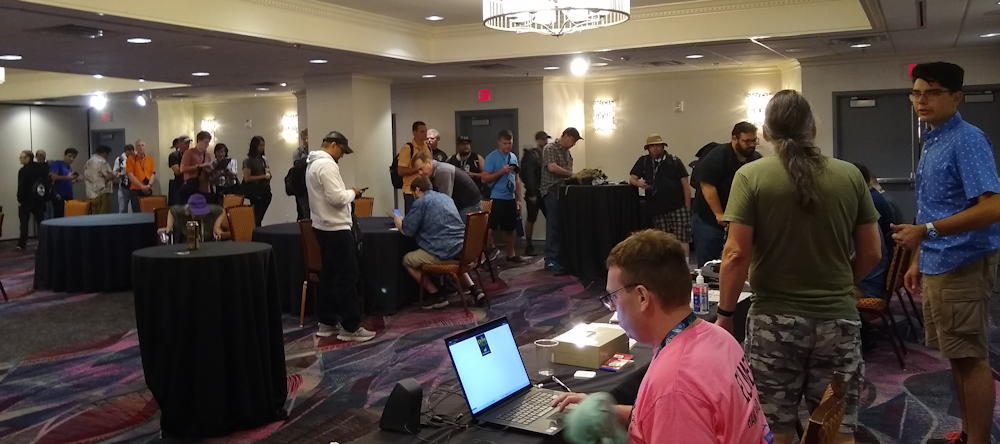
I just returned from Las Vegas yesterday, where I attended DEFCON and taught a one-day Tech class in the Ham Radio Village for the second year in a row. As it was last year, it was both exhilarating and exhausting. I arrived Wednesday afternoon, taught the class on Thursday, wandered about DEFCON on Friday, learned a few things, and left Saturday morning.

Students line up to register for the exam after my 2023 DEFCON one-day Tech class.

This year, there was another full house (pun intended) with 31 students in all. Unfortunately, only 24 passed the test. That’s a little lower than my usual pass rate, but come to find out that some of the students had never even looked at the study guide before the class. I know this because when I mentioned that I was following my study guide from front to back, several asked where they could get it.

I’m already thinking about next year. For example, I think with a little more publicity we could get 50 people to attend the class. Also, I probably should make up some slides to make up to show the students what resistors look like and what RF connectors look like. I usually have a goodie bag of components that I pass around for a local class, but it’s difficult to do that for a class somewhere other than Ann Arbor.

At lunch, an ICQPodcast listener joined me for lunch. That was nice. I told him that I was always surprised when people say they listen to us on the podcast. He replied that he was a relatively new ham, and that listening to the podcast helped him learn more about the community and become part of it. I hadn’t thought about that being one of our functions, but it’s something that I’m going to keep in mind on future episodes.

After the class, two study guide readers came up to me and thanked me for writing the study guides. One of them said that he used my study guides to pass all three tests. Now, he’s a VE with Ham Radio Village and giving back as well. How cool is that?

Hanging out at DEFCON

On Friday, I hung out at the conference and learned stuff. I learned a bit about quantum computing, how some people are using social media to chart the course of the war in Ukraine, and whether or not solid-state drives are actually more reliable than mechanical hard drives.

One of the other “villages” that I was really impressed with was the Hardware Hacking/Soldering Skills Village. They had at least a hundred people sitting at tables soldering and unsoldering things. Hamvention needs something like that.

While I’ll teach at DEFCON for as long as they’ll have me, I have never been a big fan of Las Vegas. I really have no desire at all to gamble anymore (I used to play a little blackjack), it’s incredibly hot in August (every day was over 100ºF), and the price for nearly everything is sky-high (I paid more than $20 for breakfast at a Dunkin Donuts!). Even so, it was packed to the gills. I was amazed that they get so many people there with such high temperatures and high prices.

Despite all that, DEFCON did get me pumped up about doing more hacking. For example, I’m going to look into purchasing a Xiegu X6100 and hacking on it. Apparently, the software runs on an internal Linux computer and can be user-modified. R1CBU has already hacked the X6100, adding features and improving the radio’s performance. I’m looking forward to learning more about this. I also have some other ideas, which I’ll be writing more about in the future.

UPDATE 8/15/23

I got this very nice email today:

Hi Dan,

Thank you for teaching your class @ DefCon! I was lucky enough to snag a spot at the very last minute; I got a lot out of the class but, since I had no prior knowledge of/experience with the subject and the exam was being offering for the duration of the con, I decided to hold off until I’d had a chance to review the material.

That said, I’m happy to share that I took & passed the exam on Sunday after re-reading your guide and taking a practice test.

So, thank you again for piquing my interest in ham radio & making it so accessible — I hadn’t expected to leave Las Vegas a licensed amateur radio technician!

I’ve since downloaded your “21 Things to do After” guide and look forward to getting started with my first radio.. : )

How cool is that? That bumps up my pass rate a little more  :)

Filed Under: Computers, Gear/Gadgets, Software-Defined Radio (SDR) Tagged With: DEFCON, hacking, Las Vegas

From my Mastodon feed: FutureSDR, ear training, WTF?

July 23, 2023 By Dan KB6NU 2 Comments

As Twitter descends into hellhole that Elon Musk is making it into, more hams are showing up on Mastodon, a “non-profit, abuse-free social network based on open web standards and principles.” I am @[email protected]. Mastodon.Radio is a space for the amateur (ham) radio community and anyone interested in shortwave listening (SWL). It’s run by Christopher, M0YNG. Thanks, Chris!

I’m finding it actually more interesting than Twitter for ham radio kinds of things. Here are three things that were in my feed yesterday.

FutureSDR WebAssembly SDR Live Coding

The author of FutureSDR, Bastian Bloessl, describes FutureSDR, as:

An experimental asynchronous SDR runtime for heterogeneous architectures that is:

  • Extensible: custom buffers (supporting accelerators like GPUs and FPGAs) and custom schedulers (optimized for your application).
  • Asynchronous: solving long-standing issues around IO, blocking, and timers.
  • Portable: Linux, Windows, Mac, WASM, Android, and prime support for embedded platforms through a REST API and web-based GUIs.
  • Fast: SDR go brrr!

Here, he does a little live coding that some of you might find interesting.


Open Ear

OpenEar is an open source ear training app for musicians that runs on Android phones and tablets. It includes exercises to help musicians master recognizing musical patterns. I’m wondering if it might also help those learning Morse Code. If you do download it and try it, let me know.


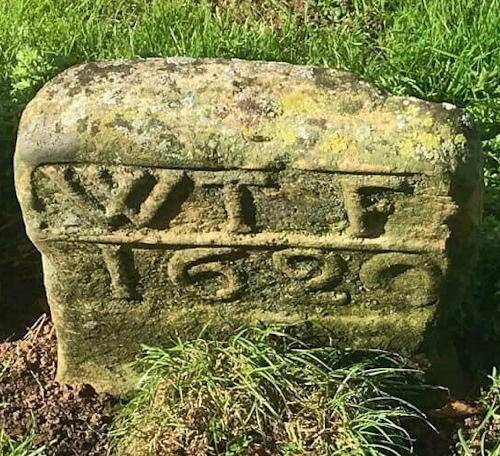
WTF?

Flashdancer (@[email protected]) shared this photo, noting, “I’m assuming that 403 years ago this person died very unexpectedly.”

Filed Under: CW, Just for Fun, Software-Defined Radio (SDR) Tagged With: FutureSDR, Open Ear

From my reading list: The inner beauty of electronics

January 23, 2023 By Dan KB6NU 1 Comment

Safari, the web browser that I use most often, has a feature called the “reading list.” It’s like a bookmark, but much more temporary. The list is meant to be a parking lot for sites that you want to read, but not read over and over. Once you’ve read it, you’re supposed to delete the site from the list.

Of course, a lot of sites get stuck on the list, so periodically I actually go through it and read some of the sites on the list. Here are three that I think hams will be as interested in as I am.

The Inner Beauty of Basic Electronics

Many components are not only marvels of electronics engineering, but mechanical engineering as well. Open Circuits: The Inner Beauty of Basic Electronics shows us how beautiful electronic components can be. The authors, Windell Oskay and Eric Schlaepfer, have painstaking opened many electronic components and taken some really amazing cross-section photographs. Here’s an example of a 15-turn potentiometer.

Also included in the book are photographs of transistors, integrated circuits, printed circuit boards, and more. Even if you don’t buy the book, taking a look at some of the photograph’s on the book’s web site is well worth it.


RFZero

I found out about this board via a Tweet by one of the designers. The RFzero is a multi-purpose, GPS-controlled Arduino shield that uses a Si5351A clock generator to generate all kinds of RF signals. Designed by designed by Johan, 5Q7J; Bo, OZ2M; Hans, OZ2XH; and Steen, OZ5N, the web page says that it can be used for all kinds of things, such as a beacon (IBP, SPB, CW, FST4, FST4W, FT4, FT8, JS8, JT9, ModeX (JT65, Q65, …), PI4, WSPR, …), stand alone WSPR/FST4W transmitter, signal generator, VFO, QO-100 dual LO, low cost GPSDO, e.g. for 10 MHz, IC-9700 LO, 90 MHz frequency counter, and more. Being Arduino-based, you can, of course, write or modify the software yourself.

It looks like a very cool board. I might even get one myself. The price is 500 DKK, or about $73.


SIGpi: A signal-intelligence-focuese Linux “go kit”

I came across this via a tweet from RTL-SDR.Com. RTL-SDR.Com is one of those websites that you really want to read if you’re doing anything with software-defined radio (SDR).

Joe, NE2Z,  has developed this Linux distribution called SIGpi. SIGpi is an installable Linux distribution for Ubuntu and Raspberry Pi 3/4 that focuses on providing multiple open source SDR programs that can be used for signal intelligence. with emphasis on capabilities in the VHF, UHF, and SHF spectrum. Optionally, you can install HF SDR software, too. For a complete list, see the SIGpi wiki.

SIGpi runs on the following platforms:

  • Raspberry Pi4 4GB RAM or Raspberry Pi 400 with 32GB microSD card running Raspberry Pi OS Full (64-bit)
  • Ubuntu 22.04 LTS on arm64 and amd64

This sounds like something fun to try on my under-utilized RPi4. Now, I just have to find the time for it.

Filed Under: Electronic Components, Microcontrollers, Software-Defined Radio (SDR) Tagged With: Arduino, Raspberry Pi, RFZero, SIGpi

Amateur radio videos: (tr)uSDX

February 18, 2022 By Dan KB6NU 2 Comments

So, a couple of days ago, a guy in our club posted to our mailing list that he was thinking of starting a group buy for the (tr)uSDX transceiver and  included a link to the video below:

Here’s a description of the little transceiver:

The (tr)uSDX is a 5-Band / Mulitmode QRP Transceiver in Pocket Format (90x60x30mm – 140g). It features a highly efficient Class E PA and Supports CW/LSB/USB and AM/FM. Right now it covers 80/60/40/30/20m and in Future there will be support for 17/15/12/10m as well.

It is supplied with an OLED Display, onboard Mic, (tiny) onboard speaker and for improvised QSO onboard PTT Key can be used as emergency CW Key. Further on, the (tr)uSDX has a (Micro)USB CAT and Programming Interface, and while it produces typically 5W @ 13,8V Power Supply, it can create 0,5W Output from 5V USB Supply alone.
Typically it draws 80mA on RX (with MS5351 – less with Si5351) and 500mA on TX @13,8V and typical 85% PA Efficiency. It is supplied with OnBoard SWR Bridge and Voltage/Current measurement Hardware, to help in tuning and operation.

Talking about the on-board test equipment, here’s a short video on how that works:

The guy says that if we do a group buy, they’ll cost about $60. That seems pretty cheap, since in single unit quantities, they’re selling for closer to $100. Here’s a video of the designer unboxing a kit from one of the Chinese suppliers:

I don’t know where the guy is going to be making the group buy, more than a dozen club members have signed up so far. I need another project like I need a hole in the head, but I’m going to get one, too.

Filed Under: Gear/Gadgets, Kits, Software-Defined Radio (SDR) Tagged With: (tr)uSDX

Adventures in Linux

November 6, 2021 By Dan KB6NU 5 Comments

A refurb HP Elite tower PC like this one has been running my shack computer for nearly three years now.

Nearly three years ago now, I retired the cheap HP 2000 laptop I was using in the shack with a refurbished HP Elite desktop computer. It has proven to be a very good buy, easily powering the SmartSDR software that runs my Flex 6400 and all the other software that I’ve thrown at it.

I still have the laptop. We used it for logging at Field Day a couple of years ago, but aside from that rather light duty, it’s just been taking up space. Last December, I had tried to install Linux on this laptop, but when I wasn’t successful right off the bat, I put the box back on the shelf, where it languished until about a month ago.

That’s when my friends over at the  Linux in the Ham Shack podcast ran Episode #434: Linux Install Media Deep Dive. They made it sound relatively easy, so I decided to give it another try.

The first thing that you have to decide—after you’ve decided to install Linux, of course—is which distribution to install. I did a search for “best linux for an old laptop,” or something similar, and found the web page, Best Linux Distributions for An Old Laptop in 2021. Based upon what I read there, I decided to give Bodhi Linux a try.

Following NE4RD’s instructions, I first downloaded Rufus, a proram that allows you to create bootable USB drives from .iso files. Then, I downloaded the .iso file for Bodhi Linux and created the bootable USB drive. So far, so good.

Unfortunately, the laptop didn’t boot from the USB drive. When I tried to boot from the USB drive, the laptop just went crazy. Thinking that it might be the BIOS settings, I played around with them, but to no avail. I think this is what tripped me up last December.

Poking around, I found a way to do it, however. What I had to do was to get into the BIOS without the USB drive being plugged in, then at the appropriate step plug it in, then specify the EFI file to boot from. When I did that it, worked!

I played around with Bodhi Linux for a a couple of days. I tried installing SDR++ because it was touted to be “bloat free,” but unfortunately, I couldn’t get it to work. I did install qgrx, and that worked just fine with my RTL-SDR dongle. In the end, though, I decided that Bodhi Linux was a little too “new agey” for me, and looked for another Linux distribution to install.

My second choice was Lubuntu. Lubuntu was touted as being “fast and lightweight,” so I thought I’d give it a go. Armed with my experience in installing Bodhi Linux, the Lubuntu install was easy. Again, I had no luck installing SDR++, but gqrx installed easily, and I quickly had it up and running.

A couple of days ago, however, I read about DragonOS Focal, which is an Ubuntu Linux image that comes preinstalled with multiple SDR software packages. According to the SourceForge page,

DragonOS Focal is an out-of-the-box Lubuntu 20.04 based x86_64 operating system for anyone interested in software defined radios. [Dragon OS Focal includes] the bigger named packages and  drivers  for SDRs, such as the HackRF One, RTL-SDR, and LimeSDR.

  • srsLTE
  • Yate/YateBTS
  • Osmo-NITB
  • Universal Radio Hacker
  • GNU Radio
  • Aircrack-ng
  • GQRX
  • Kalibrate-hackrf
  • wireshare
  • gr-gsm
  • rtl-sdr
  • HackRF
  • IMSI-catcher
  • Zenmap
  • inspectrum
  • qspectrumanalyzer
  • LTE-Cell-Scanner
  • CubicSDR
  • Limesuite
  • ShinySDR
  • SDRAngel
  • SDRTrunk
  • Kismet
  • BladeRF
  • …and more.

That looks pretty good, doesn’t it?

I expected the install to go pretty much the same as the Lubuntu install, but that was not to be. I downloaded the .iso file and created the bootable USB drive with Rufus, but for some reason, I couldn’t get that to boot.

Somehow, I got the idea to create the bootable USB drive on the Lubuntu system using Balena Etcher. So, I downloaded the program and the .iso file to the Lubuntu machine and created the bootable drive. This time, it worked like a charm!

Dragon OS has just finished installing itself, and I’m rebooting now. I’ll report in future posts on how well the SDR programs run on this old laptop.


Filed Under: Computers, Software-Defined Radio (SDR) Tagged With: Dragon OS, Lubuntu

EMC applications for software-defined radio

May 21, 2021 By Dan KB6NU Leave a Comment

This is a talk given to the IEEE Southeast Michigan Section’s EMC Society by Karen Burnham, KE8GVH. While there is a short commercial for the presenter’s company, it’s a pretty good explanation of software-defined radio (SDR) and how SDRs compare to superheterodyne radios. Over half of the talk explains how SDRs work and what you can do with them.

While the presenter says that she’s not going to talk about ham radio applications, the applications she does talk about certainly are useful for amateur radio operators. For example, one of Burnham’s demonstrations is the spectral purity of an FRS radio. You could also get a feel for how pure your HT signal is, realizing that what you get out of a cheap SDR dongle is not really calibrated.

Filed Under: EMI/RFI, Software-Defined Radio (SDR)

  • Page 1
  • Page 2
  • Page 3
  • Interim pages omitted …
  • Page 6
  • Go to Next Page »

Primary Sidebar

No Nonsense Extra Class License Study Guide: for tests given between July 2024 and June 2028

New No Nonsense Extra Class Study Guide now available!

The 2024 version of my Extra Class study guide is available in PDF, ePub, Kindle, and print versions.

Click here to get all of my "No Nonsense" study guides.

Also available: The CW Geek's Guide to Having Fun with Morse Code

W5SWL.Com
Retevis Ailunce H1 DMR Radio
DXpander: Cobweb antennas, Laser Cutting

You’ve got mail!

Enter your email address below and get an email every time I publish a new post.

Email


I frequently teach classes to help newcomers get their licenses. The next class will take place on Saturday, February 7, 2026 on the University of Michigan campus. Click here for more information.

If you can't make the class, subscribe to the mailing list to be notified of when the next class will be held.

You can always download my free study guide, and if you have any questions about the classes, or amateur radio in general, please feel free to email me directly.

Support KB6NU.Com

Donate $7.30 and get two of these cool stickers. Measuring 4.25-in. W by 2.75-in. H, it's perfect for your car, your shack, or wherever!

Contact me

If you have a question or comment about one of my blog posts, or a question about any of the material in my study guides, or just a question about ham radio in general, you can email me at [email protected].

Blogs You Should Also Read

  • AE5X: A CW-centric blog from Kingswood, Texas
  • K0LWC Blog
  • LA3ZA Ham Radio Blog
  • Little Radios, Big Fun – WB3GCK
  • Mr. Vacuum Tube's Blog
  • Radio Artisan – K3NG
  • The K0NR Weblog
  • VE3WDM's QRP Ham Radio Blog
  • W2LJ’s Blog

Ham Radio Websites

  • Dashtoons – The Hammin' Comedy by Jeff K1NSS

Podcasts

  • ICQ Podcast
  • Linux in the Ham Schack
  • No Nonsense Amateur Radio Podcast
  • Resonant Frequency Amateur Radio Podcast

Recent Comments

  • Mike on Map your contest QSOs
  • Phillip Cardwell on J-Poles
  • Dan KB6NU on Dayton Hamvention 2026: Day 1, Wednesday, May 13
  • Randy Shake on Dayton Hamvention 2026: Day 1, Wednesday, May 13
  • John Hislop on New edition of my No Nonsense Technician Class License Study Guide now ready for review

Meta

  • Log in
  • Entries feed
  • Comments feed
  • WordPress.org

Footer

Copyright © 2026 Daniel M. Romanchik, KB6NU · Log in