• Skip to primary navigation
  • Skip to main content
  • Skip to primary sidebar
  • Skip to footer

KB6NU's Ham Radio Blog

KB6NU's Ham Radio Blog
  • HOME
  • Study Guides
  • Teach a One-Day Tech Class
  • W8SRC Repeater Guide
  • Advertise
  • Hire Me

SDR

ICQPodcast Episode 469 – Club Open Day and Radio Centre Win Award

November 2, 2025 By Dan KB6NU Leave a Comment

ICQ Podcast logo.In this episode, I join Martin Butler M1MRB, Caryn Eve Murray KD2GUT, Edmund Spicer M0MNG, and Ed Durrant DD5LP to discuss the latest amateur/ham radio news, including:
  • Ham to Chair Newly Created University Department
  • Reminder: Keep Clear of Emergency Frequencies
  • Young Amateurs Learn New Modes for Emcomm
  • No, SDRs Haven’t Ruined DX’ing
  • Astronomy Trade Fair to Debut at Ham Radio Friedrichshafen

There are also reports on:

  • YOTA Month: Book Your GB25YOTA Operating
  • Is AO-7 Still the Oldest Satellite?
  • Latvia’s Hams Honor Nation’s First Broadcast Radio at 100
This episode’s feature is Club Open Day and RSGB win an award.

Filed Under: ICQ Podcast, Podcasts Tagged With: AO-7, emcomm, SDR, YOTA

Interesting Stuff: Pico-based SDR runs standalone, texting over HF, HamClock on WiFi

November 27, 2024 By Dan KB6NU Leave a Comment

There’s so much interesting stuff out there that I’m never going to get to it all. I blog about these projects, though, so that I don’t forget about them and to let others know about them. If you’v ever built or used one of these projects, please leave a comment below or email me directly.

Pico-based SDR runs stand-alone

Microcontrollers are getting to be very powerful. The Raspberry Pi Pico, for example, feature dual core processors, running at frequencies up to 150 MHz, with 520 kB of SRAM, and 4 MB of on-board flash memory. They’re very inexpensive, too. You can get one of these microcontrollers from reputable dealers for less than $8. If you’re willing to take a flyer on Ali Express, some of them are going for less than $2.

As shown in the video, this lets one build a software-defined radio (SDR) without a PC!

Think of the possibilities. One of the things that comes to my mind is to couple this with an Si5351 module and amplifier to make a small HF transceiver.

For more information:

  • Article discussing how it works.
  • Discussion on [email protected].

Chirp to send text messages

PA3FWM has developed a new digital mode he calls LongChat that uses chirp signals with an audio bandwidth 300 Hz–2700 Hz. Pieter claims that LongChat is very power-efficient and offers good performance even at very low power.

For more information:

  • Article: Signal/noise ratio of digital amateur modes.
  • Free LongChat software and setup instructions.

HamClock on a Raspberry Pi Zero 2W

Small printed-circuit board connected to a laptop via a USB cable.
Adam Drake, VE7SAL, coerced this Raspberry Pi Zero 2W to run HamClock.

The September-October 2024 issue of the Surrey Amateur Radio Club (SARC) Communicator has a great article on using a RPi Zero 2W to run HamClock. The unique thing about this implementation is that is uses the WiFi capability of the RPi Zero 2W to make, in effect, a HamClock server. With this running, you could then display HamClock on your laptop, a tablet, or even your phone.

For more information, see PE4BAS’s implementation of this project.

Filed Under: Digital Modes, Software-Defined Radio (SDR), Station accessories Tagged With: HamClock, LongChat, Raspberry Pi Pico, SDR

Amateur Radio Software Award goes to developers of OpenWebRX and OpenWebRX+

May 10, 2024 By Dan KB6NU 2 Comments

The Amateur Radio Software Award (ARSA) committee is pleased to announce that they have selected OpenWebRX, a project led by Jakob Ketterl DD5JFK, and OpenWebRX+, a project led by Marat Fayzullin KC1TXE, as the winners of the 5th annual Amateur Radio Software Award. The award recognizes software projects that enhance amateur radio and promote innovation, freedom, and openness in amateur radio software development.

These projects allow access to radio reception from around the world, whether they are ham operators, shortwave listeners or somebody curious about radio waves. The committee is impressed with the ease of installation, simplicity of use, and overall features that are provided.

The history of these projects showcase the benefit of open source software. OpenWebRX was originally created by András Retzler but due to the demands of his career he decided to discontinue its development. Jakob Ketterl took over the OpenWebRX project and continues to maintain and improve OpenWebRX. Marat Fayzullin’s OpenWebRX+ builds on top of Jakob Ketterl’s OpenWebRX adding support for additional communication modes and advanced features. Both projects are currently separate, allowing implementers of hosting sites to choose between the simple core version or the enhanced version, while allowing the developers to focus on their projects goals.

Jakob Ketterl plans to use the award money to purchase new hardware for the build system of the OpenWebRX project. Recently he added a number of avionics related modes (ADS-B, VDL2, HFDL), a new decoder for DAB (European digital broadcast standard), the ability to decode RDS / RBDS, and a new experimental data interface in the form of MQTT that is intended to allow third-party processing of the information that is received via OpenWebRX.

Marat Fayzullin’s goal for OpenWebRX+ is to support as many communication modes as possible without the need of tweaking multiple pieces of software. In his own words: “In a way, I view OpenWebRX+ as a real-life ‘tricorder’ for the radio spectrum.”

The ARSA committee is already looking forward to next year’s award and welcomes input and nominations for future awards.

Filed Under: Software Tagged With: open source, OpenWebRX, SDR

Interesting stuff from Mastodon: Olivia website, SDRs all over the world, Pico-based Palm Pilot

January 15, 2024 By Dan KB6NU 1 Comment

I’ve recently given up Twitter for Mastodon, which bills itself as a “free and open-source, self-hosted, and federated social network service.” I have a lot fewer followers than I do on Twitter, but the followers that I do have are certainly more engaging. So much so, I don’t think that I’m going back.

There are plenty of servers out there that will let you join Mastodon for free. I’m on a server set up by a radio amateur: mastodon.radio. You can find me there as @[email protected].

Here are some interesting things I’ve found on Mastodon.

Website promotes Olivia

I found several posts on Mastodon relating to Olivia, so I thought I’d check it out. I downloaded fldigi, and with the help of the Olivia Digital Mode on HF website, I’ve actually made some Olivia contacts. The website seems to be the brainchild of NW7US. On the website, you’ll find this presentation that he gave on Olivia to the Raleigh Amateur Radio Society:

I’ve been having fun operating Olivia, and I think you will, too.


World of Receivers and Transmitters

The World of Receivers and Transmitters links you to more than 1,200 software-defined radios around the world. For example, I just accessed and an SDR in Caligari, Italy and listed to a UA2 station work an SV5 station on 40-meter CW. There are SDR radios all over the world.

I think that the next time I see myself spotted on RBN in Europe, I’m going to sign in to one of the receivers in say France or Germany and see how well that receiver can hear me. It should bring a whole new dimension to my HF operating.


Palm Pilot Reborn

The rePalm is being powered by a Raspbery Pi Pico.

I used to have a Palm Pilot, which back in the 1990s was billed as a “personal digital assistant.” Basically, it was supposed to do all the things that a smart phone does now without the phone functionality. I thought it was pretty hot stuff.

A fellow named Dmitry has now brought back the Palm Pilot, but now it’s being powered by a Raspberry Pi Pico. You can find all the information on how to create your own Palm Pilot on the rePalm web page.


Filed Under: Building/Homebrew, Software-Defined Radio (SDR) Tagged With: Mastodon, Olivia, Palm Pilot, SDR

Dayton 2017: Meeting more people, food, and an impulse buy

May 29, 2017 By Dan KB6NU 2 Comments

I got back to the Green County Fairgrounds and Expo Center around 7:30 Saturday morning. I just don’t sleep well in hotels, and I didn’t see any benefit in sitting around the hotel room. Also, I figured that this would give me a chance to check out at least one more food vendor.

Hamvention 2017 food

Let me say this about the food. While some people think that the food was better this year than last, I really didn’t think so. The selection was bigger than at Hara Arena—there were vendors selling pork chop and T-bone steak sandwiches, for example—but I don’t think the quality was any better than at Hara, and in some cases, it was worse. Friday, for example, I had a really bad (and expensive) BBQ sandwich for lunch.

I also feel sorry for the community groups who manned the concessions at Hara. I don’t know how easy it’s going to be for them to replace the funds  they raised at Hara. It’s too bad that they couldn’t have been given the opportunity to serve food at the new venue.

Having said that, I did make a couple of good choices on Saturday. For breakfast, I ordered a breakfast sandwich from RB Foods, which was pretty good. For lunch, I had the cabbage rolls from Jean’s Home Cooking. I really enjoyed this. The cabbage rolls weren’t as good as my grandmother’s holubki (the Slovak word for stuffed cabbage), but it was close.

Another food vendor worth mentioning is Rader’s Ice Cream. They were making it right there on site, using what looked like a one-cylinder John Deer engine to power the ice-cream making machine. I didn’t have any of his ice cream, but it was very popular.

If you ate at any of the other food vendors, or have any other comments about the food, please comment below.

Another turn around the flea market

After eating breakfast, I took another turn around the flea market. It was much muddier than it was Friday morning. I was very careful about where I stepped, though, and luckily my shoes didn’t leak at all.

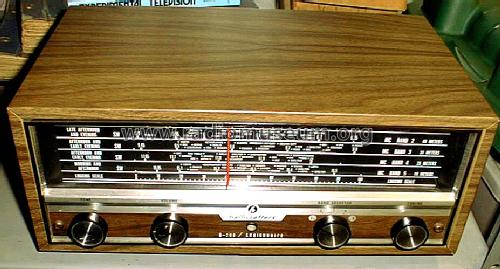
I found a couple of interesting things, although I didn’t buy anything. One radio that tempted me was a Hallicrafters S-200 Legionaire.

I owned one of these as a kid. It covered only the SW broadcast bands. They also made a general coverage version of this receiver, and I’ve seen many of those at hamfests, but this is the first time I’ve seen an S-200 in a long time.

The guy wanted $30 for it, which was probably a reasonable price, but I thought that I’d go back for it later and offer $20, if he still had it. Alas, I never got back to the flea market. It’s just as well, though. I’d probably never use it.

Another guy had a General Radio capacitance bridge. Being the measurement geek that I am, I was drawn to it, of course. It was in great shape, and we had a good time talking about it, as well as other General Radio gear. I didn’t buy it, of course. I would probably never use it, and I just don’t have the room for a big box like that. It was hard to resist, though.

As it turned out, I ended up not making a single flea market purchase, not even a single connector.

Saturday book sales again disappoint

Since Friday had been so disappointing with regard to book sales, I was hoping that Saturday would be a lot better. Unfortunately, while it was a little bit better, it was not even close to what I was hoping for.

I did, however, meet and talk with a lot of great people. I shared a laugh or two with Randy, KB3IFH, who does my QSL cards and my new business cards. He did  some “CW Geek” coasters for me, and I owed him some money.

Entry-level licensing

Cover shot of the 1951 ARRL License Manual. The Novice section is only four pages!

I also spent at least a fascinating 45 minutes with Bruce, K1BG. I’ve worked Bruce many time on 40m CW, and now I come to find out that Bruce is on the ARRL’s entry-level license committee. The committee’s charter is to make recommendations to the ARRL board regarding the entry level license.

This could take any number of different forms. They might recommend changes to the Technician Class license, but they might also recommend the establishment of an additional, but simpler, license with privileges that would give a newcomer a taste of most facets of ham radio from HF to VHF and UHF.

To be honest, I was kind of skeptical about this when I first read about it, but Bruce makes a very compelling case. He notes that the first Novice question pool consisted of only 28 questions, if you go by the number of questions found in the 1951 edition of The Radio Amateur’s License Manual. The Novice section of this manual is only four pages long, and doesn’t even have a question about Ohm’s Law! Over the years, this number grew, but slowly reaching 51 questions in  1968, when incentive licensing was established.

Bruce says that it’s his opinion that the number of teenagers getting amateur radio licenses declined as the test got more difficult. So, if we want to really attract young people into our hobby, we should have a Novice license, akin to what we had back in the day. By comparison, the current Tech test question pool has more than 430 questions! Food for thought there. I plan to keep on top of this topic and blog more about it after I investigate this some more.

Around 3:00 pm, I joined my friend, Mark, W8MP, in the County Hunter’s Forum. Mark and I have an ongoing debate as to what’s crazier: county hunting or my little side hobby of collecting QSL cards from stations whose callsigns spell words. One of the fellows who spoke at the forum, Bob, N4CD, has worked all counties nine times!

What was really fun about attending this meeting was that I actually got to work two people there whose callsigns spell words: W8TAX and W2RAN. Mark ran around and found two handhelds for us to work one another. What a great guy!

Social media meetup

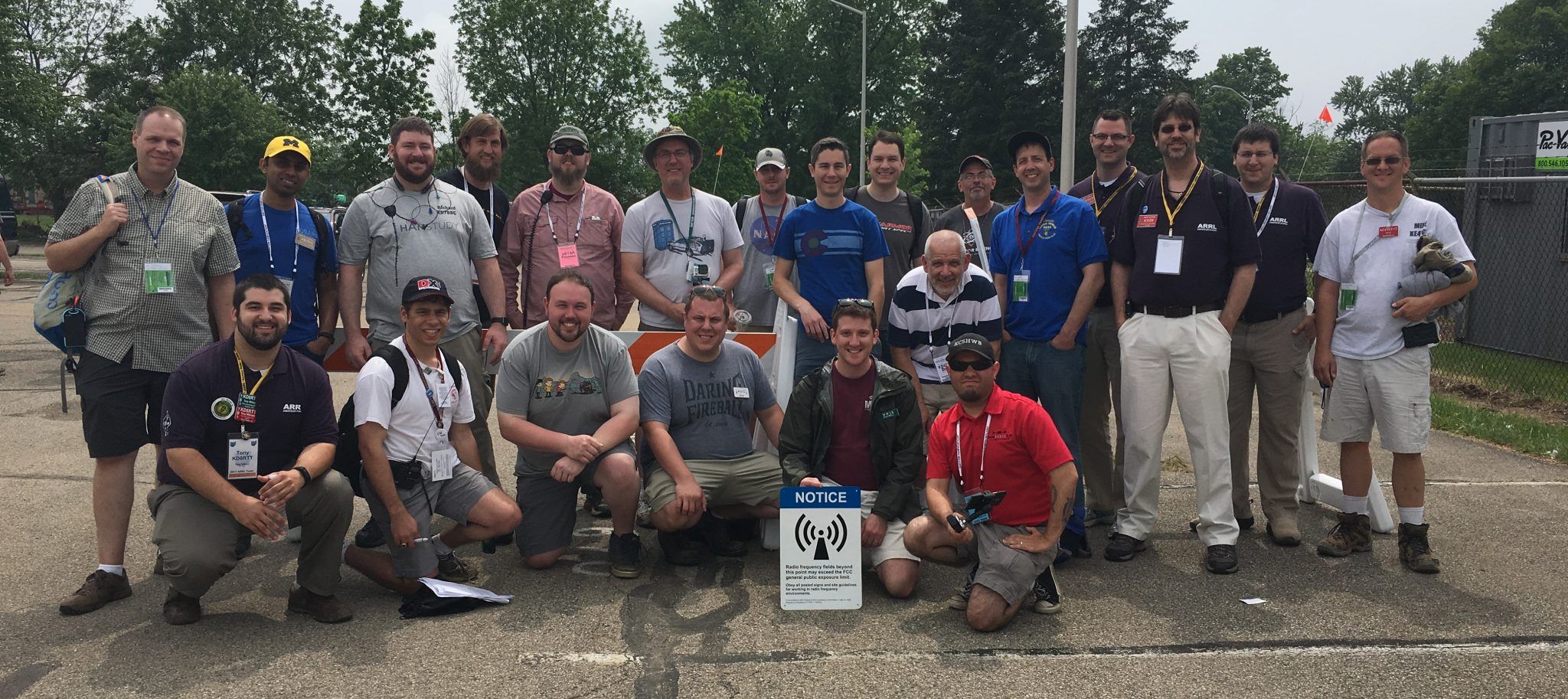
At 3:30 pm, we had the annual social media meetup (see the photo below). By my count, there were 22 of us this year.Who says ham radio operators are all old guys? I’m the oldest one in this photo!

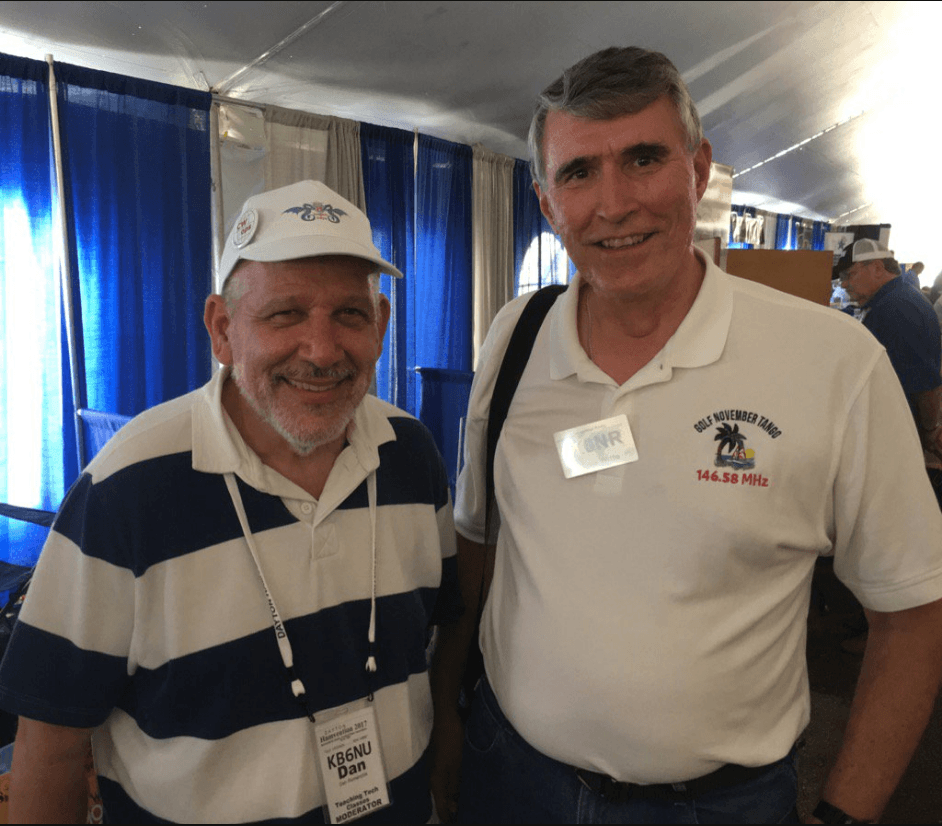
A short time after that, Bob, K0NR, wandered by my booth. I’m glad I got to meet Bob face-to-face. We actually go a long way back, back to the time I wrote for Test&Measurement World magazine. We’ve talked on the phone, and on the Internet, many times, but this is the first time we got to meet in person. Check out his take on Dayton 2017.

That’s Bob on the right and me on the left, sporting my new Begali cap.

A last-minute impulse buy

Earlier in the day, I took a break and wandered quickly around some of the other halls. One of the things that stuck with me was the new RS-HFIQ SDR transceiver by HobbyPCB. I had actually signed up for their Kickstarter back in December, but for some reason cancelled my pledge. I’m not really sure why because if I hadn’t I would have already had one up and running.

At any rate, I mulled over buying the thing until it was just about time to go. By 4 pm, foot traffic by the booth had fallen way off, and by 4:10 pm, I decided to pack up for day. After I got my books all packed up, I hurried over to the HobbyPCB booth, hoping they were still open and that they still had one for me. Fortunately, they did, and I walked away with  an RS-HFIQ and the enclosure kit for the Hamvention price of $270.

It’s not an IC-7300, but with the HardRock 50W amp (which I already own), it’s about half the cost and most of the functionality (aside from the cool LCD screen). More on this in another blog post.

That’s all, folks

Well, that’s about it for my Dayton 2017 experiences. I had a rather uneventful drive home, arriving back in Ann Arbor about 8:30 pm that evening. I’m looking forward to next year, and I’m already thinking about what I can talk about. Perhaps another talk on CW, or perhaps I could organize a panel on licensing issues, including the new entry-level license. What do you think?

Filed Under: Classes/Testing/Licensing, Hamfests, People Tagged With: Dayton, Dayton 2017, K0NR, SDR

Two-part series covers receiver basics

April 2, 2016 By Dan KB6NU 1 Comment

microwaves&rfMicrowaves&RF, an electronics engineering trade magazine is running a two-part series on receiver basics. Part 1 discusses noise figure, direct-conversion receivers, and single-conversion superheterodyne receivers.

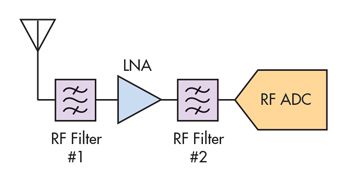
Part 2 covers dual-conversion superheterodyne receivers and direct RF sampling receivers (shown below). There’s also a short discussion of the performance characteristics of each type of receiver.

direct-rf-sampling-rcvr
Block diagram of a direct RF-sampling receiver. This is the type of receiver found in the new Icom IC-7300.

This discussion is pertinent because advances in analog-to-digital converter technology is allowing manufacturers to  direct RF sampling receivers. The Elecraft KX3, Flexradio transceivers, and the new and much-touted ICOM IC-7300 all have direct RF sampling receivers.

Filed Under: Receivers, Software-Defined Radio (SDR) Tagged With: SDR, superheterodyne

Primary Sidebar

No Nonsense Technician Class License Study Guide (for tests given between July 2026 and June 2030)

New No Nonsense Technican Class Study Guide now available!

The 2026 version of my Tech Class study guide is now available, and as always, the PDF version is FREE!. The ePub version costs $11.97, and a Kindle version and paperback version will be available on Amazon shortly.

Click here to get all of my "No Nonsense" study guides.

Also available: The CW Geek's Guide to Having Fun with Morse Code

W5SWL.Com
Retevis Ailunce H1 DMR Radio
DXpander: Cobweb antennas, Laser Cutting

You’ve got mail!

Enter your email address below and get an email every time I publish a new post.

Email


I frequently teach classes to help newcomers get their licenses. The next class will take place on Saturday, February 7, 2026 on the University of Michigan campus. Click here for more information.

If you can't make the class, subscribe to the mailing list to be notified of when the next class will be held.

You can always download my free study guide, and if you have any questions about the classes, or amateur radio in general, please feel free to email me directly.

Support KB6NU.Com

Donate $7.30 and get two of these cool stickers. Measuring 4.25-in. W by 2.75-in. H, it's perfect for your car, your shack, or wherever!

Contact me

If you have a question or comment about one of my blog posts, or a question about any of the material in my study guides, or just a question about ham radio in general, you can email me at [email protected].

Blogs You Should Also Read

  • AE5X: A CW-centric blog from Kingswood, Texas
  • K0LWC Blog
  • LA3ZA Ham Radio Blog
  • Little Radios, Big Fun – WB3GCK
  • Mr. Vacuum Tube's Blog
  • Radio Artisan – K3NG
  • The K0NR Weblog
  • VE3WDM's QRP Ham Radio Blog
  • W2LJ’s Blog

Ham Radio Websites

  • Dashtoons – The Hammin' Comedy by Jeff K1NSS

Podcasts

  • ICQ Podcast
  • Linux in the Ham Schack
  • No Nonsense Amateur Radio Podcast
  • Resonant Frequency Amateur Radio Podcast

Recent Comments

  • Dan KB6NU on Finally, a Loop for 10m.
  • Dan KB6NU on 1930s cards for my collection of QSLs from stations whose callsigns spell words
  • Sean on Finally, a Loop for 10m.
  • Bill Waslo on 1930s cards for my collection of QSLs from stations whose callsigns spell words
  • C M Wetzel KD8TNF on The Wesco BN-1

Meta

  • Log in
  • Entries feed
  • Comments feed
  • WordPress.org

Footer

Copyright © 2026 Daniel M. Romanchik, KB6NU · Log in