• Skip to primary navigation
  • Skip to main content
  • Skip to primary sidebar
  • Skip to footer

KB6NU's Ham Radio Blog

KB6NU's Ham Radio Blog
  • HOME
  • Study Guides
  • Teach a One-Day Tech Class
  • W8SRC Repeater Guide
  • Advertise
  • Hire Me

Kits

Operating Notes: I’m twitch-y, bye-bye X-6100, bring on the toroids

March 19, 2024 By Dan KB6NU 2 Comments

I’m Twitch-y!

Last night, I worked Luis, EA1TG, and this morning, he sent me a link to a video on Twitch that he made of our contact. (Click on the image to go to Twitch. For some reason, I couldn’t embed the Twitch video here.)
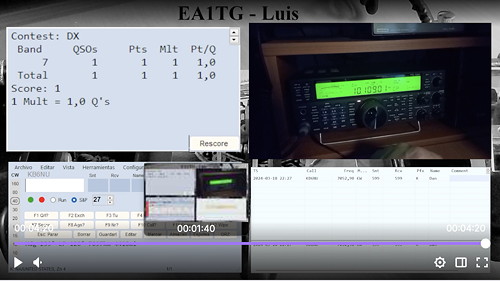
This is kind of cool. I’ve been thinking of setting up my own Twitch channel to stream my contacts. I’m not sure if anyone would actually watch them, but who knows?

Bye-bye X-6100

Last summer, I purchased a Xiegu X-6100 from Radioddity when they put it on sale. I had a lot of fun using it. In some ways, it’s  more fun to use than my Elecraft KX-3. I attribute that mainly to the brightly-colored waterfall display.

It’s just not the radio that the KX-3 is, however. For one thing, the KX-3’s antenna tuner is much better than the X-6100’s antenna tuner. The KX-3 tuner almost always achieves an SWR of 1.1:1 or less with my 66-ft. doublet antenna, while the Xiegu is satisfied once it hits 1.5:1. The color choices are also terrible, making it hard to read, especially in bright sunlight.

So, after making 36 contacts with it on my latest POTA activation, I sold the X-6100 last week. I hope that the new owner will have as much fun as did with it. And, find its shortcomings less annoying.

Bring on the toroids!

To replace the X-6100, I purchased a QRP Labs QMX kit. For less than $100, the QMX provides five band coverage (either 80m – 20m or 20m – 10m), CW and digital modes, an SDR receiver, a 24-bit 48 ksps USB sound card, CAT control, and synthesized VFO with TCXO reference. Since I’ll be using this for POTA, and propagation on the higher bands is headed in the right direction, I opted for the 20m – 10 version.

I also purchased the enclosure and power cord, so the price came to just short of $140, including shipping. Even so, that’s quite a deal, I think.

When I told my friends Rick and Paul about my purchase they jumped all over me about the toroids. One of them in particular has a trifilar winding and is supposed to be difficult to fabricate. I’m not a big fan of winding toroids, but I’m not scared of them either. Bring on the toroids!

In the meantime, I’ve been watching this video:

After watching it, it seems to me that the biggest thing to watch out for is how crowded everything is inside the radio. For example, there are several warnings about how close some of the components and traces are to one another. Forewarned is forearmed, though, so at least I’ll know what to look out for.

Stay tuned for reports on how I get along with the kit. Who knows? Maybe I’ll live-stream my toroid-building on my YouTube or Twitch channel.

Filed Under: Building/Homebrew, Gear/Gadgets, Kits, Operating, Parks on the Air Tagged With: EA1TG, QMX, QRP Labs, Twitch, X-6100, Xiegu

Don’t you think that hams should know how to solder?

October 31, 2023 By Dan KB6NU 11 Comments

So, on /r/amateurradio this afternoon there was a post asking for opinions about a new antenna analyzer by Chameleon. The thing costs $200, and as far as I can tell, only measures SWR.

I commented, “Take a look at the SDR-Kits FA-VA5 600MHz Vector Antenna Analyzer. For about the same price, it covers up to 600 MHz, and does a heck of a lot more than the Chameleon analyzer. I have an earlier version of this analyzer–the VA-4–and it works great.”

To which someone replied, “lol you have to put that together yourself.” What followed was a series of comments about how difficult it would be to build the VA-5 kit and whether or not it should be doable for most hams:

Me: “Basically, it’s just final assembly, and you get a much more capable analyzer. If you can’t do that yourself, well….”

Him: “Says there’s soldering involved. That’s pretty intense for newbies compared to this unit that is ready to go right out of the box.”

Me: “It’s really not that difficult, and like I say, you end up with a much better analyzer for about the same price.”

Him: “You’re probably right, but for someone that’s never touched a soldering iron in their life, it doesn’t matter how much it costs they’re not going to buy it.”

Me: “If you’re doing stuff that requires you to use an antenna analyzer, you should know how to solder.”

Him: “Agree to disagree. I use a coil antenna in the field. I use an analyzer to ensure I get it tuned below 1.5:1 without using a tuner. I’ve never needed a soldering iron for anything and I’ve been a ham since April 2000.”

Me: “OK. We’ll agree to disagree. I’ll say one more thing, though. If you’ve never touched a soldering iron in all that time, you’ve ended up paying more for your hobby than you need to. This is a case in point. By doing a little soldering here, you could get a lot more for your money.”

Him: “I don’t think that is accurate. Nothing I’ve purchased over the years could have been assembled by me with just a soldering iron except the N9TAX roll up jpole I purchased a few years ago but even with that it would have required more tools than a soldering iron that I don’t have either.”

Me: “I don’t know what exactly you’ve purchased, but I’d bet that there are some things you could build yourself with a soldering iron (and some other tools, of course). And, by doing so, saved yourself some money, or gotten more for your money. Not only that, by building your own stuff, you’ll learn more about how radio and electronics work. If you’ve limited yourself to using only things that you can buy you’re really missing out on one of the big pleasures of amateur radio.”

I am both amused and befuddled by this conversation. I don’t have any reason to believe that this guy is lying, but at the same time, I find it hard to believe that this person has been a ham for more than 20 years and has never soldered anything. Maybe if they only had their license for 2 months, but 23 years?

And, as I said, if they really don’t have a soldering iron, what do they do when things break? Just throw it away and buy something new? That’s crazy.

I really can’t imagine being a ham and not having a soldering iron. Soldering is ham radio 101 or should be, no?

Filed Under: Building/Homebrew, Kits Tagged With: soldering

Amateur radio videos: High-Speed Telegraphy 2021, college kit build, winding toroids

April 20, 2022 By Dan KB6NU Leave a Comment


Some of these operators are just amazing…


One of the most encouraging things in amateur radio is the renewed interest at the college level. Here’s an example:


Just for fun, here’s a little electronics theory….

Filed Under: Building/Homebrew, CW, Kits Tagged With: QRQ, toroids

Amateur radio videos: (tr)uSDX

February 18, 2022 By Dan KB6NU 3 Comments

So, a couple of days ago, a guy in our club posted to our mailing list that he was thinking of starting a group buy for the (tr)uSDX transceiver and  included a link to the video below:

Here’s a description of the little transceiver:

The (tr)uSDX is a 5-Band / Mulitmode QRP Transceiver in Pocket Format (90x60x30mm – 140g). It features a highly efficient Class E PA and Supports CW/LSB/USB and AM/FM. Right now it covers 80/60/40/30/20m and in Future there will be support for 17/15/12/10m as well.

It is supplied with an OLED Display, onboard Mic, (tiny) onboard speaker and for improvised QSO onboard PTT Key can be used as emergency CW Key. Further on, the (tr)uSDX has a (Micro)USB CAT and Programming Interface, and while it produces typically 5W @ 13,8V Power Supply, it can create 0,5W Output from 5V USB Supply alone.
Typically it draws 80mA on RX (with MS5351 – less with Si5351) and 500mA on TX @13,8V and typical 85% PA Efficiency. It is supplied with OnBoard SWR Bridge and Voltage/Current measurement Hardware, to help in tuning and operation.

Talking about the on-board test equipment, here’s a short video on how that works:

The guy says that if we do a group buy, they’ll cost about $60. That seems pretty cheap, since in single unit quantities, they’re selling for closer to $100. Here’s a video of the designer unboxing a kit from one of the Chinese suppliers:

I don’t know where the guy is going to be making the group buy, more than a dozen club members have signed up so far. I need another project like I need a hole in the head, but I’m going to get one, too.

Filed Under: Gear/Gadgets, Kits, Software-Defined Radio (SDR) Tagged With: (tr)uSDX

From the trade magazines: Impedance matching, AM flutter, DIY AI

November 21, 2021 By Dan KB6NU 1 Comment

Back to Basics: Impedance Matching By Lou Frenzel, W5LEF

The term “impedance matching” is rather straightforward. It’s simply defined as the process of making one impedance look like another. Frequently, it becomes necessary to match a load impedance to the source or internal impedance of a driving source. A wide variety of components and circuits can be used for impedance matching. This series summarizes the most common impedance-matching techniques.

  • Impedance Matching: Essential Design Knowledge
  • Back to Basics: Impedance Matching – Part 1
  • Back to Basics: Impedance Matching – Part 2
  • Back to Basics: Impedance Matching – Part 3
  • Automatic Impedance Matching in RF Design
  • Impedance Matching Basics: Smith Charts

The entire series is available as a downloadable ebook.


While I’m not sure, I’d guess that something similar happens on 160 meters or even the HF bands….Dan

AM Radio ‘Flutter’

Sometimes I like to listen to a couple of AM radio stations that transmit from southern New Jersey, which is rather far from here on Long Island. Their signals are pretty strong during the daytime but now and then there is a rapid in-and-out fading effect, which sounds very much like a flutter.

I’ve sometimes heard that same effect when listening to shortwave radio and I initially assumed it was an ionosphericphenomenon but now I don’t think so. There seems to be an alternative explanation.

…read the complete article


I haven’t tried these yet, but they look like fun….Dan

Google’s AIY kits offer do-it-yourself artificial intelligence

There’s plenty of low-cost hardware out there feasible for implementing deep learning training and (especially, along with being your likely implementation focus) inference, as well as plenty of open source (translation: free) and low-priced software, some tied to specific silicon and other more generic. Tying the two (hardware and software) together in a glitch-free and otherwise robust manner is the trick; select unwisely and you’ll waste an inordinate amount of time and effort wading through arcane settings and incomplete (and worse: incorrect) documentation, trying to figure out why puzzle pieces that shouldfit together perfectly aren’t.

That’s where Google’s AIY (which stands for “Artificial-Intelligence-Yourself,” a play on DIY, i.e., “Do-It-Yourself) Project Kits come in. They’re targeted at hobbyists and professionals alike: in Google’s own words, “With our maker kits, build intelligent systems that see, speak, and understand.

…read complete article

Filed Under: Building/Homebrew, Electronics Theory, Kits, Propagation Tagged With: AI, flutter, impedance matching

Breakout board aids Pico development

June 5, 2021 By Dan KB6NU Leave a Comment

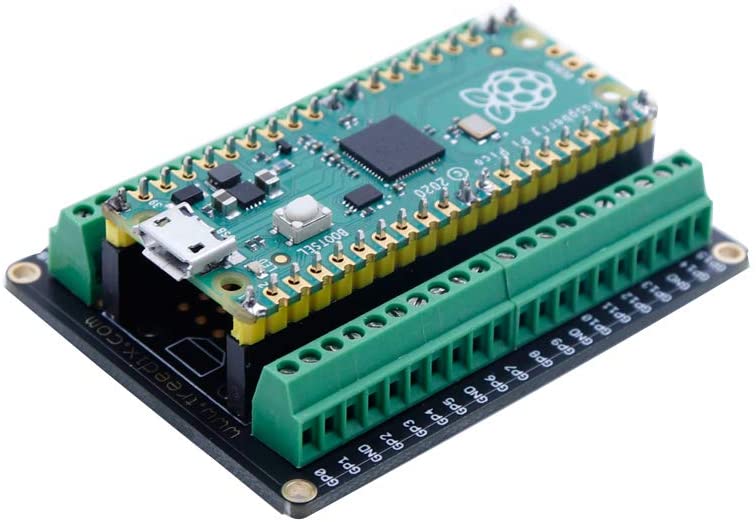
This kit provides a screw terminal for each pin on the Raspberry Pi Pico. I hope you do a better job soldering the headers than they did before taking this picture, though. :)

So, I’ve started playing around with a Raspberry Pi Pico. All I’ve been able to do so far is to blink the LED with a little Python program, but it’s going to be a lot of fun.

To make it even more fun, I just purchased and built the Raspberry Pi Pico Breakout Board (see right). One thing that I like about it is the terminal strips. The terminal strips will allow me to make secure connections to sensors and other I/O. Another nice feature is that the kit includes the headers that you need to solder to the Pico.

There’s a lot of soldering. 120 solder joints in all. But, it didn’t take too long, once I got into the rhythm. And, once you get all the soldering done, you have an effective development aid.

Filed Under: Kits, Microcontrollers Tagged With: Raspberry Pi Pico

Interesting stuff from the trade magazines: Make your own conductive inkHeathkit, scope fundamentals

December 17, 2020 By Dan KB6NU 1 Comment


How to Brew Your Own Conductive Ink

An engineer gets creative and mixes up a batch of conductive ink to make his son a birthday present.

…read more


Heathkit: An Employee’s Look Back

Heath Company was the largest kit company in the world. Heath designed and put practically every type of electronic product into kit form. Its products, called Heathkits, were exceptionally popular and many are still in use today. Recently, electronic design talked with Chas Gilmore, who was a Heath executive. For those of you who fondly remember Heathkit and miss its products, here’s a look back at this amazing company and the lessons it offers.

…read more


Oscilloscope Fundamentals Poster

Learn how to check the attenuation of your probes, how to check probe compensation, how to connect the probe ground and how to connect the probe tip to the signal you want to measure. Also learn how to avoid pitfalls such as not seeing a signal, aliasing and how to use the built-in help button when all else fails.

…get the poster

Filed Under: Building/Homebrew, Kits, Test Equipment Tagged With: conductive ink, Heathikit, oscilloscopes

QCX Mini now available

December 4, 2020 By Dan KB6NU 1 Comment

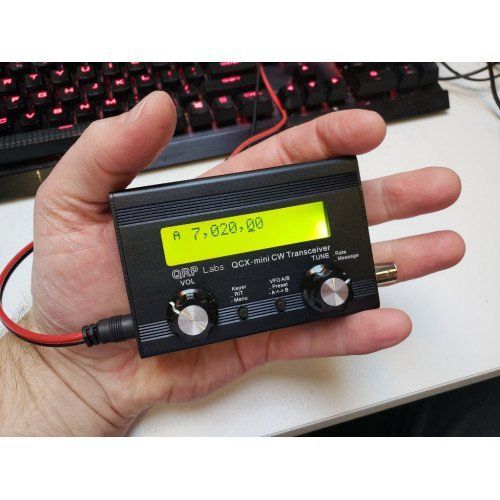
Hans G0UPL of QRP Labs posted the following to the QRP Tech mailing list. Looks like a pretty good value—the base kit is only $55—and a fun kit to build……Dan


Many of you will already be aware of the QCX CW transceiver kit which was launched in August 2017, and evolved into the QCX+ in May 2020. To date, in total 11,568 of these kits have been sold (August 2017 to December 2020).

I am pleased to announce the QCX-mini: all the same performance, functions, firmware and price of the original QCX/QCX+, but in a much smaller package, a perfect Christmas stocking gift! QCX-mini is now available costing $55 for the kit (same price as the QCX+). A beautifully CNC machined black-anodized extruded aluminium enclosure is available, with laser-etched lettering, for $20. The QCX+ TCXO option is $8.25 and is compatible with QCX-mini. Sturdy and small, it’s cute in the shack or perfect for outdoor adventures.

  • QCX-mini info
  • QCX-mini video
  • Order a QCX-mini

We also will have assembled/tested/aligned/calibrated QCX-mini kits which can be pre-ordered now but probably will take several weeks to assemble since we will be busy handling QCX-mini kit order shipments as much as possible in time for Christmas. The Assembled radio pre-order page is: http://shop.qrp-labs.com/qcxminia

Special portable-friendly features:

  • Small size: 95 x 63 x 25mm enclosure (plus protrusions)
    Yellow/green LCD module, sunlight viewable, backlight can be switched off
  • Low current consumption (for example 58mA receive current, with 12V supply and display backlight off)
  • Low weight, 202 grams
  • Sturdy extruded aluminium enclosure
  • All-metal BNC short connector, bolted to enclosure

In addition to all the standard QCX/QCX+ features:

  • Easy to build, two-board design, board with main circuit and connectors, display panel board with LCD; all-controls board-mounted on a press-out sub-board. No wiring, all controls and connectors are board-mounted
  • Professional quality double-sided, through-hole plated, silk-screen printed PCBs
  • Choice of single band, 80, 60, 40, 30, 20 or 17m (160m, 15, 12, 10 and 6m are possible with component value changes)
  • Approximately 3-5W CW output (depending on supply voltage)
  • 7-16V recommended supply voltage
  • Class E power amplifier, transistors run cool
  • 7-element Low Pass Filter ensures regulatory compliance
  • CW envelope shaping to remove key clicks
  • High performance receiver with at least 50dB of unwanted sideband cancellation
  • 200Hz CW filter with no ringing
  • Si5351A Synthesized VFO with rotary encoder tuning
  • Iambic keyer or straight key option included in the firmware
  • Simple Digital Signal Processing assisted CW decoder, displayed real-time on-screen
  • On-screen S-meter
  • On-screen real time clock (not battery backed up)
  • Full or semi QSK operation using fast solid-state transmit/receive switching
  • Frequency presets, VFO A/B Split operation, RIT, configurable CW Offset
  • Configurable sidetone frequency and volume
  • Connectors: 2.1mm power barrel connector, 3.5mm keyer jack, 3.5mm stereo earphone jack, 3.5mm stereo jack for PTT, 3.5mm stereo jack for CAT control,  BNC RF output
  • Built-in test signal generator and alignment tools to complete simple set-up adjustments
  • Built-in test equipment: voltmeter, RF power meter, frequency counter, signal generator
  • Beacon mode, supporting automatic CW, FSKCW or WSPR operation
  • GPS interface for reference frequency calibration and time-keeping (for WSPR beacon)
  • CAT control interface
  • Optional 50W PA kit

A small daughtercard PCB has been included to facilitate easy modification to the uSDX software-defined SSB transceiver see https://groups.io/g/ucx (this modification is supported by the uSDX group, not QRP Labs).

Filed Under: Building/Homebrew, Kits Tagged With: QCX

Bored at home? Here are some suggestions from the IEEE

May 14, 2020 By Dan KB6NU 1 Comment

I am a member of the Institute of Electrical and Electronic Engineers (IEEE), and every once in a while, an IEEE Spectrum Tech Alert pops up in my inbox. This morning’s email contained a link to the article, 9 New Suggestions For Bored Engineers. A couple of them look like great suggestions for amateur radio operators, too:

Get Your Vacuum Tube On: Unless you speak German, you’ll need to put Google Translate on your smartphone for this one, but it’s worth the effort. Franzis makes a shortwave radio kit that uses a single tube, and it’s a nice way to dip a toe into the world of retro-electronics. The tube is used in the radio’s receiver stage, and an integrated circuit takes care of the amplification. The cardboard box that the kit comes in doubles as a surprisingly sturdy case, with a little cutout that shows off the gently glowing tube. As mentioned above, the instruction booklet is in German, but Google Translate’s camera view option had little difficulty in transforming the pages into English. A good antenna and ground connection are important to actually picking up anything, but I hooked the radio up to my 20-meter ham stick dipole antenna at night, and was immediately able to find a couple of stations. Franzis doesn’t seem to have an official U.S. distributor, but I got the kit on eBay for $50, where it’s still available as of this posting.

Photo: ArcAttack

Thunderbolts and Lightning: We profiled Joe DiPrima of ArcAttack last year—he and his brother make custom giant Tesla coils, and during performances they use the coils to emit lightning bolts modulated with musical tones. Starting this weekend, they’ll be hosting live shows from their home base every Sunday at 3PM, Texas time. People who watch live on Facebook will even be able to make music requests.

Fight COVID With a Pi: Raspberry Pi computers are so cheap, I doubt I’m the only one who has accumulated a small collection lying dormant in drawers or old projects. Now you can put those machines to good use with the Rosetta@home project. The project aims to model the 3-D structure of complex proteins by parceling the work out to volunteers running Rosetta software on their computers. In April, the client software was updated to run on the ARM-Linux hardware and software stack compatible with the Raspberry Pi, and the project is now looking for proteins that will bind to the SARS-CoV-2 virus responsible for COVID-19.

There are several other interesting links, including a geiger counter kit, Commodore 64 games, and the BBC microbot.

They even give me a plug. The last item in the article is Get Ready to Go On the Air. It suggests that bored electrical engineers get an amateur radio license and includes a link to my study guides.

Filed Under: Computers, Kits Tagged With: IEEE

Spotted at the UK National Hamfest

September 30, 2019 By Dan KB6NU Leave a Comment

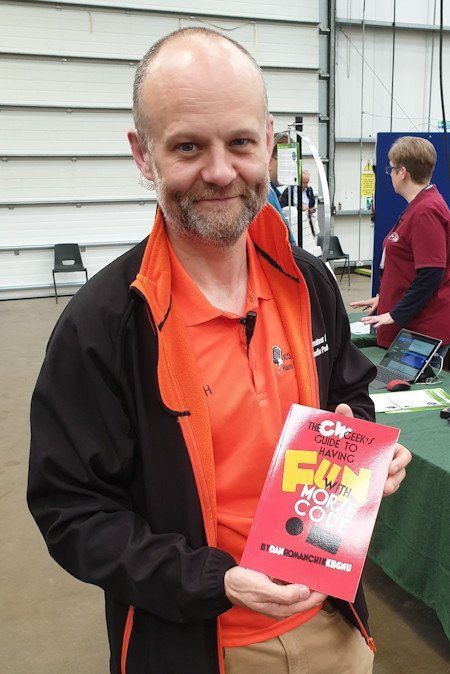
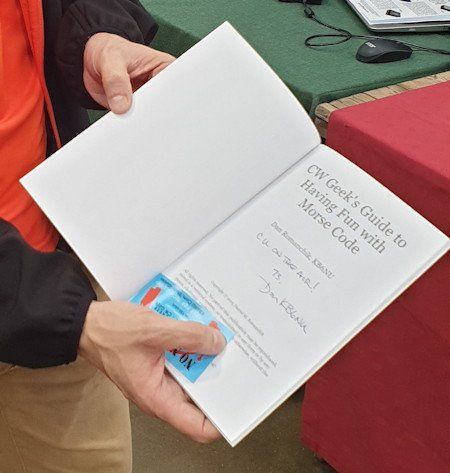
My ICQPodcast colleagues visited the UK National Hamfest over the weekend. Lo and behold, they spotted a copy of my CW Geek’s Guide to Having Fun with Morse Code at the Kanga Products booth. (Kanga is an advertiser here on KB6NU.Com. Click on their icon at right.)

Chris, M0TCH, holding a copy of my CW Geek’s Guide at the UK National Hamfest.

Dennis, G6YBC, the proprietor of Kanga purchased a bunch of the books at Dayton last year, and has been selling them ever since. Unfortunately, he had me sign the books. My friend Ralph, AA8RK, says that defacing them like that makes them less valuable. :)

Kanga carries a number of interesting kits and components, including the Foxx3 CW transceiver. Kanga has also partnered with my friend, John, KC9ON, who is the proprietor of 3rd Planet Solar. Kanga is now offering 3rd Planet Solar kits and vice versa.

For the complete ICQPodcast on the UK National Hamfest, go to the ICQPodcast website.

Filed Under: Books and Magazines, Kits Tagged With: 3rd Planet, Kanga

  • Page 1
  • Page 2
  • Page 3
  • Interim pages omitted …
  • Page 6
  • Go to Next Page »

Primary Sidebar

No Nonsense Technician Class License Study Guide (for tests given between July 2026 and June 2030)

New No Nonsense Technican Class Study Guide now available!

The 2026 version of my Tech Class study guide is now available, and as always, the PDF version is FREE!. The ePub version costs $11.97, and a Kindle version and paperback version will be available on Amazon shortly.

Click here to get all of my "No Nonsense" study guides.

Also available: The CW Geek's Guide to Having Fun with Morse Code

W5SWL.Com
Retevis Ailunce H1 DMR Radio
DXpander: Cobweb antennas, Laser Cutting

You’ve got mail!

Enter your email address below and get an email every time I publish a new post.

Email


I frequently teach classes to help newcomers get their licenses. The next class will take place on Saturday, October 10, 2026 on the University of Michigan campus. Click here for more information.

If you can't make the class, subscribe to the mailing list to be notified of when the next class will be held.

You can always download my free study guide, and if you have any questions about the classes, or amateur radio in general, please feel free to email me directly.

Support KB6NU.Com

Donate $7.30 and get two of these cool stickers. Measuring 4.25-in. W by 2.75-in. H, it's perfect for your car, your shack, or wherever!

Contact me

If you have a question or comment about one of my blog posts, or a question about any of the material in my study guides, or just a question about ham radio in general, you can email me at [email protected].

Blogs You Should Also Read

  • AE5X: A CW-centric blog from Kingswood, Texas
  • K0LWC Blog
  • LA3ZA Ham Radio Blog
  • Little Radios, Big Fun – WB3GCK
  • Mr. Vacuum Tube's Blog
  • Radio Artisan – K3NG
  • The K0NR Weblog
  • VE3WDM's QRP Ham Radio Blog
  • W2LJ’s Blog

Ham Radio Websites

  • Dashtoons – The Hammin' Comedy by Jeff K1NSS

Podcasts

  • ICQ Podcast
  • Linux in the Ham Schack
  • No Nonsense Amateur Radio Podcast
  • Resonant Frequency Amateur Radio Podcast

Recent Comments

  • Bulin 47 AI on ICQPodcast Episode 485 – World Cup Special Event Station
  • Jesse Alexander on What do you think of this artwork for the ham radio EMF Explorer
  • CADProps on My first go at 3D printing not quite a success
  • Dan KB6NU on A Media Guide to Amateur Radio
  • Steve Stroh N8GNJ on A Media Guide to Amateur Radio

Meta

  • Log in
  • Entries feed
  • Comments feed
  • WordPress.org

Footer

Copyright © 2026 Daniel M. Romanchik, KB6NU · Log in