• Skip to primary navigation
  • Skip to main content
  • Skip to primary sidebar
  • Skip to footer

KB6NU's Ham Radio Blog

KB6NU's Ham Radio Blog
  • HOME
  • Study Guides
  • Teach a One-Day Tech Class
  • W8SRC Repeater Guide
  • Advertise
  • Hire Me

symbol rate

ICQ Podcast Episode 416 – Amateur Radio Someone Else’s Problem

November 6, 2023 By Dan KB6NU Leave a Comment

In this episode, I join Martin Butler M1MRB, Caryn Eve Murray KD2GUT, Edmund Spicer M0MNG, and Ed Durrant DD5LP to discuss the latest Amateur / Ham Radio news, including:

  • Club opens arms to the Radio Community for a “build-a-long”.

  • FCC Eyes New Approach to Wireless Alerts

  • FCC To Vote on Removing Symbol Rate Restrictions

  • Northern India State Makes Hams Top Priority

  • End of Teletext Service in Ireland

  • Saved by 2 Metres

  • RFI from above is Anything but Heavenly Interference

  • Broadcast Celebrates 80 Years for UK Shortwave Site

  • D.A.R.C. Celebrates 100 years of Broadcast Radio in Germany with a Transmission on Medium Wave and other Activities.

This episode’s feature is Amateur Radio, Someone Else’s Problem. In this feature, Martin, M1MRB, and Colin, M6BOY, discuss what rank-and-file amateurs to help amateur radio grow and prosper.
Filed Under: Building/Homebrew, Rules, Regulations, Enforcement, Satellites, SWLing Tagged With: India, symbol rate

Amateur radio videos: FCC to replace symbol rate limits with bandwidth limits, K5ATA’s vision for the role of ham radio in STEM education, rain gutter POTA antenna

November 2, 2023 By Dan KB6NU 2 Comments

FCC to lift symbol rate limitations

This is a topic that’s been in the news lately. The FCC is planning to remove the baud rate limitation on digital transmissions and replace it with a 2.8 kHz bandwidth limitation. This video goes into quite some detail on this.

You can find the complete text of the Report and Order and Further Notice of Proposed Rulemaking at https://docs.fcc.gov/public/attachments/DOC-397992A1.pdf.

K5ATA’s vision for the role of ham radio in STEM education

Steve, K5ATA, ARRL Education and Learning Manager, gave the keynote speech at the 2023 ARRL Pacific Division Ham Radio Convention Pacificon. I love the vision. The question now is how to turn that vision into reality.

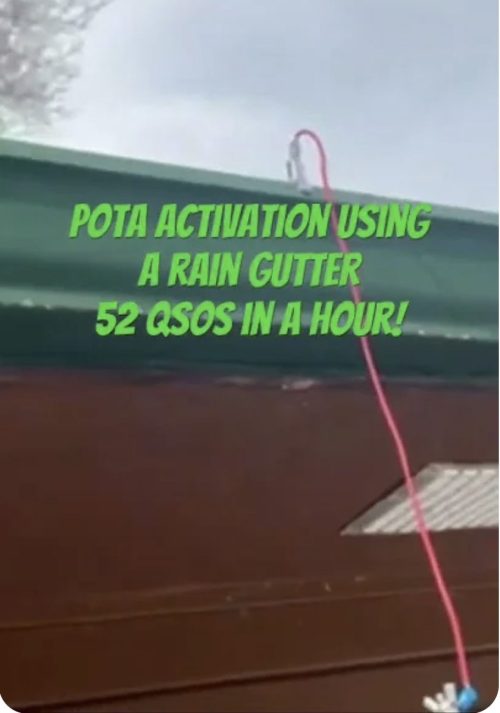
POTA activation rain gutter


Mr MUD, VA5MUD, forgot to bring an antenna to one of his latest POTA activations. That didn’t stop him, though. As he shows in this video, he simply clips a wire to a nearby rain gutter.

Filed Under: Antennas, ARRL, Digital Modes, Kids, Parks on the Air, Rules, Regulations, Enforcement Tagged With: Canada, STEM, symbol rate

Amateur radio videos: Texas wants FCC to loosen rules on data rates, DIY USB-CIV cable, truth is stranger than fiction

July 30, 2023 By Dan KB6NU Leave a Comment

Texas wants FCC to loosen rules on data rates

I’m not sure who got the Texas Department of Public Safety to do this, but kudos to them.

DIY USB-to-CIV cable

I’m a big fan of building things like this yourself. Not only do you spend less money, you learn something in the process.

Truth is stranger than fiction

Watch and see what I mean.

Filed Under: Gear/Gadgets, Rules, Regulations, Enforcement, Videos Tagged With: CI-V, Icom, symbol rate, Texas

FCC Proposes Rule Changes in Response to ARRL’s “Symbol Rate” Petition

August 2, 2016 By Dan KB6NU Leave a Comment

ARRL logo type_17ZCZC AG27
QST de W1AW
ARRL Bulletin 27  ARLB027
From ARRL Headquarters
Newington CT  July 29, 2016
To all radio amateurs

SB QST ARL ARLB027
ARLB027 FCC Proposes Rule Changes in Response to ARRL’s “Symbol Rate” Petition, Seeks Comment

The FCC has proposed to revise the Amateur Service Part 97 rules in response to the ARRL’s so-called “Symbol Rate” Petition for Rule Making (RM-11708), filed in late 2013, and it has invited comments on its recommended changes. The Notice of Proposed Rule Making (NPRM) in WT Docket 16-239, released on July 28, had been making the rounds at the FCC since May. ARRL had asked the FCC to change the Part 97 rules to delete the symbol rate limits in Part 97.307(f) and replace it with a maximum bandwidth for data emissions of 2.8 kHz on amateur frequencies below 29.7 MHz.

The NPRM can be found on the web in PDF format at http://transition.fcc.gov/Daily_Releases/Daily_Business/2016/db0728/FCC-16-96A1.pdf.

“[W]e believe that the public interest may be served by revising the Amateur Service rules to eliminate the current baud rate limitations for data emissions, consistent with ARRL’s Petition, to allow Amateur Service licensees to use modern digital emissions, thereby furthering the purposes of the Amateur Service and enhancing the usefulness of the service,” the FCC said in its NPRM.

“We do not, however, propose a bandwidth limitation for data emissions in the MF and HF bands to replace the baud rate limitations,” the NPRM concluded, “because the rules’ current approach for limiting bandwidth use by amateur stations using one of the specified digital codes to encode the signal being transmitted appears sufficient to ensure that general access to the band by licensees in the Amateur Service does not become unduly impaired.”

Under the current rules, “specified digital codes” in Part 97 may be used with a symbol rate that does not exceed 300 baud for frequencies below 28 MHz, with the exception of 60 meters, and 1200 baud in the 10 meter band. The baud rate limits were adopted in 1980, when the FCC amended Part 97 to specify ASCII as a permissible digital code.

Comments in the proceeding will be due 60 days after the date that the NPRM appears in the Federal Register.

NNNN
/EX

Filed Under: Digital Modes, Rules, Regulations, Enforcement Tagged With: Part 97, symbol rate

Missouri radio amateur petitions FCC to designate “symbol communication” subbands

May 13, 2016 By Dan KB6NU Leave a Comment

As you can imagine, this news has caused a bit of a stir on the CW mailing lists that I’m on. As I read it, this fellow is petitioning the FCC to allow digital communications with a bandwidth up to 2.8 kHz in what is currently the CW/digital portions of the HF bands. As one commenter pointed out, “To permit data transmissions with a 20 dB bandwidth of 2800 Hz throughout the non-voice segments of the 3.5-30 MHz. This would constitute a significant source of interference for narrow-band modes.” This includes modes such as PSK-31. Please consider filing a comment opposing this petition. This is the comment that I filed.
–Dan
 

FCC LogoSB QST @ ARL $ARLB016
ARLB016
ZCZC AG16
QST de W1AW
ARRL Bulletin 16 ARLB016
From ARRL Headquarters
Newington CT May 12, 2016
To all radio amateurs

SB QST ARL ARLB016
ARLB016 Missouri Radio Amateur Petitions FCC to Designate “Symbol Communication” Subbands

James E. Whedbee, N0ECN, of Gladstone, Missouri, has petitioned the FCC to designate Morse (radiotelegraphy) Amateur Radio band segments as “symbol communication” subbands. The FCC has invited comments on his Petition for Rule Making (RM-11769), filed on May 2. Arguing that retaining the current regime of “legacy” CW subbands has proven to be grossly inefficient, Whedbee said he’d like to see the FCC delete all privilege restrictions that limit any part of the Amateur Radio spectrum to Morse code to the exclusion of other modes.

RM-11769 can be found on the web at http://apps.fcc.gov/ecfs/comment/view?id=60001692464 .

“Nostalgia for retention of Morse code telegraphy-only subbands is also an insufficient reason to avoid moving forward to [the] elimination of such subbands, because nothing about this Petition suggests the elimination of the mode itself, only that it not be the sole authorized mode in the subject subbands,” Whedbee told the FCC.

Whedbee characterized CW-only subbands as “an excessive regulatory constraint, as well as a poor use of the spectrum concerned.” He proposed that the FCC’s Part 97 rules reflect the “ultimate form of communication reproduced at the receiving end.” As he explained it, his regulatory scheme would break down modes into three categories – “symbol communication mode” – for CW, digital, and other emission modes that reproduce a discrete symbol on the receiving end – “voice mode,” and “image mode.”

“[C]ontinuing regulation by specific emission designator is proving to be onerous with changes to the state of the art,” Whedbee said. “Accordingly, to continue developing the state of the art in radiocommunications, Amateur Radio needs to clearly get away from regulating in that fashion and return to consideration of what the
receiving end of the communication reproduces.”

He proposed that where the Part 97 rules refer to exclusive radiotelegraphy allocations – or subbands – privileges be changed to reflect symbol communication modes. Where the rules prohibit voice and image modes, he would revise the rules to reflect symbol communication modes. In situations where current rules prohibit symbol communication modes other than Morse, that voice and image modes would be permitted, “with an exception for manually keyed” radiotelegraphy.

For example, he would drop the distinction between 75 meters and 80 meters, authorizing symbol communication modes between 3.5 MHz and 3.65 MHz, and voice and image modes between 3.65 MHz and 4 MHz, with manual radiotelegraphy authorized throughout the band.

Whedbee told the FCC that, if his Petition is accepted for filing and put on public notice, he would submit an appendix spelling out proposed service rules as part of his Petition.

Commenters have 30 days to respond to Whedbee’s Petition.
NNNN
/EX

Filed Under: CW, Digital Modes, Rules, Regulations, Enforcement Tagged With: FCC, symbol rate

Deadline to Comment on ARRL’s “Symbol Rate” Petition Looms

December 11, 2013 By Dan KB6NU Leave a Comment

If you support this petition, please consider submitting a comment…Dan

SB QST @ ARL $ARLB034
ARLB034 Deadline to Comment on ARRL’s “Symbol Rate” Petition Looms

ZCZC AG34
QST de W1AW
ARRL Bulletin 34 ARLB034
From ARRL Headquarters
Newington CT December 11, 2013
To all radio amateurs

SB QST ARL ARLB034
ARLB034 Deadline to Comment on ARRL’s “Symbol Rate” Petition Looms

The deadline is December 21 to file comments on the ARRL’s “SymbolRate” Petition for Rule Making (PRM). The ARRL filed the Petitionlast month, and the FCC has put it on public notice for comment asRM-11708. The League subsequently filed an Erratum to correct an incorrect appendix included within the Petition. The Petition already has attracted more than 70 comments. The Petition can be found on the web at http://apps.fcc.gov/ecfs/comment/view?id=6017477458.

The ARRL has asked the FCC to delete the symbol rate limit in §97.307(f) of its Amateur Service rules and to replace it with a maximum data emission bandwidth of 2.8 kHz on frequencies below 29.7 MHz. The ARRL contends that the changes it proposes would “relieve the Amateur Service of outdated, 1980s-era restrictions that presently hamper or preclude Amateur Radio experimentation with modern high frequency (HF) and other data transmission protocols” and “permit greater flexibility in the choice of data emissions.” Symbol rate represents the number of times per second that a change of state occurs, not to be confused with data (or bit) rate.

Current FCC rules limit digital data emissions below 28 MHz to 300 baud, and between 28.0 and 28.3 MHz to 1200 baud. The League’s petition points out that other radio services use transmission protocols in which the symbol rate exceeds the present limitations set forth in §97.307(f), while staying within the bandwidth of a typical HF single sideband channel (3 kHz).

“The symbol rate restrictions were created to suit digital modes that are no longer in favor,” the ARRL noted in its petition. “If the symbol rate is allowed to increase as technology develops and the Amateur Service utilizes new data emission types, the efficiency of amateur data communications will increase.”
NNNN
/EX

Filed Under: ARRL, Rules, Regulations, Enforcement Tagged With: symbol rate

Primary Sidebar

No Nonsense Technician Class License Study Guide (for tests given between July 2026 and June 2030)

New No Nonsense Technican Class Study Guide now available!

The 2026 version of my Tech Class study guide is now available, and as always, the PDF version is FREE!. The ePub version costs $11.97, and a Kindle version and paperback version will be available on Amazon shortly.

Click here to get all of my "No Nonsense" study guides.

Also available: The CW Geek's Guide to Having Fun with Morse Code

W5SWL.Com
Retevis Ailunce H1 DMR Radio
DXpander: Cobweb antennas, Laser Cutting

You’ve got mail!

Enter your email address below and get an email every time I publish a new post.

Email


I frequently teach classes to help newcomers get their licenses. The next class will take place on Saturday, October 10, 2026 on the University of Michigan campus. Click here for more information.

If you can't make the class, subscribe to the mailing list to be notified of when the next class will be held.

You can always download my free study guide, and if you have any questions about the classes, or amateur radio in general, please feel free to email me directly.

Support KB6NU.Com

Donate $7.30 and get two of these cool stickers. Measuring 4.25-in. W by 2.75-in. H, it's perfect for your car, your shack, or wherever!

Contact me

If you have a question or comment about one of my blog posts, or a question about any of the material in my study guides, or just a question about ham radio in general, you can email me at [email protected].

Blogs You Should Also Read

  • AE5X: A CW-centric blog from Kingswood, Texas
  • K0LWC Blog
  • LA3ZA Ham Radio Blog
  • Little Radios, Big Fun – WB3GCK
  • Mr. Vacuum Tube's Blog
  • Radio Artisan – K3NG
  • The K0NR Weblog
  • VE3WDM's QRP Ham Radio Blog
  • W2LJ’s Blog

Ham Radio Websites

  • Dashtoons – The Hammin' Comedy by Jeff K1NSS

Podcasts

  • ICQ Podcast
  • Linux in the Ham Schack
  • No Nonsense Amateur Radio Podcast
  • Resonant Frequency Amateur Radio Podcast

Recent Comments

  • Dan KB6NU on The EMF Explorer: A badge for ham radio?
  • Travis Good on The EMF Explorer: A badge for ham radio?
  • MARTIN ROBERT ROTHFIELD on The EMF Explorer: A badge for ham radio?
  • Mike Chen on Operating Notes, January 5, 2026
  • Rob W4ZNG on The EMF Explorer: A badge for ham radio?

Meta

  • Log in
  • Entries feed
  • Comments feed
  • WordPress.org

Footer

Copyright © 2026 Daniel M. Romanchik, KB6NU · Log in