• Skip to primary navigation
  • Skip to main content
  • Skip to primary sidebar
  • Skip to footer

KB6NU's Ham Radio Blog

KB6NU's Ham Radio Blog
  • HOME
  • Study Guides
  • Teach a One-Day Tech Class
  • W8SRC Repeater Guide
  • Advertise
  • Hire Me

CW

Operating notes: First POTA for 2024, 30 meters open to Europe, K1USN SST

February 9, 2024 By Dan KB6NU Leave a Comment

First POTA of 2024!

The weather this week has been unseasonably warm, so I decided to drive up to K-3315, the Island Lake Recreation Area for a POTA activation. I left my house about 1:00 pm and got up to the park about 1:30. It was in the upper 50s and partly sunny.

The first thing I noticed when I got to the picnic area that I frequent is that someone had been using the picnic tables in my absence.

I guess that they thought they didn’t have to clean up the acorn shells.

I made 30 contacts in the next 75 minutes, all but two on 20 meters. 20 meters was in great shape. I tried both 15 meters and 10 meters, but there just wasn’t any activity on those bands.

It’s going to get cold here again overnight, so I’m glad I decided to go yesterday. It was a nice break from winter. Spring is just around the corner, so it’s certainly worth thinking about what improvements you might want to make for your POTA or SOTA rig.

30 meters open to Europe

30 meters has been open to Europe the past couple of evenings. Yesterday, DF7TV answered my CQ, and he was nearly S9 here. He told me he was running 500 W into a vertical antenna. I followed up that contact with an HA4 contact.

Earlier this evening, an IK1 tail-ended a contact with station in Tennessee. He wasn’t real strong, but it was 100% copy.

A question about the K1USN SST

Sunday evening, I loaded up the N1MM contesting software to make a few contacts in the K1USN Slow Speed Test (SST). I don’t operate the SST every week, but every once in a while it’s fun to do. I set my speed to 15 wpm and run a frequency.

This time, however, it seemed that everyone who replied to my CQ was either going much faster than 15 wpm or were seasoned CW ops that I’ve worked at higher speeds in ragchews or contests. It makes me wonder if the SST has perhaps strayed from its original intent, which is to “build CW skills and confidence with short easy exchanges.” I’m not sure what can be done, but I think that some consideration should be given to encouraging veteran operators not to simply work each other.
Filed Under: CW, DX, Parks on the Air Tagged With: 30 meters, SST

Random noise: My first Olivia contact, antenna efficiency, Straight Key Night

January 2, 2024 By Dan KB6NU 7 Comments

My first Olivia contact

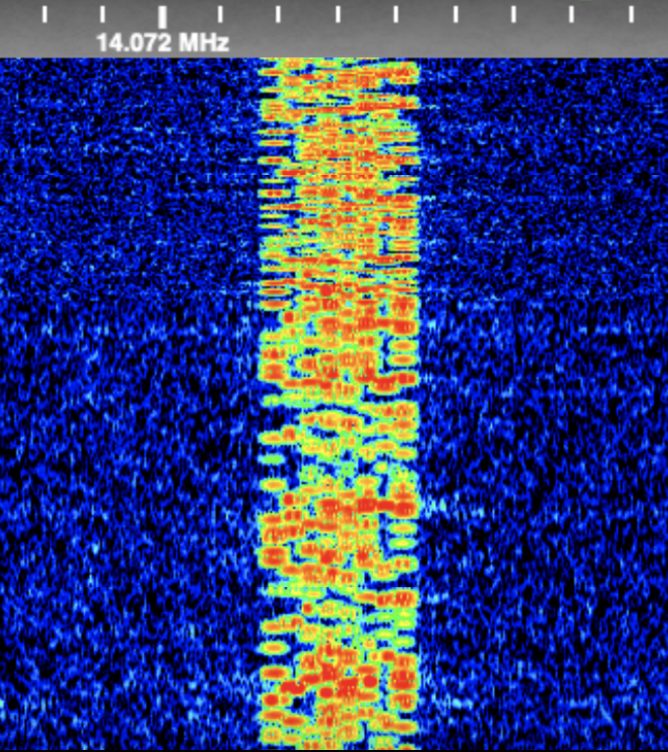
An Olivia 8/250 signal on an SDR waterfall.

I just made my first Olivia contact. The biggest hurdle was getting fldigi to work with my IC-7610. When I first ran fldigi, it received just fine, but I couldn’t get it to transmit. One of the problems was that, for some reason, there’s no official fldigi RigCAT XML file for the IC-7610, despite it being a very popular radio. 

Fortunately, I was able to find a couple of web pages that helped me get fldigi set up properly:

  • fldigi Failures Troubleshooting by N8GD
  • Configuring Icom radio for USB operation by SM7IUN

Thanks, guys, and thanks to M1GEO for coming up with a RigCAT XML file that works.

For more information on Olivia, go to the Olivia Digital Mode on HF web page. It has a bunch of information that will help you get started include a list of frequencies, links to videos by NW7US, and a link to join the Olivia Discord.

Antenna efficiency

On the X-6100 mailing list—as on many amateur radio mailing lists—there’s a discussion about the best antenna to use for portable operation. I like my 66-ft. doublet. I’ve had good success with it, and I have to believe that it’s more efficient than loaded verticals and end-fed antennas. I said as much on the list.

Of course, I can’t verify that. Not only am I not an antenna guru, there’s really no instrument that can measure antenna efficiency. Maybe some measurements could be made with a field strength meter to determine relative antenna efficiencies. Anyone have any thoughts on that?

Straight Key Night 2023

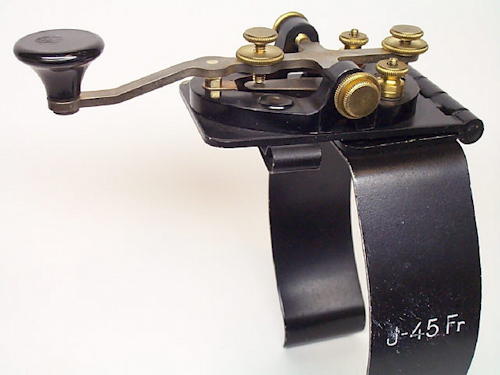
I’ve never been a big straight key guy, but even so, I dug out my J-45 key (a J-37 mounted on a leg clamp, see above) and hooked it up to the radio last night. The first contact I made was with SP7ASJ, which was nice. I made another contact before I decided to call it quits. I had intended  to make a couple more today, but I just never got around to it.

Filed Under: Antennas, CW, Digital Modes Tagged With: doublet, J-45, Olivia

Amateur radio videos: Carry a 2m Yagi in your pocket, conventional current vs. electron flow, W1SFR: made in Vermont

December 31, 2023 By Dan KB6NU 2 Comments

This is a great project. It’s simple, cheap, and looks like it works great.


I received an email this morning from a fellow who had downloaded my study guide. He wrote:

On page 5 you state, “In Figure 1, the letter I stands for current. Current flows from the positive (+) terminal of the voltage source through the circuit to the negative terminal of the voltage source.” Is this correct? I’ve read a couple of other places that it is from negative to positive.

I get this question all the time. I think that this video does a great job of explaining that while electrons do flow from negative to positive, we still use the convention that current flows from positive to negative.


Steve Robert, W1SFR, makes some great keys. His keys are unique in that they use torsion bars for tensioning instead of springs or magnets. After watching this video, I think I might want to pick up one for myself.

Filed Under: Antennas, CW, Electronics Theory Tagged With: paddles, W1SFR, Yagi antennas

Random thoughts: DLARC on Radio Survivor podcast, open-source software packaging, speed key test

November 15, 2023 By Dan KB6NU 1 Comment

Podcast peeks behind the scenes at DLARC

Radio Survivor is a podcast that covers anything related to radio, including amateur radio. In a recent episode, they interview Kay, K6KJN, curator of the Digital Library of Amateur Radio and Communications (DLARC).

SatDump Gains Notable Updates

I found this on Amateur Radio Daily:

SatDump, a popular piece of software used to decode imagery from weather satellites such as NOAA-18 and others, has gained significant updates to the way it processes and projects received images on maps. Imagery projections are much more accurate as a result of recent code refactors. A detailed deep-dive into the changes have been published.

SatDump is available for all major platforms.

This looks like a pretty cool program. I’ve added this to my list of projects to get up and running one of these days.

Speed key test

I forget on which mailing list or forum this came up, but the talk rolled around to the poor fists of some operators who use bugs and cootie keys. Someone mentioned that Navy radio operators had to pass a “speed key” test before they were allowed to use a bug on the air, and when they passed the test, they were given a certificate, like the one at right. Then, someone, with tongue firmly in cheek, suggested that hams should have to pass a similar test.

I realize that the logistics of developing and administering a speed key test for radio amateurs—not to mention enforcing it fairly—would make it an impossibility. Even so, I would encourage straight key users and cootie key users to test their fists. You can use either fldigi or a a program called Precision FistCheck to do this. Improving one’s sending not only makes it easier for the other operator to work you, but should also help you make more contacts.

Filed Under: CW, On the Internet, Software-Defined Radio (SDR) Tagged With: bug, DLARC, SatDump, speed key

Amateur radio videos: Delta loop antennas, Morse Code speed vs. proficiency, matching diodes

October 6, 2023 By Dan KB6NU Leave a Comment

Here are some videos that folks have recommended either on reddit or one of the many #hamradio mailing lists that I subscribe to.

DX Commander on delta loop antennas

Delta loops are great antennas. Here’s a tutorial on how to build one.

AD0WE on Morse Code speed vs. proficiency

Kurt, AD0WE, has done a great deal of thinking about how we learn and get better at CW—way more than I have. He has a lot more info on his Morse Code Ninja website.

M0NTV on matching diodes

M0NTV likes homebrewing diode mixers, and because one of the keys to success is using matched diodes, he’s developed a methodology for doing this.

Filed Under: Antennas, Building/Homebrew, CW, Electronic Components Tagged With: delta loop, diodes

Amateur radio in the news: Eugene woman wants to bounce signals off the moon, Morse Code making a comeback with kids, can amateur radio help with climate change?

September 28, 2023 By Dan KB6NU 1 Comment

This is a great story that shows you don’t have to be a tech nerd to appreciate amateur radio….Dan

On The Air: An unlikely conversion puts a Eugene woman in touch with a new world

I want to touch the moon.

OK, not actually. Not a hand-print-in-moon-dust kind of touch. I want to use the moon to bounce a radio signal from me to someone in Switzerland.

Up until a year ago, I didn’t know this was a thing that could be done, and I had no idea that I would want to do it. Then I got an amateur radio license, also known as ham radio. Now I am on a steep learning curve in the art and practice of ham.

…read more


Also check out the sidebar, “Using Morse Code can improve your brain health, study reveals.”

Morse Code is making a comeback!

Forget TikTok and Instagram – children and teenagers want to learn Morse Code!

Despite being created 180 years ago and not being a requirement for amateur radio operators to learn since 1990, it has been kept alive by radio enthusiasts – and now more young people are getting involved.

A combination of pandemic lockdowns forcing youngsters to learn something new, and the use of Morse Code by popular K-Pop bands, has led to ‘a renaissance’ in teens wanting to learn the once groundbreaking form of communication.

From five-year-olds to 99-year-old war veterans, people all over the world are tapping in to communicate with others on the radio.

…read more


Climate change is affecting telecommunications infrastructure. Ham radio might be able to help

As Atlantic Canada gears up for another hurricane season after a year of unprecedented disasters linked to climate change — including post-tropical storm Fiona last September — amateur radio operators say a simple technology can play a part in the response to disasters across the region.

When Fiona hit Nova Scotia, it affected electrical grids and telecommunications networks, leaving some people unable to call for help. That experience in particular prompted a renewed interest in amateur radio — also known as ham radio — which allows non-professional users to send messages without requiring the internet or cell phone networks.

“I think it’s kind of an unsung hero in communications that gets forgotten in the noise of disaster when it comes to, ‘Well, how do we get that message out?'” said John Bignell, president of the Halifax Amateur Radio Club.

…read more

Filed Under: Amateur Radio in the News, CW, Kids Tagged With: Canada, climate change, Oregon

Random thoughts about operating Parks on the Air (POTA)

July 31, 2023 By Dan KB6NU 7 Comments

I have been having a lot of fun with Parks on the Air (POTA) activations this summer. As I’ve been operating, I’ve been jotting down some random thoughts. Here are a few of them:

  • My operations are encouraging me to finally learn about antenna modeling. The reason for this is that I don’t think that I’m doing as well as I should on 20 meters. I’m thinking that’s because I’m using a 66-ft., i.e. a full-wave, doublet in an inverted-V configuration and that might have some weird antenna pattern. Perhaps if I modeled the antenna, and could get an idea of the pattern, I could orient it in some way that will give me better result. That, or just come up with some other 20-meter antenna.
  • It occurred to me after working a few slower-speed ops on my last activation that  POTA is encouraging new hams to take up CW. It’s a fixed format, so that makes the contact easier to make, most POTA contacts are relatively slow-speed contacts, and it’s overall a pretty laid-back kind of thing. I got some confirmation of this feeling this morning in the Long Island CW Club mailing list digest. In his email, Jim, N3JLN, wrote:

    Made my first CW contact today! I was a POTA hunter. Thanks to activator N2VGA for putting up with my mistakes and ridiculously slow speed. With the POTA website I was able to predict what I should be hearing and eventually get to the point I could make out his callsign and the response I should be giving.

  • This begs the question of what is the optimal speed for POTA contacts. I have been calling CQ at 17 or 18 wpm, then slowing down if need be. I think that works pretty well. Maybe I’ll try calling CQ slower from time to time to see if that gets more people to call me.
  • I’m thinking of making up a list of frequently-worked callsigns and names. That way I could personalize the contact a little. Several ops already do this, so I don’t think i’m out in left field on this.
  • I worked my first POTA DX a couple of activations ago. 15 meters was open to Europe, and I had an Italian and a Swede call me. Both had strong signals. I didn’t have quite so much luck on 15 meters last time, though.
  • I had some weird RFI when operating 20 meters last Friday. Somehow, something was getting into the little external speaker that I plug into the KX-3.  When I unplugged the speaker and plugged in my headphones, the noise went away.
  • This last thought I’m not quite sure about. I’m thinking that one feature that the POTA folks might add to pota.app is messaging. It might be nice to message other folks that are logged into the website. As I say, I’m not 100% sure about this idea, though.

Please let me know what ideas you might have had while activating parks or hunting activators.

Filed Under: CW, Parks on the Air Tagged With: rfi

From my Mastodon feed: FutureSDR, ear training, WTF?

July 23, 2023 By Dan KB6NU 2 Comments

As Twitter descends into hellhole that Elon Musk is making it into, more hams are showing up on Mastodon, a “non-profit, abuse-free social network based on open web standards and principles.” I am @[email protected]. Mastodon.Radio is a space for the amateur (ham) radio community and anyone interested in shortwave listening (SWL). It’s run by Christopher, M0YNG. Thanks, Chris!

I’m finding it actually more interesting than Twitter for ham radio kinds of things. Here are three things that were in my feed yesterday.

FutureSDR WebAssembly SDR Live Coding

The author of FutureSDR, Bastian Bloessl, describes FutureSDR, as:

An experimental asynchronous SDR runtime for heterogeneous architectures that is:

  • Extensible: custom buffers (supporting accelerators like GPUs and FPGAs) and custom schedulers (optimized for your application).
  • Asynchronous: solving long-standing issues around IO, blocking, and timers.
  • Portable: Linux, Windows, Mac, WASM, Android, and prime support for embedded platforms through a REST API and web-based GUIs.
  • Fast: SDR go brrr!

Here, he does a little live coding that some of you might find interesting.


Open Ear

OpenEar is an open source ear training app for musicians that runs on Android phones and tablets. It includes exercises to help musicians master recognizing musical patterns. I’m wondering if it might also help those learning Morse Code. If you do download it and try it, let me know.


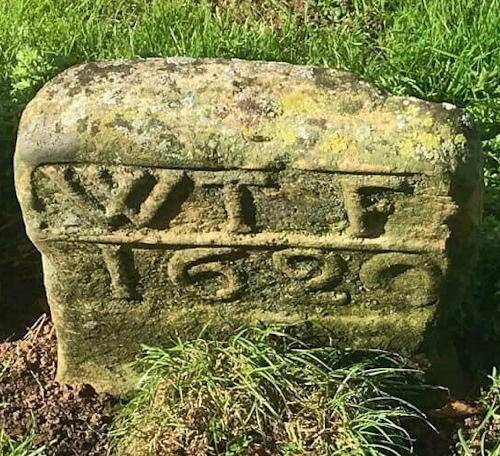
WTF?

Flashdancer (@[email protected]) shared this photo, noting, “I’m assuming that 403 years ago this person died very unexpectedly.”

Filed Under: CW, Just for Fun, Software-Defined Radio (SDR) Tagged With: FutureSDR, Open Ear

Operating Notes: Odd prop, is zero beating a lost art?

February 4, 2023 By Dan KB6NU Leave a Comment

Odd propagation

A couple of weeks ago, I turned on the rig, tuned up on 30 meters, and called CQ. The first station I worked was KB8FCG. According to QRZ.Com, KB8FCG is 28.8 miles away from me. The signal was S9 here in Ann Arbor. That seems a little too far for ground wave, but a little too close for sky wave.

The second station I worked that even was S57V. QRZ.Com says that S57V is is 4,600 miles away. He gave me a 579 report.

Is zero beating a lost art?

Zero beating is the practice of matching your transmitting frequency to that of the station you’re calling or are in contact with. Because most new rigs have DSP filtering, zero beating is more important than ever. If you call a station calling CQ, and your transmit frequency is off by more than 100 Hz, the station calling CQ may never hear you because you’ll be outside the passband.

I had this happen twice the other night. The first station to answer my CQ was 250 Hz up, the second was 250 Hz down. If I hadn’t seen these two stations on my bandscope, I never would have heard them.

The moral of the story is that if you’re answering a CQ, get as close to the station’s transmit frequency as you can. You do this by matching the frequency of the incoming signal to the frequency of your sidetone. That is to say that if you have your sidetone set to 500 Hz, the frequency that you hear when you’re receiving should also be 500 Hz.

There are a bunch of good YouTube videos on the topic. Here’s a good one:

A new Q signal?

So, I’ve been on the air quite a while now, and have contacted many stations many times. That being the case, I generally don’t need them to send me their name and location. I’d like to propose a new Q signal that will tell the other station that there’s no send this information again.

My first thought was to use QHI. There’s already a definition for QHI, but it’s not used at all in ham radio, and I bet that we could get away with it. WATSA OMs?

Filed Under: CW, Operating, Propagation Tagged With: Q-signals, zero beat

Amateur radio in the news: Morse Code edition

January 22, 2023 By Dan KB6NU Leave a Comment

Oddly enough, Morse Code has been in the news lately. Here are three articles that I’ve run across recently……Dan


This article appear in the  January/February 2023 issue of Smithsonian.

Looking to Ditch Twitter?
Morse Code is Back

For almost 20 years, Steve Galchutt, a retired graphic designer, has trekked up Colorado mountains accompanied by his pack of goats to contact strangers around the world using a language that is almost two centuries old, and that many people have given up for dead. On his climbs, Galchutt and his herd have scared away a bear grazing on raspberries, escaped from fast-moving forest fires, camped in subfreezing temperatures and teetered across a rickety cable bridge over a swift-moving river where one of his goats, Peanut, fell into the drink and then swam ashore and shook himself dry like a dog. “I know it sounds crazy, risking my life and my goats’ lives, but it gets in your blood,” he tells me by phone from his home in the town of Monument, Colorado. Sending Morse code from a mountaintop—altitude offers ham radios greater range—“is like being a clandestine spy and having your own secret language.”

…read more


Forget dot com, Americans are making a new dash for Morse code

A few years ago a group of New York ham radio enthusiasts decided to address a glaring problem. “There were not enough Morse code operators on Long Island,” said Howard Bernstein, 70, a retired chemicals importer.

Unfortunately, you have to be a subscriber to The Times to read the entire article. I don’t usually include articles behind pay walls, but I thought this was illustrative of a trend, so I included it here…Dan


I thought that perhaps the military’s experience with the Basic Morse Mission Trainer (BMMT) might have some applicability in teaching amateur radio operators Morse Code. I asked about this on the CWops mailing list, thinking that some of the members might have been trained using this system. While there were a couple, they didn’t think that this would be a good way to teach hams Morse Code. For one thing, the training was very specific to receiving random code groups and not with actually communicating with Morse Code…Dan

Innovation on Morse Code for the US Military

On January 10, 1991, the U.S. Army Intelligence School Devens (USAISD) introduced the Basic Morse Mission Trainer to the 98H Morse intercept operator and 98D emitter identifier/locator advanced individual training courses. This system revolutionized the training of Morse code copying skills for both students and instructors, reducing course attrition, and turning out better trained operators faster.

In April 1985, the deputy secretary of defense had approved the consolidation of all four military services’ manual Morse intercept training at USAISD, located at Fort Devens, Massachusetts. By 1988, consolidated training was in full swing, but instructors struggled with high attrition rates and student burnout in the basic Morse course. Mitigation measures included shortening the training day, standing up a diagnostic laboratory to help identify learning patterns of Morse students, and developing an aptitude test to predict student success in the course.

Perhaps the most significant factor to reducing course failures, however, was the introduction of the Basic Morse Mission Trainer (BMMT) to teach touch-typing and basic Morse code. Developed by Russell Beller and Kevin Mott, two civilian instructors in USAISD’s Morse Collection Department (MCD), the new computer-based system would replace the antiquated Morse Code Trainer (MCT)-4 in use since the late 1960s. The Army awarded a procurement contract to Engineering Research Associates on April 19, 1989 which delivered the new systems in October 1990. Three months later, on January 10, 1991, the BMMT was used for the first time in training.

…read more

Filed Under: CW, Everything Else Tagged With: BMMT, LICW, Smithsonian, SOFREP, Sunday Times

  • « Go to Previous Page
  • Page 1
  • Page 2
  • Page 3
  • Page 4
  • Page 5
  • Interim pages omitted …
  • Page 38
  • Go to Next Page »

Primary Sidebar

No Nonsense Technician Class License Study Guide (for tests given between July 2026 and June 2030)

New No Nonsense Technican Class Study Guide now available!

The 2026 version of my Tech Class study guide is now available, and as always, the PDF version is FREE!. The ePub version costs $11.97, and a Kindle version and paperback version will be available on Amazon shortly.

Click here to get all of my "No Nonsense" study guides.

Also available: The CW Geek's Guide to Having Fun with Morse Code

W5SWL.Com
Retevis Ailunce H1 DMR Radio
DXpander: Cobweb antennas, Laser Cutting

You’ve got mail!

Enter your email address below and get an email every time I publish a new post.

Email


I frequently teach classes to help newcomers get their licenses. The next class will take place on Saturday, October 10, 2026 on the University of Michigan campus. Click here for more information.

If you can't make the class, subscribe to the mailing list to be notified of when the next class will be held.

You can always download my free study guide, and if you have any questions about the classes, or amateur radio in general, please feel free to email me directly.

Support KB6NU.Com

Donate $7.30 and get two of these cool stickers. Measuring 4.25-in. W by 2.75-in. H, it's perfect for your car, your shack, or wherever!

Contact me

If you have a question or comment about one of my blog posts, or a question about any of the material in my study guides, or just a question about ham radio in general, you can email me at [email protected].

Blogs You Should Also Read

  • AE5X: A CW-centric blog from Kingswood, Texas
  • K0LWC Blog
  • LA3ZA Ham Radio Blog
  • Little Radios, Big Fun – WB3GCK
  • Mr. Vacuum Tube's Blog
  • Radio Artisan – K3NG
  • The K0NR Weblog
  • VE3WDM's QRP Ham Radio Blog
  • W2LJ’s Blog

Ham Radio Websites

  • Dashtoons – The Hammin' Comedy by Jeff K1NSS

Podcasts

  • ICQ Podcast
  • Linux in the Ham Schack
  • No Nonsense Amateur Radio Podcast
  • Resonant Frequency Amateur Radio Podcast

Recent Comments

  • Dan KB6NU on Some Ham-Vention History
  • David Pompea on Some Ham-Vention History
  • Walter Underwood on One lump or two (or three)?
  • Mike, KL7MJ on Question pools should make teaching classes easier
  • Karl Heinz - K5KHK on Question pools should make teaching classes easier

Meta

  • Log in
  • Entries feed
  • Comments feed
  • WordPress.org

Footer

Copyright © 2026 Daniel M. Romanchik, KB6NU · Log in