• Skip to primary navigation
  • Skip to main content
  • Skip to primary sidebar
  • Skip to footer

KB6NU's Ham Radio Blog

KB6NU's Ham Radio Blog
  • HOME
  • Study Guides
  • Teach a One-Day Tech Class
  • W8SRC Repeater Guide
  • Advertise
  • Hire Me

CW

Operating Notes: Auroral flutter, big pileups for TN8K, more new ops?

January 13, 2023 By Dan KB6NU 2 Comments

I called CQ on 30 meters a couple of evenings ago and got a surprise call from R1DX in Saint Petersburg. What was notable about this contact was the auroral flutter on Vic’s signal. I wish I had recorded it. The sound is very distinctive, though, and Vic even commented on it.

Here’s the great circle route between Ann Arbor, MI and St. Petersburg:
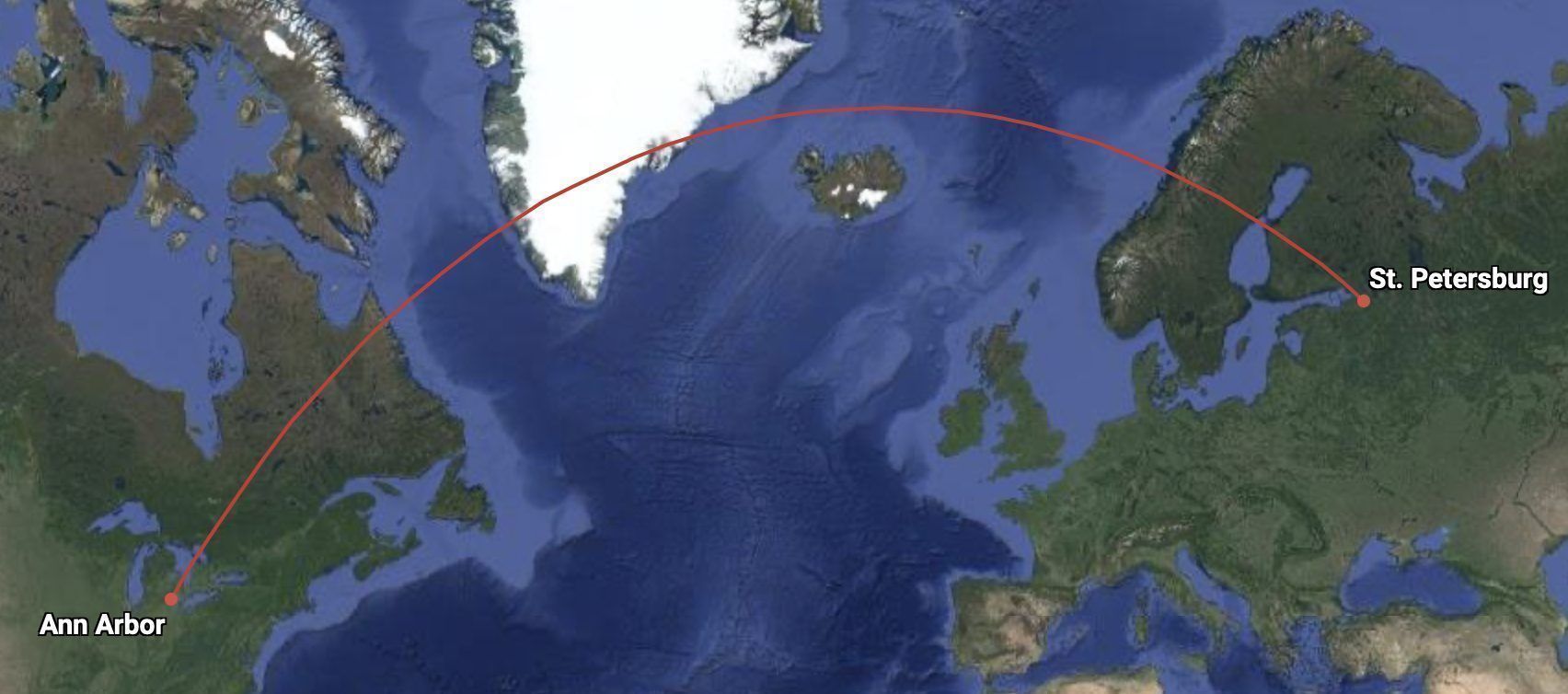
It doesn’t seem like that route goes north enough to be affected by aurora, but I suppose that it could be. The signal may have also taken a more northern route and been affected by the aurora. If you’re a propagation guru, I’d like to hear what you think about this.

Big pileups for TN8K

TN8K has been generating some pretty big pileups. Here’s one on 30 meters on January 8:
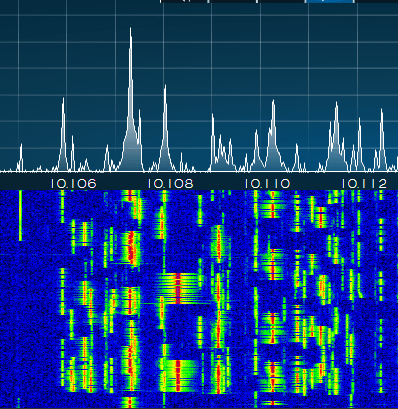
Personally, I just wait these things out, as I don’t really have a station competing in these kinds of pileups. I’m hoping to catch them towards the end of the DXpedition.

More new ops?

It may just be a coincidence, but it seems as if I’m working more new ops lately. By that I mean hams that I don’t have a record of working before. Some of these seem to be operators that have just started operating CW, like the KD4 I worked last night. Others are long-time hams that are coming back to CW.

I hope that this is a trend. We need as many CW ops as we can muster, and it’s always a pleasure to turn on the rig and see the band scope full of CW signals.Credit to CWops, Long Island CW Club, and all the other CW clubs and websites that are promoting the use of CW.

REMINDER: If  you’re an experienced CW op, slow down once in a while and work these newcomers. Encouraging them today will help them become the experienced ops of tomorrow. And, you my just meet an interesting person and make a friend.
Filed Under: CW, DX Tagged With: Russia, TN8K

Operating notes: Do I have a stalker?, don’t be a macho CW op, DXCC update

December 26, 2022 By Dan KB6NU 2 Comments

Over the past week, I’ve had a couple of odd QSOs. The first was with a guy who I almost think is stalking me. He has a tendency to call me right after I’ve completed a contact with another station. Usually, I kind of sigh every time I hear his call because he’s very hard to copy.

What makes him hard to copy is that he slurs some characters together, while actually separating the dits and dahs in other characters. For example, instead of  sending “WELL,” he’ll send what sounds like “PLL.” When sending a “G,” he’ll often send “ME.”

Anyway, the other night, his signal was fading in and out, and at one point, I lost him. So, I moved down the band a bit and called CQ. He heard my call and called me again, so I decided to give it another try even thoughI had a feeling that he’d fade out again. Instead of picking up where we left off, though, he gave me an earful for leaving him in the lurch on the other frequency—even after I tried explaining that I had lost him. Sheesh.

My point here is don’t make it unpleasant for other stations to work you. Try to send as well as you can, and be courteous when you lose a contact. Poor behavior just turns people off.

Don’t be a macho CW operator

One of the “rules” of operating CW is to not send faster than you can copy. Unfortunately, this happens at higher speeds as well as at lower ones. The other night I heard a guy calling CQ at about 25 wpm, and I replied at that speed. After my first transmission, I could tell, however, that the other guy, while his sending was pretty good, just wasn’t copying fast enough. I surmised this because he didn’t really reply to me, but instead, went off in a different directions. I guess he figured this out, too. Instead of asking me to slow down, he signed off on his third transmission.

The point here is don’t be too “macho” when it comes to Morse Code. If you’re not copying enough, ask the other operator to slow down (QRS). In this case, I would have happily done so, and we probably would have had a nice conversation.

DXCC update

As a result of working several of the recent African DXpeditions, including D60AE (Comoros), 5V7RU (Togo), and J28MD (Djibouti), I’m now at 167 DXCC entities worked. My next goal is 200. Maybe I’ll get lucky and reach this by the end of this sunspot cycle.

Filed Under: CW, DX Tagged With: DXCC, macho

Who says CW ops don’t have a sense of humor?

December 23, 2022 By Dan KB6NU 2 Comments

Enzo, M0KTZ, recently posted a series of CW jokes to his website. He writes:

You find below a collection of ham/CW-themed Christmas-Cracker jokes. They come from a challenge put up by Steve G4OCP at Essex CW ARC, who wanted to celebrate the festive season in style: sending to each other jokes in CW! I mentioned the challenge to my son Giorgio, and we ended up spitting out the jokes you find below, one after the other, more or less in the same order as they are listed. Just one of them is not genuinely ours (can you spot it?), and the blame for the worst ones is obviously on me HI HI.

Here’s a sample:

https://www.kb6nu.com/wp-content/uploads/2022/12/cw-joke-m0ktz-12wpm.mp3

For those of you that are CW-challenged, here’s the joke, “VVV – Why was Samuel Morse bad at canoeing?      He did not have a dual paddle. HI.” OK, so you’re not going to be hearing these jokes on a Netflix comedy special anytime soon, but they’re still amusing—if you’re a CW operator, anyway. You’ll find 27 more at https://m0ktz.katolaz.net/jokes.html.


Filed Under: CW Tagged With: humor

JA1NUT: Two Issues in Morse Code Learning

December 11, 2022 By Dan KB6NU 2 Comments

On the Long Island CW Club’s mailing list, someone posted a link to a blog post by Shin, JA1NUT, Two Issues in Morse Code Learning. JA1NUT is a great operator, so his advice is well worth taking.

The first issue is whether or not learning code using software is a good idea. Shin writes, “I would question if it is the best or the only way to learn it. Learning through software may help people a lot to remember all characters in Morse code in the beginning. After that step, is software learning ideal way or not, I wonder.”

I agree with JA1NUT that using software to get started is fine, but at some point, you have to wean yourself off of whatever software you’re using and get on the air. I think you’ll get faster quicker if you do. Just bite the bullet and do it. After all, the point of learning the code is to make on-air contacts, isn’t it?

The second issue is whether or not it’s a good idea to advise new operators to copy words.  Shin is not so sure that it is. He writes:

I guess advising that way [learn to copy words instead of characters], the senior operators are not conscious of what’s going on in reception process. We are taking the meaning of the message at every moment. When we copy a part of the word being sent, we subconsciously try to read the latter part of the word. We guess what word should follow in the context. Reading a sentence or even a whole message, we are guessing what to come next from the context. It is done almost unconsciously.

I say something similar in my blog post, Another perspective on copying CW in your head. I think what’s going on is more complicated that copying words, and aside from some simple, common words, I don’t copy words in my head.

In another blog post, Become a CW head case, I repeat some advice from the Malta Amateur Radio League. They write,

Listen for meaning. The goal is to learn to listen to the code as you would to the spoken spoken word. Eventually the sound will trigger your consciousness just as the spoken word does.

I end that second blog post with this paragraph:

I know a lot of this advice is kind of nebulous. Much of it is anecdotal, and as I said before, what works for one person may not work for another. I know you’re all probably tired of hearing this, but the best advice, whether it be for learning the code, learning to copy code faster, or learning to copy in one’s head is to just keep practicing. It’s just like any skill whether it be bowling or woodworking or playing a musical instrument, you gotta work at it.

Filed Under: CW Tagged With: head copy, JA1NUT, Long Island CW Club

Is this the beginning of the end for CW DXing?

November 10, 2022 By Dan KB6NU 4 Comments

In a recent thread on the CWops mailing list, a fellow wrote:

You wonder why more and more guys are getting on FTx mode? How about this?

    • MADAGASCAR, 5R. Eiki, JH8JWF is QRV as 5R8AS from Ivato, Talatamaty, IOTA AF-013, until November 6. Activity is on 80 to 6 meters using FT8. QSL via LoTW.
    • GHANA, 9G. Dave, AB0GC is QRV as 9G1SD from the Wenchi, Brong Region. Activity is on 17 to 6 meters using FT8 and FT4 at various times during the day. QSL direct to home call.
    • BANABA ISLAND, T3. Members of the Rebel DX Group are QRV as T33T until November 15. Activity is on 160 to 6 meters using FT8 in DXpedition mode. QSL via LoTW.
    • INDONESIA, YB. Amir, YB9IPY/p is QRV from the Rajaampat Islands, IOTA OC-239, until November 8. Activity is on the HF bands using only FT8. QSL direct to IK2DUW.

I’m not on FT modes, but if you like chasing DX and new band/countries, or ARRL DX Challenge, or even tracking weird and unexpected LP propagation on a “dead” band, stuff like this makes it start to become a rational decision.

Sigh….

What followed was a wide-ranging discussion of CW vs. the digital modes. Some thought that FT4 and FT8 were cheapening the value of DXCC and other DX awards (as if they had any real value to begin with). Others just brushed it off saying, “There are a steadily increasing number of ways to enjoy this hobby.  Pick your favorites for whatever reasons excite you.”

I’m more in the second camp than the first. If people get their kicks from operating FT8, then more power to them. It’s funny when you think about it. We CW operators often say that one reason for operating CW is that it’s easier to work DX on CW than phone. So, I guess it’s a bit hypocritical to bad mouth FT8 just because FT8 makes it even easier to work DX.

I’m not a big DXer, so it’s not a big deal if I don’t work Banaba Island this time around. And, overall, I think anything that gets people on the air is a good thing. Even so, not even having the chance to work these DXpeditions unless I fire up the FT8 software is a little disappointing.

What do you think?

Filed Under: CW, DX Tagged With: FT8

Operating Notes: Setting goals, DX on 30m

November 6, 2022 By Dan KB6NU 1 Comment

One of the operating activities that I participate in is the CWops QTX competition. Technically, QTX is the Q signal for “I will keep my station open for further communication with you until further notice (or until ____ hours),” but in amateur radio we use QTX to mean a long contact or ragchew.

To qualify as a QTX QSO in this activity, the contact has to last for at least 20 minutes. Every month, a bunch of us send our results in, and they get posted in the CWops newsletter.

One of my goals is to finish in the top ten, and I almost always manage that. Another goal is to make at least one QTX QSO every day. So far, I have only managed to this once. I recently submitted my score for October and noted, “Fell just short again of my goal of one per day. I guess that’s just going to be how it goes. :)” To which, Bruce, K8UDH, who compiles the reports, replied, “Yes, you’re just a little bit short of your goal, but you probably wouldn’t be where you are today without your solid goal.”

I think he’s got a point there.Setting goals for oneself, even for something as silly as making ragchew QSOs will help you achieve more. You may not always reach your goal, but you will achieve more than if you don’t have one. Next, I’m going to have to set up a goal to complete some of the homebrew projects that I have littering my workbench. Maybe I’ll finally get one or two built.

I’m thinking that completing one every two or three months is reasonable. What do you think?

DX on 30m

If you’ve been on the bands lately, you’ll know that propagation is indeed getting better. This is nice, because while I’m not a big DXer, I do like to add countries once in a while. In the past  month, I’ve worked a couple of new countries, including the D60AE DXpedition to Comoros and the 5V7RU DXpedition to Togo.

I was able to log D60AE just before they ended operations. By that time, the pileups on 30m had slowed down, making it easier for me to break the pileup. At first, I wasn’t sure that they had my call sign correct. Every time they sent my call, their signal seemed to fade a bit, and I never heard them send my call completely. I checked the online log the day after I worked them, though, and sure enough, my call was correct there.

Working 5V7RU the situation was a bit different. I had completed a QSO on 10117 kHz, and was just puttering around, with the receiver still tuned to that frequency. About 15 minutes later, 5V7RU comes on and starts calling CQ. I heard them right away and was able to work them just before the pileup descended on the frequency. That was pretty cool.

Filed Under: CW, DX, Operating

Amateur radio videos: Intro to digital communications, putting up a hex beam, Begali paddles

October 16, 2022 By Dan KB6NU 1 Comment

Here are some more great YouTube videos I’ve come across lately. This first one is a pretty good introduction to all the digital modes we, as radio amateurs, can operate.


I’ve been thinking about putting up a hex beam here for a while. The only reason I haven’t done it yet is because I’m thinking about moving.


Have I ever mentioned that I’m a Begali fanboy?

Filed Under: Antennas, CW, Digital Communications Tagged With: Begali, hex beam, paddle

ICQ Podcast #385: Is 10 W enough?

September 13, 2022 By Dan KB6NU Leave a Comment

For this episode, I joined Martin Butler M1MRB, Caryn Eve Murray KD2GUT, Edmund Spicer M0MNG and Ed Durrant DD5LP to discuss the following topics:

  • PRESENTER OPINION : How Healthy is your Club?

  • New Zealand acts over Importation of Handheld Transceivers

  • Special 9/11 Call Sign

  • Regulations change Challenges Amateurs in Cambodia

  • The Ultimate in SOTA/POTA/Portable All in One event

  • New Advocate for Slow CW

There’s also an interesting news story on how two Florida clubs are collaborating. This episode’s feature is “Is 10 Watts Enough?”

Filed Under: Clubs, CW, Parks on the Air Tagged With: Cambodia, New Zealand

Operating notes: CW Open

September 4, 2022 By Dan KB6NU 4 Comments

I’m not a big contester, but I am a member of CWops, and the CWops host a contest every year called the CW Open, and this contest takes place on Labor Day weekend. This year, I decided to take part.

My participation actually got started in a funny way. One of the things that I do for CWops is to manage the website. Just before the contest, there was some question as to whether the form used to submit teams rosters for the contest was working properly. So, to test the form, I submitted a team called Team Website, consisting of me and Theo, SV2BBK, who is also one of the website administrators.

When the list of teams was first published, Team Website was included in  the list. Theo mentioned this and suggested that Team Website be deleted. I thought about this for a second and suggested just the opposite. I thought that we should not only keep Team Website on the list, but recruit other CWops members who might also be casual contesters.

I’m happy to say that this was a big success. Theo and I had six other CWops join us on Team Website. I think that these folks had always wanted to be a member of a team, but didn’t want to feel obligated to operate the entire contest or who—like me—don’t have a fancy contest station. As I told the team members, we have no goals or expectations, so it’s very easy to meet them!

My score

The contest is split into three, four-hour sessions. I operated for about two hours, about a half hour in the first session and an hour and a half in the third session. I made 20 contacts in the first session and 95 contacts in the second session. I spent most that first 20 minutes getting used to using N1MM again and doing search and pounce.

I started out the second session doing search and pounce on 20 meters, where I made 20 contacts before the signals began to fade. Then, I switched to 40 meters, where the signals were quite strong. I still operated mostly search and pounce, but towards the end switched over to running a frequency.

That was and really upped my score. As you can see, I made a little more than one contact per minute in that final session. That’s pretty good for me.

Read the rules!

I could have made a couple more contacts had I read the rules beforehand. In most contests, you can only make contacts once per station per band. In the CW open, you can make contacts once per session per band.

So, what happened is that several stations called me during the third session who I’d already worked on 40 meters in the first session. N1MM flagged these contacts as dupes and I refused to log those contacts. This happened several times, so I decided to read the rules. That’s how I found out that I was doing it wrong. In fact, the CW Open web page says, “May contact for points only once per band, per session. Note: do not remove dupes from your log.”

Anyway, I had fun. I haven’t heard back from my other team members, but I hope they all had as much fun as I did.

Filed Under: Contests, CW Tagged With: CWOps

From QST: August 1922, 1972, 1997

August 20, 2022 By Dan KB6NU 1 Comment

Some interesting articles—at least they’re interesting to me—from the 1922, 1972, and 1997 issues of QST…

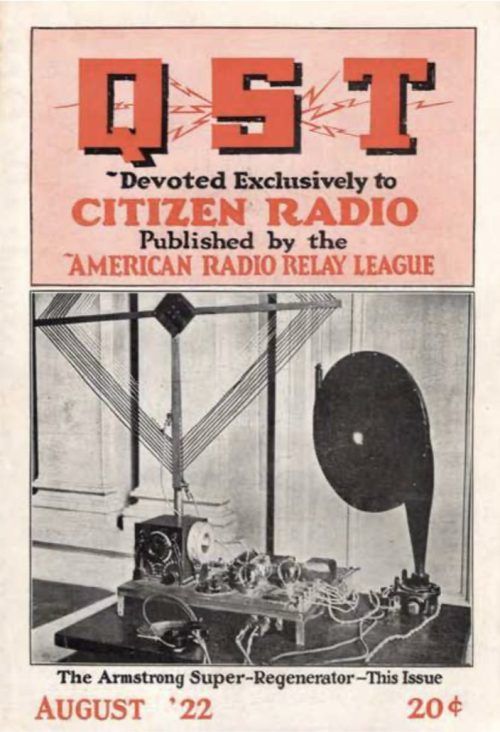
More on Super Regeneration (August 1922). In the early 1920s, regenerative receivers were a hot, new thing. This article describes some of Edwin Armstrong’s latest work and includes a circuit for a three-tube regen receiver.

Learning Morse (August 1972). In 1972, you still had to pass a Morse Code test to get an amateur radio license. In this article, WA1FKF, answers questions that hams are still asking today, including:

  1. How quickly should I be able to learn radio code?
  2. Could I possibly be too old to learn?
  3. Is it better to start with characters being sent rather quickly with a space between each or should the whole process be scaled down?

and more.

Correspondence (August 1997). This month’s issue had several interesting letters. One of them discussed the idea of removing countries from the DXCC list whose governments did not provide their citizens with basic human rights. Another talked about how to reach out and recruit both young folks and retirees into the hobby. Another labelled the no-code Tech license as a “successful failure” because so many of these licensees do not stick with the hobby. Aside from the first letter, we’re still dealing with these issues today.

Filed Under: ARRL, CW, Receivers

  • « Go to Previous Page
  • Page 1
  • Page 2
  • Page 3
  • Page 4
  • Page 5
  • Page 6
  • Interim pages omitted …
  • Page 38
  • Go to Next Page »

Primary Sidebar

No Nonsense Technician Class License Study Guide (for tests given between July 2026 and June 2030)

New No Nonsense Technican Class Study Guide now available!

The 2026 version of my Tech Class study guide is now available, and as always, the PDF version is FREE!. The ePub version costs $11.97, and a Kindle version and paperback version will be available on Amazon shortly.

Click here to get all of my "No Nonsense" study guides.

Also available: The CW Geek's Guide to Having Fun with Morse Code

W5SWL.Com
Retevis Ailunce H1 DMR Radio
DXpander: Cobweb antennas, Laser Cutting

You’ve got mail!

Enter your email address below and get an email every time I publish a new post.

Email


I frequently teach classes to help newcomers get their licenses. The next class will take place on Saturday, October 10, 2026 on the University of Michigan campus. Click here for more information.

If you can't make the class, subscribe to the mailing list to be notified of when the next class will be held.

You can always download my free study guide, and if you have any questions about the classes, or amateur radio in general, please feel free to email me directly.

Support KB6NU.Com

Donate $7.30 and get two of these cool stickers. Measuring 4.25-in. W by 2.75-in. H, it's perfect for your car, your shack, or wherever!

Contact me

If you have a question or comment about one of my blog posts, or a question about any of the material in my study guides, or just a question about ham radio in general, you can email me at [email protected].

Blogs You Should Also Read

  • AE5X: A CW-centric blog from Kingswood, Texas
  • K0LWC Blog
  • LA3ZA Ham Radio Blog
  • Little Radios, Big Fun – WB3GCK
  • Mr. Vacuum Tube's Blog
  • Radio Artisan – K3NG
  • The K0NR Weblog
  • VE3WDM's QRP Ham Radio Blog
  • W2LJ’s Blog

Ham Radio Websites

  • Dashtoons – The Hammin' Comedy by Jeff K1NSS

Podcasts

  • ICQ Podcast
  • Linux in the Ham Schack
  • No Nonsense Amateur Radio Podcast
  • Resonant Frequency Amateur Radio Podcast

Recent Comments

  • Dan KB6NU on Some Ham-Vention History
  • David Pompea on Some Ham-Vention History
  • Walter Underwood on One lump or two (or three)?
  • Mike, KL7MJ on Question pools should make teaching classes easier
  • Karl Heinz - K5KHK on Question pools should make teaching classes easier

Meta

  • Log in
  • Entries feed
  • Comments feed
  • WordPress.org

Footer

Copyright © 2026 Daniel M. Romanchik, KB6NU · Log in