• Skip to primary navigation
  • Skip to main content
  • Skip to primary sidebar
  • Skip to footer

KB6NU's Ham Radio Blog

KB6NU's Ham Radio Blog
  • HOME
  • Study Guides
  • Teach a One-Day Tech Class
  • W8SRC Repeater Guide
  • Advertise
  • Hire Me

CW

Operating notes: a (tr)usdx @ 200 W?, dead last in the MS QSO Party, 30 wpm ragchew

July 14, 2022 By Dan KB6NU 1 Comment

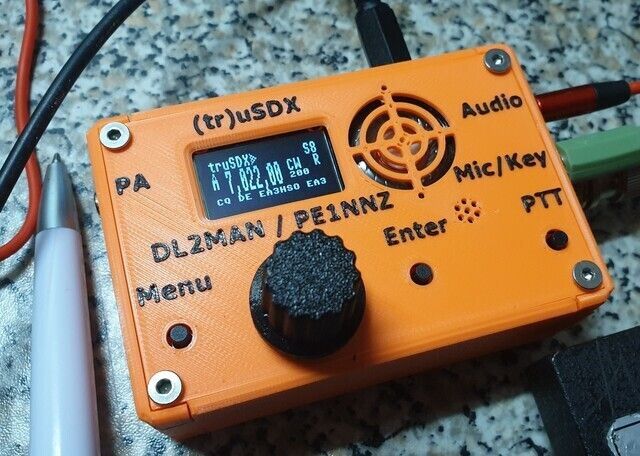
The other day, I worked a guy who said that he was using a (tr)usdx at 200 W! As it turns out, he had connected his little, 5 W radio (see right) to a linear amplifer.

Our QSO has encouraged me to get mine built. I’m hoping to get strarted on that this weekend.

One thing that he warned me about is to make sure to take ESD precautions. Indeed, several of the members of our club who have built these have had ESD failures. I do all my assembly work on a conductive mat, and for this build, I’ll also make sure to use the ESD wrist strap. The elevated humidity in my basement should help mitigate the problem as well.

Dead last in the MS QP

Last Saturday, I got an email from W5XX. Attached, were the results of 2022 MS QSO Party. Turns out, that with only 5 CW QSOs and 10 points, I was dead last from the state of Michigan. There were a few other participants that scored lower than me, but only a few.

A 30 wpm ragchew

I recently had a contact with Jeff, KA9s. He was going pretty fast (30 wpm), but I decided that since his signal was pretty strong, and his fist was pretty good, that I could hang with him. So, I cranked my keyer up to 30 wpm and called him.

Over the first couple of exchanges, I discovered that I could indeed hang with him and settled in for a ragchew. Jeff was a great ragchewer. The conversation never lagged as he asked question after question. An hour later, I realized that I had to QRT.

I have noticed that I’ve been getting faster lately, and this QSO just confirmed this. Today, I looked up Jeff on QRZ.Com and realized why he’s such a speedy operator. His last name is Goodspeed!

Filed Under: CW, Operating Tagged With: KA9S

KB6NU on the DitDit Podcast

June 11, 2022 By Dan KB6NU 1 Comment

A week or so ago, Bruce, N9WKE, phoned me and asked if I would appear on the Dit Dit podcast. He hadn’t produced an episode in nearly two years and wanted to get started again. He said that he wanted to have me on his show because I was “the #1 most requested guest.”

Now, I don’t know if that’s true or not, but it was still an honor to be asked. Here’s the episode:

The podcast doesn’t break any new ground, so if you’ve heard any of my talks or read my CW Geek’s Guide, you can pretty well guess what I have to say. But, it was a lot of fun to record, and I think you’ll enjoy listening to it.

Filed Under: CW, Podcasts Tagged With: DitDit

Amateur radio videos: High-Speed Telegraphy 2021, college kit build, winding toroids

April 20, 2022 By Dan KB6NU Leave a Comment


Some of these operators are just amazing…


One of the most encouraging things in amateur radio is the renewed interest at the college level. Here’s an example:


Just for fun, here’s a little electronics theory….

Filed Under: Building/Homebrew, CW, Kits Tagged With: QRQ, toroids

You never know what you’re going to find….

February 20, 2022 By Dan KB6NU 4 Comments

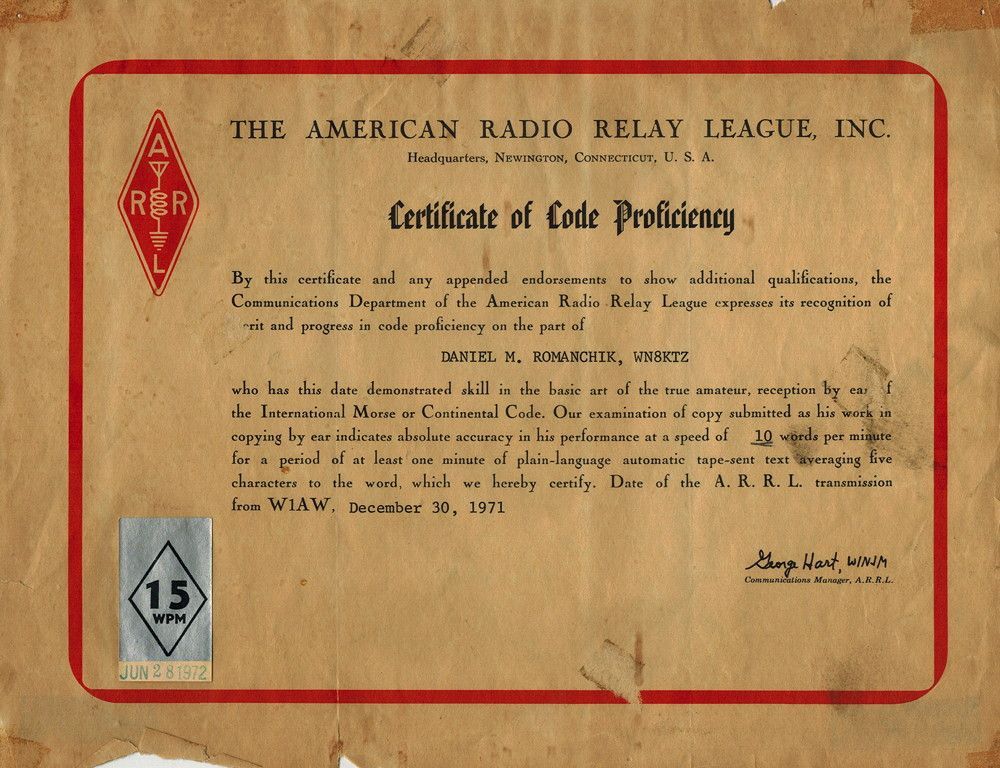
I was puttering around the shack yesterday, putting some stuff away and throwing out stuff that I’ve either finished with or will probably never get back to. In doing so, I ran across this:

It’s hard to read, but the date of the 15 wpm endorsement is “JUN 28, 1972, almost 50 years ago! I think that, just for fun, I’ll try to qualify for the 30 wpm endorsement.

The certificate itself is really brittle, but I don’t want one of the new ones. I don’t like the way they look with the Vibroplex key on them. Maybe I can have this one laminated.

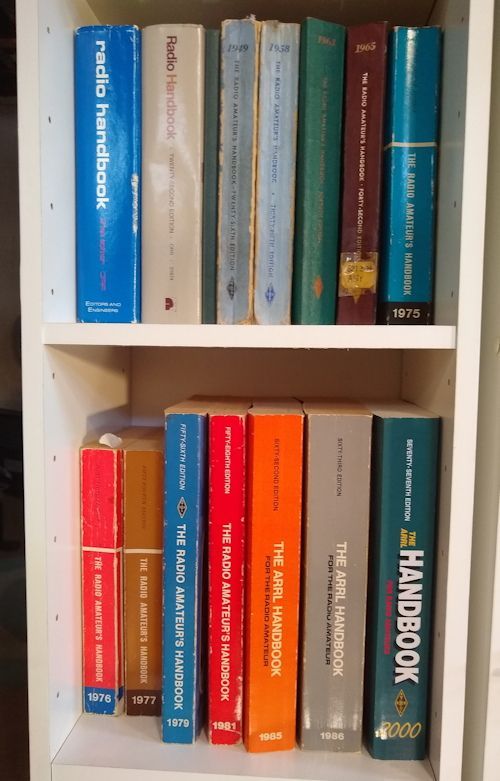
While I was at it, I decided to re-organize my small collection of ARRL Handbooks.

As you can see, I have the 1949, 1958, 1963, 1965, 1975, 1976, 1977, 1979, 1981, 1985, 1986, and 2000 Handbooks. Not shown is the six-volume 2022 Handbook that I purchased a couple of months ago.

Paging through these Handbooks really gives one a sense for the history of the  hobby. For example, the 1948 Handbook has a chapter on broadcast interference (BCI). Now, we’d call that radiofrequency interference (RFI) or electromagnetic interference (EMI). Also, I didn’t find any information on RF exposure in the 1948 Handbook.

Filed Under: ARRL, Books and Magazines, CW Tagged With: CW proficiency, Handbook

Slow-Speed (CW) Tests: I’m a believer

January 16, 2022 By Dan KB6NU 474 Comments

The CWops have this thing they call the CW Test, or CWT. CWTs are held every Wednesday/Thursday, and include four, one-hour sessions at times that favor different geographic areas. They’re not exactly contests, and some CWops think of them as practice sessions for the “real” contests, but people post their scores to 3830scores.com and brag about them on the CWops mailing list, so they’re more than just practice sessions.

Not being a contester, I’m not a big fan of CWTs. I’ve participated in maybe a half dozen over the years.

So, when the K1USN Radio Club started a slow-speed version of the CWT, called the Slow Speed Test, or SST, about a year ago, I thought to myself, “Oh, great. There’s another hour that 40m is going to be unusable.” When 0000Z rolled around tonight, however, I was sitting in front the radio, and since I had nothing better to do, I thought I’d give it a try. Don’t knock it until you try it, and all that.

First, I had to futz around with N1MM and my Arduino-based WinKeyer clone. I don’t know why, but if I don’t use N1MM for a time, the program fails to find the keyer. I have to either reboot the computer, power-cycle the keyer, or both. After I got that working, I configured N1MM to run the contest. Finally, I found a frequency to run on. Over the last 40 minutes of the SST, I made about one QSO per minute.

Although I hate to admit it, it was kind of fun. First off, I ran into some people that I know. Second, I got to help some people. You could tell some of the folks were struggling, but that was OK. I figured it was my job to help them.

Afterwards, I got this email from one of the struggling operators:

Thank you so much, tonight was my first CW contact ever. I could tell you could tell and slowed right down to the same pace I was using. You were so patient. I appreciate it. I was so nervous I couldn’t even remember how to respond.

Thanks mate. Have a great one.

Needless to say, my QSL card to commemorate this ham’s first CW QSO will be in the mail tomorrow. Helping hams make their first CW QSOs and getting more comfortable at the key is worth the time and effort. So, I’m now a believer. And, you’ll probably hear my call in next week’s SST.

Filed Under: CW, Elmering Tagged With: SST

Operating notes: LID!, iced out, short skip

December 19, 2021 By Dan KB6NU 1 Comment

About a week ago, I called CQ on 40 meters, and had a station reply, “GET AN 8 CALL LID.” Of course, there was no ID. Now, I thought I’d done everything right. I called QRL? before launching into my CQ and my sending was pretty good, I thought. So, who knows?

Ice on the ladder line

Friday night, we got some freezing rain here. It wasn’t a lot, and by late Saturday morning, the roads were clear. Oddly, though, the ice persisted on trees and bushes. It was quite beautiful, actually.  I actually should have taken some pictures.

The ice also failed to melt off my 450 Ω feedline. And, when I tried to make some contacts late Saturday evening, I found that the antenna wouldn’t tune up on 40 meters. Since it was cold and dark by that time, I just gave up for the evening.

This morning, I did go out in the backyard and knock as much ice off the feedline as I could manage. Voila! It worked!

NVIS propagation?

I don’t know if  antenna icing had any role in this, but I had a couple of really short-distance, 40-meter contacts today. The first was with NJ8D in Homer, MI, which QRZ.Com says is 68 miles away.  The second was with W8KZW, who is only 25 miles away from me. Both were nearly S9 here in Ann Arbor.

The first is definitely sky-wave propagation. The second could possibly be ground-wave propagation, but I doubt it. I’m also wondering if the higher solar flux index might have played a part in making these contact possible. As I’m writing this (at 8:30 pm EST), the solar flux is 117, and signals are still pretty strong on 40 meters.

Filed Under: Antennas, CW, Promotion & PR Tagged With: ice, NVIS

Amateur radio videos: Mountain Dew, ARRL Foundation, how does electricity really work?, how Begalis are made

December 12, 2021 By Dan KB6NU 1 Comment

Do hams drink Dew?

N3JT posted this to the CWops mailing list, and I thought it was just hilarious.

How electricity really works

This video has been making the rounds lately. It presents a very interesting explanation of how electrical energy flows.

A peek into the Begali factory

I am an unabashed Begali fanboy. Here’s a peek inside the Begali factory.


Filed Under: Amateur radio business, CW, Electronics Theory Tagged With: Begali, Mountain Dew

Operating notes: Homebrew keys, callsign fun

December 1, 2021 By Dan KB6NU 2 Comments

Homebrew cootie key cuts through QRN, QRM

A couple of days ago, I worked a guy who said he was using a homebrew sideswiper, or cootie, key. I looked him up on QRZ.Com, where he featured a photo of his key (see right). After seeing this photo, I tweeted:

Just worked a guy using this homebrew cootie key. It really cuts through the QRM and QRN.

I included the photo in the tweet.

That really caught the eye of my followers. More than two dozen have either liked or commented on it.

Homebrew paddle uses hard disk drive bearing

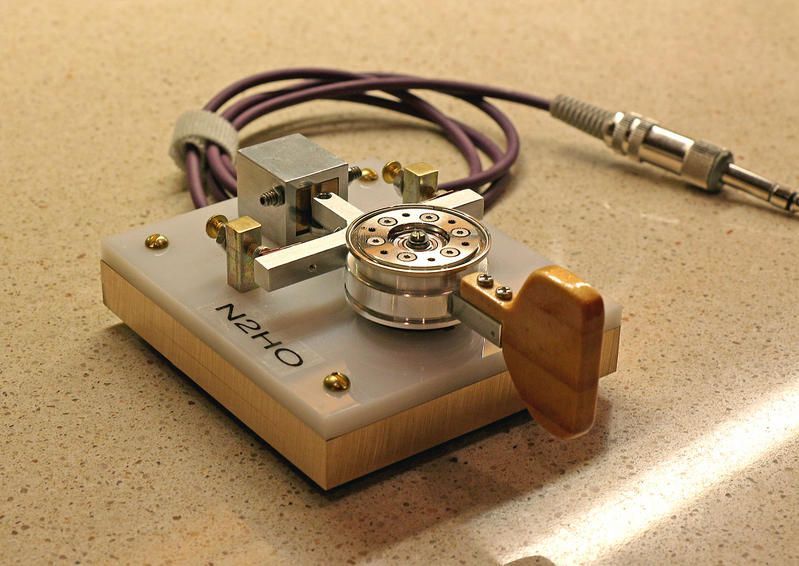
Last night, I worked a fellow who also noted that he was using a home brew paddle. He said that it was similar, but not exactly like the paddle built by N2HO (shown at left).

The unique thing about this key is that it uses the magnet and bearing from a hard disk drive. I don’t know if or how the magnetic tension is controlled, but I think the design is quite unique.

Callsign fun

In the past week or so, I’ve worked stations with fun callsigns. the first is AI5IN. Joe’s call not only spells a word, but it is palindromic, if you consider the sequence of dits and dahs.

Last night, I worked K5EMI. Bill didn’t mention why he chose this particular call, and I wonder if he knew that EMI is an acronym for electromagnetic interference. I may have to email him about that.

Filed Under: Building/Homebrew, CW Tagged With: cootie key

Amateur radio videos: ARRL Foundation, CW Academy, “brain” transplant for the IC-245

November 28, 2021 By Dan KB6NU Leave a Comment

RATPAC: ARRL Foundation

Mike Ritz, W7VO, Northwest Division Director and member of the board of the ARRL Foundation, discusses the foundation and the grants that it makes.


Master Morse Code with CWops

Joe Fischer, AA8TA, headmaster of the CWops’ CW Academy, joins the All Portable Discussion Zone podcast and talks about how to break through the struggles of learning Morse code.


A brain transplant for the ICOM IC-245

The IC-245 is an all-mode 2m transceiver. This video shows how [IMSAI GUY] replaces the microprocessor board in his transceiver with an Arduino Nano-based board to get a little more functionality. There’s also a second video that shows the initial trial of the board.

Filed Under: ARRL, CW, Gear/Gadgets Tagged With: ARRL Foundation, CW Academy, IC-245

Nominate someone for the CWops Award for Advancing the Art of CW

November 16, 2021 By Dan KB6NU Leave a Comment

CWops is pleased to announce that it is now accepting nominations for the prestigious CWops  Award for Advancing the Art of CW for the year 2022.

The purpose of the award is to recognize individuals, groups, or organizations that have made the greatest contribution(s) toward advancing the art or practice of radio communications by Morse code.

Criteria

Candidates for the award may be one or more of the following:

  • Authors of publications related to CW
  • CW recruiters, trainers, mentors, coaches and instructors
  • Public advocates of CW
  • Organizers of CW activities
  • Designers and inventors who advance the art or practice of CW
  • Other contributors to the art or practice of CW

Note: The award is not limited to amateur radio operators or their organizations.

Nomination

Nominations may be made by anybody (not limited to CWops members).  Nominations should be emailed to <[email protected]> with a copy to <[email protected]>.  An email confirmation will be sent acknowledging receipt of each nomination.  In order to be considered, a nomination should be received by March 18, 2022 and include:

  • A detailed explanation supporting nominee qualifications according to the above criteria.
  • Name(s) and call sign(s) (if applicable) of nominee(s), and contact information including their postal address(es), email address(es), and telephone number(s).
  • Name, telephone number, email address, and call sign (if applicable) of the person submitting the nomination.

Presentation of Award

A plaque will be presented at the Dayton Hamvention.  If the recipients are not present, it will be sent to them.

Filed Under: CW Tagged With: CWOps

  • « Go to Previous Page
  • Page 1
  • Interim pages omitted …
  • Page 3
  • Page 4
  • Page 5
  • Page 6
  • Page 7
  • Interim pages omitted …
  • Page 38
  • Go to Next Page »

Primary Sidebar

No Nonsense Technician Class License Study Guide (for tests given between July 2026 and June 2030)

New No Nonsense Technican Class Study Guide now available!

The 2026 version of my Tech Class study guide is now available, and as always, the PDF version is FREE!. The ePub version costs $11.97, and a Kindle version and paperback version will be available on Amazon shortly.

Click here to get all of my "No Nonsense" study guides.

Also available: The CW Geek's Guide to Having Fun with Morse Code

W5SWL.Com
Retevis Ailunce H1 DMR Radio
DXpander: Cobweb antennas, Laser Cutting

You’ve got mail!

Enter your email address below and get an email every time I publish a new post.

Email


I frequently teach classes to help newcomers get their licenses. The next class will take place on Saturday, October 10, 2026 on the University of Michigan campus. Click here for more information.

If you can't make the class, subscribe to the mailing list to be notified of when the next class will be held.

You can always download my free study guide, and if you have any questions about the classes, or amateur radio in general, please feel free to email me directly.

Support KB6NU.Com

Donate $7.30 and get two of these cool stickers. Measuring 4.25-in. W by 2.75-in. H, it's perfect for your car, your shack, or wherever!

Contact me

If you have a question or comment about one of my blog posts, or a question about any of the material in my study guides, or just a question about ham radio in general, you can email me at [email protected].

Blogs You Should Also Read

  • AE5X: A CW-centric blog from Kingswood, Texas
  • K0LWC Blog
  • LA3ZA Ham Radio Blog
  • Little Radios, Big Fun – WB3GCK
  • Mr. Vacuum Tube's Blog
  • Radio Artisan – K3NG
  • The K0NR Weblog
  • VE3WDM's QRP Ham Radio Blog
  • W2LJ’s Blog

Ham Radio Websites

  • Dashtoons – The Hammin' Comedy by Jeff K1NSS

Podcasts

  • ICQ Podcast
  • Linux in the Ham Schack
  • No Nonsense Amateur Radio Podcast
  • Resonant Frequency Amateur Radio Podcast

Recent Comments

  • Dan KB6NU on Some Ham-Vention History
  • David Pompea on Some Ham-Vention History
  • Walter Underwood on One lump or two (or three)?
  • Mike, KL7MJ on Question pools should make teaching classes easier
  • Karl Heinz - K5KHK on Question pools should make teaching classes easier

Meta

  • Log in
  • Entries feed
  • Comments feed
  • WordPress.org

Footer

Copyright © 2026 Daniel M. Romanchik, KB6NU · Log in