• Skip to primary navigation
  • Skip to main content
  • Skip to primary sidebar
  • Skip to footer

KB6NU's Ham Radio Blog

KB6NU's Ham Radio Blog
  • HOME
  • Study Guides
  • Teach a One-Day Tech Class
  • W8SRC Repeater Guide
  • Advertise
  • Hire Me

CWOps

Operating notes: CW Open

September 4, 2022 By Dan KB6NU 4 Comments

I’m not a big contester, but I am a member of CWops, and the CWops host a contest every year called the CW Open, and this contest takes place on Labor Day weekend. This year, I decided to take part.

My participation actually got started in a funny way. One of the things that I do for CWops is to manage the website. Just before the contest, there was some question as to whether the form used to submit teams rosters for the contest was working properly. So, to test the form, I submitted a team called Team Website, consisting of me and Theo, SV2BBK, who is also one of the website administrators.

When the list of teams was first published, Team Website was included in  the list. Theo mentioned this and suggested that Team Website be deleted. I thought about this for a second and suggested just the opposite. I thought that we should not only keep Team Website on the list, but recruit other CWops members who might also be casual contesters.

I’m happy to say that this was a big success. Theo and I had six other CWops join us on Team Website. I think that these folks had always wanted to be a member of a team, but didn’t want to feel obligated to operate the entire contest or who—like me—don’t have a fancy contest station. As I told the team members, we have no goals or expectations, so it’s very easy to meet them!

My score

The contest is split into three, four-hour sessions. I operated for about two hours, about a half hour in the first session and an hour and a half in the third session. I made 20 contacts in the first session and 95 contacts in the second session. I spent most that first 20 minutes getting used to using N1MM again and doing search and pounce.

I started out the second session doing search and pounce on 20 meters, where I made 20 contacts before the signals began to fade. Then, I switched to 40 meters, where the signals were quite strong. I still operated mostly search and pounce, but towards the end switched over to running a frequency.

That was and really upped my score. As you can see, I made a little more than one contact per minute in that final session. That’s pretty good for me.

Read the rules!

I could have made a couple more contacts had I read the rules beforehand. In most contests, you can only make contacts once per station per band. In the CW open, you can make contacts once per session per band.

So, what happened is that several stations called me during the third session who I’d already worked on 40 meters in the first session. N1MM flagged these contacts as dupes and I refused to log those contacts. This happened several times, so I decided to read the rules. That’s how I found out that I was doing it wrong. In fact, the CW Open web page says, “May contact for points only once per band, per session. Note: do not remove dupes from your log.”

Anyway, I had fun. I haven’t heard back from my other team members, but I hope they all had as much fun as I did.

Filed Under: Contests, CW Tagged With: CWOps

Nominate someone for the CWops Award for Advancing the Art of CW

November 16, 2021 By Dan KB6NU Leave a Comment

CWops is pleased to announce that it is now accepting nominations for the prestigious CWops  Award for Advancing the Art of CW for the year 2022.

The purpose of the award is to recognize individuals, groups, or organizations that have made the greatest contribution(s) toward advancing the art or practice of radio communications by Morse code.

Criteria

Candidates for the award may be one or more of the following:

  • Authors of publications related to CW
  • CW recruiters, trainers, mentors, coaches and instructors
  • Public advocates of CW
  • Organizers of CW activities
  • Designers and inventors who advance the art or practice of CW
  • Other contributors to the art or practice of CW

Note: The award is not limited to amateur radio operators or their organizations.

Nomination

Nominations may be made by anybody (not limited to CWops members).  Nominations should be emailed to <[email protected]> with a copy to <[email protected]>.  An email confirmation will be sent acknowledging receipt of each nomination.  In order to be considered, a nomination should be received by March 18, 2022 and include:

  • A detailed explanation supporting nominee qualifications according to the above criteria.
  • Name(s) and call sign(s) (if applicable) of nominee(s), and contact information including their postal address(es), email address(es), and telephone number(s).
  • Name, telephone number, email address, and call sign (if applicable) of the person submitting the nomination.

Presentation of Award

A plaque will be presented at the Dayton Hamvention.  If the recipients are not present, it will be sent to them.

Filed Under: CW Tagged With: CWOps

Amateur radio in the news: Kids discover new (old?) way to communicate, training scouts

February 8, 2021 By Dan KB6NU 5 Comments

Young students discover a different form of communication

In a year that has often been isolating, eight students from Foxboro are exploring a different way to communicate. They are taking a virtual course in Morse code through the [CWops] CW Academy.

Liam Polis, 11, a sixth-grader who is home-schooled this year, said his mother signed him up for the class, and at first, he wasn’t sure about it, but then found it to be fun. “It’s different than other classes because we learn on our own and then check in with the teacher, but it’s fun. I learned a lot about the history and use of Morse code and also the letters: a, e, i, o, s, t, n, m, y, l and number 1 for week one,” Liam said.

…read more

When Scoutmasters Got Trained to be Amateur Radio Operators

Did you know that amateur radio supplies can come in handy when the grid is down? In case you didn’t realize this fact before, now you do! Scott deMasi, the assistant scoutmaster, knew the right way to respond to such an alarming situation with the power down in Kingwood’s subdivision in Texas. In 2017, the devastating Hurricane Harvey (Category 4) had wreaked havoc in many parts of the region, including Scott deMasi’s subdivision.

After the water level decreased, the two assistant scoutmasters, David Godell and Scott deMasi, sat down and worked for a solution to effectively communicate with their troop of a hundred scouts. Scott deMasi had spent 15 years as an amateur radio operator and knew the effectiveness of the ham radio in times where one’s survival is at risk. The task left was to train their troop of 100 scouts and their parents to maneuver ham radios. With the power down and roads flooded with water, operating a ham radio was indeed a lifesaving skill.

…read more

Mississippi Valley Amateur Radio holds training in WXOW’s parking lot

LA CRESCENT, Minn. – The Mississippi Valley Amateur Radio Association set up camp in the WXOW parking lot on Saturday for the day. Vice President Bill Klein-Schmidt explained they can set up anywhere they want and they try to do it as often as they can.

“Basically what we are doing today is what they call the Minnesota QSO party and what that consists of is us trying to contact as many counties in the state of Minnesota that we can in a certain period of time,” said Klein-Schmidt.

He said trainings also help them practice setting up their gear quickly and in cold, bad weather. It is important because if communication were ever to go down, they would still be able to communicate with people through ham radio.

…read more

Filed Under: Contests, CW, Kids Tagged With: CWOps, MN QSO Party, scouting

Learn more than just copying characters

July 12, 2020 By Dan KB6NU Leave a Comment

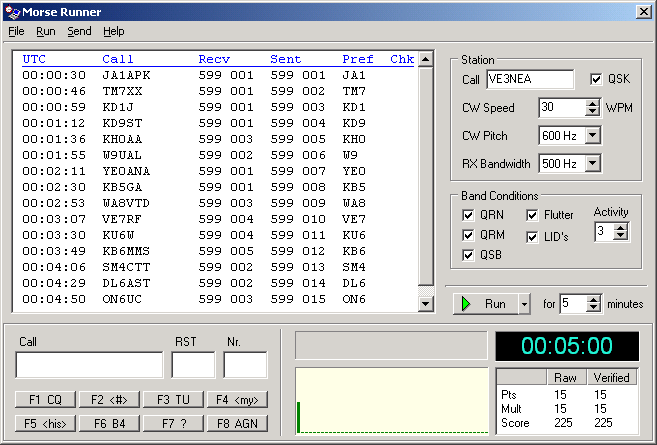
Morse Runner
Morse Runner is a contest simulator that many operators use to improve their CW skills.

Recently, I had a QSO with Gary, W0ITT. Even though there was a fair amount of fading, we managed to have a nice chat. The next day, he sent me the following email:

Nice to talk with you again.

I had a typical QSO recently using my home brew regenerative RX.  The other station wasn’t very strong, we had QSB, we had QRM at times, but I was still able to copy and had a good QSO.

In a significant number of my QSOs, the person on the other end just says “well, QSB, so QRT.”  When I have QSB, I adjust my radio, sharpen my listening skills and wait to see if the other fellow’s signal comes back up (it often does).

A lot of successful copy isn’t just knowing the code, but more about listening skills. For example, how do you mentally pick out the signal you want to hear in various situations?

For instance, when I first got back on the air, I was using a QRP transceiver where the offset frequency was set quite low (maybe less than 200 Hz).  Accordingly, I got very good at copying low-pitched signals because that is what I had to listen to.  So today, if someone comes back to me close to zero beat, I just focus and copy it.  Copying low pitched signals is a learned skill.

I could envision training people to copy stations at different volumes, at various pitches, with different kinds of interference, with heterodynes, with QRN, with zero beat QRM or close to it, with chirp or drift, with different equipment problems.

In my opinion, just working QRP is great weak signal training.  It certainly helped me, but I could see benefit in training to deal with the copying problems people will encounter in advance.

So I see lots of information about the best ways to learn the code.  I don’t see much about how to develop CW operating / copying skills.  Have you run into any classes or information on that?

I am very happy to have the copying skills and experiences I had.   But it took me 50 years.  Is anyone working with that kind of training, or do people just (hopefully) pick it up on the air?

73/72 de Gary W0ITT

I think Gary makes some really great points. I also hate it when I get the”Well, QSB here, so QRT” message. While there are times that the fading is so bad that it makes carrying on the contact nearly impossible, this says to me that the other operator just isn’t very good or that he or she just doesn’t want to talk to me any more. If the latter, I’d rather they just come out and say it instead of making some kind of lame excuse.

As far as classes or information on developing CW skills, the CWops CW Academy is perhaps the closest that we have to that. It’s a series of three classes that take someone from newbie to 25 wpm. Along the way, students are encouraged to take part in a number of different operating experiences including ragchews and contesting.

Another resource is Morse Runner. This program simulates contest operation including pileups, other guys grabbing your frequency, QRM, and QRN. I keep meaning to try it myself, but just haven’t gotten around to it yet. A lot of guys enjoy using it, though.

Filed Under: CW Tagged With: CWOps, Morse Runner

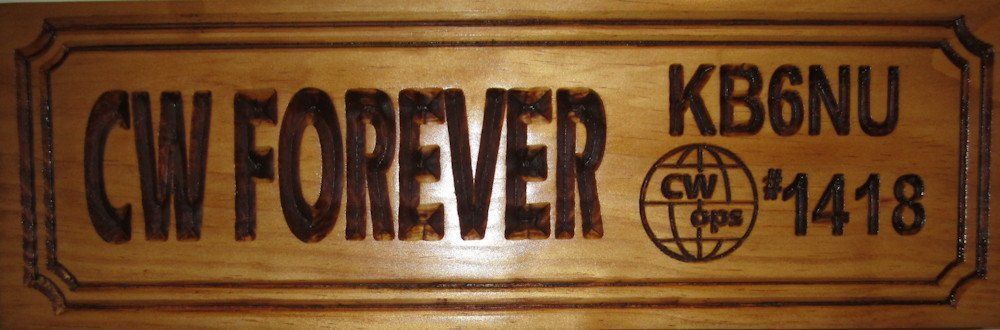
CW Forever!

June 21, 2019 By Dan KB6NU 1 Comment

This arrived in the mail on Wednesday. It was a gift from the CWOps, whose website I maintain. The CWOps are the guys that run the CW Academy.

TNX, OMS!

Filed Under: CW Tagged With: CWOps

No Nonsense Amateur Radio Podcast #4: CW!

August 14, 2018 By Dan KB6NU 3 Comments

Well, it was inevitable that Tom, KB5RF, and I would get around to talking about CW. I found Tom’s takes—as a relative newcomer—to be very insightful, and I hope that he found mine useful as well. Here are some links to internet resources that we talked about during the show:

  • CWOps. CWOps run CW Academy, a training course for those serious about learning and operating CW.
  • CW Geek’s Guide for Having Fun with Morse Code. My book on learning and operating Morse Code.
  • Head copy. I’ve written several blog posts about learning how to copy in your head:
    • Become a CW “head case”
    • Let the walrus help you copy in your head
    • Another perspective on copying CW in your head

The No Nonsense Amateur Radio Podcast is available on iHeartRadio, iTunes and Stitcher. You can also listen to it on any Android device by downloading the app Ham Radio Podcasts Free, or you can also subscribe directly using the RSS feed.

Filed Under: CW, Podcasts Tagged With: CW Academy, CWOps, head copy

Teaching CW Again

September 13, 2017 By Dan KB6NU 4 Comments

Back in the 1980s, I taught a Novice class at Doric Scientific, the company I was working for then. At that time, of course, you had to pass a 5-wpm code test. To teach the code, I brought in a key and a speaker and connected them to a fancy Wavetek frequency generator, which probably cost about $2,000. I like to joke that it was the most expensive code practice oscillator ever.

Fast forward 35 years, and I’m teaching CW again. After much badgering from my ARROW clubmates, we’ve finally started a class based on the CWOps CW Academy program. We’re starting with Level I, obviously. The class materials—Student Handbook: Practice Instructions = Level 1 and Using Morse Trainer—are available at no charge  from the CWOps website.

CW Academy uses an online application called Morse Trainer. Morse Trainer was written specifically for the CW Academy. The built-in practice sessions follow the CW Academy program letter-for-letter and word-for-word.

While you could probably learn the code by just using the CW Academy materials and Morse Trainer, it’s more effective in a class setting. I think the students motivate one another, and, of course, it’s useful to have an experienced CW guy on hand to give advice and answer questions. (If you’re an old hand like me, and you’re interested in teaching a CW class, you can find instructor resources on the CWOps website, including “Teaching Morse Code Using A Virtual Classroom Environment.”)

When they teach a class, the CWOps advisors conduct two training sessions per week for eight weeks. The classes are held online, using oovVoo, a video chat program. Here, we are going to meet on Sundays and Wednesday evenings, using Skype.

We started our CW class on Sunday evening with four students. The class started inauspiciously. I first tried using my shack PC, holding the microphone up to the laptop speakers to capture the code being generated by Morse Trainer in a browser window. Unfortunately, only one of the students could hear the code. After puzzling over that for a bit, I switched to my office Mac, and everyone was able to hear the code. 

After that, everything went pretty well. Once in a while, the code would sound a little funny. I think the reason for that is that we were getting some feedback from one or more of the students. The CWOps recommend using headphones, partly to prevent any audio feedback from distorting the code. I think this is a good idea and plan to use them next week.

For the next class, I also want to up the character speed being sent. Morse Trainer lets you set the character speed and the overall speed (Morse Trainer calls it the Farnsworth speed) separately, and I had the character speed set to 20 wpm and the Farnsworth speed set to 10 wpm. I think that 20 wpm is probably too slow, so for the next session, I’ll set it to 25  wpm. 

The goal here is to get these guys confident enough in their abilities to make CW contacts at next year’s field Day. After we’re done with the Level 1 course, I’m going encourage them all to get on the air and make some “real” contacts. One thing I’m thinking about doing is inviting them over to my house (or going to theirs) to participate in a QSO party. Getting on the air really is the best practice method out there, and QSO parties are a good way to get into the swing of contesting. If you have any thoughts or experience to share, please comment below.

Filed Under: Classes/Testing/Licensing, Clubs, CW Tagged With: CWOps, teaching

Primary Sidebar

No Nonsense Technician Class License Study Guide (for tests given between July 2026 and June 2030)

New No Nonsense Technican Class Study Guide now available!

The 2026 version of my Tech Class study guide is now available, and as always, the PDF version is FREE!. The ePub version costs $11.97, and a Kindle version and paperback version will be available on Amazon shortly.

Click here to get all of my "No Nonsense" study guides.

Also available: The CW Geek's Guide to Having Fun with Morse Code

W5SWL.Com
Retevis Ailunce H1 DMR Radio
DXpander: Cobweb antennas, Laser Cutting

You’ve got mail!

Enter your email address below and get an email every time I publish a new post.

Email


I frequently teach classes to help newcomers get their licenses. The next class will take place on Saturday, October 10, 2026 on the University of Michigan campus. Click here for more information.

If you can't make the class, subscribe to the mailing list to be notified of when the next class will be held.

You can always download my free study guide, and if you have any questions about the classes, or amateur radio in general, please feel free to email me directly.

Support KB6NU.Com

Donate $7.30 and get two of these cool stickers. Measuring 4.25-in. W by 2.75-in. H, it's perfect for your car, your shack, or wherever!

Contact me

If you have a question or comment about one of my blog posts, or a question about any of the material in my study guides, or just a question about ham radio in general, you can email me at [email protected].

Blogs You Should Also Read

  • AE5X: A CW-centric blog from Kingswood, Texas
  • K0LWC Blog
  • LA3ZA Ham Radio Blog
  • Little Radios, Big Fun – WB3GCK
  • Mr. Vacuum Tube's Blog
  • Radio Artisan – K3NG
  • The K0NR Weblog
  • VE3WDM's QRP Ham Radio Blog
  • W2LJ’s Blog

Ham Radio Websites

  • Dashtoons – The Hammin' Comedy by Jeff K1NSS

Podcasts

  • ICQ Podcast
  • Linux in the Ham Schack
  • No Nonsense Amateur Radio Podcast
  • Resonant Frequency Amateur Radio Podcast

Recent Comments

  • Dan KB6NU on Some Ham-Vention History
  • David Pompea on Some Ham-Vention History
  • Walter Underwood on One lump or two (or three)?
  • Mike, KL7MJ on Question pools should make teaching classes easier
  • Karl Heinz - K5KHK on Question pools should make teaching classes easier

Meta

  • Log in
  • Entries feed
  • Comments feed
  • WordPress.org

Footer

Copyright © 2026 Daniel M. Romanchik, KB6NU · Log in