• Skip to primary navigation
  • Skip to main content
  • Skip to primary sidebar
  • Skip to footer

KB6NU's Ham Radio Blog

KB6NU's Ham Radio Blog
  • HOME
  • Study Guides
  • Teach a One-Day Tech Class
  • W8SRC Repeater Guide
  • Advertise
  • Hire Me

Elmering

Yes, learning about radio does matter

September 14, 2023 By Dan KB6NU 16 Comments

I received an email this morning from a reader who wrote:

By way of background, I’ve been a ham for decades, operate all modes (but mostly CW), and do a lot of Parks on the Air (POTA). I also spend a lot of time recruiting people into the ham radio hobby and mentoring new hams. It’s that last focus that prompts this question.

For a variety of reasons that I can’t put on my finger on, it seems like more and more hams don’t really care about how radios or antennas work, and don’t want to invest much time or effort into learning such things. They just want to turn it on and use it. How it works, and what’s going on inside of the box, aren’t important.

For example, I know of one guy—a General-class licensee—who decided his top-of-the-line Yaesu HT was “defective” because whenever he pressed the push-to-talk switch on one of the repeater frequencies, the radio transmitted on a different frequency. Ugh. Another guy I know thought that his hamstick “wouldn’t tune,”  because the wire coil was installed upside down. As you’d guess, the hamstick tuned and worked just fine.

Some people say that we should get hung up on this. Get new hams into the hobby and they’ll learn as they go on. Except that doesn’t seem to be happening, at least not consistently. Even very experienced, highly educated hams can be clueless on very simple, fundamental radio concepts.

So, here’s the question: does any of this matter? I don’t know how my microwave oven works, and I don’t’ need to, and I don’t want to. All I want to do is push a button. So maybe it’s perfectly fine that hams don’t know about radio technology and we should stop pretending that any of this matters. Put ‘em through a “ham cram” and get them on the air. Or maybe amateur radio transceivers are different than microwave ovens and it does matter. I don’t know. I go back and forth on this and don’t really have a clear assessment in my mind.

Anyway, since this seems like the kind of thing you’ve already thought about and have some thoughtful insights, I thought I see what you make of all this. If you’re sitting around with nothing to do, I’d be curious to know what you think.

Yes, learning about radio does matter

In teaching Tech classes, I encounter many people who think this way. They just want to push buttons and talk on the radio. They say, “I’m only going to use it when I go off-roading with friends,” or “I’m only going to use it when my CERT team is activated.”

I always ask them what they’re going to do when something goes wrong—and we know that at some point, something is going to wrong. Without some basic knowledge of how radio works, how are they going to fix the problem or work around it? If they can’t do that, then they’re useless as a communicator and the experience is going to be very frustrating. So, the first thing that I try to get across that they’ll have a lot more fun with ham radio if they understand how the technology works.

The next question is how to get these people to be more curious about the technology and how to encourage them to learn more. I hope, for example, that when the guy complained about his Yaesu HT, that someone patiently explained how repeaters work. Sure, he should have known that already, but belittling him for not knowing this would only do more harm than good.

I don’t think that you can fault people for not knowing things, but you can fault them for not wanting to learn things. There’s a lot to learn in ham radio, and you can’t learn it all before you get a license. In fact, I’d argue that most things you can only learn after you get a license and start doing things.

Our challenge is to make ham radio a place where those that want to learn things can thrive. I think that we’re doing better at that. Look at all the YouTube channels where you can learn about just about anything that ham radio has to offer. The ARRL is getting in on this as well, with its “Learning Center.”

Finally, I’d say not to worry about those who don’t want to invest the time and effort. They’re not going to be hams for very long. They’re going to get frustrated when they can’t get things to work and drift off to something else. Let’s concentrate those who are curious and able and willing to invest the time and effort and make good hams out of them.
Filed Under: Classes/Testing/Licensing, Elmering

Please please please encourage new operators

July 13, 2023 By Dan KB6NU 3 Comments

Sparky says, “Encourage new hams, don’t criticize them!”

You’ve probably all heard this at one time or another. A newly-licensed radio amateur gets on the local repeater and then either gets ignored completely or criticized for using a Baofeng or committing some minor operating error.

Can  you think of a worse experience for a new ham? I’d bet that in some cases the new ham decides to give up on ham radio entirely. At the very least, it sours them on the ham radio experience.

We really need to be more encouraging to new hams and to hams that are either returning to the hobby or working on a new skill. Here’s an example. Yesterday, I worked a fellow doing a POTA activation. He was operating CW, and he made a couple of mistakes, but in the end, we completed the exchange, and I re-spotted him. A couple of minutes laters, I saw him re-spot himself with the message, “QRT…..gotta work on my ham-fisted CW.”

As I said, he made a couple of mistakes, but he wasn’t all that bad. I looked him up on QRZ.Com and emailed him:

Hi…

First, thanks for the POTA QSO.

Second, regarding your comment, “gotta work on my ham-fisted CW,” I’d say that you’re doing exactly the right thing. Getting on the air is the best practice, and if the others can’t deal with mistakes while you’re getting better, then the heck with them. :)

Keep on pounding brass.

73!

He replied:

Thank you so much for the encouragement (and the QSO 😊).  It’s been a bit rough going for me the past few times activating on both sending and copying.  I kind of get into my own head sometimes and your comments really help me remember that this is a CW journey and not a ‘light switch’.  Thanks again for working me at a park and helping me get the on-air practice in!

How cool is that? I’m going to make a point of looking for him every time I load up https://pota.app and work him if I can. I’ll also note that he looked to be in his 30s, going by his picture on QRZ.Com. So, not only is he a relatively new CW op, he’s a relatively young CW op. So, there are two good reasons to encourage him.

Yesterday, I also worked a guy who told me that I was his first contact in 20 years! Whenever I work someone who has been off the air for a while, I welcome them back, noting, “WE NEED AS MNI CW OPS AS WE CAN MUSTER.” Immediately after the contact, I filled out a QSL card and commented, “Welcome back to CW. Please call me any time.”

It’s certainly better for everyone involved to be encouraging than it is to be critical. Criticism rarely helps, but patient encouragement, be it sending a QSL card or an uplifting email or a quietly-given piece of advice, can really make a difference. Please leave a comment below on how you encourage your fellow hams.


Filed Under: Elmering

ARROW heads back to the field for Field Day

June 29, 2022 By Dan KB6NU 2 Comments

2020 and 2021 were pretty bleak years for Field Day. Since it’s just as much a social or group event as it is an amateur radio event, the Covid pandemic really put a damper on things. This year, however, ARROW, our club here in Ann Arbor, MI, figured that while Covid may still be an issue, we could safely set up outside and have a real Field Day.

Even so, participation was significantly less than 2019. People are either still cautious about gathering in groups or have gotten out of the habit of meeting in groups. Whatever the reason, we were only able to muster enough equipment for three HF stations, plus a Get on the Air (GOTA) station this year. In years past, we ran four stations, plus a GOTA station.

I again served as “head coach” for the GOTA station and as one of the CW operators. I do enjoy making contacts, but being the GOTA coach is a lot of fun, and it’s really my main focus during Field Day. I’m glad that I got to do both this year.

Our club members took a lot of pictures this year. Below is a selection of photos, each with their own story.

The weather cooperated this year. There were plenty of blue skies, and it wasn’t as hot as in years past. Even so, it was important to keep hydrated
This is Joe, AC8ES, at the phone station. This station was set up in a trailer brought out by James, KC8BGJ, our club president.
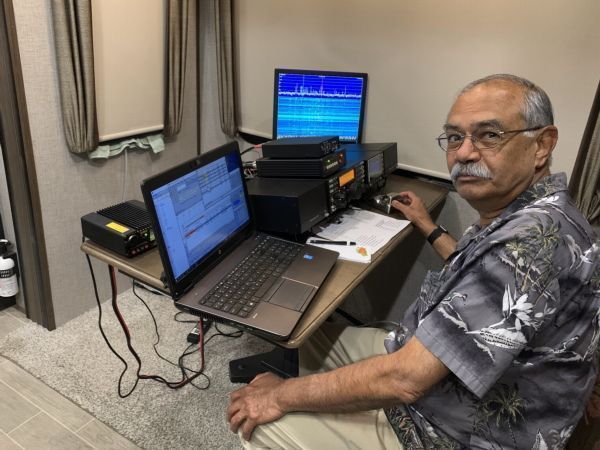
In this photo, Arun, W8ARU, is operating one of the CW stations. Arun pulls the night shift every year. This station was set up in an RV owned by Dave, N8SBE. That’s Dave’s K3S that Arun is operating.
Every year, we have one new operator who distinguishes themselves at the GOTA station. This year it was Matthew, KE8UEE, the 11-year-old fellow in the blue shirt. He made about 100 contacts over the weekend, and learned quite a bit about operating HF, and that’s what it’s all about, isn’t it? On Sunday, for example, I caught him adjusting the bandpass filter, so that he could copy stations more easily.
Matthew wasn’t the only youngster at Field Day. Here, Max, Charles W8HAX’s son, makes a contact at the GOTA station.
This little guy also visited us at the GOTA station, climbing up a table leg and making himself right at home. Some quick googling by Mary Anne, W8VWY, confirmed that our little friend is a fox snake and isn’t poisonous. Somehow, I managed to take this guy home with me. As I was unloading my car, I found him wedged between two boxes. Now, he has a new home in my backyard.
Jay, WB8TKL, was in charge of the public information table. He also brought out the trailer-mounted tower that you can see in the background.
Les, W8MSP, Michigan Section Manager, also paid us a visit. This photo shows him and Ralph, AA8RK, the Michigan Public Information Coordinator (left) proudly displaying Governor Whitmer’s proclamation of Amateur Radio Week.
One highlight of the weekend was the plane ride that I got to take. Four of us went up with Mark, W8MP, who’s a professional pilot. Our FD site is just north of Ann Arbor airport. Mark did a few turns aorund the site, and Dinesh, AB3DC took this photo.
From left to right, our motley flight crew consisted of Dinesh AB3DC, Dan KB6NU (rear), Matthew KE8UEE, and Mark W8MP. Matthew brought a handheld along and made his first aeronautical mobile contact!

Filed Under: Clubs, Elmering Tagged With: Field Day

Slow-Speed (CW) Tests: I’m a believer

January 16, 2022 By Dan KB6NU 474 Comments

The CWops have this thing they call the CW Test, or CWT. CWTs are held every Wednesday/Thursday, and include four, one-hour sessions at times that favor different geographic areas. They’re not exactly contests, and some CWops think of them as practice sessions for the “real” contests, but people post their scores to 3830scores.com and brag about them on the CWops mailing list, so they’re more than just practice sessions.

Not being a contester, I’m not a big fan of CWTs. I’ve participated in maybe a half dozen over the years.

So, when the K1USN Radio Club started a slow-speed version of the CWT, called the Slow Speed Test, or SST, about a year ago, I thought to myself, “Oh, great. There’s another hour that 40m is going to be unusable.” When 0000Z rolled around tonight, however, I was sitting in front the radio, and since I had nothing better to do, I thought I’d give it a try. Don’t knock it until you try it, and all that.

First, I had to futz around with N1MM and my Arduino-based WinKeyer clone. I don’t know why, but if I don’t use N1MM for a time, the program fails to find the keyer. I have to either reboot the computer, power-cycle the keyer, or both. After I got that working, I configured N1MM to run the contest. Finally, I found a frequency to run on. Over the last 40 minutes of the SST, I made about one QSO per minute.

Although I hate to admit it, it was kind of fun. First off, I ran into some people that I know. Second, I got to help some people. You could tell some of the folks were struggling, but that was OK. I figured it was my job to help them.

Afterwards, I got this email from one of the struggling operators:

Thank you so much, tonight was my first CW contact ever. I could tell you could tell and slowed right down to the same pace I was using. You were so patient. I appreciate it. I was so nervous I couldn’t even remember how to respond.

Thanks mate. Have a great one.

Needless to say, my QSL card to commemorate this ham’s first CW QSO will be in the mail tomorrow. Helping hams make their first CW QSOs and getting more comfortable at the key is worth the time and effort. So, I’m now a believer. And, you’ll probably hear my call in next week’s SST.

Filed Under: CW, Elmering Tagged With: SST

Remote testing: a contrary opinion

April 21, 2020 By Dan KB6NU 18 Comments

Remote license exams have been a hot topic lately. I’ve blogged about it, the ARRL reports that remotely administered testing is promising, and the W5YI VEC in conjunction with HamStudy.Org has also conducted some remote testing. I think that it’s safe to say that before long remote testing will be widely available.
Not everyone is thrilled by this idea. Jeff, KE9V, tweeted the following yesterday:

Not a fan of remotely administered tests. It puts even more distance between newcomers and other hams, mentors, and clubs. I doubt it will cease when life goes back to normal so this feels like yet another self-inflicted wound. arrl.org/news/remotely-… #hamradio

He’s got a point. I think that we already have a problem mentoring the next generation of hams, and going to remote testing is only going to exacerbate this problem. The flip side, of course, is that this is inevitable. I replied:

That’s certainly a concern, but it’s been my experience that many, if not most, new hams don’t take advantage of mentors and clubs anyway. Whether for good or ill, they’re getting their mentoring from YouTube, reddit, and other online forums, or just foregoing it altogether.

Jeff went on to say, “I get that, but ceding this function renders local radio clubs a little more unnecessary, and most are in a tenuous position as it is.” Jeff is right on again, but the saying, “You can lead a horse to water, but you can’t make him drink” comes to mind. Even with local testing, most newcomers don’t attend local radio club meetings or take advantage of the mentoring that club members could provide. For example, I offer to help every single student that attends my one-day Tech classes. and over the past dozen years or so, I’ve had hundreds of students. My guess is that less than 10 percent of them have ever asked for help.

I still think it’s time for remote testing, but Jeff’s point is well-taken. There are lots of good YouTube videos on different amateur radio topics, but I don’t think any of them are designed to help a newcomer discover what he or she might like best.

I hope the VE teams that do remote testing will at least point the newcomers at some resources to help them get into amateur radio. Hopefully that would include links to the ARRL’s Find a Club page so that they could find some one-on-one help, if they need it or want it. And, it might be time for the ARRL to actually get serious about a mentoring program. Many folks do just fine on their own, but I’d guess that many more would benefit by having hams they can rely on for advice and a helping hand.

Filed Under: Classes/Testing/Licensing, Clubs, Elmering Tagged With: mentoring, remote testing

How to help kids learn CW?

November 7, 2019 By Dan KB6NU 4 Comments

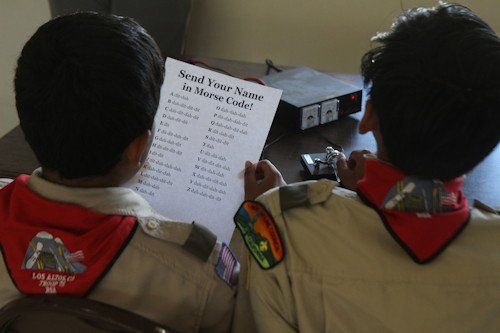
At the 2019 Pacific Skyline Council’s JOTA event, kids enjoyed sending their names in Morse Code.

Yesterday, a reader wrote:

My 9 year old son and his 7 year old twin brothers have expressed some interest in learning Morse code. Actually they’re pestering me about it. I don’t know the code nor do I have a clue how to beat teach it. I’ve messed around with Koch method but just haven’t put enough effort into it to master CW. Koch seems like a good technique to learn.

Looking for your guidance on what tools and approach might work for kids.

I’m thinking they might like a code practice oscillator to practice sending and receiving. I have a couple arduinos laying around if there’s an easy kit available. I also don’t mind buying a commercial product (one for each boy) if there’s a good one.

I really don’t know where to start here but I want to encourage them.

I posted this question to the CWOps mailing list and got a bunch of suggestions and offers to help. Here is a summary:

  • Give them an iPad and download some Morse Code apps?
  • Re: teaching code to youngsters.  I did that in 1985 for my two sons ages 9 & 11, and a group of their friends.  Along with Morse, they studied the Novice license manual, built a code practice oscillator, and passed the Novice exam in 5 weeks.  I’m not sure about the 7-year old twins, but if the desire and ability is there they may succeed also.  I wrote an article, “Robbing_the_Cradle” for the August 1986 issue of QST, pp. 46, 47, under my previous call sign, W8LNJ.Key points:  have the boys get a small group of friends to work with them, if possible, though 3 may be enough.  Building the oscillator taught them some soldering skills.  Get another ham or two to help out, depending on the number of students.  Good luck to your reader.
  • Take a hard look at the Morse Toad app (iPhone, Android). I think it teaches the code by sound – as it should. A quick look showed me that it starts forming words right away with just a few letters learned. It starts the student out on a preset lesson plan path and I don’t believe it allows skipping ahead so it’s simple and structured. The graphics on the program aren’t sophisticated, but who cares? I think it looks like a good app to begin with, or at least a contender.
  • Have them try CW_PLAYER to learn the Morse code.
  • Sign up for the Youth CW Academy. For the last two years I’ve been teaching Youth CW Academy exclusively.  Never had 7 year olds, but I’ve had plenty of 9 year olds. If they sign up for CW Academy they automatically get put in the youth program.  Young people are not required to wait if there is a waiting list.
  • Here’s a low-tech approach: When I was 10, my buddy and I (he was a little older) would call each other on the landline every evening and simply talk the code (i.e., dit-dah) to each other, timing with a watch, until we were good enough to become WN3WHJ and WN3WHK.  No key to train our fists, but that came later.

Please add a comment below if you have any other suggestions.


Filed Under: CW, Elmering, Kids

Operating Notes: I took three days off

July 22, 2019 By Dan KB6NU 3 Comments

I took the last three and a half days off. Friday afternoon, our power went off, and although it came back on Saturday morning, Silvia and I shortly afterward, headed up to Lake Huron for a couple of days at the beach. No email, no ham radio, no internet.

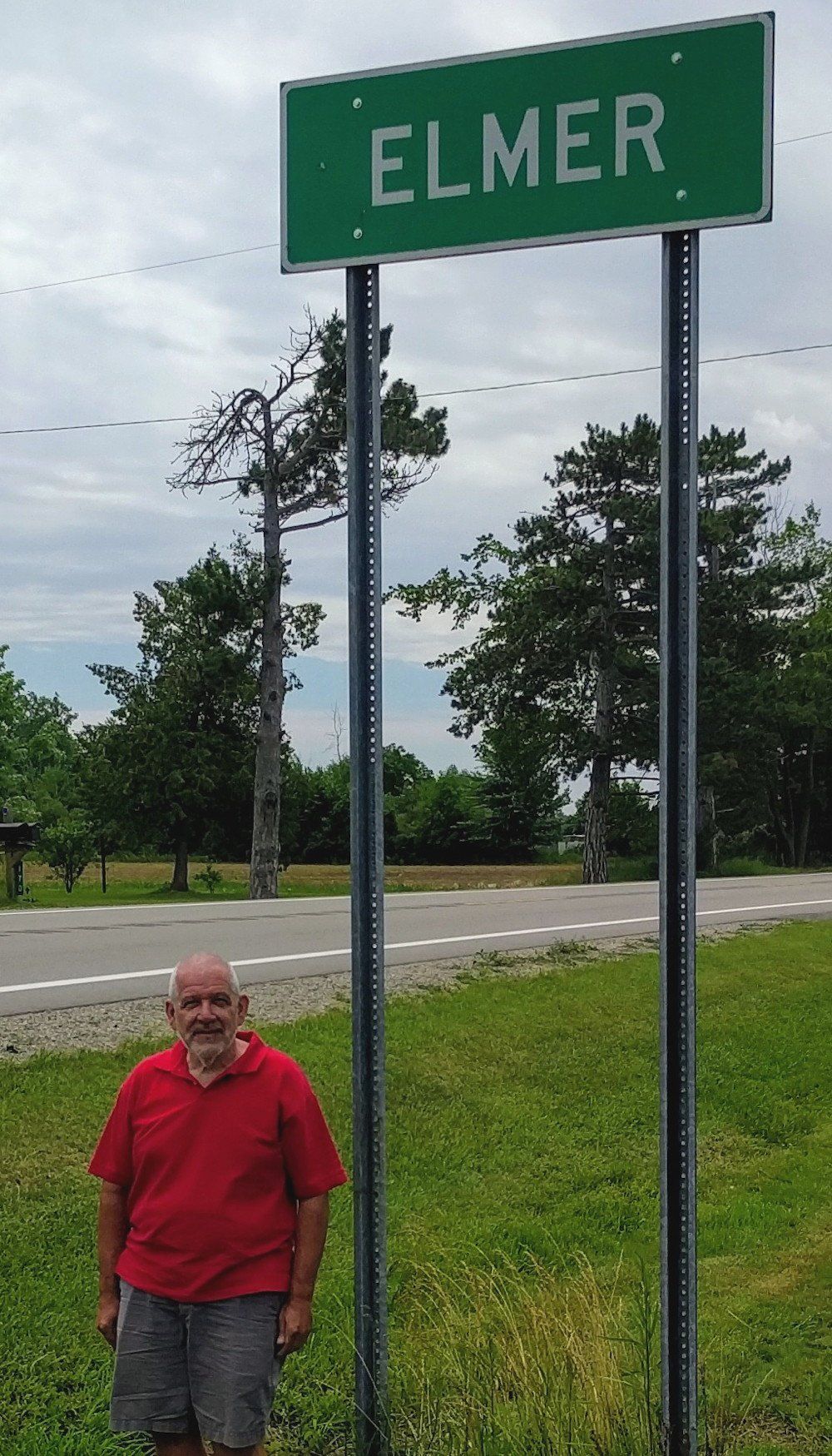
We did, however stop in Elmer on the way back. Some newer hams think the term Elmer is dated, and even a little creepy. I understand where they’re coming from, but I’m happy to be an Elmer to dozens, if not hundreds of hams.

Filed Under: Elmering, Operating

Are we losing knowledge in this hobby?

December 15, 2018 By Dan KB6NU 13 Comments

On reddit, someone asked:

Are we losing knowledge in this hobby that used to be common?

The other day I was listening to a conversation on the local repeater, and it was a relatively recently licensed General giving some “advice” to a new Technician who was hoping to upgrade soon, and who had some HF gear and an antenna but who hadn’t transmitted yet on HF.

What I heard coming from General was appalling. He recommended that the guy get an automatic antenna tuner, and regales him with a tale of how he managed to burn up the finals on a radio because he couldn’t manage to adjust a manual antenna tuner properly.

This is something I learned how to do as a Novice. In fact, I built my first antenna tuner from a kit (Heathkit HFT-9A QRP tuner). I still have and use it, as a matter of fact.
I was just boggled that a General class ham radio operator didn’t know how to adjust a manual antenna tuner. It was so difficult for him that he managed to damage a radio in the process.

I didn’t speak up, though, because I didn’t want to be “That guy”, you know, the type of old fogey know-it-all ham radio operator that’s commonly railed against in this subreddit. There were a few other bits of “advice” he passed along that were sketchy.

So I’m wondering if we are losing a bit of the institutional knowledge that long-experienced hams know, in the rush to get as many hams licensed and on the air as possible. We used to “Elmer” new hams, and if we aren’t bothering to do that anymore, the knowledge of how to do things is going to die out.

When I read this, I thought, “Yeah. We really are losing it in amateur radio.” On second thought, though, I’m I’m not so sure.

Yes, there are a lot of new hams on the air with perhaps not as much Elmering as they could use, but hey, you can’t expect every ham to know everything. I know that when I passed the General Class test (at the FCC office in downtown Detroit, none this VE “rubbish,” as Davey Jones of eevblog might say), I was still pretty clueless. And, how do you learn how to do things? Well, often it’s by blowing something up.

If it were me hearing this conversation, I would have definitely piped up and said that there’s some value to learning how to adjust a manual antenna tuner. Not only that, I may have even volunteered to come over and have a look at the guy’s setup. I can understand the poster’s reluctance to  be “that guy,” but if he’s not going to step up and help this newbie, who is?

What do you think? Are we losing this kind of basic knowledge in amateur radio? If you’re a “long experienced” ham, do you volunteer to help out when you hear something like this on the local repeater?

Filed Under: Elmering

Does your club website help ham wannabes?

September 17, 2018 By Dan KB6NU 4 Comments

Whether you know it or not, your club website undoubtedly gets some hits from people who want to become hams. That being the case, shouldn’t your club website have information on how to get a license and become an active amateur radio operator? Here’s a good example that I ran across the other day:

I got permission to “plagiarize” this page and created a similar page on our club’s website.

Does your club website have a page like this? Add a link in the comment section below.

Filed Under: Classes/Testing/Licensing, Clubs, Elmering

Keep up with what’s going on in amateur radio by reading QRZ.Com ads

October 8, 2017 By Dan KB6NU 2 Comments

Like many of you, I have installed an ad blocker on my browser. I don’t really care about the website that glass lovers are going crazy over or the smartphone accessory that is almost too good.

I don’t, however, run the ad blocker when I’m using QRZ.Com. It’s not that I want Fred, AA7BQ, to make more money. I want to find out about what new goods and services people are offering to amateur radio operators.

Here are three recent QRZ.Com ads that I’ve clicked on:

Hamcestry.com. From the Hamcestry.Com FAQ:


What is Hamcestry?Obviously, it’s a play on the word Ancestry, but for HAM radio. I bet everyone who is an amateur radio operator got involved in the hobby because someone they knew was a HAM and that got them interested. And every HAM probably has influenced at least 1 other person to take up the hobby too. I started Hamcestry as a project I thought would be interesting to see grow. It relies on other people using it. Without that, it goes nowhere, so hopefully there will be enough interest to get that to happen. I am always hearing the stories about how “so-and-so” got started in the hobby, so I know the interest and desire to tell people the who’s, how’s and where’s of how they got started is strong and alive. I thought it would be nice to visualize these connections.

I like this idea, and I’m going to add a few of my Elmerees to the site. The site also offers practice exams and Morse Code practice as well.

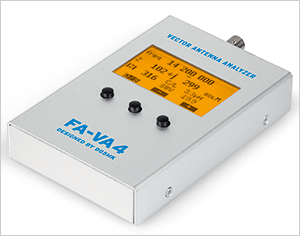
FA-VA4 Antenna Analyzer Kit. The FA-VA4 Antenna Analyzer is an improved version of the IV-Meter from DG5MK, based on his article published in QEX May/June 2017. It has a frequency range 100 kHz to 100 MHz and costs $140. This looks like a very cool project to me.

K3NQT for Vice Director. Lloyd Roach, K3NQT, is running for Vice Director of the ARRL Atlantic Division, and he’s advertising on QRZ.com. I was especially interested in this ad because I (unsuccessfuly) ran for Vice Director of the Great Lakes Division several times in the early 2000s. While Lloyd seems qualified for the position, I found his vision to be a little vague. I emailed him, hoping to get some clarification on what he’d actually do as Vice Director, but he didn’t seem interested in engaging in a discussion with me.

Another interesting twist is that he’s running against Riley Hollingsworth, K4ZDH, the former FCC Special Counsel, who was responsible for enforcing the Amateur Radio Service rules during his last ten years at the FCC. Both men are highly qualified, and this will be an interesting race.

Filed Under: Antennas, ARRL, Elmering, Gear/Gadgets, Online Resources, Test Equipment Tagged With: antenna analyzers, ARRL Board of Directors

  • Page 1
  • Page 2
  • Page 3
  • Interim pages omitted …
  • Page 8
  • Go to Next Page »

Primary Sidebar

No Nonsense Technician Class License Study Guide (for tests given between July 2026 and June 2030)

New No Nonsense Technican Class Study Guide now available!

The 2026 version of my Tech Class study guide is now available, and as always, the PDF version is FREE!. The ePub version costs $11.97, and a Kindle version and paperback version will be available on Amazon shortly.

Click here to get all of my "No Nonsense" study guides.

Also available: The CW Geek's Guide to Having Fun with Morse Code

W5SWL.Com
Retevis Ailunce H1 DMR Radio
DXpander: Cobweb antennas, Laser Cutting

You’ve got mail!

Enter your email address below and get an email every time I publish a new post.

Email


I frequently teach classes to help newcomers get their licenses. The next class will take place on Saturday, October 10, 2026 on the University of Michigan campus. Click here for more information.

If you can't make the class, subscribe to the mailing list to be notified of when the next class will be held.

You can always download my free study guide, and if you have any questions about the classes, or amateur radio in general, please feel free to email me directly.

Support KB6NU.Com

Donate $7.30 and get two of these cool stickers. Measuring 4.25-in. W by 2.75-in. H, it's perfect for your car, your shack, or wherever!

Contact me

If you have a question or comment about one of my blog posts, or a question about any of the material in my study guides, or just a question about ham radio in general, you can email me at [email protected].

Blogs You Should Also Read

  • AE5X: A CW-centric blog from Kingswood, Texas
  • K0LWC Blog
  • LA3ZA Ham Radio Blog
  • Little Radios, Big Fun – WB3GCK
  • Mr. Vacuum Tube's Blog
  • Radio Artisan – K3NG
  • The K0NR Weblog
  • VE3WDM's QRP Ham Radio Blog
  • W2LJ’s Blog

Ham Radio Websites

  • Dashtoons – The Hammin' Comedy by Jeff K1NSS

Podcasts

  • ICQ Podcast
  • Linux in the Ham Schack
  • No Nonsense Amateur Radio Podcast
  • Resonant Frequency Amateur Radio Podcast

Recent Comments

  • Matt W1CDN on A completely different picture of Wayne Green, W2NSD (SK)
  • Chana Walsh on Rethinking ham radio education
  • Rob WfourZNG on Videos: What’s next for POTA, ham radio helps rescue man trapped in cave
  • Dan KB6NU on The EMF Explorer: A badge for ham radio?
  • Travis Good on The EMF Explorer: A badge for ham radio?

Meta

  • Log in
  • Entries feed
  • Comments feed
  • WordPress.org

Footer

Copyright © 2026 Daniel M. Romanchik, KB6NU · Log in