• Skip to primary navigation
  • Skip to main content
  • Skip to primary sidebar
  • Skip to footer

KB6NU's Ham Radio Blog

KB6NU's Ham Radio Blog
  • HOME
  • Study Guides
  • Teach a One-Day Tech Class
  • W8SRC Repeater Guide
  • Advertise
  • Hire Me

Elmering

“Snackable” ham radio?

September 24, 2017 By Dan KB6NU 4 Comments

I never watch any amateur radio videos or listen to any amateur radio podcasts all the way through. And this includes the episodes that I appear on! The exception that proves the rule, however, is the recently released episode 345 of Ham Radio Now,featuring noted maker, Jeri Elsworth, AI6TK, and her friend and co-worker, Amy Herndon, KM6FZE.

One of the reasons that got me to watch this video to the end is the obvious chemistry between Gary, KN4AQ, and his guests. That’s something that you don’t normally get on podcasts like this for some reason.

Another is Jeri and Amy’s takes on amateur radio. While Jeri is a celebrity in the maker world, and an electronic industry entrepreneur, she has only recently taken up amateur radio. Her QRZ.Com page notes that she has only been licensed since October 2016. I think that her  combination of technical expertise, entrepreneurial chops, and recent license make her opinions on ham radio worth listening to.

For example, at about the 28:00 mark of the episode, Ellsworth and Herdon bemoan the complicated user interfaces of most amateur radio equipment. (Anyone ever try to manually program a memory channel on a Baofeng UV-5R?) She notes that this difficulty even threw her for a bit, and she’s a very sophisticated user of electronics equipment.

About the 34:15 mark, she says, “I think that there is a way to make amateur radio more ‘snackable.'” What she means by that is that the out-of-the-box experience should be more immediately gratifying. “It would be awesome if the radios did JT-65 right out of the box. You put in your password and your station showed up on QRZ or LOTW.”

I like this idea a lot. And, it’s something that we—and the ham radio manufacturers—should think about.
Filed Under: Elmering, Getting started in amateur radio Tagged With: Jeri Ellsworth, user interfaces

What radio should a first-time CW operator buy?

September 12, 2017 By Dan KB6NU 10 Comments

In a comment on the post, What new hams are up against, Patty writes:

I am in the process of learning Morse Code and also studying for my Technician license. I am overwhelmed by what starter radio to get. I am interested in just doing CW and have articles on a two-band QRP rig. Is there any recommended radios that I can get that just send and receive CW? I appreciate any feedback. Thanks.

Normally, when I get asked this question, I advise people to visit the ARRL’s Buying Your First Radio webpage, and in particular, to download the PDF file, Choosing a Ham Radio.  This publication has a lot of good information on what frequencies and modes that hams can operate and what radio equipment is required to operate them.

In particular, Patty has determined that she wants to be a CW operator. Of course, I think that’s really great. Knowing that narrows down the choices. Since most CW operation is on the HF bands, she will want her first radio to be an HF radio.

Patty has already done some research on this topic, as evidenced by the fact that she mentions having read an article on a two-band QRP rig. While this may do the trick for her, I’d advise against a QRP radio as one’s first radio. The main reason for this is that the low power output will make contacts harder to make, and the receivers in these radios are generally not as good as more mainstream transceivers.

At this point, the radio I like the most for beginners is the Yaesu FT-450D. It costs less than $700, but still has advanced features, such as digital signal processing (DSP). Several guys around here have purchased them and are very pleased with them. Other radios that are about the same price (actually a little cheaper) are the ICOM IC-718 and the Alinco DX-SR9T. Both are good radios, but the IC-718 has been around for a while already, so doesn’t quite have the features that the FT-450D has. Alinco has never been a popular choice, so I’d stay away from them just based on that.

Another option, for a little more money, is the Kenwood TS-480SAT. It costs $850.

Of course, you’ll need more than just the radio. At the very least, you’ll need a power supply and antenna in addition to the radio. Figure on spending $200 – $300 on these accessories. That still brings your investment to less than $1,000, though.

Now, Patty might complain, “But, I only want to operate CW. Why do I have to pay for all the other stuff?” This is actually a somewhat valid complaint, but I would counter that adding voice and digital capabilities doesn’t add that much cost to the radio, and she’ll have those capabilities should she decided to upgrade to General Class at some point and then work SSB or digital modes.

A step up from the beginner radios are the ICOM IC-7300, Yaesu FT-dx1200, and the Kenwood TS-590SG. These radios range from about $1,200 to $1,400, and offer features not found on the less expensive transceivers. For example, the receivers are generally better, and the IC-7300 and the FT-dx1200 have bandscope displays.

Another question that often gets asked is, “Can I buy used equipment?” Well, yes, you can, but I’ll defer to the advice given by the article Choosing a Ham Radio about used equipment:

Used equipment is cheaper, of course, but may have faults or defects with which you might be unfamiliar, leading to problems. Teaming up with an experienced ham or a reputable dealer is the way to evaluate used equipment.

Whether you buy new or used, teaming up with an experienced ham, or “Elmer” in ham radio lingo, is a good idea. A good Elmer will help you avoid some of the more common mistakes that new hams make and help you have more fun with ham radio. And, you may find a lifelong friend in the process.

Filed Under: Elmering, Gear/Gadgets

What new hams are up against

August 29, 2017 By Dan KB6NU 7 Comments

A  reader writes:

Although I hold a recently-acquired Technician license, I am a grey-haired rookie. When passing the test, the protocol questions were pretty easy for me, because both my parents had been radio hams. I memorized the technical questions, really do not understand the underlying principles.

The handhelds totally baffle me. I am an active member of here where I live, and I’ve asked for help so many times I’m embarrassed to ask again. 

I have two Yaesu  FT60s. When I try to carry them, I inadvertently touch one of the buttons, which changes the settings, and I have no idea how to get back to where they were. I tried to investigate how to “lock” the keyboard and discover in the manual that there are a multitude of ways in which the instrument can be locked.

It’s all just too complicated. Just because a manufacturer can create a certain kind of programmability, it doesn’t necessarily mean that such a capability is really needed. It’s overkill, and interferes with the use of the basic functions of the instrument.

This email points out two challenges facing new hams:

  1. The complexity of today’s technology.
  2. The lack of qualified or willing Elmers.

#1 sounds like a business opportunity to me. I realize that the FT60 is already supposed to be a stripped-down, easy-to-use HT, but perhaps there’s a market for something that’s even simpler to use.

#2 is a totally different matter. I am especially disappointed that my reader was unable to get the help she needed at her local club.

I’ve written before that I think part of the problem is that many long-time hams are really not as knowledgable as they may seem, or if they are, they’re just not prepared to be “Elmers.” When they’re asked to help, they get flustered and embarrassed. They don’t realize that it’s OK to say that they don’t know something and then go find the answer. This is especially true these days when the technology, as my reader aptly pointed out, is complicated and confusing.

I really think that the amateur radio community needs to make a more concerted effort to encourage and support Elmers. Recently, the ARRL suggested that they are considering “new programs and services to increase the knowledge base of newcomers in order to get them active, as well as programs to keep experienced amateurs up to date with changing technology and practice.” I’m going to suggest again that they also include a program to create more Elmers. Without a trained group of Elmers to bring these new programs and services to new hams, it will be a total failure.

Filed Under: Classes/Testing/Licensing, Clubs, Elmering

Recognize your Elmer!

August 28, 2017 By Dan KB6NU 3 Comments

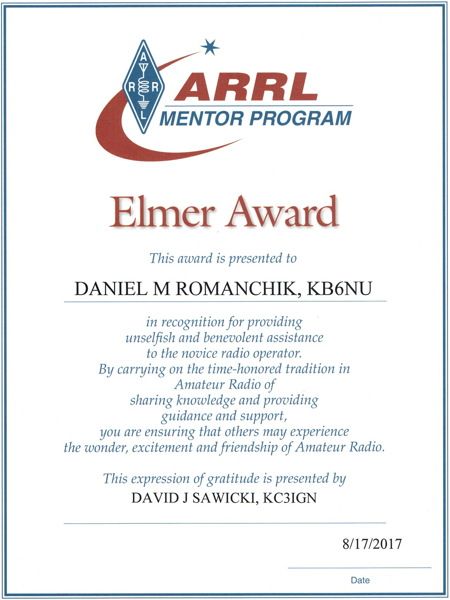
I got this in the mail Saturday:

How cool is this? I didn’t even realize that the ARRL had such an award.

I want all of you, right now, to go to http://www.arrl.org/elmer-award and recognize your Elmers. There’s no charge for this, and I’m sure your Elmer will appreciate it. I sure did.

Filed Under: Elmering

NCDXC to start HF Elmering program

August 2, 2017 By Dan KB6NU Leave a Comment

The Northern California DX Club (NCDXC) is starting an Elmering program designed to get newly-licensed amateur radio operators on the HF bands in September. According to the club’s website”

The goal of the NCDXC Elmering Project is to get you on the HF bands doing something that you enjoy. We know that all of you may not be primarily interested in working DX so there is material on all phases of HF operation, station building, equipment selection and antennas woven into three tracks.

After a couple of introductory classes the tracks include Track I General License Exam Preparation, Track II HF Operating and Station Building and Track III Advanced Topics. Because the material is presented in tracks you can take only the classes that interest you. Our plan is to expose you to everything HF at your own skill level. There will even be a little material on how to chase DX thrown in for good measure.

Classes are free and we will do our best to make them fun. Some classes will be taught using Webex so you don’t even have to leave your home to take them. Others will be taught at your Elmer’s shack where you can try out what you are learning on the air. We look forward to helping you to enjoy HF ham [sic].”

More information is available on the NCDXC website, including:

  • A flyer that briefly describes the program.
  • A PowerPoint presentation that goes into a little more detail.

The ARRL also has a news story on this program.

I like this idea a lot, and I think that the topics they plan to cover really will help get those who are interested on HF. Unfortunately, the information on this program isn’t quite as complete as it could be. For example, none of the materials give details on how to sign up for the classes.

While the web pages says that some classes will be taught online, while others will take place “at your Elmer’s shack,” it doesn’t really say that only students in Northern California (where, presumably, all of the NCDXC Elmers reside) can take the classes. I am a member of NCDXC, and have volunteered to Elmer one or two students here in SE Michigan, should anyone sign up here.

I’ll update this post when I get the answers.

Filed Under: Elmering

A program to help new hams

May 11, 2017 By Dan KB6NU 10 Comments

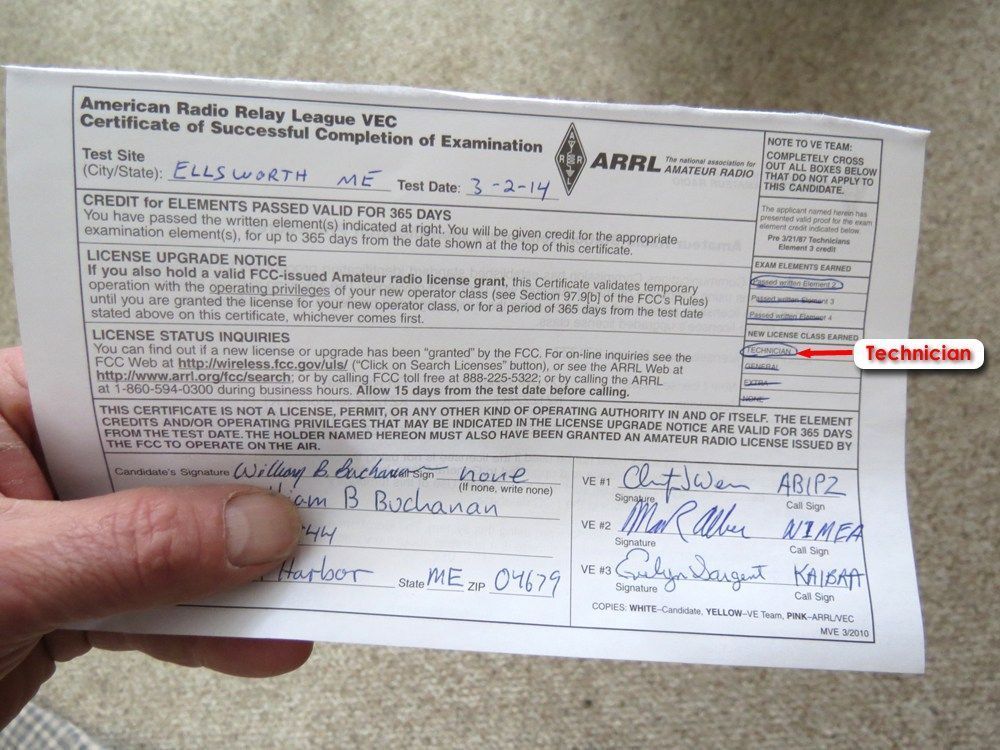
A new ham proudly showing off the CSCE that proves he passed the test.

While I’ve been quite successful with my one-day Tech classes, I must admit that I haven’t been so successful following up with the new Techs. It’s not that I’ve abandoned them, but rather I don’t have a program to really engage them with the hobby. Many of those who have been in my classes have gone on to get advanced licenses and have a lot of fun with ham radio, but I can’t help but think that perhaps I could have helped more.

I would think about offering follow-on classes every once in a while, but I never really had enough time to both come up with a program and then develop the individual classes.

That’s why I got a little excited when I saw the article, “Making a Good hobby Better Through Post-Licensing Enrichment” by Tim Busch, N0CKR in the latest issue of Radio Waves. Radio Waves is the ARRL’s email newsletter that bills itself as, “News you can use for license instruction and radio science education.”

In the article, Tim describes several activities that his club encourages, including a “new ham net” and the Field Day GOTA station, but he also details a program of “mini classes” that will teach specific skills related to ham radio. These include:

  • Programming Radios and Getting on the Air
  • Soldering 101
  • Multimeter 101
  • Build and Use a Roll-Up J-Pole Antenna
  • Build and Use a Satellite Antenna
  • Foxhunts
  • Operating Digital Modes: IRLP, AllStar, D-Star, EchoLink, etc.
  • Remote Operation
  • Software-Defined Radios
  • Transitioning from VHF/UHF to HF Operating
  • Chasing Awards
  • Learn CW
  • Contesting
  • Build Projects

Tim writes,

Each class is intended to be no more than two hours at a sitting, so they can be held before a monthly club meeting. The variety of subject matter allows many club members to get involved in leading a topic. Materials kits are prepared in advance, so students walk away with practical items they can use at home.

I think this is a great set of classes, and I plan to try some of these in the fall. A couple of other topics that occur to me are:

  • Power Supplies 101
  • Mobile Operation 101
  • ARRL 101
  • RFI/TVI 101

Can you think of any other mini-classes that would fit into this program?

Filed Under: Classes/Testing/Licensing, Clubs, Elmering Tagged With: new hams

Respect your Elmers!

October 2, 2016 By Dan KB6NU 1 Comment

scarsNo, that’s not a typo in the headline above. Here’s what the Norman, OK South Canadian Amateur Radio Society (SCARS) is doing to honor their Elmers. Thanks to Sam, W5KF for sending this to me….Dan
Elmer List on the W5NOR.org website

This week we talk about a brand new feature on the W5NOR web site. In the amateur radio community, an experienced amateur radio operator who mentors a new or prospective ham is commonly called an “Elmer”. In our hobby, that seems to be a great way for knowledge to be transferred. Yes, we all have taken an FCC test to receive our license, however that’s only the starting point. Remember that person that helped you set up your first radio, or gave you the courage to press the PTT button, or answered endless questions about a radio, or an antenna? That’s the kind of thing we’re talking about.

Thanks to a great suggestion from Gary Skaggs WB5ULK [not sure it was my idea. – Editor], we’ve created the SCARS Elmer Page, located at http://w5nor.org/elmers for us to celebrate Elmers; past, present, and future. We provide a place for Elmers to list their specialty, and contact information, which allows new hams to find someone they can ask questions of. Since this is a new section of the web site, this list is rather short. In fact, as of this writing, there’s only one listing. So, if you’re willing to help others on a given topic, send a message to [email protected] and you will be added to the list. Right now we need lots of different categories, like antennas, radio setup, HT programming, contesting, satellite operation, high power operation, test gear, building your own gear, repairing radios, APRS, D-Star, DMR, CW, logging, etc. oh well, you get the idea. Listen, you don’t need a PhD to be listed here. You just need a willingness to help others in a given area. It’s OK to be a new ham, and be listed here. You may have just struggled through your first space contact, but you’ll have infinitely more knowledge than the person who’s been a ham for 40 years, and has never tried that portion of the hobby.

Also, there is a link to the “ARRL Elmer Award” page of the American Radio Relay League’s web site. Here, you can enter your favorite Elmer’s name and callsign. The ARRL will print a nice certificate, and mail it to the address you enter. Yes, for FREE! This certificate can either be mailed to your favorite Elmer, or you can mail it to yourself so you can present it to them personally. Feel free to order an Elmer certificate, and present it to your Elmer at an upcoming SCARS meeting. Talk with one of the officers before the meeting to get your place on the agenda. What a great way to recognize these people for their extra efforts.

Finally, we’ve got a place to list YOUR favorite Elmer in our SCARS Elmer Hall-of-Fame. This is the place to memorialize your Elmer, whether they are SCARS members, Silent Keys, or not. I’ve already listed a few Elmers on the list from my own travels through the hobby. We’d love to list the people that help us all succeed.

So, please help make this page useful, visit the SCARS Elmer page at: http://w5nor.org/elmers and be listed as an Elmer, and list your favorite Elmers.

You all might think of doing something similar in your club. A little recognition could go a long way.

Now, I want to know why there’s a Canadian club in Oklahoma?!

Filed Under: Clubs, Elmering Tagged With: SCARS

Are hams born or made?

September 5, 2016 By Dan KB6NU 1 Comment

A friend pointed me towards an article in the latest K9YA Telegraph by Philip Cala-Lazar, K9PL, that asks the question, “Nature vs. Nurture: Hams born or made?” K9PL concludes the article by saying,

I suggest that, like musicians, mathematicians and others with preternatural abilities, hams share an innate desire to learn, build, earn a license and get on the air. I can’t explain it at a neurological level, but it seems hams are born wired with an itch only RF can scratch.

I come to a somewhat different conclusion. Hams have to be both born AND made.

The author is correct that hams usually have an innate desire to learn and a fascination with technical things. In particular, hams have a fascination with the phenomenon of radio. These people are may be predisposed to be hams, but if these qualities are not nurtured, nothing comes of that interest. Without some “making,” their “preternatural abilities” are for naught.

That’s certainly true in my case. If my parents hadn’t encouraged—or at least tolerated—my interest in radio, who knows if I’d ever have gotten a license?

I also know people who obtained their license because their father was a ham, or their spouse is a ham. Usually, nothing comes of this. These folks pass the test, but never really get on the air or participate in other ham radio activities. Sometimes, though, these people develop a real interest in the hobby and become great hams. These are “made hams.”

I also think that hams can be made from people who already have a geek bent, but who now need radio for some particular application or perhaps have not been shown how cool radio can be. I’m thinking about the recent interest in drones, for example. The fun of flying might be what drew these folks into droning, but at some point, many realize that ham radio will allow them to fly them farther.

It might be romantic to think of oneself as born to be a ham, but it’s more complicated than that. Just as those who have innate athletic ability don’t turn into Olympic athletes without coaching, without Elmers, many hams never realize their full potential.

Filed Under: Elmering

Operating Notes: Be an on-air CW Elmer

August 20, 2016 By Dan KB6NU 1 Comment

cw-geek-button-250x250This morning, I got the following e-mail from Ruben, AC2RJ:
I am Ruben, AC2RJ, we just had a contact on 7.027 MHz. I just wanted to say thanks for the contact and  let you know I saw one of your interviews on YouTube about CW months ago, and it was very important in my decision of getting in the air in CW even when I was not ready at all :) Everything turned okay, and now, it’s my favorite mode!! Who new!?!? 

Thanks again for the contact, and hopefully we will contact again soon.

73, Ruben, AC2RJ

I was calling CQ about 25 wpm when Ruben called me. He didn’t send my call, but somewhat shakily and somewhat slowly only sent his callsign. From the tone of his call, I guessed that he’d been able to copy “CQ” but not my callsign. So, I cranked it down, and sent my call again several times. This time, he was able to copy my call and we had a nice conversation, until the band changed and we started getting some QRM. At any rate, I’m glad we made contact, and I’m looking forward to working Ruben again.

I had another experience with a new CW operator last night. Every once in a while, I get on the #redditnet IRC channel and chat with the guys there. One of them asked, “So, where is everyone hanging out tonight.”

I replied, “I’m on 40m CW, 7027 kHz.” He said, “I think I can do that. Give me a minute.”

A short time later, I heard him call. We had a short, somewhat disjointed QSO. After we signed, he texted me on #redditnet, “Sorry, but I’m not very good at ragchewing.” I replied, “No worries. It just takes practice.” I also said that next time we’ll have a smoother, longer contact.

Indeed, it does take practice. So, if you happen to make one of these contacts, don’t just blow off the other guy as being a poor operator. He or she may just be a newcomer getting used to ragchewing.

We should be encouraging these operators to become regulars on the CW bands. Be prepared to help them through a QSO by asking them some questions. Send slowly and cleanly. Follow the proper operating protocols. Follow up by sending a QSL card thanking them for the contact, noting that you look forward to the next one. All of these will help turn these newcomers into great CW ops.

Filed Under: CW, Elmering

Field Day fun, 2016 edition

June 28, 2016 By Dan KB6NU 5 Comments

This year’s Field Day was a blast as usual. In fact, in some ways it was a lot more fun than previous years. Here are some random notes about this year’s Field Day.

setting-up-gota-antenna
Setting up the GOTA station antenna.

Setup. Setup was much easier this year, mainly because I did not make it out to the site on Friday evening. I felt a little guilty about that, but as it turned out, I needn’t have. There were quite a few new members—new members who attended my classes—who did show up, so my help wasn’t really needed.

What I did do was get the club’s IC-746PRO and checked it out on Friday. The power cord needed some surgery, i.e. I replaced the huge lugs that someone had put on it with smaller ones that worked a lot better on the Astron power supply that we used.

On Saturday morning, after breakfast at a local diner with our crew, we got over to the site about 9:30 am. With help from Rich KA8BMA, Prem AC8QV, Faye KE8DDB, and Joe AC8ES, we set up the 40m/20m fan dipole, supported by my surplus fiberglass mast set. We’ve been using this setup so long, and there was very little wind, so that went up quickly.

Rick had brought extension cords, which he ran over to the generator, so we had power. Finally, we connected up the radio, and we had the station on the air (in record time) by 11 am. After that, we just sat around for a while enjoying the nice weather.  The weather was so much nicer than last year, when we experienced monsoon-like conditions.

I tuned around a bit and answered a few CQs and called “CQ almost Field Day” a couple of times. The bands seemed to be in pretty good shape, and we were making contacts left and right. I was even “running” a frequency, calling “QRZ?” after saying 73 to the previous contact.

Get on the Air (GOTA). I was again the head coach for this year’s GOTA station.  Seeing as how we are in Ann Arbor, MI, home of the University of Michigan, you could say that I was the Jim Harbaugh of Field Day. I had a lot of great assistant coaches, too, including Rick KA8BMA, Mark W8MP, Dinesh AB3DC, and probably one or two more that I’m forgetting. Their assistance made it a lot easier on me.

One nice thing is that we had no shortage of operators for this year’s GOTA station. I e-mailed the students who attended my January class and the class I held just a week and a half ago, and many of them showed up. There were five operators lined up at 2 pm Saturday when we started operating.

After a little tutorial on how to tune for stations calling CQ Field Day and then how to reply and give the exchange, I showed them how to log the contact on the computer. To make it as easy as possible, I made up a cheat sheet with our call, W8PGW, spelled phonetically. Also on the cheat sheet was what to say for the exchange, “THANK YOU. PLEASE COPY THREE ALPHA MICHIGAN, MIKE INDIA.”

They struggled a little through their first contacts, but eventually, most of them got the hang of it. Three of the operators made more than the 20 contacts needed to get the 20 bonus points in addition to the contact points. We made a total of 119 contacts in all, mostly on 40m SSB.

Yours truly coaching Steve, W8AYN, through his first FD QSO.

One of the operators was ten-year-old Sofi. She passed the test on Saturday, June 18, but unfortunately did not have her call sign yet. I showed her what to do, coached her through her first contact, and then she made three more.

I think she’d still be sitting there if her mother hadn’t made her give her eight-year-old brother a turn. He made two contacts, and then the parents said that they had to leave. I’m sure that we’ll be seeing Sofi again at next year’s Field Day.

About 4 am, Mark W8MP, showed up, and shortly after, Noah, one of his son’s friends, joined us. Although the GOTA rig had been disconnected so that it didn’t walk off on us, we immediately decided to fire it up again. After a little coaching from me, Noah was off to the races, and when our CW station operator decided to call it a night, I took over the CW station and Mark took over as GOTA coach. All told, Noah made 30 contacts, including the contact with Hawaii.

Finally, on Sunday, we even got our elected official to make a contact. How cool is that?

If your club doesn’t have a GOTA station, you’re missing out on one of the best things about Field Day. It’s not the points, either. It’s about the fun that both the participants and the coaches have.

Overall activity. While this was a very successful Field Day for our club, it seemed to me that overall activity was down. It wasn’t hard at all to find an open frequency on CW, and a couple of other guys commented on this. Activity will probably only get worse over the next couple of years, as we hit the sunspot cycle minimum.

Well, another Field Day is in the log. We all had a lot more fun because of the participation of everyone that helped set up, operate, provide food and drink, greet visitors, and tear down. I’m already looking forward to next year.


Filed Under: Elmering, Operating Tagged With: Field Day, GOTA

  • « Go to Previous Page
  • Page 1
  • Page 2
  • Page 3
  • Page 4
  • Interim pages omitted …
  • Page 8
  • Go to Next Page »

Primary Sidebar

No Nonsense Technician Class License Study Guide (for tests given between July 2026 and June 2030)

New No Nonsense Technican Class Study Guide now available!

The 2026 version of my Tech Class study guide is now available, and as always, the PDF version is FREE!. The ePub version costs $11.97, and a Kindle version and paperback version will be available on Amazon shortly.

Click here to get all of my "No Nonsense" study guides.

Also available: The CW Geek's Guide to Having Fun with Morse Code

W5SWL.Com
Retevis Ailunce H1 DMR Radio
DXpander: Cobweb antennas, Laser Cutting

You’ve got mail!

Enter your email address below and get an email every time I publish a new post.

Email


I frequently teach classes to help newcomers get their licenses. The next class will take place on Saturday, October 10, 2026 on the University of Michigan campus. Click here for more information.

If you can't make the class, subscribe to the mailing list to be notified of when the next class will be held.

You can always download my free study guide, and if you have any questions about the classes, or amateur radio in general, please feel free to email me directly.

Support KB6NU.Com

Donate $7.30 and get two of these cool stickers. Measuring 4.25-in. W by 2.75-in. H, it's perfect for your car, your shack, or wherever!

Contact me

If you have a question or comment about one of my blog posts, or a question about any of the material in my study guides, or just a question about ham radio in general, you can email me at [email protected].

Blogs You Should Also Read

  • AE5X: A CW-centric blog from Kingswood, Texas
  • K0LWC Blog
  • LA3ZA Ham Radio Blog
  • Little Radios, Big Fun – WB3GCK
  • Mr. Vacuum Tube's Blog
  • Radio Artisan – K3NG
  • The K0NR Weblog
  • VE3WDM's QRP Ham Radio Blog
  • W2LJ’s Blog

Ham Radio Websites

  • Dashtoons – The Hammin' Comedy by Jeff K1NSS

Podcasts

  • ICQ Podcast
  • Linux in the Ham Schack
  • No Nonsense Amateur Radio Podcast
  • Resonant Frequency Amateur Radio Podcast

Recent Comments

  • Matt W1CDN on A completely different picture of Wayne Green, W2NSD (SK)
  • Chana Walsh on Rethinking ham radio education
  • Rob WfourZNG on Videos: What’s next for POTA, ham radio helps rescue man trapped in cave
  • Dan KB6NU on The EMF Explorer: A badge for ham radio?
  • Travis Good on The EMF Explorer: A badge for ham radio?

Meta

  • Log in
  • Entries feed
  • Comments feed
  • WordPress.org

Footer

Copyright © 2026 Daniel M. Romanchik, KB6NU · Log in