
First of all, Happy New Year to everyone!
Straight Key Night 2025: 10 QSOs
I was going to start this portion of my blog post with a little of the history of Straight Key Night (SKN). Unfortunately, there is none to be found on the internet. Perhaps that’s some thing that someone at the ARRL can remedy by the time SKN rolls around next year.
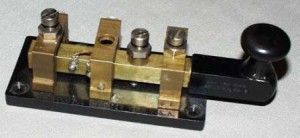
This year, I operated SKN with my Bunnell #9 key (see right). This is a great little key, with a very nice action. I’m not sure how old my key is, but it still operates flawlessly.
First, I had to find a cable for it. Fortunately, I already had a two-conductor cable with a 1/4-in. phone plug on it, so all I had to do was crimp a couple of terminal onto the bare wires at the cable’s other end. In about 15 minutes, I was on the air.
Conditions were a little up and down on 40 meters, due to a geomagnetic storm, but even so, I managed to make eight contacts Tuesday night. I even “ran” the frequency I was on for a bit. Twice I called “QRZ?” after ending a contact and had someone come back to me. Wednesday morning, I got on again and made two contacts before deciding to call it quits.
The highlight of SKN for me was my contact with KE4GBE. He said that listening to my previous QSO had prompted him to dig out his straight key and that it was his first straight key QSO in over 25 years!
Freezing rain halts operation
About a week ago, we had some freezing rain here in southeast Michigan. Normally, when my 450 Ω window line feedline gets wet, I have to adjust my antenna tuner. This time, though, I couldn’t get SWR down enough to be comfortable operating. I just shut things down for the night.
Several years ago, I purchased a 43-ft. vertical antenna, but never did put it up. I’m going to have to set that up, so that I can get on the air even when there’s freezing rain.
Are end-feds poor receiving antennas?
I’ve never been a big fan of end-fed antennas, but I can certainly see their appeal. They are easy to set up, don’t require a long feedline, and can be quite stealthy.
I think that one disadvantage might be that they don’t receive as well as center-fed antennas. I have no science to back this up, but more times than not, when someone gives me a report where my signal strength is less than what I give the other station, they’re using an end-fed half-wave antenna or an end-fed random wire antenna.
I’d be interested in hearing what your experience has been. Does this hold true for you, too?
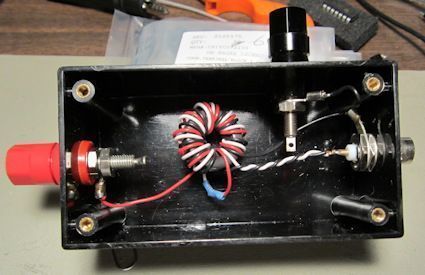
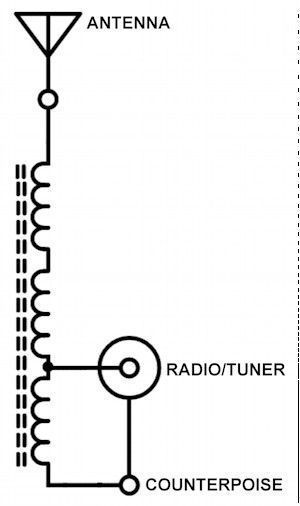 In many cases, the impedance can be transformed with the help of a 9:1 unun (unbalanced input to unbalanced output). See the figure at right. A 9:1 unun is a transformer that reduces the impedance at the input by a factor of 9. So, if you connect a length of wire that presents an impedance of about 450 Ω to the input, you’ll get an impedance of about 50 Ω on the output.
 I built one on a T80-2 powdered iron core, using some 22-ga. wire that I scavenged from some four-conductor cable (see photo at left.) I got a little bit lucky in that the T80 core has a diameter just big enough to accommodate nine turns. Using different colored wires (red, black and white) made it easier to wire it up properly.